
Beta
The AI SEO Tool That Analyzes,
Generates & Optimizes Your Content
Rank higher on Google, get seen by ChatGPT & SGE, and convert more visitors — all powered by AI and built for serious digital marketers.
🧠 Deep SEO Analysis
Paste your blog and get an SEO score, keyword gaps, AI visibility rating, CTR improvements & conversion tips.
🚀 Generate a Full SEO Blog
Give a topic and get a 2000+ word blog with title, meta, H1–H4 headings, FAQs, internal linking ideas & CTA.
⚡ Optimize Your Blog
Paste any existing blog and get a fully rewritten version optimized for SEO, GEO, LLMO, readability & engagement.
Want this level of SEO done for your entire website?
Our expert team at Digehub handles content strategy, on-page SEO, technical audits, and AI-powered growth — so you rank, get leads, and grow faster.
🚀 Get Professional SEO Services →The Ultimate Guide to AI SEO Tools & AI Writing Tools in 2026
The world of digital content has been permanently transformed by artificial intelligence. Whether you are a solo blogger, a digital marketing agency, or a large enterprise, using AI writing tools and AI SEO tools is no longer optional — it is the difference between ranking on page one and getting buried on page five. This comprehensive guide covers everything you need to know about AI for SEO, the best AI writing tools available today, how to use AI content writers effectively, and why combining SEO, GEO, AEO, and LLMO is the winning strategy for 2026 and beyond.
💡 Quick Takeaway: The best AI SEO tools do more than just write — they analyze search intent, optimize for AI engines like ChatGPT and Google’s SGE, and help your content rank for both traditional search and generative AI answers.
What Are AI SEO Tools — And Why Do They Matter?
AI SEO tools are software platforms that use large language models (LLMs) and machine learning to help marketers research, create, and optimize content for search engines. Unlike traditional SEO tools that focus on data and metrics, AI-powered writing tools actually generate, rewrite, and improve the content itself — saving hours of manual work and producing results that would otherwise require an entire writing team.
The rise of AI writing tools has coincided with a major shift in how search engines work. Google now uses AI (via systems like MUM and Gemini) to understand content at a deeper level. Meanwhile, platforms like ChatGPT, Perplexity, and Google’s Search Generative Experience (SGE) are changing how users discover information entirely — making LLMO (Large Language Model Optimization) and GEO (Generative Engine Optimization) just as important as traditional SEO.
Using AI for SEO means you can publish more content, better content, and more strategically optimized content — all in a fraction of the time. AI writing assistants can generate first drafts in seconds, identify keyword gaps instantly, and suggest internal linking structures that a human researcher would spend days mapping manually.
Best AI Writing Tools in 2026 — Head-to-Head Comparison
With dozens of AI writing tools flooding the market, it can be hard to know which one is right for your SEO strategy. Below is a detailed comparison of the top platforms — including our own free Digehub AI SEO Tool — to help you make an informed decision.
| Tool | SEO Analysis | Blog Generation | GEO / LLMO | Free Plan | Blog Optimization | Starting Price |
|---|---|---|---|---|---|---|
| Digehub AI SEO Tool THIS TOOL | ✔ Full Analysis | ✔ 2000+ Words | ✔ Built-In | ✔ 100% Free | ✔ Full Rewrite | Free |
| Surfer SEO | ✔ Advanced | ✔ With AI | ✘ Limited | ✘ No | ✔ Yes | $89/mo |
| Jasper AI | ✘ Basic | ✔ Yes | ✘ No | ✘ Trial Only | ✔ Yes | $49/mo |
| Copy.ai | ✘ None | ✔ Yes | ✘ No | ✔ Limited | ✘ Limited | Free / $49/mo |
| Writesonic | ✘ Basic | ✔ Yes | ✘ No | ✔ Limited | ✔ Yes | $16/mo |
| Quillbot AI Writer | ✘ None | ✘ No | ✘ No | ✔ Yes | ✔ Paraphrase | Free / $19.95/mo |
| Semrush AI Writing | ✔ Full SEO | ✔ Yes | ✘ Limited | ✘ No | ✔ Yes | $119/mo |
As the table shows, most AI writing tools focus on just one function — either generation or optimization — and very few address GEO and LLMO optimization at all. Digehub’s AI SEO Tool is built to address all three content needs (analyze, generate, optimize) in a single free interface, making it one of the most complete free AI content writing tools available for SEO professionals in India and globally.
How to Use AI for SEO Writing — A Step-by-Step Strategy
Using an AI writer for SEO is about much more than typing a topic and hitting “generate.” The marketers who get the best results from AI-powered writing tools follow a structured workflow that integrates keyword research, audience intent, content architecture, and multi-engine optimization. Here’s the strategy used by top digital agencies:
Step 1: Define Your Keyword Cluster First
Before you use any AI writing tool, start with a keyword cluster — a group of semantically related terms around a core topic. For example, if your core term is “AI SEO tools,” your cluster might include “best AI writing tools,” “free AI writer,” “AI content writer,” “AI for SEO,” and “artificial intelligence SEO.” This gives your AI writer the full context it needs to create content that ranks for multiple terms simultaneously, not just one.
Step 2: Run an Analysis on Competing Content
Use the Analyze mode of an AI SEO tool (like the one above) to evaluate existing top-ranking content in your niche. Understanding what keywords are missing, what questions aren’t being answered, and where intent gaps exist will give your AI-generated content a significant structural advantage before you even start writing.
Step 3: Generate With Full Context
When generating a blog with an AI writing assistant, always provide: the target keyword, secondary keywords, the intended audience, the desired tone, and the goal of the article (traffic, leads, conversions). The more context you give your AI writer free or paid, the better the output quality. Generic prompts produce generic content. Specific, detailed prompts produce publication-ready articles.
Step 4: Optimize for GEO and LLMO — Not Just Google
Traditional SEO writing focused entirely on Google’s algorithm. In 2026, you also need to optimize for Generative Engine Optimization (GEO) — the practice of writing content that AI models like ChatGPT, Gemini, and Perplexity are likely to cite and reference in their answers. This means writing in direct, authoritative sentences, structuring content with clear headers and FAQ sections, and providing specific data points that AI models can extract and quote. This approach is what we call LLMO — Large Language Model Optimization.
Step 5: Optimize and Refine the Output
No AI writing tool should produce your final, publish-ready article on the first pass. Always use an AI blog optimizer (like the Optimize mode above) to refine the generated content — improving readability, adjusting keyword density, adding internal links, and strengthening the CTA. The best content writing AI workflow is iterative: generate, analyze, optimize, publish.
Free AI Writing Tools — What You Actually Get For Free
Searching for a “free AI writer” or “free AI writing tools” yields hundreds of results, but it’s important to understand what you’re actually getting with free plans. Most free AI content generators offer limited monthly word counts (typically 2,000–10,000 words), no SEO analysis features, no LLMO optimization, and generic output that lacks strategic structure.
The best free AI writing tools in 2026 that offer real value include: our Digehub AI SEO Tool (unlimited use, full SEO + GEO + LLMO output), Quillbot AI Writer for paraphrasing and grammar improvements, Copy.ai for short-form content and email copy, and Google’s Gemini for basic research assistance. For comprehensive SEO content strategy, however, a dedicated AI SEO writing tool that understands keyword clustering, search intent, and content architecture will always outperform a general-purpose free AI writing generator.
🔑 Pro Tip: Even the best free AI writer produces output that needs human review. Always fact-check AI-generated statistics, add original examples from your own experience, and ensure the content genuinely serves your audience’s needs. This E-E-A-T approach (Experience, Expertise, Authoritativeness, Trustworthiness) is what separates content that ranks from content that doesn’t.
AI Content Writer vs Human Content Writer — What’s the Real Difference?
The debate between AI content writers and human writers has become less relevant over time. The most successful content marketing teams in 2026 use a hybrid model: AI writing assistants handle the heavy lifting of structure, research synthesis, and first-draft generation, while human writers add original perspective, personal experience, brand voice consistency, and E-E-A-T signals.
Here’s how the two approaches compare in practice across key dimensions that matter for SEO performance:
| Dimension | AI Content Writer | Human Writer | AI + Human (Best) |
|---|---|---|---|
| Speed | ✔ Instant (seconds) | Hours to days | ✔ Fast + refined |
| SEO Structure | ✔ Consistent | Variable | ✔ Optimal |
| Original Insight | Limited | ✔ Strong | ✔ Best of both |
| Scale | ✔ Unlimited | Expensive at scale | ✔ Scalable |
| E-E-A-T Signals | Weak alone | ✔ Strong | ✔ Strong |
| Cost | ✔ Low | High | Moderate |
| GEO / LLMO | ✔ Optimizable | Requires training | ✔ Optimal |
AI SEO Optimization — The Four Pillars: SEO, GEO, AEO & LLMO
The Digehub AI SEO Tool is built around a four-pillar optimization framework that goes beyond traditional keyword stuffing. Here’s what each pillar means and why it matters for your content strategy:
SEO (Search Engine Optimization)
Traditional SEO focuses on keyword targeting, on-page signals (title tags, headers, meta descriptions), content depth, internal linking, and technical factors like page speed and mobile-friendliness. AI SEO tools automate the on-page optimization layer by ensuring the right keywords appear at the right density, headings follow a logical hierarchy, and meta data is crafted for maximum click-through rates. Artificial intelligence SEO has made it possible to do in minutes what previously took experienced SEOs days to accomplish manually.
GEO (Generative Engine Optimization)
GEO is the practice of optimizing content to be cited, quoted, or referenced by AI-powered search engines and generative AI platforms like Google SGE, ChatGPT browsing mode, and Perplexity. Content optimized for GEO tends to include direct, declarative statements, specific data points, authoritative citations, structured lists, and FAQ sections — formats that AI models prefer when synthesizing answers to user queries. The Digehub AI writing tool incorporates GEO principles natively into every piece of generated content.
AEO (Answer Engine Optimization)
AEO targets featured snippets, People Also Ask boxes, and voice search results by structuring content to directly answer specific user questions. This includes using question-format headers (H2s and H3s that mirror common search queries), writing concise 40–60 word answer paragraphs directly below those questions, and marking up content with FAQ Schema. AI content writers that understand AEO structure can dramatically increase a page’s chances of capturing zero-click featured snippet positions.
LLMO (Large Language Model Optimization)
LLMO is the newest and fastest-growing optimization discipline. It focuses on making your content “trainable” — that is, written in a format and style that large language models are likely to learn from, reference, and reproduce in their outputs. Key LLMO signals include factual accuracy, clear attribution, structured knowledge presentation, and covering topics comprehensively enough that an LLM would consider your page a primary source. As AI-mediated search continues to grow, LLMO will become as important as traditional SEO for content discoverability.
AI Writing Help for Specific Use Cases
AI writing assistants are not just for blog posts. Modern AI writing tools cover a remarkably wide range of content formats, each requiring slightly different optimization approaches:
- AI Article Writer: Generates long-form, researched articles optimized for search rankings. Best used for pillar pages, comparison content, and comprehensive how-to guides.
- AI Blog Writer: Creates conversational, audience-focused blog posts with storytelling elements, practical advice, and engagement hooks designed to reduce bounce rate and increase time-on-page.
- AI Email Writer / Free AI Email Writer: Drafts cold outreach emails, newsletter content, follow-up sequences, and promotional campaigns with subject line optimization and conversion-focused copy.
- AI Letter Writer Free / Letter Writer AI: Generates formal and informal letters, proposals, cover letters, and business correspondence quickly and in a professional tone.
- AI Paragraph Writing: Rewrites or generates individual paragraphs to improve clarity, readability, keyword inclusion, or engagement within an existing piece of content.
- Ghost Writing AI: Produces content in a specific brand voice or personal style, used by thought leaders and executives who want to maintain content presence without writing every piece themselves.
- AI Story Writer Free / Story Writing AI Free: Creates narrative content, case studies, brand stories, and creative marketing pieces that use storytelling structures to build emotional connection with readers.
- Book Writing AI Free: Assists with long-form content projects including ebooks, lead magnets, white papers, and full-length publications through structured chapter generation and content planning.
SEO Content Writing Tools — What to Look For
Not all seo content writing tools are created equal. When evaluating an AI writing tool for SEO purposes, look for these essential capabilities:
- Keyword Integration: Does it naturally weave your target keywords and semantic variations throughout the content without forcing them in unnaturally?
- Search Intent Matching: Does the tool understand whether a query is informational, navigational, commercial, or transactional — and match the content format accordingly?
- Structured Output: Does it produce content with proper H1–H4 hierarchy, meta description suggestions, slug recommendations, and title tag options?
- Readability Scoring: Does it produce content that reads naturally, scores well on readability scales, and is appropriate for your target audience’s literacy level?
- SERP Analysis: Can it analyze what’s currently ranking for a keyword and identify gaps your content needs to fill to outperform the competition?
- FAQ Generation: Does it automatically generate relevant FAQ sections that target PAA (People Also Ask) opportunities?
- CTA Optimization: Does it include compelling calls to action that are contextually appropriate and conversion-optimized?
Writing With Artificial Intelligence — Best Practices for 2026
Whether you use Digehub’s AI SEO tool, Jasper, Writesonic, or any other AI-powered writing tool, following these best practices will maximize the quality and SEO performance of your AI-assisted content:
- Always start with a content brief. Even the best AI writer produces better output when given a clear brief including target keyword, audience persona, content goal, word count, and tone of voice. Treat your AI writing assistant like a skilled but context-free freelancer — the more information you provide, the better the result.
- Use AI for structure, humans for soul. Let AI writing tools handle heading hierarchies, keyword placement, meta copy, and FAQ sections. Then add original anecdotes, expert opinions, local examples, and brand-specific language that an AI cannot replicate.
- Optimize for conversational queries. With voice search and AI chat interfaces becoming primary discovery channels, content that answers questions conversationally — the way a knowledgeable friend would explain something — performs better than keyword-dense walls of text.
- Publish consistently, not perfectly. One advantage of using a free AI writing generator or AI writing assistant free online is the ability to dramatically increase content output. A consistent publishing cadence of SEO-optimized content signals authority to search engines far more effectively than infrequent “perfect” posts.
- Monitor and iterate. Track your content’s performance in Google Search Console and analytics. Identify which pieces are gaining impressions but not clicks (CTR problem — fix with title optimization), which are getting clicks but high bounce rates (engagement problem — fix with content depth), and which are ranking but not converting (CRO problem — fix with CTA optimization). Use AI tools iteratively at each stage.
- Stay human-centric. Google’s Helpful Content updates have made it clear: content written primarily for search engines rather than humans will be penalized. Use artificial intelligence write for me capabilities to accelerate production, but always edit with the reader’s genuine needs in mind.
📊 Industry Insight: According to multiple digital marketing studies, businesses that publish AI-assisted, SEO-optimized content consistently see 3–5x higher organic traffic growth compared to those relying solely on manual content creation — because they can simply produce more high-quality content more frequently.
Frequently Asked Questions About AI SEO Tools & AI Writing
Why Digehub Is Your Best Partner for AI-Powered SEO Growth
Digehub is India’s leading AI-powered Digital Growth Platform, combining world-class content strategy, technical SEO expertise, and proprietary AI tools to help businesses rank faster, generate more leads, and scale their digital presence sustainably. From Chennai-based local businesses to global SaaS companies, Digehub’s team handles the full-funnel digital growth strategy that no free AI writing tool can replace — but that this tool gives you a powerful taste of.
Our approach combines everything covered in this guide — SEO, GEO, AEO, and LLMO — into a comprehensive content and search strategy tailored to your industry, competition level, and business goals. If you’re serious about dominating your niche on Google, appearing in AI-generated answers, and converting traffic into revenue, the next step is talking to our team.
✦ FREE AI SEO SUITE BY DIGEHUB — The AI SEO Tool That Analyzes, Generates & Optimizes Your Content
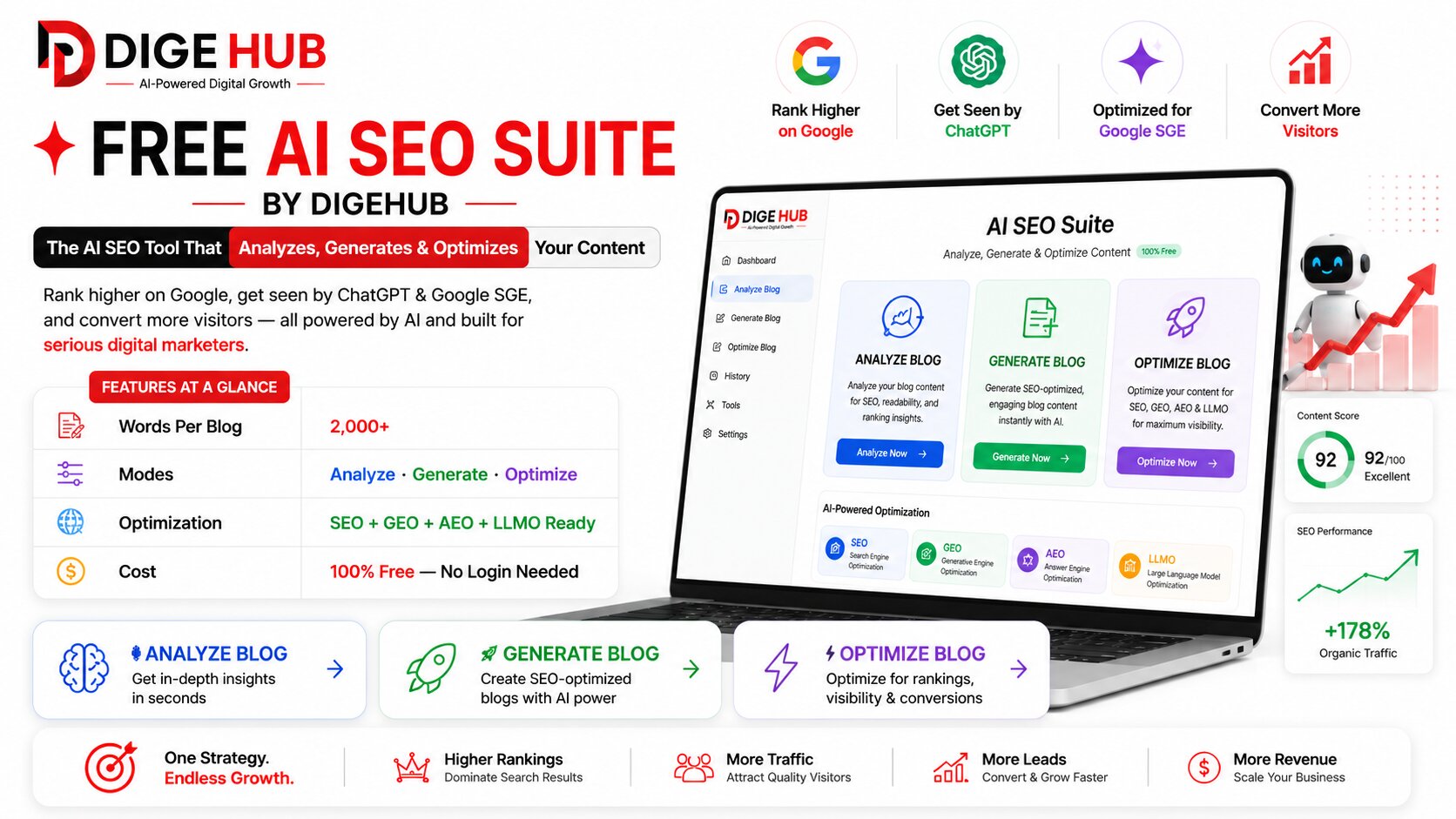
Rank higher on Google, get seen by ChatGPT & Google SGE, and convert more visitors — all powered by AI and built for serious digital marketers.
| Feature | Details |
|---|---|
| 📝 Words Per Blog | 2,000+ |
| 🔧 Modes | Analyze · Generate · Optimize |
| 🌐 Optimization | SEO + GEO + AEO + LLMO Ready |
| 💸 Cost | 100% Free — No Login Needed |
🧠 Analyze Blog · 🚀 Generate Blog · ⚡ Optimize Blog
What Are AI SEO Tools — And Why Do They Matter in 2026?
AI SEO tools are software platforms that use large language models (LLMs) and machine learning to help marketers research, create, and optimize content for search engines. Unlike traditional SEO tools that focus purely on data and metrics, AI-powered writing tools actually generate, rewrite, and improve the content itself — saving hours of manual effort and producing results that would otherwise require an entire writing team.
The rise of AI writing tools has coincided with a fundamental shift in how search engines work. Google now uses AI systems like MUM and Gemini to understand content at a deeper semantic level. Meanwhile, platforms like ChatGPT, Perplexity AI, and Google's Search Generative Experience (SGE) are completely transforming how users discover information — making LLMO (Large Language Model Optimization) and GEO (Generative Engine Optimization) just as critical as traditional SEO.
Using AI for SEO means you can publish more content, better content, and more strategically optimized content — all in a fraction of the time it used to take. AI writing assistants can generate first drafts in seconds, identify keyword gaps instantly, and map internal linking structures that a human researcher would spend days building manually.
💡 Quick Takeaway: The best AI SEO tools do far more than just write. They analyze search intent, optimize for AI engines like ChatGPT and Google SGE, and help your content rank for both traditional search results and generative AI answers simultaneously.
The Complete List of Best AI Writing Tools in 2026 — What's Actually Worth Using?
The AI tools list has exploded in recent years. There are now hundreds of options positioned as "the best AI writing tools," but not all of them deliver on their promises — especially for serious SEO professionals. This comprehensive seo tools review breaks down the top platforms by capability, pricing, and real-world usefulness for content marketers.
Top 10 AI Tools for SEO Content Writing in 2026
Below is a detailed comparison of the top 10 AI tools that genuinely move the needle for content marketers and SEO professionals. We've evaluated each one on SEO analysis capability, blog generation quality, GEO/LLMO readiness, free plan availability, and content optimization features.
| Tool | SEO Analysis | Blog Generation | GEO / LLMO | Free Plan | Blog Optimization | Starting Price |
|---|---|---|---|---|---|---|
| Digehub AI SEO Tool (This Tool) | ✔ Full Analysis | ✔ 2,000+ Words | ✔ Built-In | ✔ 100% Free | ✔ Full Rewrite | Free |
| Surfer SEO | ✔ Advanced | ✔ With AI | ✘ Limited | ✘ No | ✔ Yes | $89/mo |
| Jasper AI | ✘ Basic | ✔ Yes | ✘ No | ✘ Trial Only | ✔ Yes | $49/mo |
| Copy.ai | ✘ None | ✔ Yes | ✘ No | ✔ Limited | ✘ Limited | Free / $49/mo |
| Writesonic | ✘ Basic | ✔ Yes | ✘ No | ✔ Limited | ✔ Yes | $16/mo |
| Quillbot AI Writer | ✘ None | ✘ No | ✘ No | ✔ Yes | ✔ Paraphrase | Free / $19.95/mo |
| Semrush AI Writing | ✔ Full SEO | ✔ Yes | ✘ Limited | ✘ No | ✔ Yes | $119/mo |
| HubSpot AI Blog Writer | ✘ Basic | ✔ Yes | ✘ No | ✔ Limited | ✔ Yes | Free / $18/mo |
| CTRify AI SEO Tool | ✔ SERP-Focused | ✘ Limited | ✘ No | ✘ No | ✔ Yes | $99/mo |
| Eesel AI Blog Writer | ✘ None | ✔ Yes | ✘ No | ✔ Limited | ✘ Limited | Free / $10/mo |
Key Insight: Most AI writing tools focus on a single function — either content generation or SEO analysis — and virtually none address GEO and LLMO optimization adequately. Digehub's AI SEO Tool is uniquely built to address all three content needs (analyze, generate, optimize) in one completely free interface, making it one of the most complete free AI content writing tools available for SEO professionals in India and globally.
Digehub Free AI SEO Tool — The Only 3-in-1 AI SEO Tool You Need
🧠 Mode 1: Deep SEO Analysis
The AI SEO analysis mode is built for marketers who want real intelligence, not vanity scores. Paste your existing blog content, enter your target keywords, and within seconds you receive:
- SEO Score (0–100) — an honest assessment of your current on-page optimization level
- Keyword Gap Report — secondary and LSI keywords you're missing that competing pages rank for
- AI Visibility Rating — a unique score measuring how likely ChatGPT, Gemini, and Perplexity are to cite or reference your content
- CTR Improvement Suggestions — actionable title tag and meta description rewrites to increase click-through rates
- Conversion Optimization Tips — CTA placement, offer clarity, and trust signal recommendations
- Readability Assessment — sentence complexity, paragraph length, and Flesch-Kincaid scoring
- Internal Linking Opportunities — gaps in your site's link architecture that are costing you ranking power
- AEO Readiness Check — whether your content is structured to capture featured snippets and People Also Ask positions
- LLMO Compliance Score — a measure of how well your content is formatted for ingestion by large language models
🚀 Mode 2: AI Blog Generation (2,000+ Words)
The AI blog writer generation mode creates complete, publication-ready blog posts optimized for SEO², GEO, AEO, and LLMO simultaneously. Unlike generic AI content generators that produce keyword-stuffed filler, this mode builds every article around:
- A strategic H1–H4 heading hierarchy designed for featured snippet capture
- Keyword-rich but naturally written introductions that establish topic authority immediately
- Body sections with proper semantic depth — covering the full topic cluster, not just the seed keyword
- Data tables, comparison charts, and bullet-point structures that AI engines prefer when synthesizing answers
- FAQ sections targeting People Also Ask opportunities and voice search queries
- Compelling CTAs placed at peak engagement moments within the article structure
- Meta title, meta description, and URL slug suggestions with character count compliance
- Internal linking placeholders mapped to your existing site architecture
⚡ Mode 3: AI Blog Optimization (Full Rewrite)
The optimization mode is the closest thing to having a senior SEO content strategist review every piece of content you've ever published. Input any existing blog post and receive:
- A fully optimized rewrite that preserves your brand voice while improving every technical SEO element
- Keyword density normalization — ensuring primary, secondary, and LSI terms appear at optimal frequencies
- Header restructuring for maximum AEO and snippet capture potential
- GEO signal insertion — adding the declarative statements, data points, and structured formats that AI models prefer
- Readability improvements that reduce bounce rate without sacrificing depth
- CTA strengthening with conversion-focused language refinements
- Schema markup recommendations (FAQ Schema, Article Schema, HowTo Schema where applicable)
Best AI Writing Tools 2026 — Detailed Reviews and Comparisons
1. Digehub AI SEO Tool — Best Free AI SEO Tool (Overall Winner)
What it is: A free, browser-based 3-in-1 AI SEO content platform built by Digehub — India's AI-powered digital growth agency.
Who it's for: Bloggers, digital marketing agencies, freelance SEO professionals, small business owners, and content teams in India and globally who need enterprise-level SEO content capability without the enterprise price tag.
Key strengths:
- The only completely free AI SEO tool that covers analysis, generation, AND optimization in one interface
- Built natively around the SEO² framework (SEO + GEO + AEO + LLMO)
- No login, no credit card, no word count limits on the free tier
- Generates 2,000+ word, fully structured SEO blog posts optimized for both Google and generative AI engines
- Produces content with FAQ sections, comparison tables, and structured data recommendations built in
- Ideal for AI SEO tool free searches — delivers genuine professional-grade output at zero cost
Limitations: As a free tool, complex multi-URL competitive analysis requires the full Digehub SEO service package. For enterprise-scale content operations (50+ articles/month), the managed service tier unlocks deeper capabilities.
Best for: Freelancers, startups, Indian SMBs, and agencies who want the best free AI blog writer with real SEO intelligence baked in.
Rating: ★★★★★ (5/5) — Best Free Option
2. Surfer SEO — Best AI SEO Tool for Advanced On-Page Optimization
What it is: A premium AI-powered SEO content editor that provides real-time SERP analysis and content scoring as you write.
Who it's for: Established content teams and agencies with budget for premium tools who publish high-volume content and need real-time optimization feedback.
Key strengths:
- Real-time Content Score that updates as you write based on NLP analysis of top-ranking pages
- Keyword density suggestions pulled directly from SERP competitors
- Outline builder that maps content structure to top-performing articles
- AI writing integration (Jasper partnership) for guided content generation
- Content audit tool for refreshing underperforming pages
Limitations: No free plan. At $89/month, it's expensive for solo bloggers and small agencies. GEO and LLMO optimization are not natively built into the workflow — you'd need to layer in additional processes.
Best for: Mid-to-large content teams doing competitive SEO in English-language markets.
Rating: ★★★★☆ (4/5) — Best Premium Option
3. Jasper AI — Best AI Writing Tool for Long-Form Content Teams
What it is: One of the original AI writing tools for marketers, built around GPT-4 with templates for 50+ content formats.
Who it's for: Marketing teams that need high-volume content across multiple formats — blogs, social media, ads, email sequences, and landing pages.
Key strengths:
- Brand Voice feature that captures and applies your specific tone across all content
- 50+ templates covering every content format a marketing team needs
- Jasper Chat for conversational content creation and iteration
- Integration with Surfer SEO for combined generation + optimization
- Team collaboration features for content workflow management
Limitations: No meaningful SEO analysis capability on its own. Requires Surfer SEO integration for on-page optimization. No GEO or LLMO optimization built in. Trial-only free access — paid plans start at $49/month. Quality can be inconsistent without detailed prompting.
Best for: Marketing teams with budget who need AI-assisted content at scale across multiple formats, not just SEO blogs.
Rating: ★★★★☆ (4/5) — Best for Content Teams
4. Semrush AI SEO Tool — Best All-in-One for Enterprise SEO Teams
What it is: The AI writing and optimization features embedded within the Semrush platform — the industry's most comprehensive SEO toolkit.
Who it's for: Enterprise SEO teams and large agencies that already use Semrush for keyword research, site auditing, and competitor analysis.
Key strengths:
- AI-powered content creation directly integrated with Semrush's keyword database
- Automatic pulling of SERP competitor data into every content brief
- SEO Writing Assistant plugin available for WordPress and Google Docs
- Full SEO audit capabilities at the platform level
- Backlink analysis, rank tracking, and content performance monitoring all in one ecosystem
Limitations: The most expensive option on this list — plans start at $119/month, with full AI features requiring higher tiers. No GEO or LLMO optimization. Significant learning curve for new users. Overkill for small sites and individual bloggers.
Best for: Enterprise-level marketing teams that need the full Semrush ecosystem and want AI writing integrated into their existing SEO workflow.
Rating: ★★★★☆ (4/5) — Best Enterprise Option
5. HubSpot AI Blog Writer — Best Free AI Blog Writer for HubSpot Users
What it is: HubSpot's built-in AI writing assistant for generating and optimizing blog content within the HubSpot CMS ecosystem.
Who it's for: Businesses already using HubSpot CMS for their website and blog who want integrated AI content generation without switching platforms.
Key strengths:
- Seamlessly integrated into the HubSpot content editor
- Generates blog outlines, introductions, and full drafts based on topic prompts
- Connected to HubSpot's CRM data for audience-aware content personalization
- Free tier available on HubSpot's Starter plan
- Easy-to-use interface with minimal learning curve
Limitations: Only genuinely useful if you're already on HubSpot CMS. Very limited SEO analysis capability — it generates content but doesn't deeply optimize for technical SEO signals. No GEO or LLMO optimization. Lacks the content depth and keyword intelligence of dedicated AI SEO tools.
Best for: HubSpot CMS users who want a convenient built-in AI blog writer tool without needing a separate platform.
Rating: ★★★☆☆ (3/5) — Best for HubSpot Ecosystem Only
6. CTRify AI SEO Tool — Best for SERP-Focused AI SEO Strategy
What it is: A specialized AI-powered SEO platform focused on improving click-through rates and SERP visibility through AI-driven content and behavioral optimization.
Who it's for: SEO professionals and agencies focused specifically on improving SERP performance metrics — particularly CTR and user engagement signals.
Key strengths:
- AI-driven title tag and meta description optimization for maximum CTR
- SERP snippet preview tools for visualizing how content will appear in search results
- Behavioral signal optimization strategies
- Keyword ranking analysis with CTR-weighted scoring
Limitations: Not a full AI writing platform — limited content generation capability compared to dedicated AI blog writers. No free plan. At $99/month, expensive relative to capabilities. No native GEO or LLMO optimization. Best used as a complement to a full AI writing tool, not a replacement.
Best for: Advanced SEO professionals who want to focus specifically on CTR optimization as part of a broader SEO tech stack.
Rating: ★★★☆☆ (3/5) — Specialized Tool
7. Eesel AI Blog Writer — Best AI Writing Tool for Knowledge Base Integration
What it is: An AI writing assistant designed to generate content based on your existing knowledge base, documentation, and internal data sources.
Who it's for: SaaS companies, knowledge-driven businesses, and teams that want AI-generated content grounded in their proprietary knowledge base rather than generic internet training data.
Key strengths:
- Connects to your internal documents, wikis, and knowledge bases (Notion, Google Drive, Confluence)
- Generates content that accurately reflects your specific products, processes, and terminology
- Useful for creating documentation, help articles, and product-led blog content
- Free plan available with limited generation capacity
Limitations: Not built for SEO — no keyword research, SERP analysis, GEO optimization, or AEO structuring. Better suited for internal knowledge management than external SEO content marketing. Limited content generation depth compared to dedicated AI blog writers.
Best for: Internal knowledge management and product documentation teams, not SEO content marketers.
Rating: ★★★☆☆ (3/5) — Niche Use Case
8. Writesonic — Best AI Writing Tool for Affordable Volume
What it is: A versatile AI writing platform covering blog posts, landing pages, ad copy, and social media content at competitive pricing.
Who it's for: Freelancers, small agencies, and solo content marketers who need volume content generation at a low price point.
Key strengths:
- One of the most affordable AI content generation platforms at $16/month
- Botsonic for building custom AI chatbots alongside content tools
- Factual article generator with web-connected research capability
- Surfer SEO integration available for combined optimization
- Limited free plan with monthly word credit allocation
Limitations: Basic SEO analysis — no deep keyword intelligence or SERP analysis. Content quality can be inconsistent for long-form SEO articles without heavy manual editing. No native GEO or LLMO optimization capability.
Best for: Freelancers and small content teams on tight budgets who need affordable AI-generated drafts that they will edit significantly.
Rating: ★★★☆☆ (3/5) — Best Budget Option
9. Copy.ai — Best Free AI Writing Tool for Short-Form Content
What it is: An AI writing platform with a functional free plan and strong capabilities for short-form marketing content — emails, social posts, ad copy, and product descriptions.
Who it's for: Marketing teams and entrepreneurs who need fast, high-quality short-form content without a large budget.
Key strengths:
- Genuinely useful free plan with unlimited projects
- Strong templates for email sequences, social media posts, and ad copy
- GTM (Go-to-Market) workflows for product launches and campaigns
- Clean, intuitive interface with low learning curve
Limitations: Very limited SEO capabilities. Not designed for long-form blog content — output quality drops significantly for articles above 1,000 words. No GEO, AEO, or LLMO optimization. The free plan is excellent for short-form but inadequate for SEO blog strategy.
Best for: Marketers focused on email marketing, social media content, and ad copy rather than SEO blog strategy.
Rating: ★★★☆☆ (3/5) — Best for Short-Form Only
10. Quillbot AI Writer — Best Free AI Writing Tool for Paraphrasing and Grammar
What it is: An AI-powered writing enhancement tool specializing in paraphrasing, grammar checking, summarization, and citation generation.
Who it's for: Students, academics, content editors, and writers who need to improve existing content rather than generate new content from scratch.
Key strengths:
- Best-in-class paraphrasing engine with multiple tone and style modes
- Grammar and style checker integrated with the paraphrasing tool
- Summarizer for condensing long-form content
- Citation generator for academic writing
- Genuinely functional free plan
Limitations: Not an AI content generator in the SEO sense — it rewrites and improves existing text rather than creating new content. No keyword research, SERP analysis, or SEO optimization features. No AEO, GEO, or LLMO capability.
Best for: Students, academics, and content editors who need a paraphrasing and grammar tool — not for SEO content strategy.
Rating: ★★★☆☆ (3/5) — Best for Paraphrasing
Best AI Writing Tools Free — What You Actually Get Without Paying
Searching for "free AI writing tools" or "best ai writing tools free" yields hundreds of results, but there's a significant gap between what's marketed as free and what's genuinely useful without payment.
The Reality of Free AI Writing Tools
Most free-tier AI content generators offer:
- Limited word counts — typically 2,000–10,000 words per month before paywalls kick in
- No SEO analysis — they generate content but have no ability to evaluate whether it will rank
- No LLMO or GEO optimization — output is not structured for AI engine visibility
- Generic output quality — without deep SEO integration, content lacks the structural elements needed to compete in search results
- Watermarks or branding — many free tools add their own branding to outputs
Free AI Writing Tools That Actually Deliver Real Value
| Tool | Best Free Feature | Word Limit | SEO Capability |
|---|---|---|---|
| Digehub AI SEO Tool | Full 3-in-1 SEO Suite | Unlimited | ✔ Full SEO + GEO + AEO + LLMO |
| Copy.ai | Short-form content | Unlimited projects | ✘ None |
| Quillbot | Paraphrasing | 125 words/paraphrase | ✘ None |
| Google Gemini | Research assistance | Unlimited | ✘ None |
| HubSpot AI | Blog drafts (HubSpot CMS) | Limited | ✘ Basic |
| Eesel AI | Knowledge base content | Limited | ✘ None |
The clear conclusion for SEO-focused content creators: If your goal is ranking on Google, appearing in AI-generated answers, and converting organic traffic into leads, Digehub's free AI SEO tool is the only free option that delivers a complete SEO optimization workflow — including the GEO and LLMO signals that most paid tools still don't address.
Best AI Writing Tools for Students — A Separate Evaluation
The best AI writing tools for students have a different set of requirements than those for professional content marketers. Students primarily need help with:
- Essay structuring and outlining — organizing arguments logically before writing
- Research summarization — condensing long academic papers into actionable notes
- Grammar and clarity improvement — identifying and fixing writing weaknesses
- Citation generation — producing accurate academic references in APA, MLA, Chicago formats
- Paraphrasing — rewriting source material in original language to avoid plagiarism
- AI detection avoidance — understanding that many institutions now flag AI-written submissions
Top AI Writing Tools for Students in 2026
Quillbot AI Writer remains the most popular tool among students because of its strong free paraphrasing engine, grammar checker, and citation generator. The free tier is functional for daily use, and the premium plan ($19.95/month) adds unlimited paraphrasing length and additional writing modes.
Google Gemini is increasingly used by students for research assistance, brainstorming, and essay planning. As a free tool with web access, it's particularly useful for gathering current research that may postdate training data cutoffs.
Grammarly combines AI writing assistance with deep grammar analysis and tone detection. The free version covers basic grammar corrections; the premium tier ($30/month) adds full AI writing suggestions, tone adjustments, and plagiarism checking.
ChatGPT (Free Tier) remains widely used by students for essay brainstorming, explanation of complex concepts, and draft generation. However, institutions increasingly use AI detection tools, and unedited ChatGPT output is flagged at high rates.
Microsoft Copilot is integrated into Microsoft 365 (available free through many educational institutions) and works directly within Word, helping students draft and refine academic writing within familiar tools.
⚠️ Academic Integrity Note: Always check your institution's policy on AI writing tool usage before submitting AI-assisted work. Most tools now recommend using AI for planning, outlining, and revision — not for generating final submitted text verbatim.
Small SEO Tool AI Detector — How AI Content Detection Works
The rise of AI writing tools has been matched by a parallel rise in AI content detectors — tools designed to identify whether text was written by a human or generated by an AI model. This matters for:
- Educational institutions checking student submissions for AI-generated content
- Content agencies verifying that freelancers are delivering original work
- Publishers ensuring content meets human-authored standards
- Google's algorithms which, despite the company's stated position on AI content, clearly factor in content quality signals that correlate with human authorship
How AI Detectors Work
AI detectors analyze text for perplexity (how predictable or unpredictable the word choices are) and burstiness (the variation in sentence length and structure). AI-generated text tends to be more uniform in sentence length and predictable in word choice, while human writing has more natural variation.
Popular AI Detection Tools
Small SEO Tools AI Detector is a free online tool that scans text and returns a percentage probability of AI vs. human authorship. It's widely used by content agencies and educators for quick checks. The tool analyzes text patterns, vocabulary diversity, and sentence structure consistency.
GPTZero is one of the most widely used AI detection platforms, claiming high accuracy rates for detecting GPT-4, Claude, and Gemini-generated content. It's used by thousands of educational institutions.
Originality.AI is designed specifically for content publishers and agencies. It combines AI detection with plagiarism checking and is considered one of the most accurate detectors available.
Copyleaks offers AI detection alongside plagiarism detection and is widely used by academic institutions for assignment submission scanning.
How to Create AI-Assisted Content That Passes Detection
The best approach is to use AI tools as first-draft generators and research synthesizers, then:
- Add personal experience, anecdotes, and original observations
- Vary sentence length and rhythm to create more natural burstiness
- Rewrite sections that feel generic or predictable
- Add specific data, case studies, and examples from your own expertise
- Run the final content through an AI detector before publishing
This AI + Human hybrid workflow produces content that is both efficient to create and authentic enough to satisfy both AI detectors and Google's helpful content standards.
AI Content Writer Jobs — How AI Is Reshaping the Content Career Landscape
The emergence of powerful AI content writer tools has raised legitimate concerns among professional writers about career displacement. The reality is more nuanced — and more optimistic for skilled writers who adapt.
How AI Is Changing Content Writing Careers
What AI replaces: Low-skill content writing tasks — generic product descriptions, templated blog intros, repetitive category copy, and formulaic how-to articles. If a piece of content can be specified with a simple template, AI can produce it faster and cheaper than a human writer.
What AI amplifies: Strategic writing, editorial judgment, brand voice development, original research, subject matter expertise, and content that requires genuine experience. Writers who use AI tools to accelerate production while adding layers of genuine expertise are dramatically outproducing their all-manual counterparts.
New roles AI is creating:
- AI Content Strategist — professionals who design content systems that combine AI generation with human editorial oversight
- Prompt Engineer (Content) — specialists in crafting detailed prompts that produce publication-ready AI output
- AI SEO Specialist — professionals who manage AI-powered content pipelines while monitoring performance and optimization
- Content Auditor — writers who review, fact-check, and elevate AI-generated content to meet E-E-A-T standards
- GEO/LLMO Specialist — a new discipline focused on optimizing content for generative AI engine visibility
Is There Still Demand for Human Content Writers?
Yes — significantly so. The demand for skilled content writers who understand SEO, can conduct original research, have domain expertise, and can inject genuine personality and authority into content has never been higher. The market has bifurcated: generic content writing has been commoditized by AI, while expert-led, experience-backed content has become more valuable than ever.
For content professionals: The career path forward involves building expertise in AI writing tools, developing skills in AI content optimization, and positioning around areas where human judgment and experience remain irreplaceable — which is a very large territory.
How to Use AI for SEO Writing — A Complete Step-by-Step Strategy
Using an AI writer for SEO is about far more than typing a topic and clicking "generate." The marketers who achieve the best results from AI-powered writing tools follow a structured workflow that integrates keyword research, audience intent mapping, content architecture planning, and multi-engine optimization. Here is the exact strategy used by top digital agencies including Digehub:
Step 1: Build Your Keyword Cluster First
Before you use any AI writing tool, start with a keyword cluster — a group of semantically related terms organized around a core topic. For example, if your core term is "AI SEO tools," your cluster might include: "best AI writing tools," "free AI writer," "AI content writer," "AI for SEO," "AI blog generator," and "artificial intelligence SEO."
This cluster gives your AI writer the full semantic context it needs to create content that ranks for multiple terms simultaneously rather than targeting a single keyword in isolation.
How to build keyword clusters:
- Use Google's People Also Ask and related searches sections for free cluster expansion
- Use Semrush, Ahrefs, or the Keyword Planner to find semantic variations
- Analyze the H2s and H3s of top-ranking competitor pages — they reveal the sub-topics Google expects covered
- Group keywords by intent (informational, commercial, transactional) and create separate clusters for each intent category
Step 2: Analyze Competing Content Before Writing
Use the Analyze mode of an AI SEO tool to evaluate the top-ranking content for your target keyword cluster. You want to understand:
- What topics and sub-topics are covered by every top-ranking page?
- What questions are NOT being answered (your gap opportunity)?
- What content formats dominate — listicles, guides, comparisons, FAQs?
- What word count range do top pages fall in?
- What structured data schemas are used?
- How many internal and external links does each page have?
This competitive analysis gives your AI-generated content a structural advantage before you've written a single word.
Step 3: Create a Detailed Content Brief
A content brief is the instruction set that transforms a generic AI output into a publication-ready article. A strong SEO content brief includes:
- Primary target keyword (exact match)
- Secondary keywords (3–8 semantic variations)
- LSI keywords (topically related terms to demonstrate depth)
- Target audience (who is reading this and what do they need?)
- Search intent (informational, commercial, transactional, navigational)
- Content format (comprehensive guide, comparison, how-to, list article)
- Target word count (based on competitor analysis, not guesswork)
- Required sections (headers that must appear based on SERP and PAA research)
- Competitor URLs to outperform (include 3–5 top-ranking pages as reference)
- CTA goal (what action should readers take after reading?)
- Brand tone (formal, conversational, authoritative, educational)
- Internal linking targets (which pages on your site should this link to?)
Step 4: Generate With Full Context Input
When using an AI blog writer to generate content, always provide the complete content brief as input context. The quality gap between generic AI output and brief-driven AI output is enormous.
Generic prompt (produces mediocre output): "Write a blog post about AI SEO tools."
Brief-driven prompt (produces publication-quality output): "Write a 3,000-word comprehensive guide targeting the primary keyword 'best AI SEO tools 2026.' Secondary keywords include: free AI SEO tool, AI blog writer, AI content writer tools. Target audience: Indian digital marketing agency owners and freelance SEO professionals. Intent: commercial investigation. The article must include: a comparison table of top tools, a section on free vs. paid options, a section specifically covering GEO and LLMO optimization, an FAQ section targeting People Also Ask queries, and a CTA to try the Digehub free AI SEO tool. Tone: authoritative and educational. Internal links to: /seo-services, /blog, /contact."
Step 5: Optimize for GEO and LLMO — Beyond Google
Traditional SEO writing focused entirely on Google's algorithm. In 2026, you must also optimize for Generative Engine Optimization (GEO) — structuring content so that AI models like ChatGPT, Gemini, and Perplexity are likely to cite and reference it in their generated answers.
GEO optimization techniques:
- Write in direct, declarative statements ("AI SEO tools are software platforms that use LLMs to...")
- Lead every major section with a crisp, quotable definition or fact
- Include specific statistics with source attributions that AI models can reference
- Use structured formats (tables, numbered lists, bullet points) that LLMs extract easily
- Cover topics comprehensively enough that no follow-up queries are needed
- Answer questions that appear in "People Also Ask" sections with concise 40–60 word paragraphs immediately below the question header
LLMO optimization techniques:
- Use factual, verifiable claims — LLMs penalize content with inaccuracies or unverifiable assertions
- Establish clear topic authority in the opening section — state what the page covers and for whom
- Structure knowledge hierarchically — broad definitions first, then specifics
- Include comparison tables that LLMs use to generate recommendation answers
- Mark up content with FAQ Schema so AI engines can extract structured Q&A data directly
Step 6: Optimize and Refine the Output
No AI writing tool should produce your final, publish-ready article on the first pass. Always use an AI blog optimizer to refine generated content:
- Readability pass: Vary sentence length, eliminate jargon overuse, ensure paragraphs have natural transitions
- Keyword pass: Verify primary, secondary, and LSI keywords appear naturally without stuffing
- Structure pass: Confirm heading hierarchy is logical (H1 → H2 → H3) and each section answers a specific user question
- E-E-A-T pass: Add original examples, specific data points, expert opinions, and brand-specific context that AI cannot generate independently
- CTA pass: Ensure every CTA is contextually appropriate and conversion-optimized
- Technical pass: Check meta title (under 60 chars), meta description (under 160 chars), URL slug (keyword-included, hyphenated), and image alt text
Step 7: Publish, Monitor, and Iterate
The final step — and the one most content marketers skip — is systematic performance monitoring and iteration.
- Monitor Google Search Console weekly for new keyword impressions and ranking changes
- Identify CTR problems: Pages getting impressions but low clicks need title tag and meta description optimization
- Identify engagement problems: Pages getting clicks but high bounce rates need content depth improvement
- Identify conversion problems: Pages with good engagement but low conversions need CTA optimization
- Update AI-generated content regularly — Google rewards freshness signals on competitive keywords. Plan quarterly content refreshes for every high-priority page.
The Four Pillars of AI SEO Optimization: SEO², GEO, AEO & LLMO
The Digehub AI SEO Tool is built around a proprietary four-pillar optimization framework — SEO² — that goes far beyond traditional keyword optimization. This framework is the competitive advantage that separates Digehub's content from generic AI-generated pages.
Pillar 1: SEO (Search Engine Optimization) — The Foundation
Traditional SEO remains the bedrock of digital content visibility. It encompasses:
On-Page SEO Signals:
- Title Tags: Primary keyword in first 60 characters, compelling for CTR
- Meta Descriptions: 150–160 characters, keyword-inclusive, action-oriented
- H1 Tag: Single, keyword-optimized page heading
- H2–H4 Structure: Logical hierarchy covering topic depth and breadth
- Keyword Density: Primary keyword at 0.5–1.5% density; secondary keywords distributed naturally
- Internal Linking: 3–7 contextual internal links per 1,000 words to relevant pages
- External Linking: 2–4 authoritative external links per article to establish credibility
- Image Optimization: Descriptive, keyword-rich alt text; compressed file sizes; descriptive file names
- Schema Markup: Article Schema, FAQ Schema, HowTo Schema, BreadcrumbList
Technical SEO Foundations:
- Core Web Vitals compliance (LCP < 2.5s, FID < 100ms, CLS < 0.1)
- Mobile-first indexing readiness
- Canonical URL implementation
- XML sitemap and robots.txt optimization
- HTTPS security protocol
AI SEO tools automate the on-page optimization layer — ensuring keywords appear at the right density, headings follow logical hierarchy, and meta data is structured for maximum CTR — completing in minutes what previously took experienced SEOs days.
Pillar 2: GEO (Generative Engine Optimization) — The Future
GEO is the discipline of optimizing content to be cited, quoted, or referenced by AI-powered search engines. As Google SGE, ChatGPT browsing mode, Perplexity AI, and Microsoft Copilot become primary discovery channels, appearing in AI-generated answers becomes as valuable as a top-10 Google ranking.
Why GEO matters now:
- Google SGE now appears for over 84% of search queries in active testing markets
- ChatGPT's browsing mode and Perplexity AI collectively process hundreds of millions of queries monthly
- AI-generated answers often displace traditional blue-link clicks entirely for informational queries
- Brands cited in AI answers receive massive trust and authority signals that drive branded search growth
GEO optimization signals:
- Declarative authority statements: Lead every section with a clear, citable definition ("Generative Engine Optimization (GEO) is the practice of...")
- Specific, verifiable data points: Include statistics with source attributions that AI models can cite
- Structured formatting: Tables, numbered lists, and bullet points are preferred by LLMs when synthesizing comparison answers
- Comprehensive topical coverage: AI engines favor pages that cover a topic so completely that no follow-up search is needed
- Direct answer paragraphs: 40–80 word paragraphs that directly answer a specific question, immediately following an H2 or H3 that phrases the question
- Entity clarity: Clear identification of named entities (tools, companies, people, places) with full context that AI models can extract reliably
The Digehub AI writing tool incorporates GEO optimization principles natively into every piece of generated content — this is what separates it from generic AI content generators that produce text optimized only for traditional keyword searches.
Pillar 3: AEO (Answer Engine Optimization) — Capturing Zero-Click Visibility
AEO targets featured snippets, People Also Ask boxes, and voice search results by structuring content to directly answer specific user questions before they need to click through.
Why AEO matters:
- Featured snippets generate a 20–30% higher CTR than the #1 organic result in many cases
- People Also Ask boxes appear in 43% of search results pages and are expanding
- Voice search (via Google Assistant, Siri, and Alexa) pulls almost entirely from featured snippet content
- Zero-click searches now account for over 65% of all Google searches — you must be the answer, not just the search result
AEO optimization techniques:
Question-format H2s and H3s: Structure headers as exact questions that users type into search engines. Examples:
- "What is the best free AI SEO tool in 2026?"
- "How do AI writing tools improve SEO rankings?"
- "What is the difference between GEO and SEO?"
Concise answer paragraphs (40–60 words): Immediately after each question-format header, write a direct, complete answer in 40–60 words. This structure mirrors the featured snippet format that Google selects and surfaces.
FAQ Schema markup: Implement FAQ Schema (JSON-LD) on every page with question-and-answer content. This directly communicates your Q&A structure to Google's algorithm and significantly improves featured snippet capture rates.
Numbered and bulleted lists: Structure how-to content and comparison lists as numbered sequences or bullet points. Google frequently pulls these directly into featured snippet positions.
Table formatting: Comparison tables are regularly pulled into featured snippet positions for commercial investigation queries ("best AI writing tools," "AI SEO tools compared").
Pillar 4: LLMO (Large Language Model Optimization) — The Emerging Frontier
LLMO is the newest and fastest-growing optimization discipline in digital marketing. It focuses on making your content "LLM-ready" — written in a format and style that large language models are likely to learn from, reference, and recommend in their generated outputs.
What LLMO means in practice:
Large language models like GPT-4, Gemini, Claude, and Llama are trained on vast datasets of web content. Content that appears in their training data — or that they index through retrieval-augmented generation (RAG) — influences what they recommend when users ask questions.
Key LLMO signals:
- Factual accuracy and verifiability: LLMs penalize inaccuracies. Every claim should be verifiable, and uncertain claims should be clearly qualified.
- Clear entity definition: Define every technical term, product, and concept the first time it appears. LLMs use these definitions when generating explanatory answers.
- Structured knowledge hierarchy: Present information from broad/general to specific/detailed. This mirrors how LLMs process and retrieve information most effectively.
- Comprehensive coverage: A page that leaves questions unanswered forces users to search again — a negative signal. Cover your topic so completely that the LLM treats your page as a primary source.
- Authoritative citation practices: Reference credible sources and data points. LLMs evaluate source credibility as part of their response generation.
- Consistent entity mentions: Mention your brand, product names, and key terminology consistently throughout the content. Repetition builds entity recognition in LLM training data.
- Semantic completeness: Use the full vocabulary of your topic area — all relevant terminology, synonyms, and related concepts — to establish topical authority that LLMs recognize.
The LLMO opportunity for brands: As AI-mediated search continues to grow — and as more users turn to AI assistants for product recommendations, service comparisons, and expert guidance — being recognized as a primary source by LLMs becomes a significant competitive moat. Brands that invest in LLMO now are building visibility that will compound as AI search adoption increases.
AI Writing Help for Every Use Case — The Complete Content Format Guide
Modern AI writing tools cover a remarkably broad range of content formats. Here's a comprehensive guide to using AI writing assistance effectively across different content types:
AI Article Writer — Long-Form Research Content
Best for: Pillar pages, comprehensive guides, comparison articles, research-backed thought leadership Key optimization focus: Topical depth, internal linking architecture, structured data markup Recommended workflow: Keyword cluster research → content brief → AI generation → expert editing → E-E-A-T enrichment → technical SEO pass
AI article writers are most effective when given a comprehensive brief and used to generate a well-structured first draft that human experts then enrich with original research, personal experience, and brand-specific insights.
AI Blog Writer — Audience-Focused Engagement Content
Best for: Educational blog posts, how-to guides, listicles, news commentary, opinion pieces Key optimization focus: Readability, audience intent matching, engagement signals (time-on-page, scroll depth) Recommended workflow: Topic selection from keyword cluster → audience intent clarification → AI draft generation → storytelling and personal example addition → CTA optimization
AI blog writers are at their best for creating the structural skeleton of audience-facing content. The most effective AI-generated blog posts combine algorithmic structure with human personality.
Free AI Email Writer — Conversion-Focused Outreach
Best for: Cold outreach sequences, newsletter campaigns, product announcements, follow-up automations Key optimization focus: Subject line CTR, personalization, conversion copy principles Recommended workflow: Audience segment definition → goal specification → AI draft → subject line A/B variants → CTA refinement → personalization token insertion
AI Letter Writer — Professional Correspondence
Best for: Business proposals, formal correspondence, cover letters, partnership outreach Key optimization focus: Tone appropriateness, clarity, professional formatting Recommended workflow: Context and recipient brief → AI draft → tone refinement → factual verification → personalization
AI Paragraph Writing — Content Refinement
Best for: Improving specific sections of existing content, adding keywords naturally, improving readability Key optimization focus: Natural keyword integration, clarity improvement, readability scoring Recommended workflow: Identify weak paragraphs → AI rewrite with keyword and clarity goals → human review for brand voice consistency
Ghost Writing AI — Brand Voice Content at Scale
Best for: Executive thought leadership, personal brand content, social media presence management Key optimization focus: Voice consistency, authenticity signals, audience resonance Recommended workflow: Brand voice documentation → sample content analysis → AI generation with voice guidelines → extensive human review for authenticity
AI Story Writer — Narrative Marketing Content
Best for: Brand origin stories, case studies, customer success narratives, content marketing campaigns Key optimization focus: Narrative structure, emotional resonance, CTA integration within storytelling Recommended workflow: Story arc planning → character/conflict/resolution brief → AI narrative generation → emotional authenticity review
Book Writing AI — Long-Form Lead Generation Assets
Best for: eBooks, white papers, lead magnets, industry reports, comprehensive guides Key optimization focus: Value delivery, gating strategy, lead capture integration Recommended workflow: Topic and audience definition → chapter outline → AI chapter generation → expert review and enrichment → design and formatting → lead capture funnel integration
SEO Content Writing Tools — What to Look For (Complete Evaluation Framework)
When evaluating any SEO content writing tool — whether free or paid — use this framework to assess whether it genuinely serves your content strategy needs:
Tier 1: Essential Capabilities (Must-Have)
1. Keyword Integration Intelligence Does the tool naturally integrate target keywords, secondary terms, and LSI variations throughout the content without forcing them unnaturally? Look for tools that understand semantic relationships, not just keyword frequency.
2. Search Intent Matching Does the tool understand the four intent categories (informational, navigational, commercial, transactional) and adjust content format, depth, and CTA accordingly? A commercial-intent query ("best AI writing tools") needs different content than an informational one ("what is AI writing").
3. Structured Output Quality Does the tool produce content with a proper H1–H4 heading hierarchy, logical section progression, meta description suggestions, URL slug recommendations, and title tag options within character count limits?
4. Readability Standards Does output read naturally, score appropriately on readability scales (Flesch-Kincaid Grade Level 7–9 for most marketing content), and avoid the telltale over-formal, overly uniform prose patterns of generic AI generation?
Tier 2: Advanced SEO Capabilities (Strong Differentiators)
5. SERP Analysis Integration Can the tool analyze what's currently ranking for a target keyword and identify content gaps, missing topics, and structural patterns your content needs to match or exceed to compete?
6. FAQ Generation and AEO Structuring Does the tool automatically generate People Also Ask-targeted FAQ sections with properly formatted question headers and 40–60 word concise answers for featured snippet capture?
7. Internal Linking Architecture Does the tool identify opportunities for internal links within generated content and map those to relevant pages on your existing site?
8. Schema Markup Recommendations Does it recommend and ideally generate the appropriate structured data schemas (FAQ, Article, HowTo, BreadcrumbList) based on the content type?
Tier 3: Next-Generation Capabilities (Future-Proofing)
9. GEO Optimization Does the tool natively build in the declarative statements, structured formats, data point integration, and comprehensive coverage that makes content citable by AI-powered search engines?
10. LLMO Readiness Does it produce content with the factual accuracy, entity clarity, semantic completeness, and knowledge hierarchy that large language models prefer when indexing and referencing web content?
11. CTA Optimization Intelligence Does the tool understand the relationship between content type, audience stage, and conversion goal — and generate contextually appropriate, conversion-optimized CTAs at the right points in the content?
12. Performance Iteration Capability Can the tool take existing performance data (from Google Search Console, for example) and generate optimized rewrites targeting specific metrics — CTR improvement, ranking advancement, or engagement enhancement?
AI Writing Best Practices for 2026 — Maximizing Quality and SEO Performance
Whether you use Digehub's free AI SEO tool, Surfer SEO, Jasper, or any other AI-powered writing tool, following these principles will consistently maximize the quality and search performance of your AI-assisted content:
1. Always Start With a Detailed Content Brief
Even the best AI writer produces dramatically better output when given a comprehensive brief. Treat your AI writing assistant like a highly skilled but context-free freelancer: the more information you provide, the more tailored and publication-ready the output. A brief that takes 20 minutes to write can save 3–4 hours of post-generation editing.
2. Use AI for Structure, Humans for Soul
The most effective content creation workflow leverages AI for heading hierarchies, keyword placement, meta copy, FAQ sections, and comparison tables — then adds original anecdotes, expert opinions, local market examples, proprietary data, and brand-specific language that no AI can replicate. This combination is what produces content that ranks AND converts.
3. Optimize for Conversational Queries
With voice search interfaces and AI chat becoming primary discovery channels, content that answers questions conversationally — the way a knowledgeable expert would explain something to a friend — outperforms dense, keyword-heavy walls of text. Write for people first; structure for algorithms second.
4. Publish Consistently, Not Perfectly
One of the greatest competitive advantages of AI writing tools is the ability to dramatically increase content publishing frequency. A consistent cadence of high-quality, SEO-optimized content sends far stronger authority signals to Google than infrequent "perfect" posts. Use AI to maintain momentum; use human review to maintain quality standards.
5. Always Add Original Data and Examples
Generic AI content lacks the specificity that both human readers and AI engines prefer. Strengthen every AI-generated piece by adding:
- Your own data, analytics insights, and performance results
- Original case studies from client work or your own business
- Local market examples specific to your geography (e.g., Chennai, Bangalore, Mumbai for India-focused content)
- Expert quotes from team members or industry sources
- Screenshots, custom charts, or original graphics that add visual value
6. Monitor, Iterate, and Update Systematically
Track every piece of AI-generated content's performance in Google Search Console and analytics tools. Categorize underperformers by problem type and apply targeted fixes:
- High impressions, low CTR: Title tag and meta description optimization
- High CTR, high bounce rate: Content depth, page experience, or intent mismatch fix
- Good engagement, low conversions: CTA optimization, offer clarity improvement
- Low impressions overall: Keyword targeting review, internal linking enhancement, authority building
7. Maintain E-E-A-T Standards Throughout
Google's E-E-A-T (Experience, Expertise, Authoritativeness, Trustworthiness) framework is the core quality standard by which helpful content is judged. AI-generated content on its own scores poorly on Experience and often weakly on Expertise. Human editorial enrichment is essential for:
- Experience: First-person accounts, case studies, and lessons from direct practice
- Expertise: Demonstrable domain knowledge that goes beyond what a general AI knows
- Authoritativeness: Citations, expert quotes, original research, and industry recognition signals
- Trustworthiness: Factual accuracy, transparent authorship, clear sourcing, and honest limitations disclosure
📊 Industry Benchmark: Businesses that publish AI-assisted, SEO-optimized content consistently achieve 3–5x higher organic traffic growth compared to those relying on manual content creation alone — because they can produce significantly more high-quality content, more frequently, while maintaining consistent optimization standards.
Frequently Asked Questions About AI SEO Tools & AI Writing Tools
What is the best AI SEO tool available for free in 2026?
The best free AI SEO tool in 2026 is the Digehub AI SEO Tool — the only completely free platform that provides full SEO analysis, AI blog generation (2,000+ words), and content optimization in a single interface, with no login, no credit card, and no word count limitations. Most other free AI tools offer only content generation without SEO analysis, or vice versa. Digehub's tool uniquely covers all three functions while also natively optimizing for GEO, AEO, and LLMO — making it the most complete free AI SEO tool for digital marketers in India and globally.
What is the difference between an AI SEO tool and an AI writing tool?
An AI writing tool generates text — blog posts, emails, social media content, and other written content — using large language models. An AI SEO tool combines AI content generation with SEO intelligence: keyword research, SERP analysis, content scoring, structured data recommendations, and optimization for search engine ranking. The best AI SEO tools integrate both capabilities, allowing marketers to generate and optimize content in a single workflow rather than using two separate platforms.
What are the best AI writing tools for content marketing in 2026?
The best AI writing tools for content marketing in 2026 are: (1) Digehub AI SEO Tool — best free all-in-one option with GEO/LLMO optimization; (2) Surfer SEO — best for advanced on-page SEO with real-time scoring; (3) Jasper AI — best for multi-format content teams with brand voice requirements; (4) Semrush AI Writing — best for enterprise teams already in the Semrush ecosystem; (5) Writesonic — best affordable option for freelancers and small agencies. The choice depends on your budget, content volume, and whether you need SEO analysis alongside generation capability.
Is there a truly free AI blog writer that produces SEO-optimized content?
Yes — Digehub's AI blog writer is 100% free, requires no login or credit card, and generates 2,000+ word blog posts that are natively optimized for SEO, GEO, AEO, and LLMO simultaneously. Most free AI blog writers produce generic content without SEO optimization. The Digehub tool is specifically built for SEO professionals and digital marketers, incorporating keyword integration, heading hierarchy optimization, FAQ section generation, and structured content formatting into every generated article.
What is the best AI writing tool for students?
The best AI writing tools for students are Quillbot AI Writer (best for paraphrasing, grammar correction, and citations), Google Gemini (best for research assistance and brainstorming), and Grammarly (best for grammar and writing clarity improvement). For students writing SEO-focused assignments or content marketing coursework, the Digehub AI SEO Tool offers professional-grade blog generation that demonstrates real-world content strategy principles. Students should always check their institution's policy on AI writing tool usage before submitting AI-assisted work.
How does the Digehub AI SEO Tool compare to Surfer SEO?
Digehub's AI SEO Tool and Surfer SEO serve similar goals but with very different positioning. Surfer SEO ($89/month) offers real-time on-page content scoring, deep NLP-based SERP analysis, and integration with Jasper AI for premium content teams. Digehub's AI SEO Tool is 100% free and adds GEO and LLMO optimization that Surfer lacks. For businesses that cannot justify $89/month, or that specifically need content optimized for AI engine visibility alongside traditional SEO, Digehub offers significantly more value. For enterprise teams doing high-volume competitive SEO with existing budgets, Surfer's real-time scoring and deep competitor analysis may justify the cost.
How do AI SEO tools help with GEO and LLMO optimization?
AI SEO tools that natively support GEO and LLMO (like Digehub's) optimize content by: inserting declarative authority statements that AI engines can cite; structuring content with comparison tables and bullet lists that LLMs prefer for answer synthesis; generating comprehensive FAQ sections targeting People Also Ask queries; ensuring factual accuracy and verifiable claims; creating semantic completeness by covering all sub-topics in a keyword cluster; and producing the entity-clear, knowledge-hierarchical content structure that large language models use when indexing and referencing web pages.
What is the CTRify AI SEO tool used for?
CTRify is an AI SEO tool focused specifically on improving click-through rates and SERP performance through AI-driven content and behavioral signal optimization. It helps SEO professionals optimize title tags and meta descriptions for maximum CTR, preview how content appears in search results, and understand SERP position performance. It is not a full content generation platform — it is best used as a SERP performance optimization layer within a broader SEO tech stack rather than as a standalone AI writing solution.
What is the HubSpot AI blog writer, and who should use it?
The HubSpot AI blog writer is an AI content generation feature built into HubSpot's CMS platform. It generates blog outlines, introductions, and full drafts based on topic prompts and is connected to HubSpot's CRM for audience-aware personalization. It's best suited for businesses already using HubSpot CMS who want integrated AI content assistance without a separate platform. For companies not using HubSpot, or for content teams that need genuine SEO analysis alongside generation, dedicated AI SEO tools offer more complete capability.
What is the Eesel AI blog writer used for?
Eesel AI is primarily a knowledge base integration tool that generates content based on your internal documents, wikis, and data sources (Notion, Google Drive, Confluence). It's used for creating documentation, product help articles, and content grounded in company-specific knowledge. It is not designed for SEO content marketing — it lacks keyword research, SERP analysis, and optimization features. Content marketers focused on organic search growth should use a dedicated AI SEO tool rather than Eesel.
How does the Small SEO Tools AI detector work?
Small SEO Tools AI Detector is a free online tool that analyzes text for patterns characteristic of AI-generated content. It evaluates perplexity (how predictable word choices are) and burstiness (variation in sentence structure and length), returning a percentage probability of AI vs. human authorship. AI-generated text tends to score as more uniform and predictable than human writing. To create content that passes AI detection, add original examples, vary sentence structure naturally, include personal experiences, and ensure claims are grounded in genuine expertise rather than generic AI knowledge.
Are AI content writer jobs disappearing because of AI writing tools?
AI writing tools are changing — not eliminating — content writing careers. While AI has commoditized low-skill writing tasks like generic product descriptions and templated articles, the demand for skilled content writers who understand SEO strategy, can conduct original research, have genuine domain expertise, and can produce content that meets E-E-A-T standards has increased significantly. New roles like AI Content Strategist, Prompt Engineer, and GEO/LLMO Specialist are emerging. Writers who build expertise in AI tools and focus on areas where human judgment is irreplaceable — strategic planning, editorial oversight, original research, brand voice development — have stronger career prospects than ever.
What is the best AI writing tool for beginners?
For beginners, the best AI writing tools are those with intuitive interfaces that require minimal technical knowledge. Copy.ai's free plan is excellent for short-form content beginners. Digehub's AI SEO Tool is the best starting point for beginners focused on SEO content — it guides you through the Analyze, Generate, and Optimize workflow with clear input fields and no technical configuration required. For writing assistance (grammar, clarity, paraphrasing), Quillbot's free tier is the most accessible starting point.
How many words can the Digehub AI blog writer generate per article?
The Digehub AI blog writer generates 2,000+ words per article in the Generate mode. Content is structured with a full heading hierarchy (H1, H2, H3, H4), introduction, body sections, FAQ section, and conclusion — fully formatted for SEO publication. Unlike AI generators that produce padded content to hit word counts, Digehub's output is engineered around keyword cluster coverage and topic depth, ensuring every word serves an SEO or audience engagement purpose.
Examples of AI Tools in Action — Real-World Content Marketing Applications
Understanding examples of AI tools in practical content marketing workflows helps demystify how these platforms fit into real digital marketing operations:
Example 1: Indian Digital Marketing Agency (Digehub Use Case)
Challenge: A Chennai-based digital marketing agency needs to publish 12 SEO-optimized blog posts per month to build organic traffic for its service pages — while managing client delivery.
AI Tool Workflow:
- Keyword research: Identify 12 target blog topics from the content calendar keyword clusters
- Content brief creation: Build detailed briefs for each topic including keyword clusters, competitor URLs, and CTA goals
- AI generation: Use Digehub's Generate mode to produce 2,000+ word first drafts for all 12 posts
- Human enrichment: Agency writers add client case studies, Chennai-specific market examples, and expert perspective
- Optimization pass: Use Digehub's Optimize mode to finalize keyword density, heading structure, and meta data
- Publication: Post to WordPress with FAQ Schema and Article Schema markup
Result: 12 fully optimized, publication-ready blog posts per month, produced in 30% of the time required for fully manual creation, with consistent SEO quality standards across all content.
Example 2: E-Commerce Brand (Product Category SEO)
Challenge: A footwear e-commerce brand needs 50 product category pages optimized for Google Shopping and organic search.
AI Tool Workflow:
- Keyword mapping: Map transactional keywords to each category page
- AI generation: Generate keyword-rich, structured category descriptions with comparison tables
- Schema implementation: Add Product Schema and BreadcrumbList Schema to each page
- GEO optimization: Ensure category pages include the declarative statements and structured formats that AI shopping assistants use to generate product recommendations
Example 3: SaaS Company (Content-Led Demand Generation)
Challenge: A B2B SaaS company needs to establish topical authority in a competitive niche through high-quality pillar content.
AI Tool Workflow:
- Pillar page identification: Map out 5 core pillar topics covering the full solution space
- Cluster content planning: Build 10–15 cluster articles per pillar from keyword research
- AI-generated first drafts: Generate all cluster articles with full briefs driving structured output
- Subject matter expert review: Product team reviews each article for technical accuracy and adds product-specific insights
- LLMO optimization: Ensure all pillar and cluster content is structured to be cited by AI assistants answering questions in the product category
Why Digehub Is Your Best Partner for AI-Powered Digital Growth
Digehub is India's leading AI-powered Digital Growth Platform, combining world-class content strategy, technical SEO expertise, and proprietary AI tools to help businesses rank faster, generate more qualified leads, and scale their digital presence sustainably.
Our unique SEO² framework (Search Everywhere Optimization) integrates four optimization disciplines — SEO, GEO, AEO, and LLMO — into every piece of content we create and every campaign we run. This means your content is not just optimized for Google's algorithm today; it's built to appear in AI-generated answers, voice search results, and next-generation search experiences as they continue to evolve.
What Digehub Delivers Beyond the Free Tool
The Digehub AI SEO Tool gives you a powerful taste of AI-powered content optimization. Our full managed service takes this further:
Content Strategy & SEO:
- Complete pillar-cluster content architecture built around your keyword universe
- Monthly content calendar with topic prioritization based on traffic opportunity, competition, and business value
- Full content production pipeline from brief to publication with E-E-A-T enrichment at every stage
- Technical SEO auditing and implementation across your full site architecture
Paid Advertising:
- Google Ads campaign management with AI-powered bid optimization and audience targeting
- Meta Ads strategy covering awareness, consideration, and conversion funnel stages
- Performance tracking with attribution modeling across all digital channels
AI Visibility & GEO/LLMO:
- Systematic optimization of your existing content library for AI engine citation
- Entity building strategies that establish your brand as a primary source in LLM training data
- Regular AI visibility audits tracking your brand's appearance in ChatGPT, Gemini, and Perplexity answers
Location-Based SEO:
- Local SEO for Chennai, Bangalore, Mumbai, Delhi NCR, Hyderabad, and all major Indian markets
- Google Business Profile optimization and local citation building
- Hyperlocal content targeting specific business districts and customer geographies
AI Automation:
- Workflow automation connecting your content pipeline, CRM, and marketing channels
- AI-powered lead qualification and nurturing sequences
- Reporting automation delivering performance insights without manual data compilation
Our client base spans real estate developers, dental and cosmetic clinics, interior designers, automobile dealerships, salons, B2B services companies, and e-commerce brands across India — all building sustainable organic growth through the SEO² framework.
Getting Started With the Digehub Free AI SEO Tool — 3 Modes, Zero Barriers
There are no signups, no credit cards, and no word count limits. Choose your mode and start now:
🧠 Analyze Mode — For Existing Content Owners
Have a blog post that isn't ranking as well as it should? Paste it into the Analyze mode with your target keyword, and receive an instant, comprehensive audit covering SEO score, keyword gaps, AI visibility rating, CTR opportunities, and conversion improvements.
Best for: Auditing existing blog posts, identifying quick-win optimization opportunities, understanding why your content isn't ranking for its target keyword.
🚀 Generate Mode — For New Content Creation
Need a fresh, fully optimized blog post on any topic? Enter your keyword, secondary keywords, target audience, website URL, and content goal — and receive a 2,000+ word, publication-ready article optimized for Google, AI engines, featured snippets, and voice search simultaneously.
Best for: Building out a content calendar, creating pillar and cluster content, producing optimized content at a pace that manual writing cannot match.
⚡ Optimize Mode — For Content Refresh Campaigns
Have older content that needs updating to meet current SEO and AI visibility standards? Paste any existing article into the Optimize mode and receive a full rewrite that improves keyword integration, heading structure, GEO signals, readability, and CTA performance — while preserving your brand voice.
Best for: Content refresh projects, recovering traffic from declining pages, improving conversion rates on high-traffic but low-converting content.
Final Thoughts — The AI Writing Tools Landscape in 2026
The best AI writing tools in 2026 share a common characteristic: they are no longer just writing tools. The most valuable platforms combine content generation with SEO intelligence, GEO optimization, AEO structuring, and LLMO readiness — because ranking in the modern digital landscape requires being visible across Google's traditional algorithm, AI-powered search features, voice interfaces, and generative AI platforms simultaneously.
For marketers, agencies, and businesses in India and globally, the opportunity is significant. The content teams that adopt structured AI workflows now — with proper briefs, human enrichment, and systematic optimization — will build organic traffic and AI visibility moats that become increasingly difficult for competitors to close.
The Digehub free AI SEO tool is your starting point: no cost, no barriers, and the full four-pillar optimization framework built in from the first keystroke.
Start with Analyze if you have existing content. Start with Generate if you're building new content. Start with Optimize if you're refreshing your content library.
All three modes. Zero cost. Full SEO² optimization. Start now.
🚀 Explore Digehub SEO Services →
📞 Contact the Digehub Team →
📖 Read the Digehub SEO Blog →
Digehub — India's AI-Powered Digital Growth Platform. SEO · Google Ads · Meta Ads · Content Marketing · AI Visibility · AI Automation · Website Development. Serving businesses in Chennai, Bangalore, Mumbai, Delhi NCR, Hyderabad, and international markets.