SEO Agency Contract Checklist for Chennai Businesses: 12 Clauses to Check Before You Sign
Most SEO disputes start with something the contract never said: who owns the Google profile, what the monthly fee actually covers, or how to leave. This checklist walks through twelve clauses to read before you sign, with what good looks like and what to push back on.
Why the contract matters more in SEO than in most services
With many services you can see the result: a printed banner, an installed AC. SEO work is mostly invisible. Pages get edited, links get built, settings get changed, and you rely on the agency’s report to know what happened. That is why the agreement carries more weight. It is the only place where “what we do” and “what you get” are written down.
Google makes a point that is easy to overlook: you are ultimately responsible for what the companies you hire do on your site. Its guidance for hiring an SEO also lists red flags, including guarantees of top placement, secrecy about what will be done, link schemes, and claims of a special relationship with Google. A good contract is how you turn those warnings into enforceable terms. If you are still choosing, start with our 8 questions to ask an SEO agency in Chennai, then use this page when the draft agreement arrives.
We are a marketing agency, not lawyers. This is a practical checklist for reading an agreement, not legal advice. For a large or long agreement, ask a lawyer to review the final draft.
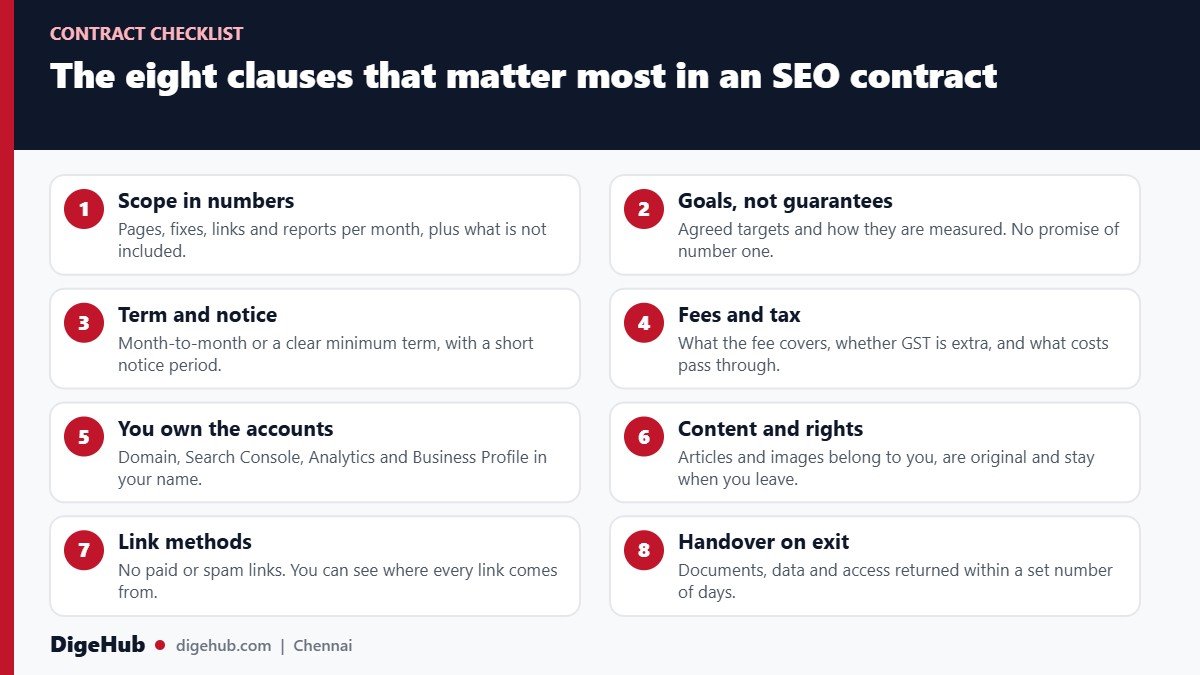
Twelve clauses to check, with what good looks like
1. Scope of work, in numbers
Good: a monthly list such as “four service-page improvements, two articles of 1,500+ words, Business Profile updates, a set number of earned links, one report”. Push back on: phrases like “on-page optimisation” or “link building” with no quantity. Also ask what is excluded, such as developer time, paid tools, content translation or photography.
2. Goals and how success is measured
Good: agreed targets tied to business outcomes (enquiries from organic search, calls, form fills) with a stated way of measuring them, plus leading indicators like indexed pages and visibility on target searches. Push back on: any promise of a number one ranking. Google says plainly that no one can guarantee it. If ranking is the headline metric, ask which searches, in which area, on which device.
3. Term and notice period
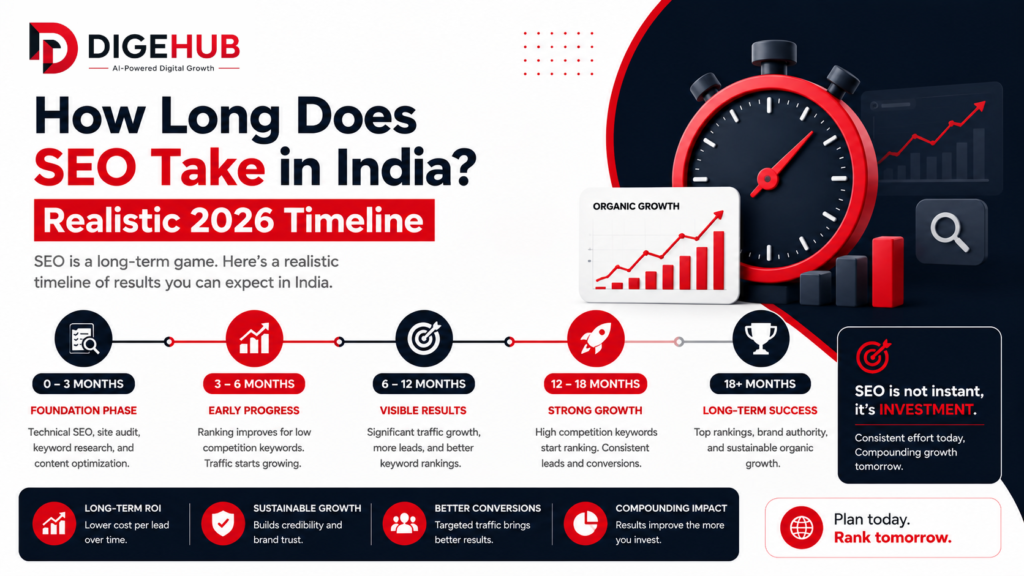
Good: month-to-month, or a short starting term followed by monthly renewal, with notice of 15 to 30 days. Push back on: 12-month lock-ins with no exit for non-performance, and auto-renewals buried in the fine print. We cover why timelines matter in how long SEO takes, and a fair compromise is a three-month starting period, then monthly. DigeHub plans are month-to-month with no lock-in.
4. Fees, tax and pass-through costs
Good: one monthly fee, what it covers, the payment date, and a clear statement of whether GST is extra. Marketing services normally attract GST (18 per cent is the usual rate; confirm with your CA). Any cost that passes through, such as paid tools, stock images or content freelancers, should be named. Push back on: unexplained “setup fees”, price rises without notice, and annual prepayment for work not yet done. For benchmarks see SEO pricing in Chennai.
5. Ownership of accounts and assets
Good: your domain, hosting, Google Search Console, Google Analytics and Google Business Profile all stay in your name, and the agency receives access through each platform’s permission roles. Push back on: any set-up where the agency is the primary owner of your Business Profile, or where your analytics sits inside their account. The consequences are laid out in our guide to switching SEO agencies.
6. Content, images and intellectual property
Good: articles, images and designs made for you belong to you once paid for, are original, and do not infringe anyone’s rights. The agency must disclose any use of stock or AI tools, and must not copy competitors’ text. Push back on: clauses that let the agency reuse your content for other clients, or that withdraw rights if you leave.
7. Link-building methods
Good: a promise to follow Google’s spam policies, no paid links that pass ranking credit, no private blog networks, and the right to see where each link sits. Push back on: “we have a network of sites” with no names. Google’s guidance also treats link schemes and offers to submit your site to “thousands of search engines” as red flags. Our link building guide explains the difference between earned and bought links.
8. Reporting and access to data
Good: a monthly report with raw numbers from dashboards you can open yourself, a regular call, and tracking numbers and forms registered to your accounts. Push back on: reports made only of screenshots, or tracking that lives in the agency’s tools and vanishes when they leave.
9. Change approvals and documentation
Good: changes that can hurt rankings (URL changes, redirects, deleting pages, theme or plugin changes) need your written approval, and every change is logged with the reason. Google notes that an SEO with server access should explain every change they make. Push back on: blanket permission to edit anything.
10. Data protection and confidentiality
If the agency touches customer data, such as form leads or call recordings, the contract should say how it is stored, who sees it, and that it is returned or deleted at the end. India’s Digital Personal Data Protection Rules were notified on 13 November 2025, and the main obligations for businesses that handle personal data apply after an 18-month phase, around May 2027. Writing sensible data terms into the agreement now saves a scramble later.
11. Who actually does the work
Good: the contract names the account lead and says whether freelancers or partner agencies will be used, with the agency remaining responsible for their work. Push back on: a senior name in the pitch and unnamed juniors in the delivery, with no commitment about who handles your account.
12. Termination, handover and guarantees
Good: either side can end the agreement for serious breach, and on exit the agency hands over documents, data, access and work in progress within a set number of days. Push back on: clauses that hold your accounts or content until a final invoice is paid in full, or that bar you from hiring another agency.
Plain-English sample wording to discuss with your lawyer
Contracts do not need to be dense. These short examples show the tone to aim for. They are starting points for a conversation, not finished legal text.
| Clause | Example in plain English |
|---|---|
| Ownership | “The client owns the website, domain, Search Console, Analytics and Business Profile. The agency receives access through each platform’s own user permissions and will not take ownership of any of them.” |
| Links | “The agency will follow Google’s spam policies. It will not buy links that pass ranking credit or use private blog networks, and will share a list of links built each month.” |
| Notice | “Either party may end this agreement with 30 days’ written notice. Fees are payable only for work done up to the end date.” |
| Handover | “Within 10 working days of the end date, the agency will deliver reports, documents, content files and a list of work in progress, and will remove its own access from the client’s accounts.” |
| No guarantee | “The agency will work to improve organic visibility and enquiries but does not guarantee any particular ranking, as search results are controlled by search engines.” |
Month-to-month or fixed term?
This is the question owners ask most, and both sides have a fair point. SEO takes time to show, so agencies prefer a minimum term to cover the early work. Ahrefs found that only a small share of new pages reach the top ten within a year, so no one should judge results after three weeks. But a long lock-in shifts all the risk to you.
| Month-to-month | Fixed term (6 or 12 months) | |
|---|---|---|
| For the business | Easy exit if quality drops, less risk | Sometimes a lower monthly fee |
| For the agency | Must keep earning the retainer | Stable income and time to build |
| Watch for | Short-term thinking from both sides | Exit rights if deliverables are missed, no auto-renewal |
Our view: a fair middle is a short starting period, with full reporting, and then monthly renewal. If an agency insists on twelve months, ask what you get in return, such as a lower fee, and make sure you can leave for non-delivery.
Red flags in the agreement itself
- A ranking or traffic guarantee, especially with a specific position or number of visitors.
- Claims of a special relationship with Google, or an “approved” tool or method.
- The agency listed as owner of your Google Business Profile, Search Console or Analytics.
- Vague deliverables with no numbers or dates.
- Auto-renewal with a long notice window, or penalties for leaving.
- No mention of how links are built, or a promise of “hundreds of links” a month.
- Content rights that return to the agency if you leave.
- A requirement to add links to the agency’s own site on yours.
How to ask for changes without souring the relationship
Many owners hesitate to mark up a contract because they fear looking difficult. A reasonable agency expects questions, and the way they respond is useful information. A few habits help.
- Ask a question instead of making a demand. “Can we state in the contract that the Business Profile stays in our name?” is easier to agree to than “remove this clause”.
- Change a few things that matter, not everything. Ownership, notice, deliverables and links will cover most of the risk. Do not spend goodwill on minor wording.
- Ask for the reason behind a refusal. If an agency will not put deliverables in numbers, ask why. Some work really is uncertain, but there is usually a range that can be written down.
- Get the answer in the document. Emails and calls help you understand, but only the signed text decides a dispute.
- Compare drafts. If you are talking to two or three agencies, put their key terms side by side: term, notice, price, scope, and ownership. The differences often tell you more than the sales pitch.
If an agency refuses every request and insists the standard terms cannot change, you have learned how they will treat you later. A confident agency has no reason to hide behind a template. Keep a record of what you asked and what they said. If you decide to leave an existing agency, our handover guide shows how those written terms help.
Finally, remember that a contract is only as useful as the habit of reading it. Put the renewal date, notice deadline and first review in your calendar on the day you sign. A short monthly check against the scope list takes ten minutes and keeps both sides honest.
A ten-minute check before you sign
- Read the scope aloud. If you cannot say what you will receive each month, ask for numbers.
- Find the exit. Locate the notice period, minimum term and renewal in the document itself.
- Find the ownership clause. Make sure the main accounts stay in your name.
- Ask for a sample report. It should match what the contract promises.
- Request an audit first. A SEO audit shows how the team thinks before you commit money.
- Get changes in writing. A verbal promise on a call is not part of the agreement.
At DigeHub, we start with a free audit, keep plans month-to-month, and publish our price bands openly: Rs40,000 to Rs60,000 a month for Local SEO Starter, Rs65,000 to Rs1.2 lakh for Growth SEO, and Rs1.2 lakh and above for Enterprise. See our SEO agency in Chennai page for what each plan includes. If you already have a draft from another agency, send it on WhatsApp and we will tell you honestly what we think of it.
Frequently asked questions
Is an SEO contract legally binding in India?
Can an SEO agency guarantee first-page rankings?
Should I pay for SEO upfront?
Who should own my Google Business Profile?
Does GST apply on SEO services?
What happens to my content if I stop?
Sources and further reading
- Google Search Central: Do you need an SEO?
- Google Search Central: Spam policies for web search
- AZB and Partners: DPDP Rules notified 13 November 2025, phased commencement
- Google Business Profile Help: Manage owners and managers
- Google Search Console Help: Users, owners and permissions
- Ahrefs: How long does it take to rank?
Want this done for your Chennai business?
Tell us what you sell and where your customers are. We will send a straight answer on what is worth doing first, with no lock-in contract.
- Free audit of your site, Google Business Profile and AI answers
- Reply within 2 business hours on WhatsApp
- Month-to-month plans from ₹40,000