
SEO for Schools and Colleges in Chennai: Win More Admission Enquiries
Parents and students research schools and colleges for weeks before they ever fill in a form. If your institution is missing from those searches, or shows up with an out-of-date fee page, the enquiry goes elsewhere. This guide covers the admission calendar, the pages families look for and the rules that keep your claims honest.
Admission search is seasonal, and the calendar is public
Education is one of the most predictable categories in search. Demand rises sharply when applications open, falls after seats fill, and starts building again months ahead of the next cycle. Planning your SEO around that calendar is the difference between being found during the decision window and being found after it. These are the 2026 dates reported for two major Tamil Nadu processes, to show how tight the windows are. Dates change each year, so always check the official portals.
| Process | 2026 timeline as reported | What it means for your website |
|---|---|---|
| RTE 25 per cent admissions in private schools (2026-27) | Applications 20 April to 18 May on the state portal, lottery on 22 May (DT Next) | Schools publish seat numbers early. Have your RTE information page accurate before April. |
| TNEA engineering counselling | Registration opened 3 May and was due to close 2 June, later extended to 5 June. Certificate verification 8 to 20 June, rank list 29 June (Careers360, DT Next) | Engineering colleges are compared most closely from the rank list onward. Programme, fee and placement pages must be current by early June. |
The reports note about 2 lakh engineering seats across more than 400 colleges, which shows how crowded the choice is. Private school admissions, arts and science colleges, MBA programmes and coaching batches follow their own calendars. Map yours, then work backwards: pages ready two months before applications open, visibility checks one month before, and a daily eye on enquiries during the window.
For the wider picture of how we approach SEO in the city, see our SEO agency in Chennai page and our education page.
What parents and students actually search
In Google Keyword Planner (India, 5 November 2026), “seo for schools” shows 100 to 1,000 monthly searches, so institutions are already looking for this help. The searches your families make are different, and they differ by type of institution.
| Institution | Typical searches | What the searcher needs to see |
|---|---|---|
| School | “CBSE school in Velachery”, “LKG admission”, “school fees structure”, “schools near me” | Board, classes, admission steps, dates, fees, transport, location, safety |
| College | “BE CSE colleges in Chennai”, “MBA colleges Chennai fees”, “placements”, “hostel facilities” | Programmes, accreditation, intake, fees, faculty, placement process, campus |
| Coaching centre | “NEET coaching Chennai”, “JEE coaching near me”, “TNPSC coaching in Tamil” | Batches, faculty, schedule, fees, past results explained honestly |
| Skill or vocational | “diploma courses Chennai”, “short term courses after 12th” | Eligibility, duration, fees, certification, job outcomes |
These are the kinds of searches to check in your own Search Console, not volumes we are quoting. Many mix Tamil and English, and parents often search from a phone while commuting. Plan for both. See Tamil SEO in Chennai for how to cover those searches properly.
The pages every school and college site needs
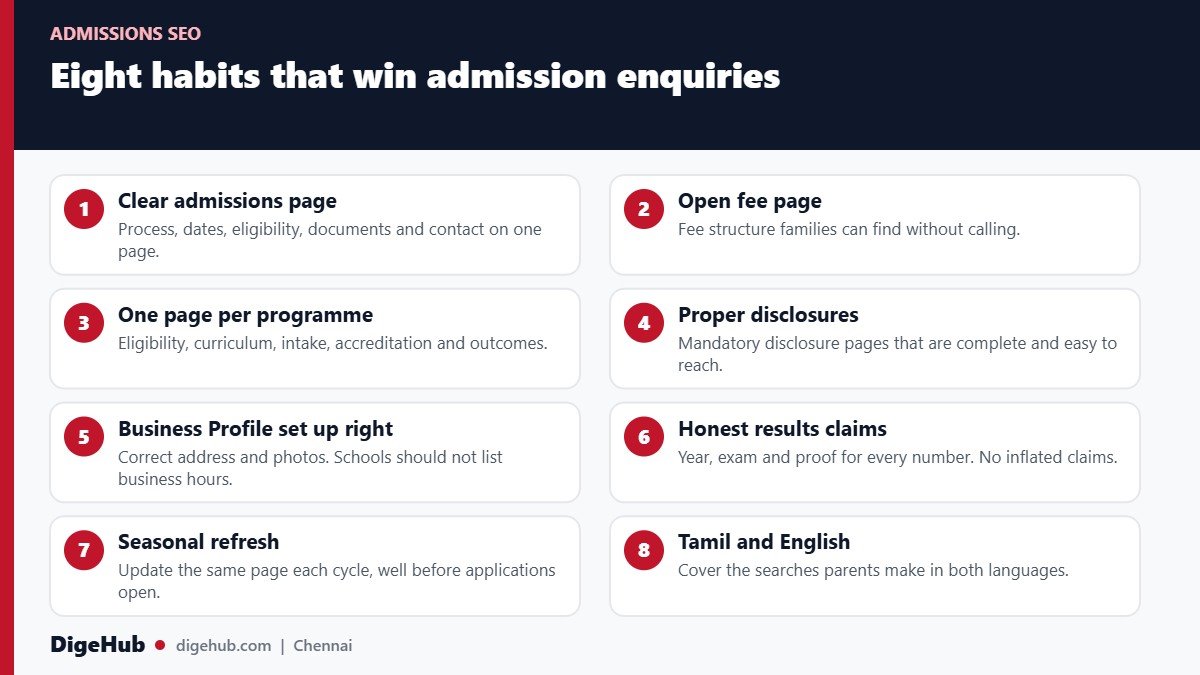
- Admissions page. The most important page on the site. State the process step by step, with dates, eligibility, documents needed, age criteria, and a clear way to contact the admissions office. Update the same page each year rather than creating a new URL, so it keeps its history.
- Fee structure page. Families often cannot compare institutions without calling. A clear fee page, with what is included and what is extra, builds trust and saves your staff time.
- Programme or class pages. For colleges, one page per programme with eligibility, curriculum, duration, intake, accreditation and career paths. For schools, a page per stage (pre-primary, primary, middle, senior).
- Mandatory disclosure page. See the next section. Make it complete and easy to find.
- Faculty and leadership. Names, qualifications and experience. This is a strong trust signal.
- Campus and facilities. Real photos, a virtual tour, transport routes, hostel and safety details.
- Results and outcomes, presented honestly (see below).
- FAQs for parents or students. Real questions from your admissions desk, answered in plain language.
Write each page for the person making the decision. A parent comparing three schools wants to know what is different about yours and how to take the next step. Avoid pages that read like a brochure with nothing concrete. Our on-page SEO checklist covers titles, headings and internal links for these pages.
Mandatory disclosures: a compliance duty that doubles as a trust page
CBSE-affiliated schools are required to publish a set of public disclosures on their website. According to a Careers360 report from March 2022, these cover areas such as affiliation details, school and principal contact information, safety and sanitation certificates, board results, fee structure, teacher details and infrastructure. The report also found that many schools were not displaying the disclosure as the board expects. It is from 2022, so check the current CBSE requirements and your own status.
For SEO, the point is simple. A complete, current disclosure page is the kind of factual, verifiable content that earns trust from parents and from search engines. Link to it from the homepage footer and the admissions page, keep the documents readable (not only scanned images), and update it each year. Colleges approved by bodies such as AICTE or UGC have their own disclosure expectations, so confirm what applies to you.
Google Business Profile for schools and colleges
For “near me” searches, the map listing is often the first thing a parent sees. Google’s guidelines include a few points that matter for education:
- Schools and universities should not list business hours. Google’s guidelines say so, because the hours of an admissions office differ from when a school is in session. Keep the listing focused on the address, phone, website and photos, and put office hours on your site.
- One profile per location. If you run several campuses, each can have its own profile with its real address.
- The name must match the real-world name used on signage and your website. Do not add “best school” or location phrases.
- Add real photos of the building, classrooms, labs, playground and transport.
- Reviews matter. Reply politely and factually. Do not offer incentives, and never pressure students or parents. See Google reviews for Chennai businesses.
Our Business Profile guide covers categories, photos and posts. Choose the most specific primary category that fits, and keep the address and phone number exactly the same across your site and listings.
Results and claims: be specific, be able to prove it
Education marketing is full of numbers: “100 per cent results”, “top ranks”, “guaranteed selection”. They also draw attention from regulators. The Central Consumer Protection Authority issued guidelines for the prevention of misleading advertisements in the coaching sector, which took effect on 13 November 2024. They address false claims about courses, selection, ranks, job security and admissions, and false urgency or scarcity, and they say student photos and testimonials need the student’s consent, obtained after selection. The guidelines apply to anyone providing coaching or running a coaching centre, including endorsers. Schools and colleges are not named in the summary we reviewed, but the principle applies to everyone: claims must be true and provable. This is not legal advice, so read the official text.
A practical checklist for every number you publish:
- State the year and exam: “62 students qualified NEET in 2026” (an illustrative format, not a real figure) and not “many toppers”.
- Explain how it is counted: enrolled for the full course, or any student who attended a short test series?
- Keep proof on file: rank letters, result sheets, enrolment records.
- Get written consent before using any student’s name or photo, after the result.
- Avoid “guaranteed”, “100 per cent” and fake urgency such as “only 3 seats left” unless it is literally true.
Honest, specific claims also perform better with families who have seen exaggeration before.
A yearly rhythm for admissions SEO
| When | Work |
|---|---|
| 3 to 4 months before applications open | Audit the site and Business Profile. Fix speed, broken pages and outdated fees. Plan new content from last year’s enquiry questions. |
| 2 months before | Refresh the admissions, fee and programme pages with the new cycle’s information. Keep the same URLs. Add FAQs. |
| 1 month before | Check visibility for the key searches, mobile speed and form tests. Make sure calls and WhatsApp clicks are tracked. |
| During the window | Watch enquiries daily. Update dates and seat information. Reply to reviews and Business Profile questions quickly. |
| After the window | Review which pages and searches produced admissions. Publish results honestly. Plan the next cycle. |
Keeping the same URL for each yearly page is a simple habit with a real benefit: the page keeps its history and links, and you avoid creating a new page every year that starts from zero. SEO also takes time. Ahrefs found that only a small share of new pages reach the top ten within a year, so starting early matters.
Mistakes we see on education websites
- Admission information buried in a PDF. A scanned circular is hard to read on a phone and hard for search engines to understand. Put the key facts in the page itself and offer the PDF as a download.
- Fees hidden behind a phone call. Families compare quietly first. If competitors show fees and you do not, you lose the comparison before a conversation starts.
- Last year’s dates still live. An admissions page that says a closed deadline is open damages trust quickly. Add a review date to your calendar.
- One page for all courses. A college with twenty programmes needs twenty useful pages, not a list.
- Stock photos of foreign campuses. Parents want to see your real building, classrooms and students (with consent).
- No tracking of calls and WhatsApp. For most Chennai institutions the first contact is a call. If you cannot count them, you cannot tell what works.
- Ignoring mobile speed. Many families search on a phone. Google’s Core Web Vitals guidance sets 2.5 seconds or less for the largest element to load as a good target.
If you are unsure where your site stands, a structured SEO audit will show these problems in order of importance.
Chennai specifics: neighbourhoods, boards and languages
Chennai families usually shortlist by area first. A parent in Velachery or Anna Nagar often wants a school within a sensible commute, so neighbourhood signals matter: your address on the page, the area names families really use, transport routes and nearby landmarks. Do not create dozens of thin “school in every area” pages. Instead, add a genuine “getting here” section with bus routes, metro access and pick-up zones. Our guide to neighbourhood SEO in Chennai explains how to do this without spam.
Board and medium matter too. State clearly whether you follow CBSE, ICSE, the State Board or an international curriculum, and whether instruction is in English, Tamil or both. For colleges, state affiliation and approvals plainly. Visitors who cannot find these facts in a few seconds will leave.
Measuring results and what it costs
- Enquiries by source. Add a “how did you hear about us” field to the form, and track calls and WhatsApp clicks.
- Campus visit bookings and application starts from organic search.
- Non-brand visibility. Searches such as “CBSE schools in Adyar” or “BE CSE colleges Chennai” in Search Console.
- Admissions, finally. Ask the admissions office to tag each admitted student’s source.
For a single school or college, the Local SEO Starter plan at DigeHub (Rs40,000 to Rs60,000 a month) often covers the basics. A group with several campuses or many programmes usually fits Growth SEO (Rs65,000 to Rs1.2 lakh). Plans are month-to-month with no lock-in, and the first step is a free audit. For context on prices, see SEO pricing in Chennai. If you want us to look at your admission pages before the next cycle, send us the link on WhatsApp and we will reply within two business hours.
We cannot guarantee a number one ranking, and nobody honestly can. What we can do is make sure that when a family searches, your pages are accurate, easy to use and worth trusting.
Frequently asked questions
When should a school start SEO for admissions?
Should a school list opening hours on its Google profile?
Can a coaching centre advertise 100 per cent results?
Do we need a separate page for each course?
Is Tamil content worth it for a school website?
How do we avoid creating a new admissions page every year?
Sources and further reading
- DT Next: Tamil Nadu RTE applications open from April 20 for 2026-27
- Careers360: TNEA 2026 registration begins; apply by June 2
- Careers360: How many schools violate CBSE regulations on mandatory disclosures (21 March 2022)
- Google Business Profile Help: Guidelines for representing your business
- Fox Mandal: CCPA issues guidelines for prevention of misleading advertisement in the coaching sector, 2024
- Ahrefs: How long does it take to rank
- Google Search Central: Core Web Vitals
Want this done for your Chennai business?
Tell us what you sell and where your customers are. We will send a straight answer on what is worth doing first, with no lock-in contract.
- Free audit of your site, Google Business Profile and AI answers
- Reply within 2 business hours on WhatsApp
- Month-to-month plans from ₹40,000
