
Hotel SEO in Chennai: Get More Direct Bookings and Rely Less on OTAs
A guest searching for a hotel in Chennai usually meets booking platforms, map listings and review sites before they ever reach a hotel’s own website. That is not a reason to give up on direct bookings. It is a reason to be precise about where you can win. This guide covers the pages, profile settings and booking path that move guests from search to your own booking engine.
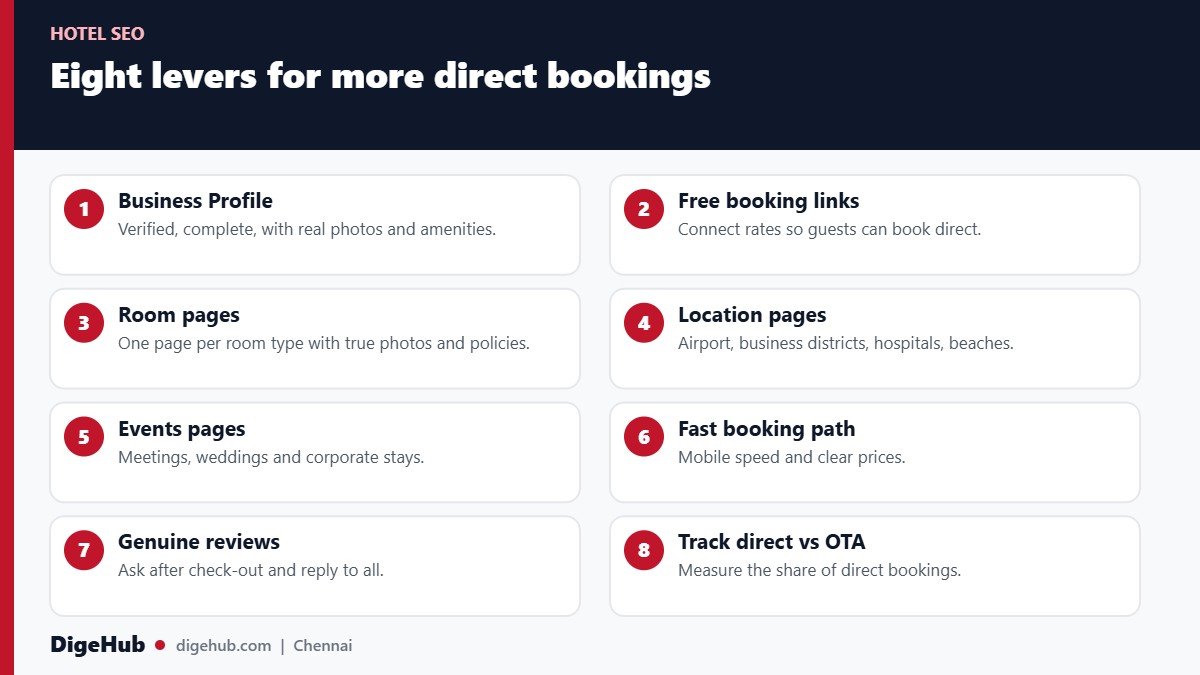
A realistic view of hotel search
In Google Keyword Planner (India, 5 November 2026), “hotel seo” sits in the 100 to 1,000 monthly searches range, with top-of-page bids of roughly Rs22 to Rs164, a wide spread that shows how valuable a booking click can be. Hoteliers are clearly interested in this topic. But the first thing to accept is that for generic searches such as “hotels in Chennai”, large booking platforms and Google’s own hotel results will usually dominate. Pretending otherwise wastes money.
The realistic goals for an independent Chennai hotel or service apartment are narrower and more valuable:
- Win your own name. When someone searches for your hotel after seeing it elsewhere, the direct booking link should be the easiest route.
- Win specific, high-intent searches that platforms serve poorly: “hotels near Chennai airport with airport transfer”, “service apartments near [hospital]”, “hotel with banquet hall in [area]”.
- Capture repeat and referral guests with a simple direct booking path and a reason to book direct.
- Show up on the map with a profile that converts.
The economics are simple. If an OTA booking of Rs5,000 carries a 15 per cent commission (an illustrative figure; check your own contracts), the hotel pays Rs750 on it. Moving even a modest share of bookings to your own channel is meaningful. For our broader approach to local search, see our SEO agency in Chennai page.
Google Business Profile and free booking links
For hotels, the Business Profile is often the first thing a guest sees. Google’s partner guidance says that once your hotel is verified with a free Business Profile, it can appear on Search and Maps, and that you can add photos and amenities and respond to reviews. To show rates and availability with a booking link, Google says you need to work with a connectivity partner who sends real-time rates and availability, and that you can set your own rates without having to offer a best available rate. Hotel Ads are an optional paid addition.
Google began expanding free hotel booking links to Search and Maps in March 2022, which let hotels that qualify add rates to their profile and see click counts in a report. Eligibility and the product itself change over time, so check Google’s current requirements and ask your booking engine or channel manager whether they are connected.
- Use the real name, exactly as on your signage. No keyword stuffing, and no area names unless they are part of the name.
- Choose the right category. Hotel, service apartment, guest house or resort should match what you are.
- Complete the amenities accurately: parking, Wi-Fi, breakfast, airport transfer, accessibility, pet policy.
- Upload real photos of rooms, bathrooms, lobby, restaurant, exterior and views. Guests compare these carefully.
- Link to a useful landing page, not just the homepage, and add the booking link where possible.
- Answer questions in the Q and A and reply to reviews.
See our Business Profile guide for the setup in detail.
Room pages that help a guest decide
Many hotel sites show a single page of rooms with a few photos and a price. Guests comparing options want more. A page for each room type should include:
- The actual photos, including the bathroom and the view. Avoid stock images.
- Size, bed type, capacity and floor. Specifics reduce disappointment and complaints.
- What is included: breakfast, Wi-Fi, parking, airport transfer, late check-out.
- Policies in plain language: check-in and check-out times, cancellation, extra bed, ID requirements.
- Who it suits: business travellers, families, long stays, patients and attendants.
- A clear price or “from” price and a direct booking button that opens the booking engine on the right room and dates.
Include a short, honest note about noise, lift access or anything else that might matter. Hotels that tell the truth earn better reviews, which in turn improves visibility. For titles, headings and linking, see our on-page SEO checklist.
Location pages: be the best answer for where you are
Chennai guests usually choose by purpose and area. A business traveller wants easy access to an IT corridor, a patient’s family wants to be near a hospital, a transit guest wants the airport, a tourist wants the beach and the old city. Create a page for each real reason someone would choose your location, and write it from your own knowledge:
- Distance and travel time to the airport (Chennai International Airport is at Meenambakkam), the central railway station, major hospitals, business districts and the convention venues nearby, with honest ranges that note traffic.
- Getting there: metro, taxi, airport pickup, parking.
- Nearby food, shops and places to visit, with a few recommendations that go beyond the obvious.
- Day trips: such as Mahabalipuram or Pondicherry, with realistic travel times and what to book in advance.
Do not create a page for every neighbourhood just to capture search terms. Only write about places that genuinely matter to your guests. Our neighbourhood SEO guide shows the line between useful local content and thin pages.
Meetings, weddings and corporate stays
If you have a banquet hall, meeting room or longer-stay rooms, these can be more valuable than single-night leisure bookings and face less OTA competition. Give them their own pages:
- Venue pages with capacity in each layout, size, ceiling height, floor plan, AV equipment, catering options, parking and accessibility.
- Corporate and long-stay pages with monthly rate approach, inclusions, laundry, kitchenette, billing and GST invoice process.
- A request form that asks for dates, guest count, event type and budget, and a promise on reply time.
- Real photos and, where permitted, past events to show the space in use.
Enquiry volume for these is lower, but the value per enquiry is high, and a fast, specific reply wins the booking.
The booking path decides whether search turns into revenue
Even a perfect listing fails if the booking engine is slow or confusing. Test the full path on a mid-range phone:
- Speed. Google’s good target for Largest Contentful Paint is 2.5 seconds or less. Compress photos and avoid autoplay video on the homepage.
- Clarity. Show the total price with taxes before the final step. Surprise charges are the top reason guests abandon a booking.
- Few steps. Remove fields you do not need. Offer UPI and cards.
- Reasons to book direct. Free breakfast, a late check-out or flexible cancellation can be enough, provided it is honest and consistent with your OTA agreements.
- Contact options. Phone and WhatsApp for guests who prefer to talk, especially for group or long-stay queries.
Test the path with real bookings every month. A broken date picker on mobile can quietly cost more than any ranking drop.
Reviews: the strongest signal for hotels
Guests read reviews carefully before booking, and recent ones matter most. BrightLocal’s 2026 consumer survey (US data) reports that consumers pay attention to recency and read multiple reviews. The habits are similar elsewhere, though the data is American. Ask guests for a review at check-out or the day after, using a direct link or QR code at the desk. Do not offer discounts for reviews, do not review your own property, and respond to every review, thanking the happy guests and answering complaints with specifics and a route to resolve them.
Fix repeating complaints, such as slow check-in or noisy air conditioning, since reviews that mention them hurt both visibility and bookings. See Google reviews for Chennai businesses for message templates and rules.
Structured data: help machines read the facts
Google’s local business documentation advises using the most specific business type that fits and keeping markup consistent with the visible page. Schema.org has a Hotel type with properties for amenities, check-in and check-out times and star rating. Markup can help systems understand your facts, but it does not guarantee any visual enhancement or ranking. Keep it accurate: do not mark up amenities you do not offer, ratings you cannot support or prices that differ from the page.
Mistakes we see on hotel websites
- No rates on the website. If guests cannot see a price, they go back to the platform where they can. Show a “from” price at minimum.
- Different information everywhere. Check-in time, breakfast timing or parking rules that vary between the site, the profile and the OTA listings create disputes and bad reviews.
- A booking engine on another domain with no branding. Guests lose confidence when the page changes suddenly. Brand it and explain it.
- Stock photos. Guests compare your photos with reviews. If they do not match, the review wins.
- Ignoring the Q and A and messages on the Business Profile. Unanswered questions look like neglect.
- One page for every guest type. A family, a corporate traveller and a patient’s attendant need different information.
- No tracking of phone and WhatsApp. Many direct bookings start with a call. If you cannot see them, you will undervalue the channel.
Plan content around Chennai demand
Hotel demand in Chennai moves with weather, festivals, business travel and events. A calendar helps you publish at the right time and avoid last-minute scrambles:
| Period | Typical guest need | Content to prepare |
|---|---|---|
| Year-end and January | Leisure, family visits, festival travel | Seasonal packages, local guides, early booking benefits |
| Wedding months | Guest accommodation, banquets | Room block process, venue pages, group booking form |
| Corporate cycles | Business stays, training, offsites | Corporate rates, meeting rooms, GST invoicing |
| Monsoon | Flexible plans, transit stays | Honest information on flooding risk, access and backup power |
| Year round | Medical stays, relocation, short stays | Service apartment pages, long-stay terms, hospital proximity |
Check your own booking data for the real peaks, since each property differs, and update seasonal pages at the same URL each year so they keep their history.
A 90-day plan and what it costs
| Period | Work |
|---|---|
| Days 1 to 30 | Audit the site and booking path. Verify and complete the Business Profile. Check connectivity partner and free booking links. Set up tracking for direct bookings, calls and WhatsApp. |
| Days 31 to 60 | Rebuild room pages with real photos and policies. Add three location pages and the events or corporate page. Start a review routine. |
| Days 61 to 90 | Review direct booking share, Business Profile actions and Search Console. Fix booking path issues. Plan seasonal content for the December to January peak and festival weekends. |
An independent hotel usually fits our Local SEO Starter plan (Rs40,000 to Rs60,000 a month); a larger property or a group with events and several services often needs Growth SEO (Rs65,000 to Rs1.2 lakh). Plans are month-to-month with no lock-in, and we start with a free audit. Send your website on WhatsApp and we reply within two business hours. We cannot promise a number one ranking against the big platforms, and we will tell you which searches are worth fighting for.
Frequently asked questions
Can a small hotel outrank booking platforms in Chennai?
What are Google free booking links?
Do we need a separate page for each room type?
Are location pages worth creating?
How do we get more direct bookings?
How long until SEO improves bookings?
Sources and further reading
- Google for hotels: Make your hotel stand out on Google
- Hospitality Net: Google’s free hotel booking links arrive on Search and Maps (March 2022)
- Google Business Profile Help: Guidelines for representing your business
- Google Search Central: Local business structured data
- Google Search Central: Core Web Vitals
- BrightLocal: Local Consumer Review Survey
- Google Keyword Planner (India, English), checked 5 November 2026
Want this done for your Chennai business?
Tell us what you sell and where your customers are. We will send a straight answer on what is worth doing first, with no lock-in contract.
- Free audit of your site, Google Business Profile and AI answers
- Reply within 2 business hours on WhatsApp
- Month-to-month plans from ₹40,000
