How to Do SEO in 2026: The Complete Step-by-Step Guide (With AI Visibility Strategies)
The Reality of SEO in 2026
You published a website. You wrote the pages. You launched the blog. And then — nothing.
No traffic. No rankings. No leads.
If that sounds familiar, you’re not alone. Thousands of businesses around the world — from SaaS startups in San Francisco to agencies in London, consultants in Toronto, and e-commerce founders in Sydney — invest in websites every year and watch them go completely dark on Google.
The problem isn’t your product. It isn’t your writing. It’s that nobody showed you how SEO actually works in today’s environment.
Because here’s what most SEO guides won’t tell you: the rules changed. Google’s algorithm is smarter, more contextual, and increasingly intertwined with AI systems that don’t operate on the same logic as traditional search. There are now two types of search visibility — the kind that earns you a spot on Google’s first page, and the kind that gets your brand cited by ChatGPT, Perplexity, and Google’s AI Overviews.
This guide covers both.
Whether you’re a business owner trying to rank your website for the first time, a marketer learning the fundamentals, or an agency professional who wants a deep strategic refresh, this is the most complete, practical, and up-to-date walkthrough on how to do SEO in 2026.
No fluff. No theory for theory’s sake. Just what works.
Quick Answer: What Is SEO and How Does It Work?
SEO (Search Engine Optimization) is the process of improving your website so it appears higher in search engine results pages (SERPs) when people search for topics related to your business.
Search engines like Google use automated programs called crawlers to discover and index web pages. They then rank those pages based on hundreds of signals — including content relevance, site authority, technical health, user experience, and backlink profile.
The goal of SEO is to signal to Google (and now to AI systems like Perplexity and ChatGPT) that your page is the most trustworthy, relevant, and useful result for a given query.
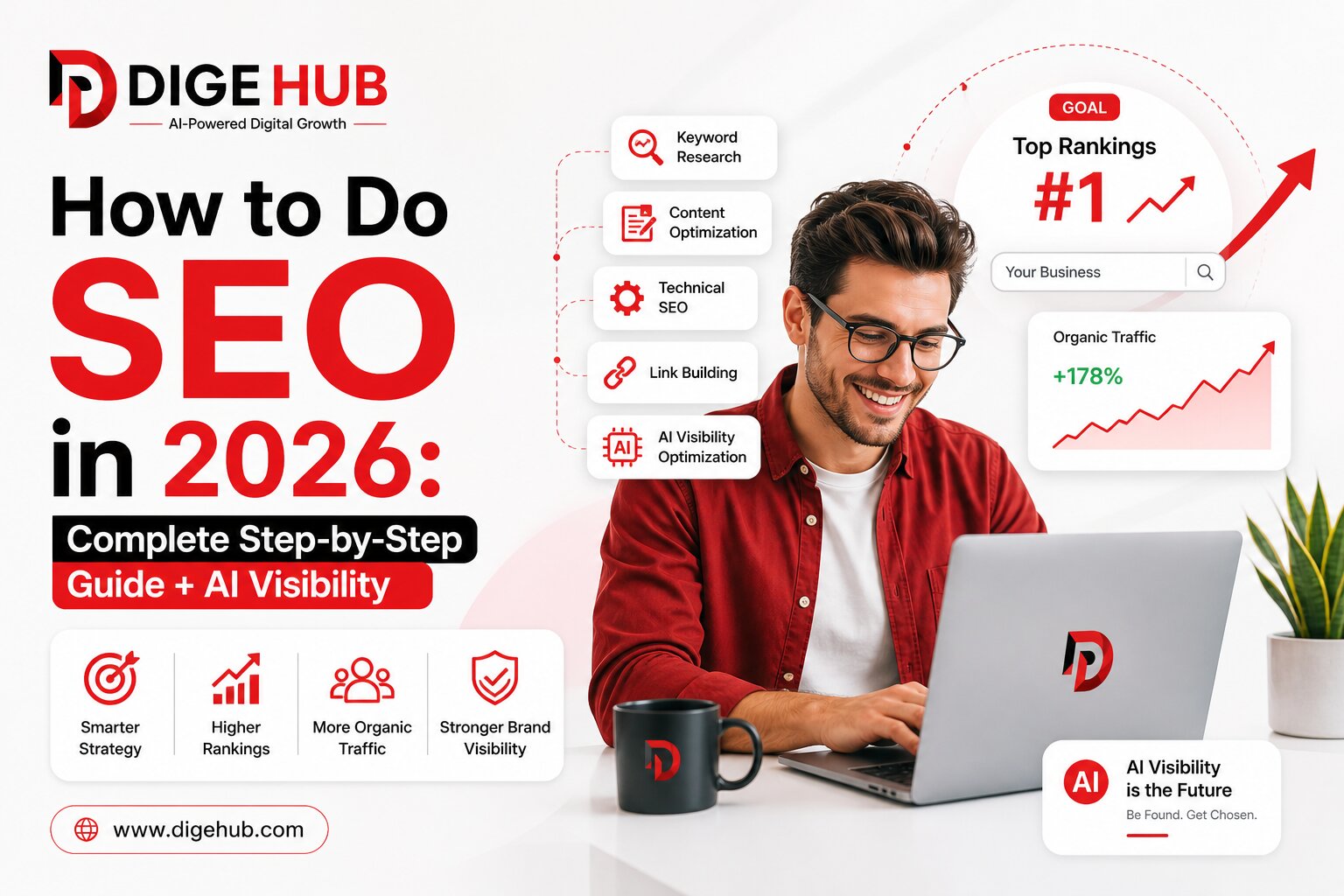
How does SEO work in 2026? It operates across five interconnected layers:
| Layer | What It Covers |
|---|---|
| Technical SEO | Crawlability, site speed, structured data, indexing |
| On-Page SEO | Keywords, content quality, headings, meta tags |
| Off-Page SEO | Backlinks, brand mentions, authority signals |
| Local SEO | Google Business Profile, local citations, maps rankings |
| AI Visibility | LLM citations, AI Overviews, answer engine optimization |
Master all five, and you build an organic channel that compounds over time — one that consistently brings in qualified traffic without paying for every single click.
- How to Do SEO in 2026: The Complete Step-by-Step Guide (With AI Visibility Strategies)
- The Reality of SEO in 2026
- Quick Answer: What Is SEO and How Does It Work?
- 1. Why SEO Still Matters More Than Ever in 2026
- 2. How to Do Keyword Research
- 3. How to Do On-Page SEO
- 4. Technical SEO: The Foundation That Holds Everything
- 5. Link Building: How to Build Backlinks That Actually Work
- 6. How to Do Local SEO
- 7. AI Visibility: The New Frontier of SEO in 2026
- 8. How to Do an SEO Audit
- 9. Common SEO Mistakes That Kill Rankings
- 10. How to Check Your Website Ranking on Google
- 11. Expert Insights: What Separates Top-Ranking Sites
- 12. Future of SEO: Trends to Watch
- 13. Frequently Asked Questions
- The Bottom Line: SEO That Compounds
- Ready to Build an SEO Strategy That Actually Delivers?
1. Why SEO Still Matters More Than Ever in 2026
There’s a recurring narrative that “SEO is dying.” It surfaces every time Google updates its algorithm or a new AI tool launches. And it’s been wrong every single time.
The truth is more nuanced: bad SEO is dying. Strategic SEO is thriving.
Here’s the context that matters:
- Google processes over 8.5 billion searches per day globally
- Organic search drives 53% of all website traffic across industries (BrightEdge, 2025)
- The top organic result on Google captures 27.6% of all clicks
- AI-generated search experiences (SGE, AI Overviews) still cite external sources — meaning your SEO signals now determine your AI citation probability too
Businesses that invested in SEO during 2020–2023 are now generating compounding returns. Those who paused are now buying expensive ads to compensate.
The game hasn’t ended. It’s evolved.
2. How to Do Keyword Research
Keyword research is where every successful SEO strategy begins. It’s not just about finding what people search for — it’s about understanding why they search, and whether ranking for that query will move your business forward.
Step 1: Map Your Business to Search Intent
Before you open any tool, ask: what does someone need to know, do, or decide when they’d benefit from finding your page?
Search intent breaks into four categories:
- Informational — “how to do SEO for my website” (learning)
- Navigational — “Digehub SEO services” (finding a specific brand)
- Commercial — “best SEO agency for SaaS” (comparing options)
- Transactional — “hire SEO agency” (ready to act)
Your content strategy should map to all four — but each piece of content should target one primary intent.
Step 2: Use the Right Tools
For keyword research in 2026, the professional toolkit includes:
- Semrush — The most comprehensive keyword data platform. Use Keyword Magic Tool to find thousands of related queries, filter by difficulty, and cluster by topic. If you’re serious about SEO, Semrush is one of the first tools worth investing in.
- Google Search Console — Free, direct data from Google about what queries are already bringing impressions to your site. Underutilized by most beginners.
- Google Keyword Planner — Free, basic. Good for volume estimates and commercial intent signals.
- Ahrefs — Exceptional for competitor keyword analysis and content gap research.
- Surfer SEO — Bridges keyword research with on-page optimization. Strong for content briefs.
- AlsoAsked / AnswerThePublic — Invaluable for finding long-tail and question-based queries, which are critical for both featured snippets and AI Overviews.
Step 3: Evaluate Keyword Viability
Not all keywords are worth targeting. For each candidate, assess:
Search Volume — How many people search it monthly. For most small-to-mid businesses, targeting keywords between 200–5,000 monthly searches often delivers better ROI than chasing high-volume terms.
Keyword Difficulty (KD) — A score (usually 0–100) representing how hard it is to rank on page one. New sites should target KD below 30. Established domains can compete at KD 50–70+.
Business Relevance — A keyword that drives 10,000 visits a month means nothing if none of those visitors are your target customers.
SERP Features — Does the keyword trigger featured snippets, People Also Ask boxes, local packs, or AI Overviews? Each is a targeting opportunity in itself.
Step 4: How to Do Keyword Analysis for SEO
The process of keyword analysis goes beyond finding keywords — it’s about building a logical topic architecture. Here’s a practical framework:
- Identify your pillar topics — The 4–6 core themes that define your expertise (e.g., “SEO services,” “content marketing,” “technical SEO”)
- Map cluster keywords — 10–20 supporting keywords per pillar, covering different angles, questions, and stages of intent
- Assign content types — Each keyword gets a content format: blog post, landing page, comparison page, FAQ, etc.
- Prioritize by opportunity — Balance volume, difficulty, and business value to sequence your content calendar
This is the structure behind every high-performing SEO content program. It’s also how search engines understand your site’s expertise — not page by page, but as a coherent topic ecosystem.
Practical example: If you run a digital marketing agency, your pillar topic might be “SEO services.” Cluster keywords would include “how to do SEO for a small business,” “SEO audit checklist,” “on-page SEO tips,” “how to find backlinks,” and “how to rank higher on Google.” Each cluster page links back to the pillar service page — reinforcing topical authority.
3. How to Do On-Page SEO
On-page SEO is everything you control within the page itself. It’s where most beginners make the most mistakes — either over-optimizing with keyword stuffing or under-optimizing by ignoring the signals Google actually reads.
Title Tags
Your title tag is the single most important on-page SEO element. It appears in search results, browser tabs, and is heavily weighted by Google’s ranking algorithms.
Best practices for 2026:
- Include your primary keyword, ideally near the beginning
- Keep it under 60 characters to avoid truncation in SERPs
- Make it genuinely compelling — your CTR (click-through rate) is itself an indirect ranking signal
- Add a year (e.g., “2026”) for informational content to signal freshness
Bad: SEO Tips
Good: How to Do SEO in 2026: Step-by-Step Guide for Beginners
Meta Descriptions
Meta descriptions don’t directly affect rankings, but they have a massive effect on whether someone clicks. A well-crafted meta description can lift CTR by 20–30%, which does send positive signals to Google.
Write meta descriptions as mini-sales copy: identify the reader’s problem, hint at your solution, and include a clear benefit or call to action. Target 150–160 characters.
Heading Structure (H1, H2, H3)
Your heading hierarchy tells both readers and search engines how your content is organized.
- H1 — One per page. Contains the primary keyword. Matches or closely echoes the page’s SEO intent.
- H2 — Major sections. Use semantic variations of your keywords here (not exact repeats).
- H3 — Subsections. Great for FAQs, step breakdowns, and supporting detail.
Google uses headings to understand context. AI systems use them to parse document structure before deciding what to cite. Don’t treat them as decoration.
Content Depth and E-E-A-T
In 2026, Google’s quality framework is anchored in E-E-A-T: Experience, Expertise, Authoritativeness, and Trustworthiness.
This means shallow content — even if keyword-optimized — is systematically losing ground to content that demonstrates real knowledge. When you write about how to do SEO, Google wants to see evidence that you’ve done SEO: real case examples, specific technical details, outcomes you’ve observed.
Practical on-page content checklist:
- [ ] Primary keyword in first 100 words
- [ ] Minimum 1,500–3,000 words for competitive informational topics
- [ ] Semantic keywords distributed naturally throughout
- [ ] Internal links to related pages on your site
- [ ] External links to authoritative sources where appropriate
- [ ] Original data, examples, or perspective that adds value beyond what’s already ranking
- [ ] Author byline with credentials (especially for YMYL topics)
Image Optimization
Images are often the last thing optimized — and frequently the reason pages load slowly, hurting rankings.
- Compress all images (tools like Squoosh, TinyPNG, or WebP conversion)
- Add descriptive alt text using natural language that describes the image and includes keywords where genuinely relevant
- Use descriptive filenames (e.g.,
on-page-seo-checklist.jpgnotIMG_0384.jpg)
URL Structure
Clean, logical URLs help both users and search engines. Keep them:
- Short and descriptive:
/blog/how-to-do-seo/not/p?id=1284&cat=5 - Lowercase and hyphen-separated
- Inclusive of the primary keyword where it fits naturally
4. Technical SEO: The Foundation That Holds Everything
You can write the most brilliant content on the internet. But if Google can’t crawl it, index it, or load it quickly — none of it matters.
Technical SEO is the discipline that ensures search engines can access, understand, and rank your site without friction.
Crawlability and Indexation
Before Google can rank your page, it must find it (crawl) and add it to its database (index).
Common crawlability issues include:
- Robots.txt blocking — Accidentally disallowing pages you want indexed
- Orphan pages — Pages with no internal links pointing to them, making them hard for crawlers to discover
- Noindex tags — Accidentally left on pages during development and never removed
- Duplicate content — Multiple URLs serving the same content, confusing crawlers about which version to rank
Use Google Search Console’s URL Inspection tool to check whether any page is being indexed, and why it might not be.
Site Speed and Core Web Vitals
Google uses Core Web Vitals as a ranking factor. These are real-world user experience metrics:
- LCP (Largest Contentful Paint) — How fast the main content loads. Target: under 2.5 seconds.
- FID / INP (Interaction to Next Paint) — How quickly the page responds to user input. Target: under 200ms.
- CLS (Cumulative Layout Shift) — How stable the page layout is as it loads. Target: below 0.1.
Test your site at PageSpeed Insights and address the highest-impact issues first. Common fixes include image compression, removing unused JavaScript, and enabling browser caching.
Mobile-First Indexing
Google indexes the mobile version of your site first. This isn’t a future consideration — it’s been the default since 2021. If your mobile experience is broken or incomplete, your rankings will reflect that.
HTTPS
Non-HTTPS sites carry a ranking penalty and display security warnings in browsers. If your site is still on HTTP, moving to HTTPS via an SSL certificate is a non-negotiable baseline fix.
Structured Data (Schema Markup)
Structured data is code you add to your pages that tells search engines what type of content they contain. It powers rich results in Google — star ratings, FAQ dropdowns, how-to guides, product prices — and it’s a key signal for AI Overviews and knowledge panels.
For most websites, the highest-priority schema types include:
- Organization (your company identity)
- LocalBusiness (for location-based businesses)
- Article / BlogPosting (for content pages)
- FAQPage (for FAQ sections)
- BreadcrumbList (for site structure)
- Product / Review (for e-commerce)
Use Google’s Rich Results Test to validate your schema implementation.
Sitemaps
An XML sitemap is a file that lists all the pages on your site you want Google to index. Submit it via Google Search Console. Keep it updated — dynamically generated sitemaps in WordPress and other CMS platforms handle this automatically.
5. Link Building: How to Build Backlinks That Actually Work
Backlinks — links from other websites pointing to yours — remain one of the most powerful ranking signals in Google’s algorithm. But the nature of effective link building has shifted significantly.
How Backlinks Work
When a reputable website links to your page, it’s essentially casting a vote of confidence. Google interprets this as evidence that your content is authoritative. Not all links are equal — a link from a high-authority publication like Forbes or TechCrunch is worth exponentially more than a link from a low-quality directory.
Key concepts:
- Domain Rating / Domain Authority — A metric estimating a site’s overall link authority (0–100 scale). Higher is better.
- Anchor Text — The clickable text of a link. Diverse, natural anchor text signals organic link acquisition.
- Do-Follow vs. No-Follow — Do-follow links pass SEO authority. No-follow links don’t pass authority directly, but they contribute to a natural link profile and can drive referral traffic.
How to Check Backlinks to Your Website
Knowing your current backlink profile is essential before building more. Use:
- Google Search Console → Links report (free, direct from Google)
- Ahrefs Site Explorer → Most comprehensive backlink data
- Semrush Backlink Analytics → Strong for competitor comparison
- Moz Link Explorer → Good for Domain Authority tracking
To check backlinks for a competitor, simply enter their domain in any of the above tools. This reveals where they’re earning links — and gives you a roadmap for your own outreach.
Effective Link Building Strategies in 2026
Content-Led Link Earning The most sustainable link building approach is creating content people want to cite. This includes:
- Original research and data studies
- Comprehensive guides (like this one)
- Free tools, calculators, or templates
- Industry surveys and reports
When your content becomes a reference point, links accumulate passively over time.
Digital PR Pitching stories, data, and expertise to journalists and bloggers who cover your industry. Tools like HARO (Help a Reporter Out), Connectively, and Qwoted connect you with journalists looking for expert sources.
Guest Posting Writing high-quality articles for industry publications in exchange for an author backlink. The key word here is quality — publishing thin guest posts on low-authority sites generates spam signals, not ranking power.
Broken Link Building Find pages on relevant sites that link to broken URLs. Reach out to the webmaster, alert them to the broken link, and suggest your content as a replacement. High effort, high conversion rate.
Competitor Gap Analysis Find sites that link to your competitors but not to you. Reach out with a stronger version of the content they linked to. This is one of the highest-ROI link building activities for established businesses.
⚠️ What NOT to do: Buying links, participating in private blog networks (PBNs), or using automated link building tools violates Google’s guidelines and can result in manual penalties. The risk-reward ratio is catastrophically bad in 2026.
6. How to Do Local SEO
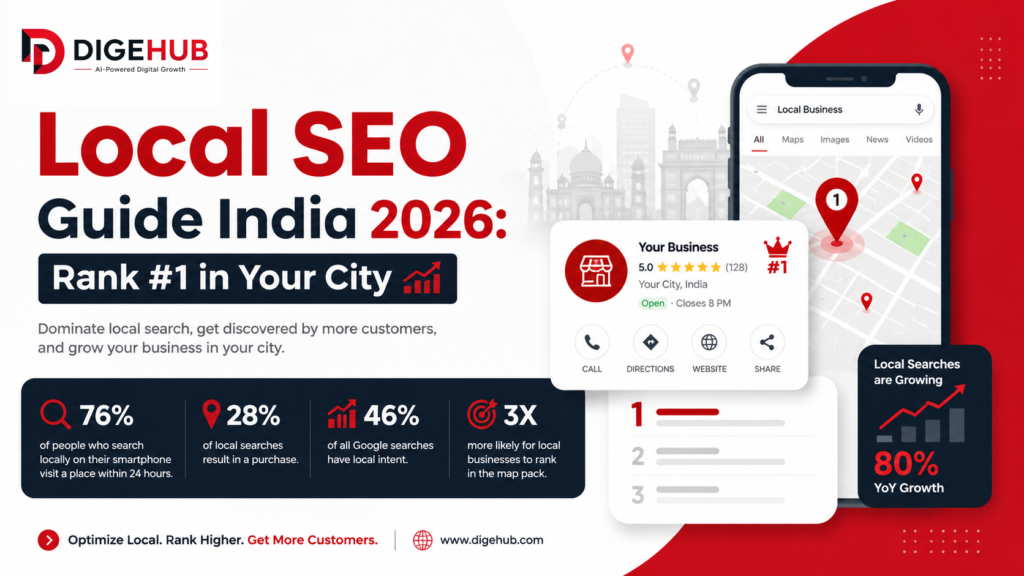
If your business serves a specific geographic area — whether you’re a law firm in Chicago, a restaurant in Melbourne, or a digital agency in London — local SEO is what separates you from competitors who look identical on paper.
Google Business Profile (GBP)
Your Google Business Profile is the single most important local SEO asset. It controls your appearance in Google Maps, the local pack (the three business listings that appear under the map in local searches), and Knowledge Panel results.
Optimize your GBP by:
- Completing every section (hours, services, description, photos)
- Selecting the most accurate primary and secondary categories
- Publishing weekly Google Posts (updates, offers, events)
- Actively requesting and responding to reviews
- Adding products/services with keyword-rich descriptions
- Ensuring your Name, Address, and Phone (NAP) exactly match your website
Local Citations
Citations are mentions of your business on other websites — directories, local chambers of commerce, review platforms. Consistency matters: if your business address is listed differently across 40 directories, it creates trust signals that contradict each other.
Build citations on: Google Business Profile, Bing Places, Apple Maps, Yelp, Yell.com, TripAdvisor (if relevant), and industry-specific directories.
Localized Content
Creating content that speaks to local intent is increasingly important. A plumbing company in Toronto should have pages targeting “plumber in Scarborough,” “emergency plumber North York,” and “drain cleaning Etobicoke” — not just a generic services page.
The structure that works: one landing page per service per location, with genuinely useful local content that goes beyond just inserting a suburb name into a template.
7. AI Visibility: The New Frontier of SEO in 2026
This is the section that most SEO guides ignore entirely — and it may be the most important one to read.
In 2025 and accelerating into 2026, a fundamental shift occurred in how people find information: AI-powered answer engines became mainstream.
ChatGPT now handles over 10 million searches per day. Perplexity has grown to tens of millions of monthly active users. Google’s AI Overviews appear in approximately 30–40% of US searches. Microsoft’s Copilot is embedded in Windows and Bing.
For businesses, this creates a new visibility problem: your website might rank on page one of Google, but if it’s not being cited by AI systems, a growing percentage of your potential audience may never know you exist.
AI visibility — often called LLMO (Large Language Model Optimization), GEO (Generative Engine Optimization), or AEO (Answer Engine Optimization) — is the practice of optimizing your digital presence to appear in AI-generated answers.
How AI Systems Decide What to Cite
AI language models and answer engines don’t rank content the same way Google does. They prioritize:
Structured, definitive answers — AI systems scan for content that directly answers questions with clear, quotable statements. Ambiguous content gets overlooked.
Authority and trustworthiness signals — The same E-E-A-T framework Google uses also influences which sources AI models are trained on or retrieve from. Thin, unattributed content is invisible to AI.
Entity recognition — If your brand, products, or key people are mentioned across multiple authoritative sources (Wikipedia, industry publications, news outlets), AI systems recognize you as a real entity and cite you more readily.
Semantic completeness — Content that comprehensively covers a topic — including related subtopics, definitions, counterarguments, and practical applications — is more likely to surface in AI retrieval than content covering only one narrow angle.
Freshness and specificity — AI retrieval systems (especially in real-time tools like Perplexity) favor content that includes current data, specific statistics, and recent developments.
How to Optimize for AI Visibility
1. Use FAQ and Q&A Structures Liberally AI systems are built to answer questions. Pages structured around clear questions and direct answers are optimized for AI retrieval. Use FAQPage schema to formalize this structure.
2. Write Definitive Statements “The best way to improve your Core Web Vitals score is to optimize image delivery, reduce render-blocking JavaScript, and eliminate layout shifts.” — That’s a citable, quotable statement. Vague content isn’t.
3. Build Brand Authority Across the Web Get mentioned in industry publications. Contribute to roundup articles. Get quoted as an expert source. Create a Wikipedia entry if your organization qualifies. The more your brand appears across authoritative sources, the more AI systems recognize you as a credible entity.
4. Create Structured Data at Scale Schema markup isn’t just for Google rich results. It helps AI systems understand the nature and context of your content — whether you’re publishing a how-to guide, a product review, a news article, or a research report.
5. Publish Original Research and Data AI systems cite statistics. Original research makes your content the primary source for specific data points — dramatically increasing citation probability.
6. Optimize for Conversational Queries AI-native searches are more conversational and complete: “What’s the best way to do SEO for a SaaS company in 2026?” rather than just “SaaS SEO.” Write content that mirrors this natural language, addressing the specific context behind queries.
7. Prioritize Answer Completeness A page that answers not just the primary question but all logically related follow-up questions is significantly more valuable to AI retrieval. Think: “If someone asked me this question in a conversation, what are the 10 things they’d want to know?” — then answer all 10.
If you want a professional approach to AI visibility strategy — one that goes beyond basic SEO — Digehub’s AI Visibility Services are built specifically to help businesses establish presence in AI-generated answers and generative search environments.
8. How to Do an SEO Audit
An SEO audit is a systematic review of everything that affects your site’s ability to rank. Think of it as a health check — it tells you what’s working, what’s broken, and what to fix first.
Step 1: Crawl Your Site
Use a tool like Screaming Frog (desktop crawler, free up to 500 URLs), Semrush Site Audit, or Ahrefs Site Audit to crawl your entire site and surface technical issues.
Common issues it will reveal:
- Broken links (404 errors)
- Redirect chains (A → B → C → D, slowing down link equity flow)
- Missing or duplicate title tags and meta descriptions
- Pages with thin content (under 300 words)
- Missing H1 tags or multiple H1s per page
- Missing alt text on images
- Non-canonical duplicate pages
Step 2: Analyze Your Keyword Rankings
Connect Google Search Console to see which queries are driving impressions and clicks. Look for:
- High impressions, low clicks → CTR optimization opportunities (better titles/metas)
- Rankings in positions 4–15 → Quick win opportunities where better optimization or more backlinks could push you onto page one
- Keywords you rank for but never targeted → Expand content around these
Step 3: Evaluate Your Backlink Profile
Use Ahrefs or Semrush to analyze your inbound link profile:
- How does your Domain Authority/Rating compare to competitors?
- Are there toxic or spammy links pointing to your site? (Disavow if necessary via Google Search Console)
- What percentage of your links are do-follow vs. no-follow?
- Which pages on your site have the most backlinks?
Step 4: Audit Competitor Rankings
Enter your top three competitors into your SEO tool of choice and review:
- What keywords are they ranking for that you’re not?
- Which pages earn them the most organic traffic?
- Where are they getting their backlinks from?
- What content formats perform best in your niche (guides, comparisons, tool pages, landing pages)?
This competitive intelligence should directly shape your next 90-day content and outreach plan.
Step 5: Review Core Web Vitals and Mobile Experience
Check your Core Web Vitals in Google Search Console under the Experience section. Test your site on mobile at various connection speeds. Identify the pages with the worst performance scores and prioritize fixes there first.
9. Common SEO Mistakes That Kill Rankings
Most SEO failures aren’t random. They follow predictable patterns. Here are the errors that consistently set businesses back — often without them realizing it.
Targeting keywords that are too broad too early. A new website trying to rank for “SEO” or “digital marketing” is competing against global brands with decades of authority. This isn’t a strategy — it’s a waste of budget. Start specific, earn authority, then expand upward.
Creating content without a clear intent match. Ranking for “how to do SEO” with a page whose primary goal is selling SEO services creates an intent mismatch. Google penalizes this friction. Informational content and commercial landing pages require separate, purpose-built pages.
Publishing thin, me-too content. Writing the same 600-word overview article that already exists in 500 versions doesn’t earn rankings. If you can’t add something better, more specific, or more authoritative than what’s already ranking — don’t publish it.
Ignoring technical SEO. Beautiful content on a slow, poorly indexed, non-mobile-optimized site is essentially invisible. Technical SEO isn’t glamorous, but it’s the foundation everything else sits on.
Building links before earning them. Jumping into link outreach before you have high-quality, link-worthy content is like inviting people to a party before your house exists. Build the asset first.
Treating SEO as a one-time project. Companies that do an SEO audit, implement fixes, then walk away see temporary gains followed by inevitable decline. SEO is a continuous program — it requires fresh content, ongoing link acquisition, regular technical maintenance, and constant competitive monitoring.
Not measuring correctly. Vanity metrics (total traffic, keyword rankings) without business metrics (leads generated, conversion rate by channel, revenue attributable to organic) create dangerous illusions of progress.
10. How to Check Your Website Ranking on Google
Checking where your site ranks for specific keywords requires more than just Googling yourself — your personalized search history will show you inflated results that don’t reflect what most users see.
Tools to accurately check your Google ranking:
- Google Search Console — Shows average position for every query your site ranks for, along with impressions and clicks. Free and authoritative.
- Semrush Position Tracking — Set up keyword tracking for your target terms and monitor daily position changes, SERP feature capture, and competitor movements.
- Ahrefs Rank Tracker — Clean interface for tracking keyword positions with historical data.
- SERPWatcher (Mangools) — A budget-friendly option for smaller businesses monitoring a defined keyword set.
When reviewing ranking data, always look at trends over time — not just today’s snapshot. A keyword at position 8 that’s been climbing from position 25 over three months is a success story in progress. A keyword at position 3 that’s been slowly sliding deserves immediate attention.
11. Expert Insights: What Separates Top-Ranking Sites
After working across dozens of industries and helping businesses in markets from Chennai to California build organic traffic, certain patterns consistently separate sites that rank from sites that don’t.
The ones that rank think in ecosystems, not individual pages. They understand that a single page doesn’t rank in isolation — it ranks because of the entire context of authority, relevance, and structure surrounding it. This is why topic clusters work better than random content publishing.
They treat SEO as a business channel, not a marketing expense. Top-performing organic programs have clear attribution, clear conversion paths, and regular review against business objectives. The sites that rank best are usually the ones where someone in leadership actually understands SEO and treats it with the same rigor as paid acquisition.
They publish less but better. The era of churning out 300-word posts daily for keyword stuffing is over. Sites publishing 4–8 high-quality, deeply researched posts per month consistently outperform sites publishing 30 thin ones. Quality over volume — with quality meaning genuinely comprehensive, specific, and useful.
They invest in brand authority, not just keywords. Brand mentions, press coverage, industry conference appearances, guest expert contributions — all of these build the broader authority signals that make SEO results compound over time. Pure keyword optimization without brand development is increasingly insufficient.
They understand that SEO and conversion rate optimization are the same job. What’s the point of ranking if visitors don’t convert? The best SEO programs are designed from intent to conversion — every page knows its job, its audience, and its next step.
12. Future of SEO: Trends to Watch
The next 12–24 months will bring significant changes to how SEO is practiced. Here’s what’s already happening and what’s accelerating.
Multimodal Search. Google Lens, voice search, and AI-driven visual search are growing channels. Optimizing images with descriptive alt text, structured data, and high-quality product photography isn’t just for traditional SEO anymore — it feeds into multimodal ranking signals.
Zero-Click Searches and AI Overviews. Google’s AI Overviews pull answers directly into the search results page, reducing clicks to traditional blue links. The implication: you need to rank both for the underlying source citation in the AI Overview AND have a compelling enough organic result that users click through anyway. Both require deeper investment in content quality and brand authority.
Voice and Conversational SEO. Smart speaker usage and voice assistant queries favor conversational, complete answers. Content written in natural Q&A structures, using complete sentences and direct answers, is better positioned for this channel.
AI-Assisted Content at Scale with Human Oversight. The agencies and businesses winning at SEO in 2026 are using AI to scale production — but with experienced editors and strategists maintaining quality, accuracy, and brand voice. Fully automated, unchecked AI content is detectable and increasingly penalized. Human-guided AI production is the sustainable model.
First-Party Data and SEO Integration. As third-party cookies continue their sunset, businesses that have built organic traffic channels with strong email capture and audience development are insulated from paid media volatility. SEO-to-email funnel strategies are growing in strategic importance.
Agentic AI Search. AI agents that browse the web on behalf of users (like OpenAI’s operator-style tools) will increasingly make decisions based on structured, trustworthy, findable content. Your AI visibility isn’t just about being cited in a chat response — it’s about being the source an AI agent recommends or acts upon.
13. Frequently Asked Questions
How long does SEO take to work?
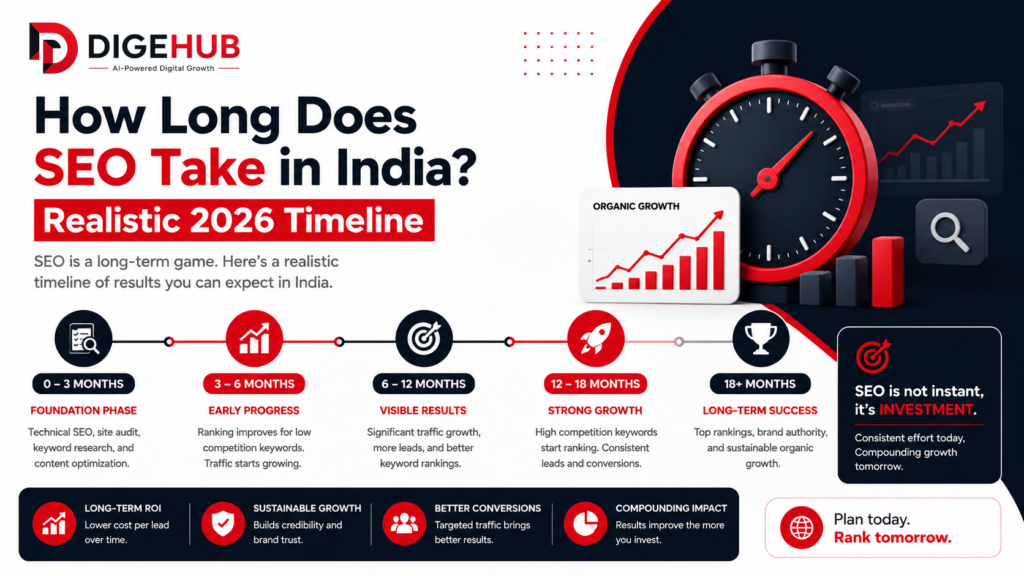
Realistically, most websites begin seeing meaningful ranking improvements within 3–6 months of consistent, well-executed SEO work. Competitive keywords in established industries can take 9–18 months. Local SEO for less competitive terms can show movement in 4–8 weeks. SEO is a compound investment — the longer you run it, the more the returns accelerate.
Can I do SEO myself?
Yes, especially for lower-competition markets and simpler websites. Most on-page SEO, content optimization, technical fixes, and basic link outreach can be self-managed with the right tools and a learning commitment. That said, competitive industries, enterprise-scale sites, and AI visibility optimization benefit significantly from professional expertise.
How do I do SEO on WordPress?
WordPress is one of the most SEO-friendly CMS platforms available. Key steps: install a reputable SEO plugin (Yoast SEO or Rank Math), set correct permalink structure (/post-name/), submit your XML sitemap to Google Search Console, use a fast theme and caching plugin for performance, and implement the core on-page and technical practices covered in this guide.
How do backlinks help SEO?
Backlinks signal to Google that other websites trust and value your content. Each quality backlink acts as a vote of confidence, increasing your domain’s perceived authority. This authority is distributed across your site and helps individual pages rank for competitive queries. Without backlinks, even the best content often struggles to outrank competitors in medium-to-high competition niches.
What is the difference between SEO and SEM?
SEO (Search Engine Optimization) refers to earning organic, non-paid search rankings through content quality, technical health, and authority signals. SEM (Search Engine Marketing) typically refers to paid search advertising, primarily Google Ads. They’re complementary: SEM provides immediate, controllable traffic; SEO provides compounding, lower-cost-per-click traffic over time.
How do I find the best keywords for my website?
Start with your business offerings and map them to the language your customers use. Use tools like Semrush Keyword Magic, Google Search Console, and AnswerThePublic to expand your list. Prioritize by search volume, difficulty, and business relevance. Focus on long-tail variations first if your domain is new.
How does SEO work on Google specifically?
Google uses a multi-stage process: crawling (discovering pages via links and sitemaps), indexing (storing and categorizing page content), and ranking (scoring indexed pages against hundreds of factors to determine position for each query). Key ranking factors include content relevance and quality, page experience (speed, mobile-friendliness, Core Web Vitals), backlink authority, user engagement signals, and increasingly, entity recognition and structured data.
What’s the best way to improve my SEO quickly?
The fastest legitimate wins typically come from: fixing technical errors that block crawling or indexing, optimizing existing pages that rank between positions 5–20 (better titles, updated content, added internal links), claiming and completing your Google Business Profile for local searches, and building even a small number of quality backlinks from relevant sources. Quick wins exist — but “quick” in SEO still usually means weeks, not hours.
The Bottom Line: SEO That Compounds
SEO in 2026 is not a simple checklist you complete once. It’s a strategic discipline that rewards consistency, expertise, and genuine value creation. The businesses that win in organic search — and increasingly in AI citations — are the ones that treat SEO as a long-term brand asset, not a shortcut.
The path is clear: research your keywords with intent, build technically sound pages, create content that demonstrates real expertise, earn quality backlinks through genuine value, optimize for local where relevant, and now — critically — build your AI visibility so you’re present not just on Google, but wherever your future customers are searching.
If you’re a business that’s ready to take SEO seriously — whether you’re in the USA, UK, Canada, or Australia — the strategy is the same. Execute the fundamentals at a high level, stay consistent, and the compounding returns are real.
Ready to Build an SEO Strategy That Actually Delivers?
Most businesses don’t fail at SEO because the concept is too complex. They fail because they’re trying to execute it without a clear system, the right tools, or experienced guidance.
At Digehub, we build SEO programs that are tied directly to business outcomes — not vanity metrics. We combine traditional SEO with AI Visibility optimization, ensuring our clients rank in both Google and the AI-generated answers that are reshaping how people discover businesses.
→ Explore Digehub’s SEO Services
If AI-generated visibility is your priority, our dedicated practice covers exactly this:
→ Digehub AI Visibility Services
Or if you’re looking for a content program that fuels long-term organic growth:
→ Digehub Content Marketing Services
We work with global businesses — from early-stage SaaS companies to established agencies and enterprise brands. If you’re serious about organic growth in 2026, let’s talk about what that looks like for you.