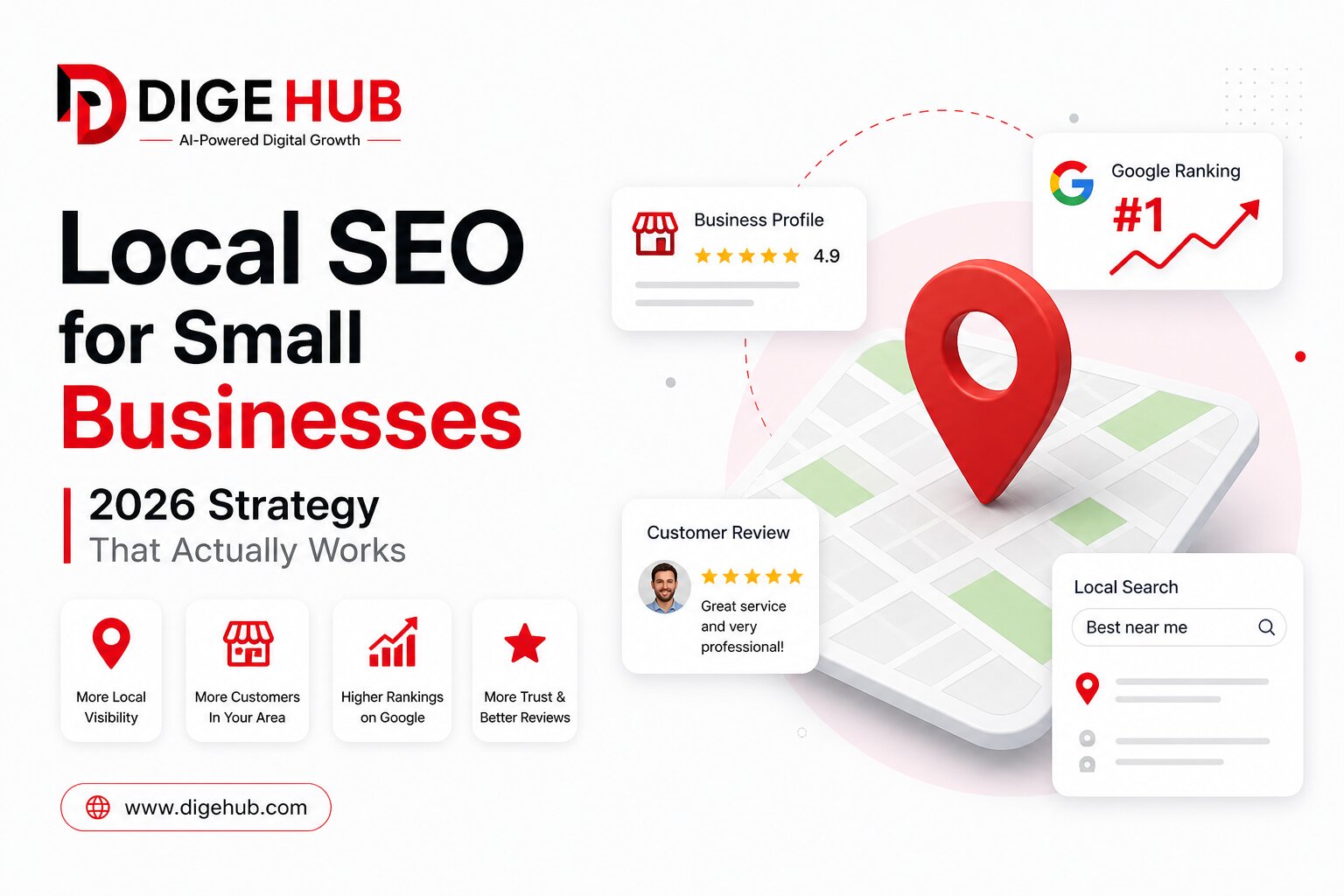
Local SEO for Small Businesses in 2026: The Complete Guide to Getting Found in Your City (Before Your Competitor Does)
Ravi runs a dental clinic in Anna Nagar, Chennai. He’s been in practice for 11 years. He has happy patients, solid reviews, and a good reputation in his neighbourhood. But when someone in Kilpauk types “dentist near me” on Google, Ravi’s clinic doesn’t show up — his competitor three lanes away does.
The competitor? Open for just 14 months. Smaller setup. But they did one thing right: they invested in Local SEO.
This isn’t a Chennai-only story. It plays out every single day in Bengaluru’s Koramangala, Mumbai’s Andheri, Delhi’s Lajpat Nagar, and thousands of smaller towns across India. Small businesses with real value — restaurants, clinics, gyms, boutiques, tutors, salons — are getting pushed to page 2 and beyond, simply because they haven’t told Google where they are and what they do.
In 2026, the stakes have gone up significantly. Google’s local algorithm has evolved. AI search engines like ChatGPT, Gemini, and Perplexity are now answering questions like “best CA firm in Bangalore” and “affordable physiotherapist in South Mumbai.” If you’re not optimized for local search, you’re invisible to the very people walking distance from your door.
This guide will change that.
- What Is Local SEO for Small Businesses?
- 1. Why Local SEO Matters More Than Ever in 2026
- 2. How Google's Local Search Algorithm Works
- 3. Google Business Profile: Your Most Important Local SEO Asset
- 4. On-Page SEO for Local Businesses
- 5. Local Citations and Directory Listings
- 6. Reviews: The Currency of Local Trust
- 7. Local Link Building That Actually Works in India
- 8. Local SEO for AI Search Engines (GEO + AEO + LLMO)
- 9. Local SEO Strategy by Business Type
- 10. Common Local SEO Mistakes Indian Businesses Make
- 11. Expert Tips for 2026
- 12. Frequently Asked Questions
- 13. Final Thoughts + Your Next Step
What Is Local SEO for Small Businesses?
Local SEO (Local Search Engine Optimization) is the process of optimizing your online presence so that your business appears in location-based search results — like Google Maps, “near me” searches, and city-specific queries. For small businesses in India, it’s the most cost-effective way to attract high-intent customers who are actively looking for your product or service nearby.
1. Why Local SEO Matters More Than Ever in 2026
Let’s talk numbers that actually mean something to a business owner in India.
- 46% of all Google searches have local intent — people looking for something nearby
- “Near me” searches have grown over 200% in the last three years in India alone
- 76% of people who search for something nearby on their phone visit a business within 24 hours
- 28% of those local searches result in a purchase
Now layer on this: with the rise of AI-powered search (Google SGE, ChatGPT with Bing, Gemini), local recommendations are increasingly being pulled from structured, well-optimized business data. If your Google Business Profile is incomplete or your website has no local signals, AI engines will simply not recommend you — even if you’re the best option in your area.
For small businesses in cities like Chennai, Bangalore, Mumbai, and Delhi, where competition is intense and consumer attention spans are shrinking, local SEO isn’t optional. It’s survival strategy.
2. How Google’s Local Search Algorithm Works
Before you can play the game, you need to understand the rules.
Google ranks local businesses based on three core factors:
Relevance
Does your business match what the user is searching for? This is determined by your Google Business Profile category, your website content, keywords, and the services you’ve listed.
Distance
How far is your business from the searcher (or the location they specified)? Google uses the searcher’s real-time location when calculating this.
Prominence
How well-known and trusted is your business online? This includes your reviews, backlinks, mentions on other sites, and the overall authority of your web presence.
Here’s what most business owners miss: you can’t control distance, but you absolutely can control relevance and prominence. And those two factors carry enormous weight.
In 2026, Google has added new signals to its local ranking algorithm:
- User engagement with your listing (clicks, calls, direction requests)
- Photo freshness and quantity
- Response time to reviews
- Social signals from platforms like Instagram and Facebook
- Structured data / schema markup on your website
- AI-indexed content from your site being referenced in AI answers
3. Google Business Profile: Your Most Important Local SEO Asset
If there’s only one thing you do after reading this guide, make it this: optimize your Google Business Profile (GBP) completely.
It is the single highest-impact, zero-cost action available to any local business in India.
Step-by-Step GBP Optimization
Step 1: Claim and Verify Your Profile Go to google.com/business and claim your listing. If your business is already on Google, claim it. If not, create it. Verification is usually done via postcard or phone call.
Step 2: Fill Every Section — Every Single One Most business owners fill 60–70% and stop. That’s a mistake. Complete:
- Business name (exactly as it appears on your signboard — no keyword stuffing)
- Primary and secondary categories
- Full address with landmark (extremely helpful in Indian cities)
- Local phone number (not a toll-free number)
- Business hours, including holidays
- Website URL
- Business description (750 characters — use them wisely with natural keywords)
Step 3: Add High-Quality Photos Businesses with 10+ photos get 42% more direction requests and 35% more website clicks than those with fewer. Add:
- Exterior shots (helps people recognize you)
- Interior shots
- Team/staff photos
- Product or service photos
- Before/after (for salons, clinics, construction businesses)
Update your photos every 2–3 months to signal activity.
Step 4: Use Google Posts Google Posts are mini blog posts that appear directly on your profile. Post weekly:
- Offers and promotions
- Events
- New product launches
- Informational tips
Step 5: Enable Messaging and Q&A Turn on messaging so customers can WhatsApp or message you directly from the listing. Monitor the Q&A section — answer every question, and proactively add your own common questions with answers.
Step 6: Add Products and Services If you’re a local shop or service provider, adding your products/services with names, descriptions, and prices dramatically improves relevance.
4. On-Page SEO for Local Businesses
Your website needs to speak Google’s local language. Here’s what that means practically.
Create Location-Specific Landing Pages
If you serve multiple areas, create a dedicated page for each. For example:
/services/dental-clinic-anna-nagar//services/dental-clinic-t-nagar//services/dental-clinic-velachery/
Each page should have:
- Unique title tag:
[Service] in [Location] | [Business Name] - Local keyword in the H1 heading
- A Google Maps embed of your location
- Area-specific content (mention nearby landmarks, areas you serve)
- Customer testimonials from that area
Optimize Title Tags and Meta Descriptions
Stop writing generic titles. Instead of “Welcome to Our Clinic,” try: “Best Dental Clinic in Anna Nagar, Chennai | Expert Energywave Dental Care”
Your meta description should answer what you do, where you are, and what makes you different — in under 160 characters.
Add LocalBusiness Schema Markup
Schema markup is code that tells Google (and AI search engines) structured facts about your business. It’s one of the most underused tools by Indian businesses.
Here’s a simplified example:
{
  "@context": "https://schema.org",
  "@type": "LocalBusiness",
  "name": "Your Business Name",
  "address": {
    "@type": "PostalAddress",
    "streetAddress": "123, Anna Salai",
    "addressLocality": "Chennai",
    "addressRegion": "Tamil Nadu",
    "postalCode": "600002",
    "addressCountry": "IN"
  },
  "telephone": "+91-XXXXXXXXXX",
  "openingHours": "Mo-Sa 09:00-18:00",
  "url": "https://yourbusiness.com"
}
This schema helps your business appear in AI-generated answers and Google’s Knowledge Panel — extremely valuable in 2026.
Embed Google Maps on Your Contact Page
Simple but often missed. Embedding your exact location on your Contact Us page reinforces your local presence to Google’s crawlers.
5. Local Citations and Directory Listings
A local citation is any online mention of your business name, address, and phone number (collectively called NAP). Citations help Google verify that your business is legitimate and located where you claim.
Where to List Your Business in India
Priority Tier 1 (Must-Have):
- Google Business Profile
- Justdial
- Sulekha
- IndiaMart (for B2B)
- Bing Places
- Apple Maps
Priority Tier 2 (Highly Recommended):
- Practo (for clinics and healthcare)
- MagicBricks / 99acres (for real estate)
- Zomato / Swiggy (for food businesses)
- UrbanClap / Urban Company (for service professionals)
- Yellow Pages India
- TradeIndia
Priority Tier 3 (For Authority Building):
- Facebook Business Page
- LinkedIn Company Page
- Instagram Business Profile (yes, Google indexes this)
The NAP Consistency Rule
This is critical and commonly violated: your business name, address, and phone number must be identical across every platform. Even minor variations — “St.” vs “Street,” “No.” vs “#” — can dilute your local authority.
Run a quarterly citation audit. Correct inconsistencies the moment you find them.
6. Reviews: The Currency of Local Trust
Imagine two restaurants side by side. One has 14 reviews averaging 3.2 stars. The other has 112 reviews averaging 4.7 stars. Which one would you walk into?
Your customers think the same way. And so does Google.
Reviews are the #1 social proof signal for local businesses, and in 2026, they also feed directly into AI-generated recommendations.
How to Get More Google Reviews (the Right Way)
Ask at the Right Moment: The best time to ask for a review is immediately after a positive experience — when the customer is happy, engaged, and still on-site or on-call.
Make It Easy: Create a short Google review link using Google’s review link generator and share it via WhatsApp, SMS, or email. Don’t make customers hunt for your profile.
Train Your Team: If you have staff interacting with customers, train them to mention reviews casually: “If you’re happy with the service, a quick Google review would mean a lot to us.”
Respond to Every Review — Positive and Negative: Responding to reviews signals professionalism and activity to Google. When replying to negative reviews, stay calm, be empathetic, and offer a resolution. Never get defensive publicly.
What NOT to Do
- Never buy fake reviews — Google’s algorithm detects patterns and can penalize or delist your profile
- Don’t offer incentives in exchange for reviews (violates Google’s policies)
- Don’t ask friends and family who haven’t actually used your service
7. Local Link Building That Actually Works in India
Backlinks from other local websites tell Google that your business is trusted within your community. Here’s how to get them without hiring expensive link-building agencies.
Partner with Local Businesses: If you’re a gym, partner with a nutritionist nearby. If you’re a dental clinic, partner with a pharmacy. Swap mentions on each other’s websites or write a joint blog post.
Sponsor Local Events: Sponsor a college fest, a local sports event, or a charity run. Event websites almost always mention sponsors with links.
Get Featured in Local Media: Reach out to local journalists or bloggers who cover your city’s business scene. Offer insights or a story. Press coverage = authoritative backlinks.
Submit to Local Business Associations: The Chennai Chamber of Commerce, NASSCOM (for tech businesses), or your city’s industry association often have member directories with links.
Write for Local Blogs: Offer to write guest posts for popular city blogs or news portals. Topics like “5 Things to Know Before Visiting a Dermatologist in Bangalore” can earn you a local link while building topical authority.
8. Local SEO for AI Search Engines (GEO + AEO + LLMO)
This is where 2026 changes everything.
When someone asks ChatGPT “best physiotherapist in South Delhi” or tells Gemini “find me a reliable electrician in Andheri,” these AI engines pull answers from structured, well-indexed content across the web. Your Google Business Profile, your website content, and your review volume all feed into these recommendations.
This is called Generative Engine Optimization (GEO), Answer Engine Optimization (AEO), and LLMO (Large Language Model Optimization) — three emerging disciplines that complement traditional SEO.
What You Need to Do for AI Visibility
Structure your content clearly: AI engines prefer content that directly answers questions. Use clear headings, bullet points, and short paragraphs. Write FAQ sections with complete, direct answers.
Use natural language in your website copy: Don’t just write for keywords. Write how your customers speak. “How much does a root canal cost in Chennai?” is more likely to be picked up by AI than “root canal cost Chennai.”
Get mentioned in authoritative sources: AI engines are trained on high-authority content. If your business is mentioned in news articles, industry directories, or government portals, you have a higher chance of being recommended.
Maintain consistent NAP data across the web: AI engines cross-reference data from multiple sources. Consistency builds confidence in your business’s legitimacy.
Publish locally-relevant, helpful content on your website: A dental clinic that publishes “How to Choose the Right Dentist in Anna Nagar” will likely get recommended by AI for that query — because the content directly addresses it.
If navigating AI search optimization feels complex, working with a team that specializes in AI Visibility Services can help you get ahead of this curve before your competitors even realize it exists.
9. Local SEO Strategy by Business Type
For Healthcare (Clinics, Dentists, Physiotherapists)
- Use the
MedicalBusinessschema type - Get listed on Practo and Google Health
- Feature patient testimonials (without violating privacy)
- Create content around common health questions in your city
- Ensure your website is mobile-first and fast-loading
For Restaurants and Food Businesses
- Optimize on Zomato AND Google
- Keep menu information updated on GBP
- Encourage photo reviews (food photos on Google get massive engagement)
- Use
Restaurantschema with menu links - Post on Instagram regularly — Google crawls social profiles
For Professional Services (CA Firms, Lawyers, Consultants)
- Create a “Services” page for each specific offering
- Write local authority content: “GST Filing Process for Small Businesses in Chennai”
- Get listed on professional directories (ICAI for CAs, Bar Council for lawyers)
- Collect LinkedIn recommendations in addition to Google reviews
For Retail Shops and Boutiques
- Upload product photos to Google Business Profile regularly
- Enable “In-store availability” through Google Merchant Center if possible
- Optimize for voice search queries like “cotton saree shops near me”
- Run location-targeted Google Ads campaigns for high-intent keywords
For Educational Institutes and Tutors
- Optimize for queries like “NEET coaching centres in Velachery” or “IELTS classes Koramangala”
- Add course details, fee structure, and faculty info to your website
- List on Sulekha, UrbanPro, and Shiksha
- Video testimonials from students perform extremely well in local search
10. Common Local SEO Mistakes Indian Businesses Make
These mistakes are costing real businesses real customers, every single day.
1. Incomplete or Unverified Google Business Profile Nearly 40% of Indian small businesses either haven’t claimed their GBP or have left it 50% incomplete. This is like having a shop with no signboard.
2. Using a Shared or Virtual Address If five businesses share the same address on Google, your local signals are diluted. Google may suppress your listing or flag it as suspicious.
3. Inconsistent NAP Across Platforms Your phone number is different on Justdial and your website. Your address is formatted differently on Google and Facebook. These mismatches confuse Google’s local algorithm.
4. Ignoring Mobile Experience Over 80% of local searches in India happen on mobile. If your website takes 5 seconds to load or requires pinching and zooming, visitors leave — and Google notices.
5. Not Responding to Negative Reviews Ignoring a 1-star review is worse than getting it. Businesses that respond thoughtfully to negative reviews actually improve their perceived trustworthiness.
6. No Localized Content on the Website Your website says “We serve all of Chennai” but has no specific content for any neighborhood. That’s missed opportunity. Hyper-local pages rank faster and drive more targeted traffic.
7. Buying Fake Reviews or Backlinks Tempting but dangerous. Google’s Spam Brain algorithm is sophisticated and getting smarter. Fake reviews can get your entire profile suspended.
8. Posting Once and Forgetting Local SEO is not a set-it-and-forget-it strategy. Google rewards active, updated profiles. Regular posts, fresh photos, and new reviews signal a healthy, active business.
11. Expert Tips for 2026
After working with dozens of local businesses across India, here are the insights that consistently move the needle:
Tip 1: Geo-Tag Your Business Photos When uploading photos to your Google Business Profile or website, embed geo-location metadata (EXIF data) into the images. Some SEO tools allow you to do this. It strengthens your location relevance signal.
Tip 2: Build a Local FAQ Strategy Think of every question a customer walking into your shop might ask. Write a dedicated FAQ page on your website with these answers. This feeds both traditional search results (featured snippets) and AI search engines.
Tip 3: Use WhatsApp Business Strategically India runs on WhatsApp. Link your Google Business Profile to your WhatsApp Business account. This not only increases contact conversions but also signals that your business is active and accessible.
Tip 4: Target “Near Me” + Intent Keywords Move beyond basic location keywords. “Best AC repair near me in Chennai” has different intent than “AC repair service Chennai.” Map your content to different stages of the buyer’s journey — awareness, consideration, and decision.
Tip 5: Monthly GBP Insights Review Google Business Profile has a built-in analytics dashboard. Every month, check:
- How many people searched for your business
- What search terms triggered your listing
- How many called you vs. visited your website
- Which photos got the most views
Use this data to improve your strategy month over month.
Tip 6: Competitor Reverse-Engineering Search for your own service in your city. Who’s showing up in the top 3? Go through their GBP, website, reviews, and citations. Identify what they’re doing that you’re not. Then do it better.
Tip 7: Hyperlocal Content Is a Long-Term Moat A competing business can copy your Google Ads budget, but they cannot easily copy 50 pages of high-quality, hyperlocal content that took you a year to build. Content is a durable competitive advantage.
If you’re unsure where to start with content strategy, a well-planned Content Marketing approach tailored to your local market can make a significant difference in your organic growth trajectory.
12. Frequently Asked Questions
Q1: How long does Local SEO take to show results? For most small businesses starting from scratch, expect to see meaningful improvements in 3–4 months for Google Business Profile rankings, and 4–8 months for website-level local rankings. Factors like competition level, domain age, and consistency of effort affect the timeline.
Q2: Is Local SEO free? The foundational elements — Google Business Profile, citations on free directories, generating reviews — cost nothing except your time. However, hiring an experienced local SEO company or agency will accelerate your results significantly, especially in competitive markets like Chennai, Bangalore, and Mumbai.
Q3: Can I do Local SEO myself if I’m a small business owner? Absolutely. The Google Business Profile optimization, NAP consistency, and review generation steps in this guide can be done by any business owner. The more technical aspects — on-page SEO, schema markup, local link building — benefit from professional support.
Q4: How is Local SEO different from regular SEO? Regular (national/global) SEO focuses on ranking for broad keywords regardless of location. Local SEO focuses specifically on ranking in location-based searches — Google Maps, “near me” queries, and city-specific searches. The strategies, signals, and tools are somewhat different, though they complement each other.
Q5: Do I need a website for Local SEO? You can rank on Google Maps without a website using just your GBP. However, a website dramatically increases your ability to rank for more keywords, build authority, and convert visitors. For serious local growth, a website is strongly recommended.
Q6: Does social media affect Local SEO? Indirectly, yes. Google doesn’t directly use social media signals as ranking factors, but active social media profiles increase your brand’s overall online presence and mention volume, which can influence local prominence. Also, Instagram and Facebook business profiles appear in search results.
Q7: What’s the difference between Local SEO and Google Ads for local businesses? Google Ads (PPC) gets you immediate visibility but stops the moment you stop paying. Local SEO builds organic visibility over time — it’s slower to start but provides compounding returns and doesn’t require ongoing ad spend to maintain rankings.
Q8: How does Voice Search affect Local SEO in India? Voice search (using Google Assistant, Alexa, or Siri) almost always has local intent. Queries are longer and more conversational — “where can I find a good CA near me in Koramangala?” Optimizing for natural-language questions, structuring FAQ content, and maintaining a complete GBP all help capture voice search traffic.
13. Final Thoughts + Your Next Step
Local SEO in 2026 is not the same beast it was in 2020 or even 2023. Between Google’s increasingly sophisticated local algorithm, the rise of AI-powered search, and India’s growing population of mobile-first consumers, the opportunity — and the competition — has never been greater.
The businesses that will win the local search game in India over the next three years will be those that:
- Show up completely — an optimized, verified, active Google Business Profile with photos, posts, and reviews
- Own their local web presence — a fast, mobile-optimized website with localized content and proper schema markup
- Build trust consistently — collecting genuine reviews, responding to every one, and building local authority through citations and links
- Stay ahead on AI search — structuring content in ways that AI engines can pull and recommend
This isn’t about having the biggest budget. Many of the best-ranking local businesses in Indian cities are small, owner-operated setups that simply got their fundamentals right before the others.
If you’ve read this far, you clearly care about growing your business through local search. The question is just how quickly you want to move.
Ready to dominate local search in your city?
At Digehub, we work with small businesses and local companies across India — helping them build local SEO systems that generate consistent leads month after month, without burning money on ads that stop the moment you pause them.
Whether you’re in Chennai, Bangalore, Mumbai, or Delhi, we understand the local competitive landscape and know what it takes to rank.
👉 Explore our SEO Services → 👉 Work with a Digital Marketing Agency in Chennai → 👉 Digital Marketing Agency in Bangalore → 👉 Digital Marketing Agency in Mumbai → 👉 Digital Marketing Agency in Delhi →
Have a question about your specific local SEO situation? Drop us a message — we’re happy to take a look.
Also worth reading:
- What Is SEO and Why Does Every Indian Business Need It in 2026?
- GEO vs SEO: How Generative Engine Optimization Is Changing the Rules
- Google Business Profile Optimization: The Complete 2026 Checklist for Indian Businesses
- How to Get More Customers Online Without Spending on Ads
Published by Digehub — An AI-Powered Digital Growth Platform based in Chennai, India. We help businesses grow through SEO, content, AI visibility, and performance marketing.