
SEO for Exporters and Logistics Companies in Chennai: Reach Global Buyers
A procurement manager in Europe, the Gulf or the US who needs a supplier or a freight partner in India rarely starts with a phone call. They search, shortlist, read, and check whether you look like a company that ships on time. Many Chennai exporters and logistics firms have a website that tells that buyer very little. This guide shows what to put on it and how to be found.
Chennai has the supply, but buyers cannot see it
Tamil Nadu is one of India’s strongest export states. A DT Next report on the Export Preparedness Index 2024, updated in January 2026, says the state ranks second after Maharashtra. It cites engineering goods exports of about Rs1.4 lakh crore in 2023-24, a 35 per cent share of India’s auto component exports, and a rapid rise in electronics, which it says now gives the state around a third of the country’s electronics exports. Wikipedia’s entry on Chennai likewise describes the city as a major centre for auto components and leather. The numbers are approximate and from news and reference summaries, but the picture is clear: the capability is here.
What is often missing is the way that capability appears online. Many suppliers have a brochure site with a few photos, a generic “about us” and a contact form. A buyer comparing five suppliers from five countries will quickly pick the one that shows more evidence. This is the opportunity, and it is why export SEO is as much about content and trust as it is about rankings. Our B2B manufacturing SEO guide covers the foundations, and our SEO agency in Chennai page explains how we work.
How overseas buyers search and vet suppliers
Industrial buyers search in specific, practical terms. They also use more than Google: trade directories, LinkedIn, trade fairs and referrals all contribute, and your website is the place they verify what they found elsewhere. Typical search patterns include:
| Buyer | Example search patterns | What they check |
|---|---|---|
| Importer of manufactured goods | “auto component manufacturer India”, “stainless steel fasteners supplier India”, “leather exporters Chennai” | Products, standards, capacity, certifications, samples |
| Sourcing agent or trading company | “OEM supplier South India”, “contract manufacturer Chennai” | Process, quality control, lead time, MOQ |
| Shipper looking for a forwarder | “freight forwarder Chennai”, “customs clearance Chennai port”, “LCL shipment from Chennai” | Services, lanes, licences, tracking, support |
| Domestic exporter | “export documentation help Chennai”, “air freight to Dubai from Chennai” | Experience, response time, pricing approach |
These are patterns to verify in your own Search Console and enquiry history, not quoted volumes. For Google Keyword Planner (India, 5 November 2026), terms such as “seo for manufacturers” appear in the 100 to 1,000 range, but buyers use hundreds of long, specific phrases that tools do not capture well. Your sales team’s email history is a better keyword source than any tool.
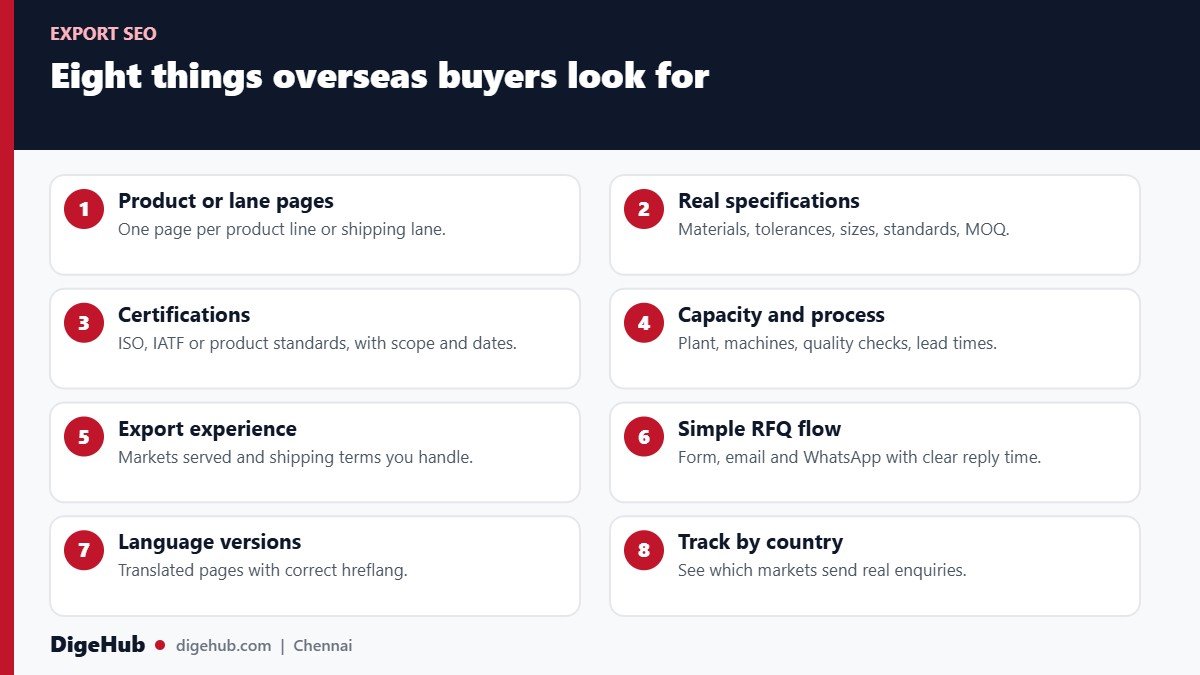
The pages that win a shortlist place
- Product line or lane pages. One for each product family or shipping lane. Title them the way buyers search (“Forged Steel Components Manufacturer in Chennai, India”), then deliver on it.
- Specifications and downloads. Materials, grades, dimensions, tolerances, standards, packaging and sample datasheets. Offer PDFs, but also put the key facts in the page text so they can be read and found.
- Capability and capacity. Plant size, machines, shifts, monthly capacity, in-house testing, and how orders flow from enquiry to dispatch.
- Quality and certifications. Name each certification, scope, issuing body and validity, and show the certificate. Never display one you do not hold.
- Export experience. Markets served, shipping terms (Incoterms) you work with, ports used, packing and documentation you handle. Customer names only with permission.
- Factory and team. Real photographs, leadership profiles and the address. Many buyers look for evidence that the company exists and operates.
- RFQ and contact. A short form that asks for product, quantity, destination and timeline, plus email and WhatsApp, with a stated reply time.
For logistics companies the equivalent is service pages by mode and lane (sea FCL and LCL, air freight, customs clearance, warehousing), with licences, network, tracking, transit time ranges and a quote request. Our on-page SEO checklist covers titles, headings and internal links.
Proof beats adjectives
“World-class quality” and “reliable partner” are on every supplier’s site and mean nothing. Replace them with facts a buyer can check:
- A line such as “delivered 40 container loads to the Gulf in the last financial year” (an illustrative example) is useful only if it is true and you can back it up. If you cannot share numbers, share the process: “every lot is inspected against the buyer’s drawing, with a report attached to the shipment.”
- Case-style write-ups with a real brief, how you solved it, and the outcome, with the client’s permission. If you cannot name the client, describe the industry and region.
- Test reports, inspection checklists and packaging photos.
- Names and photos of the people a buyer will deal with.
- Transparent terms: MOQ, typical lead time, payment terms you accept, sample policy.
Be honest about what you do not do. A supplier that says “we do not take orders below 500 pieces” sounds more credible than one that promises everything.
Language versions and international set-up
Most buyers will read English, but some markets respond better to their own language. If you add language versions, Google’s documentation says to use hreflang annotations, placed in HTML link tags, HTTP headers or an XML sitemap, with every version pointing to itself and to all the others. If page A links to page B, page B must link back, or the tags are ignored. An x-default entry can serve as a fallback. We cover the details in medical tourism SEO in Chennai, where the same principles apply.
Other technical points matter for an overseas audience:
- Speed from abroad. A site hosted on a slow server in India may load slowly in Europe or the US. Use a content delivery network and optimise images and scripts.
- Crawlable catalogues. If products appear only after a script runs or behind a login, search engines may not see them.
- Structured data. Organization and product markup should match visible content.
- Currency and units. Show metric and imperial units where relevant, and state clearly whether prices are FOB, CIF or ex-works.
An SEO audit will test speed, indexing and structure from a buyer’s perspective.
Local signals still matter
It surprises some exporters, but local presence supports trust. A verified Google Business Profile for your factory or office, with the correct address, phone, hours and photos, tells a buyer that the company is real. Google’s guidelines require the address to be a real place you operate from. Add clear, accurate categories, and keep the name exactly as on your signage. A logistics company with a customs office near the port or a warehouse can add each as a separate location if staff are present there. See our Business Profile guide.
Also check the other places where buyers verify you: LinkedIn company page, trade directories, and any export council listings. Make sure the name, address and descriptions match your website.
Enquiry handling is part of the SEO
A search that brings an RFQ is wasted if no one answers it for three days. For export enquiries, set a few simple standards:
- Reply within one business day, and acknowledge within hours. Cover time zones where your main buyers are.
- Ask for what you need in the first reply: quantity, specifications, destination, timeline.
- Filter fake or irrelevant enquiries politely. Many B2B sites receive spam and sales pitches, so a short qualifying form with relevant fields helps.
- Keep a log of each enquiry with source, country, product, status and outcome.
- Follow up after sending a quote. Many orders are lost in silence.
Handle buyer data carefully. India’s Digital Personal Data Protection Rules were notified on 13 November 2025, with obligations phasing in over time, and buyers in some markets will have their own expectations on privacy.
Mistakes we see on exporter websites
- A catalogue as a PDF only. Search engines read PDFs poorly compared with web pages, and buyers on phones struggle with them.
- One page for “Products”. It cannot rank for specific items or answer specific questions.
- Stock photos of factories. Buyers notice immediately.
- No physical address or named people. It looks like a trading intermediary, or worse.
- Keyword stuffing with a list of cities and countries. It reads as spam and can hurt trust.
- Relying entirely on marketplaces. Directories bring volume but give the marketplace control of the relationship. Use them, but also build your own presence.
- Not tracking enquiries by country. Without that, you cannot tell which markets are worth more investment.
Beyond Google: LinkedIn, directories and referrals
B2B discovery is not only search. Treat the other channels as part of the same system, because buyers move between them and your website is where they check.
- LinkedIn. Keep the company page complete and consistent with your site. Share real updates such as new capabilities, trade fair participation and shipments with permission. Individual leaders posting useful, specific knowledge often earn more attention than the company page.
- Trade directories and marketplaces. They can bring enquiries, and listings also act as references. Keep the company description, address and product names identical to your website.
- Trade fairs and export councils. A buyer who met you at a fair will search your name afterwards. Make sure the brand name search leads to a strong homepage and an easy contact path.
- Industry content. Guides on subjects your buyers care about, such as how to specify a part, how to choose a shipping mode, or what documents a shipment needs, earn links and attention from the right people.
Write these guides from actual experience. A buyer reading “how we inspect fasteners before shipment” from a plant manager learns more about you than from any slogan.
Measuring what matters in B2B export SEO
Traffic numbers mislead in B2B. A hundred visits from the right buyers outweigh ten thousand from the wrong ones. Measure:
- Qualified RFQs per month, defined by product, quantity and destination fit.
- Enquiries by country, from analytics and your own log.
- Which pages assist enquiries, such as product and capability pages viewed before the form.
- Branded search growth, as a sign that buyers are looking for you after seeing you elsewhere.
- Time to first reply and quote. Operational speed influences conversion more than most rankings.
- Orders by source, reviewed quarterly, because deals take time.
Review monthly, but judge results over quarters. Long sales cycles mean the enquiry you receive this month may come from a page published six months ago.
A 90-day plan and what it costs
| Period | Work |
|---|---|
| Days 1 to 30 | Audit speed, indexing and structure. Review the last year of enquiries to find the products, markets and phrases that already work. Set up enquiry tracking by country. |
| Days 31 to 60 | Build pages for the top three product lines or lanes, with specifications, proof and an RFQ flow. Add capability and certification pages with real documents. |
| Days 61 to 90 | Review Search Console and enquiries. Add language versions for the priority market with correct hreflang. Expand to the next product line. |
A single-product exporter or a small forwarder may fit our Local SEO Starter plan (Rs40,000 to Rs60,000 a month). Manufacturers with several product lines and international targeting often need Growth SEO (Rs65,000 to Rs1.2 lakh). Plans are month-to-month with no lock-in, and we start with a free audit. Send your website on WhatsApp and we reply within two business hours. B2B buying cycles are long, and nobody can honestly guarantee a ranking or a date for the first order. What we can do is make sure your site stands up to the scrutiny a serious buyer applies.
Frequently asked questions
Do exporters really get customers from Google?
Should we use marketplaces like IndiaMART or Alibaba as well?
How many pages should an export website have?
Do we need a multilingual site?
Can logistics companies rank for “freight forwarder Chennai”?
How long does export SEO take?
Sources and further reading
- DT Next: What drives Tamil Nadu’s exports, Export Preparedness Index report (updated 17 January 2026)
- Wikipedia: Chennai
- Google Search Central: Tell Google about localized versions of your page
- Google Search Central: Managing multi-regional and multilingual sites
- Google Business Profile Help: Guidelines for representing your business
- Ahrefs: How long does it take to rank
- Google Keyword Planner (India, English), checked 5 November 2026
Want this done for your Chennai business?
Tell us what you sell and where your customers are. We will send a straight answer on what is worth doing first, with no lock-in contract.
- Free audit of your site, Google Business Profile and AI answers
- Reply within 2 business hours on WhatsApp
- Month-to-month plans from ₹40,000

