
Medical Tourism SEO in Chennai: Reach International Patients Honestly
Chennai is one of India’s best known destinations for patients travelling from abroad, and the competition for those patients is global. A family in Dhaka, Muscat or Baghdad is choosing between countries, then cities, then hospitals, often from a phone and often through a facilitator. This guide explains how Chennai hospitals can be found and trusted at each step, without exaggeration.
The market in numbers, and what they do not tell you
India’s Parliament was told in August 2025 that about 1.32 lakh (131,856) foreign tourists arrived for medical purposes between January and April 2025, roughly 4.1 per cent of all foreign tourist arrivals in that period. The same reply put medical arrivals at 6.5 lakh in 2023 and 6.4 lakh in 2024, against 1.8 lakh in 2020. The most common source countries listed were Bangladesh, Iraq, Somalia, Oman and Uzbekistan (as reported by Punjab Kesari from the minister’s written reply).
Chennai’s place in this is well established. Wikipedia’s summary of the city notes that Chennai receives over 40 per cent of the medical tourists who come to India, although the figure is dated and you should treat it as indicative and not exact. What the national numbers do not give you is the number of patients choosing your hospital, or why. That is the job of your own data: which countries your enquiries come from, in which languages, for which treatments, and how many convert.
The lesson for SEO is to be specific. A hospital page that says “world class care for international patients” competes with hundreds of identical ones. A page that explains how a Bangladeshi family can plan a cardiac procedure in Chennai, step by step, competes with almost none. Our general approach to hospitals is in hospital SEO in Chennai, and the wider plan is on our SEO agency in Chennai page.
How an international patient actually decides
The journey is longer and involves more people than a local one. Understand it before writing a page:
- Condition and treatment research. Searches like “knee replacement abroad cost” or “heart surgery in India”. Many start with the treatment, not the hospital.
- Country comparison. India against Turkey, Thailand, Malaysia, Singapore or home options.
- City and hospital shortlist. “Best hospital in Chennai for kidney transplant”, often discovered through forums, friends, a local doctor or a facilitator.
- Verification. Doctor credentials, accreditation, reviews, and how other patients from their country fared.
- First contact. Usually WhatsApp or email with medical reports attached, asking for an opinion and estimate.
- Planning. Visa, flights, accommodation, interpreters, payment, and a plan for follow-up after returning home.
Your website supports steps 1 to 5 and sets up step 6. Many hospitals invest only in the final step, the international desk, while the earlier steps happen on pages that are thin or missing. Facilitators and agents also play a major role, so include a clear section for them with how you work and how to reach your desk.
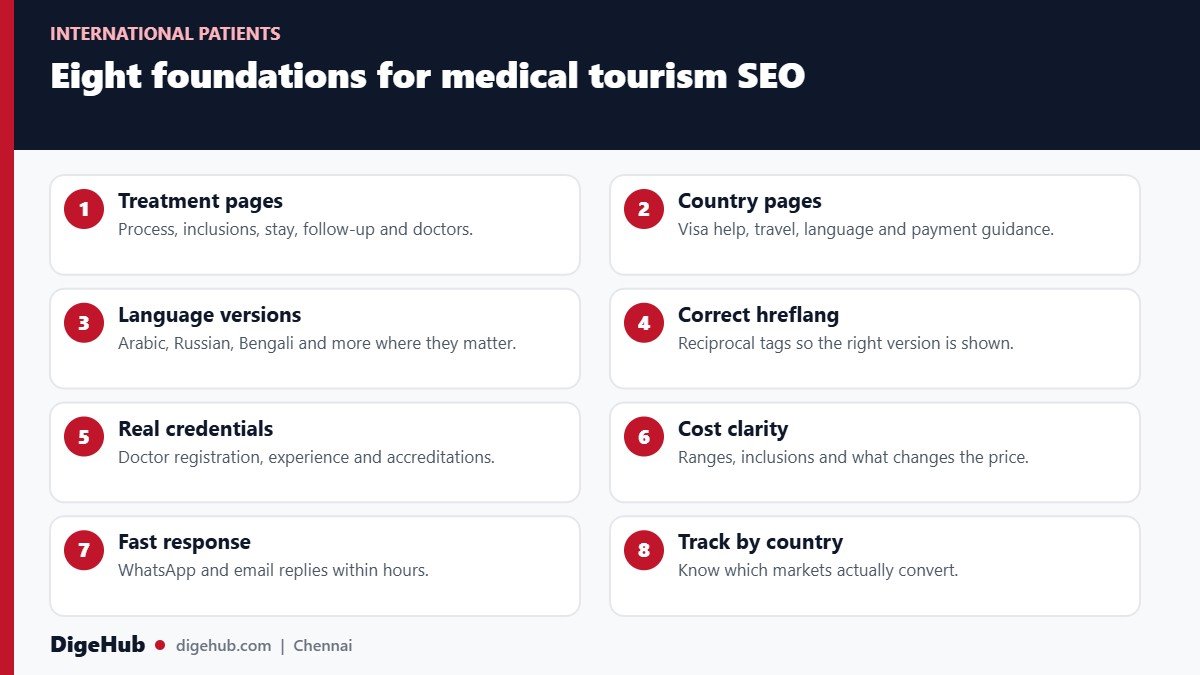
Treatment pages that answer the real questions
For each major treatment, a patient abroad needs more than a description of the condition. A useful page includes:
- Who it is for and when this treatment is typically considered, written with a clinician.
- The named team, with qualifications, registration and experience.
- The process, from sending reports to a remote opinion, arrival, tests, procedure, recovery and discharge.
- Typical duration of stay, as a range, and what affects it.
- What the package includes and excludes, in plain terms. Surprise charges are the biggest source of complaints in medical travel.
- Cost guidance. Even a range with clear assumptions builds more trust than “contact us for price”. Do not publish numbers you cannot honour.
- Risks and alternatives, stated honestly. A page with no risks reads as marketing.
- Follow-up, including tele-consultation after the patient returns home.
- How to send reports and who will reply, with expected response time.
Keep medical claims within accepted guidelines, avoid guaranteed outcomes, and have a clinician review each page. See AI visibility for hospitals for the review process we recommend.
Country pages and language versions
A patient from Oman and a patient from Bangladesh have different questions: language, travel routes, visa process, payment methods, community support and even food. A country page for each priority market lets you answer these directly. Start with the countries that already send you patients, using your own enquiry data, and only then add others. The national figures above suggest markets such as Bangladesh, Iraq, Oman and Uzbekistan, but your hospital’s mix may differ.
For visa guidance, link to the official Indian government visa portal and describe the steps you help with, rather than restating rules that change. Say clearly what your international desk does, such as the invitation letter and airport pick-up, and what the patient must do.
Language is where many hospitals leave value on the table. A properly translated page for Arabic, Russian or Bengali speakers, with a human reviewer and a local phone or WhatsApp number, signals that you are ready for them. Machine translation without review is risky for medical content, so have a qualified translator check anything clinical. This is the same principle we apply to Tamil content for local audiences.
Technical set-up: hreflang, speed and structure
When you publish the same content in several languages or for several regions, tell Google how the versions relate. Google’s documentation says to use hreflang annotations, which can be placed in HTML link tags, HTTP headers or an XML sitemap. The key rules:
- Each version must list itself and every other version. If page A points to page B, page B must point back to A. Otherwise, Google ignores the tags.
- Use an x-default entry as a fallback for users whose language does not match any version, such as a language selector page.
- Translated pages are not treated as duplicates when the main content is actually translated. Pages that keep untranslated text with only a translated template can cause problems.
- Hreflang helps Google show the most suitable version. It does not replace good content, and Google detects the language of a page by itself.
Beyond that, keep a clean URL structure (for example /ar/ or /bn/ folders), fast mobile pages (Google’s good target for Largest Contentful Paint is 2.5 seconds or less), and right-to-left layout support for Arabic. Many international patients are on slower connections, so heavy sliders and large videos can cost you enquiries. An SEO audit checks all of this.
Trust signals that carry weight abroad
Patients travelling to another country are taking a larger risk than a local patient, and they look for proof. The signals that matter most:
- Doctor credentials and registration, with real photos and experience, and where possible publications or society memberships.
- Accreditations, such as NABH or international accreditation if you hold them, with the correct scope and date. Never display an accreditation you do not have.
- Transparent pricing and inclusions.
- Patient stories with consent, that respect privacy and make no outcome promises. Check medical advertising rules before using testimonials.
- Real contact details, a named international desk, working hours across time zones and a physical address.
- Reviews on trusted platforms. See Google reviews for Chennai businesses for handling them well.
Google’s guidance on helpful content says trust is the most important part of E-E-A-T and that health topics are held to a higher standard. For a patient deciding about surgery abroad, that standard is also simply what a sensible person expects.
The enquiry desk is part of SEO
You can win the search and lose the patient in the first reply. Set standards and measure them:
- Reply time. Aim for hours, not days. Time zones differ, so cover the hours when your main markets are awake.
- A named person. Patients trust a name and a photo more than a generic inbox.
- A standard first reply that asks for the reports you need, explains the next step, and sets expectations about timelines and estimates.
- Languages. If your desk cannot reply in Arabic, say so and offer an interpreter or written translation.
- Privacy. Medical reports are sensitive. Use secure channels, explain how data is handled, and follow India’s data protection rules as they take effect. The Digital Personal Data Protection Rules were notified on 13 November 2025, with the remaining obligations phasing in over time.
Track every enquiry by country, treatment, source and outcome. After a few months you will know which pages and markets produce patients, and which only produce questions.
Mistakes that cost international enquiries
- A single “International Patients” page for every treatment and country. It cannot rank for specific searches or answer specific questions.
- Stock photos of generic patients. Use real doctors, wards and desk staff.
- Hidden costs. Vague pricing fuels distrust, especially after stories of surprise bills.
- Unreviewed machine translation. A mistranslated medical term is worse than none.
- Relying wholly on facilitators. They matter, but if the hospital has no direct presence, facilitators control the relationship and the margin.
- Ignoring WhatsApp. For many markets it is the main channel. A form that sends an email that nobody reads for two days loses patients.
- Overpromising outcomes. It breaches advertising guidelines and damages trust when reality differs.
What international patients search, and how to build around it
Search habits abroad follow a pattern. Patients start broad (“heart surgery in India”), narrow to a place (“heart surgery Chennai”), then check a hospital by name along with words such as reviews, cost and doctor names. Many also search in their own language, and many search on a phone. Build your content around three layers:
| Layer | Example pattern | Page to build |
|---|---|---|
| Treatment plus India or Chennai | “knee replacement in Chennai”, “kidney transplant India” | A deep treatment page with the process and team |
| Treatment plus country of origin | “cardiac surgery in India for Iraqi patients” | A country page that links to the treatment pages |
| Hospital name checks | “[hospital] reviews”, “[doctor] Chennai” | Doctor pages, accreditation page, reviews and press |
These are patterns to verify in your own Search Console and enquiry data, not search volumes we are quoting. Google Keyword Planner gives only ranges for most medical queries and may show little data for non-English terms, so rely on your enquiries and on the questions your international desk answers every week. Those questions are the best content brief you have: write one page for each question that comes up again and again.
Also think about where the patient hears about you before searching. Local doctors who refer overseas, patient communities and facilitators all shape the shortlist. A clear, linkable page for referring doctors and agents (how to refer, what you need, who replies) gives them something to share and earns links naturally.
A 90-day plan and what it costs
| Period | Work |
|---|---|
| Days 1 to 30 | Analyse enquiry data by country and treatment. Audit the site for speed, indexing and structure. Choose three treatments and two countries to start with. |
| Days 31 to 60 | Publish clinician-reviewed treatment pages for the three treatments. Build the first two country pages. Set up the enquiry desk standards and tracking. |
| Days 61 to 90 | Add translated versions with hreflang. Review enquiries and response times. Expand to the next treatments and markets that show real demand. |
International patient SEO is broader than local SEO, so it usually fits our Growth SEO plan (Rs65,000 to Rs1.2 lakh a month) or an enterprise scope (Rs1.2 lakh and above) for multi-language, multi-speciality hospitals. Plans are month-to-month with no lock-in, and we start with a free audit. Send us your site on WhatsApp and we reply within two business hours.
No one can promise a particular ranking, and any agency that guarantees international patients should be treated with caution. A better promise is steady improvement in the pages, the response and the measurement that lead to patients.
Frequently asked questions
How many foreign patients come to India for treatment?
Do we need separate pages for each country?
What is hreflang and do we need it?
Can we publish treatment costs?
Should we work with medical tourism facilitators?
Is machine translation acceptable for medical pages?
Sources and further reading
- Punjab Kesari: Over 1.3 lakh foreigners choose India for medical treatment till April (Centre, 7 Aug 2025)
- Wikipedia: Chennai
- Google Search Central: Tell Google about localized versions of your page
- Google Search Central: Creating helpful, reliable, people-first content
- Google Search Central: Core Web Vitals
- Ministry of Electronics and IT: Digital Personal Data Protection Rules, 2025
Want this done for your Chennai business?
Tell us what you sell and where your customers are. We will send a straight answer on what is worth doing first, with no lock-in contract.
- Free audit of your site, Google Business Profile and AI answers
- Reply within 2 business hours on WhatsApp
- Month-to-month plans from ₹40,000
