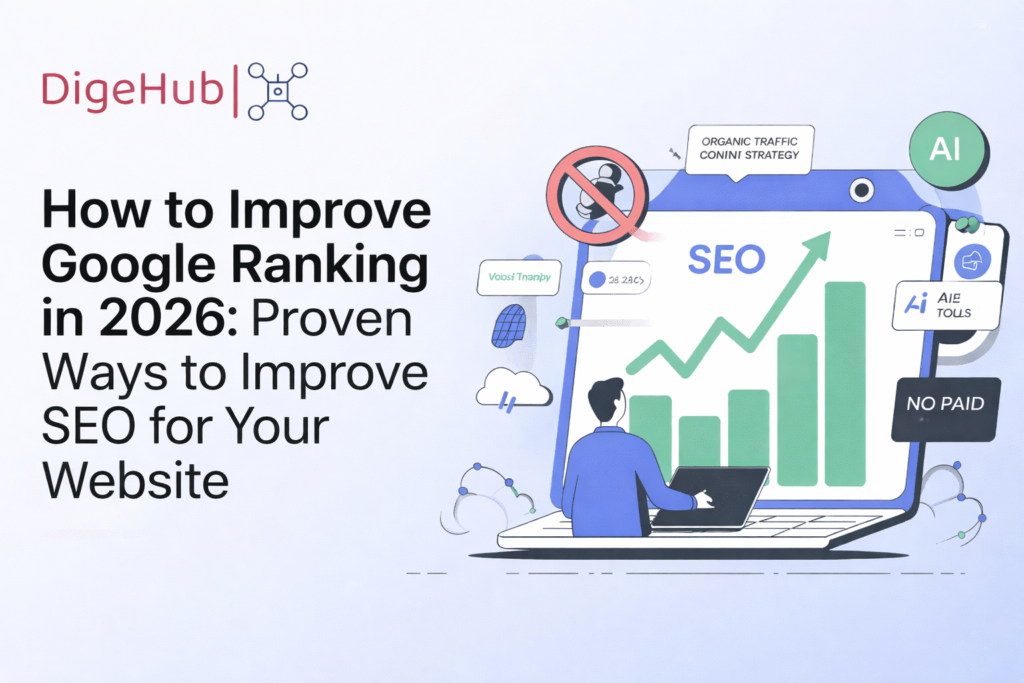
How to Improve Google Ranking in 2026: Complete Guide to Improving SEO for Your Website
If you are reading this, you are likely feeling the squeeze. The Customer Acquisition Cost (CAC) on Google Ads and Meta has skyrocketed, making paid traffic mathematically unsustainable for many growing businesses. Meanwhile, the organic traffic playbook that worked flawlessly in 2023 now feels like shouting into a void.
You aren’t imagining things. The rules of organic visibility have fundamentally shifted. If you are wondering how to improve google ranking in 2026, the answer isn’t about gaming the algorithm with keyword stuffing or buying massive packages of low-quality backlinks. It is about becoming the undisputed primary source of truth for Large Language Models (LLMs) like ChatGPT, Gemini, and Perplexity, while surviving the era of AI Overviews.
What does it mean to rank organically in 2026? Ranking your website without paid ads in 2026 means structuring your content to be instantly retrieved, understood, and cited by Answer Engines and AI Overviews. It requires shifting from traditional keyword density to entity optimization, Answer Engine Optimization (AEO), and providing unique information gain.
(Struggling to keep up with these algorithmic shifts? See how our organic growth experts can help you pivot).
Here is your complete, battle-tested blueprint for dominating organic search in the AI era.
1. The State of Search in 2026: Google vs. AI Engines
The modern search landscape is no longer a simple list of ten blue links. It is a multi-modal, zero-click environment dominated by generative summaries and conversational interfaces.
The Rise of Zero-Click Searches and AI Overviews
A “zero-click search” occurs when a user gets the complete answer to their query directly on the search engine results page (SERP), without ever needing to click through to a website. With the aggressive rollout of Google’s AI Overviews, alongside the massive mainstream adoption of platforms like Perplexity AI and ChatGPT Search, zero-click searches now account for a massive majority of informational queries. Studies from data providers like Semrush and Ahrefs have continually highlighted this exact trend over the last few years: standard clicks are down, while on-SERP resolution is up.
If your entire SEO strategy relies on answering simple “What is X?” questions, your traffic is going to drop to zero. The AI will summarize the answer, the user will be satisfied, and your site will remain unvisited.
Why Traditional SEO is Losing ROI (And What’s Replacing It)
In our experience working with clients at Digehub, one mistake most businesses make is clinging to outdated playbooks. They are still obsessed with arbitrary keyword density, writing 3,000-word fluff pieces, and paying for low-quality guest post backlinks on irrelevant sites.
What actually works in real campaigns today is shifting your focus from fetching clicks to securing citations.
| Traditional SEO (Pre-2024) | Modern SEO (2026 & Beyond) |
|---|---|
| Focus on keyword search volume | Focus on user intent, entities, and conversational queries |
| Success measured by blue-link clicks | Success measured by AI citations and brand mentions |
| Strategy: Write 3,000-word ultimate guides | Strategy: Write highly structured, dense, “Bite-Snack-Meal” content |
| Goal: Game the algorithm with backlinks | Goal: Train the LLM’s vector database on your brand entity |
2. Generative Engine Optimization (GEO): The New SEO
When business owners ask us how to improve seo for website performance in the modern era, our answer is simple: stop optimizing just for Google. If traditional SEO was about optimizing for search engines, GEO is about optimizing for Answer Engines.
🔹 Definition: Generative Engine Optimization (GEO) is the systematic process of structuring your digital content so that it is easily understood, retrieved, cited, and prioritized by Large Language Models and AI-driven search interfaces.
🔹 Insight: If you do not format your content for AI parsers using direct answers and semantic HTML, you will be entirely invisible on platforms like ChatGPT Search, regardless of how high your traditional Domain Authority is.
Optimizing for LLMs and RAG
Search engines today use a framework called Retrieval-Augmented Generation (RAG). When a user asks a question, the AI doesn’t just “think” of an answer off the top of its digital head. It retrieves the most relevant, highly structured data from its index and generates a response based specifically on that retrieval.
If your content is a massive wall of unstructured text, the AI parser will skip it. It takes too much computational power to parse. Instead, it will favor a competitor who used clean HTML tables, bolded definitions, and logical H2/H3 hierarchies.
The “Information Gain” Mandate
Google and AI models actively penalize “copycat” content. If your blog post simply rewrites the top 5 ranking articles on page one, you provide zero Information Gain.
Contrarian View: Long-form content is dying. The era of fluff-filled 3,000-word ultimate guides is over. Search engines are actively penalizing word count for the sake of word count. Density of value—delivering a highly structured, data-backed answer in 800 words—will consistently outrank a rambling, generic 3,000-word post.
To rank in 2026, you must bring net-new facts to the internet. This could be proprietary data, first-party research, a unique framework, or a strongly argued perspective that goes against the grain.
3. The 5-Step Framework to Rank Without Ads
If you are actively researching how to improve seo on website architectures today, you need a synchronized approach to Answer Engine Optimization, Topical Authority, Entity Building, and Technical SEO. Here is the exact framework we use.
Step 1: Answer Engine Optimization (AEO)
You must structure your content for direct answers. We use a framework at Digehub called the “Bite, Snack, Meal” method.
- The Bite: A direct, 1-2 sentence bolded answer immediately beneath your H2 or H3 heading. This is optimized perfectly for Voice Search and AI Overviews.
- The Snack: A bulleted list or Markdown table breaking down the components of the answer, making it easy for AI to extract data points.
- The Meal: The deep-dive, nuanced, human-driven explanation that follows.
Real-World Example: The E-commerce AEO Win We recently analyzed an e-commerce brand selling marine spare parts. They were losing massive traffic to Amazon because their product pages were just walls of text. By implementing strict FAQ Schema on their product pages and using the “Bite, Snack, Meal” format to directly answer queries like “What is the lifespan of a standard impeller?”, they captured AI overview snippets and bypassed traditional blue-link competitors entirely.
Step 2: Building Topical Authority
Topical authority means dominating an entire subject, not just a single keyword. You need to build tightly woven content clusters that signal to AI that you are the definitive expert on a topic. When you are building an authoritative content strategy, ensure you interlink your cluster pages logically using semantic anchor text.
Contrarian View: Keyword Search Volume is a trap. High-volume keywords are often vanity metrics that result in zero-click AI overviews. Instead, target high-intent, low-volume, “conversational” queries that actually drive sales. A long-tail query with 50 searches a month that converts at 10% is infinitely more valuable than a top-of-funnel query with 5,000 searches that the AI answers immediately without sending you a single click.
Step 3: Entity & Brand Optimization
An “Entity” is a singular, unique, well-defined thing or concept (a person, place, or brand). In 2026, you want your brand to become a recognized entity within the search engine’s Knowledge Graph.
Original Insight: Brand Entity > Backlinks. In 2026, an LLM recognizing your brand as a semantic entity closely tied to your niche is vastly more powerful than 50 mediocre guest-post backlinks. Search engines look at brand search volume (people physically typing “Your Brand + Your Service” into the search bar) as the ultimate, un-fakeable signal of trust.
Real-World Example: The Local Business Entity A local plumber doesn’t need to out-blog major home improvement sites. They need to optimize their Google Business Profile, get mentioned in local digital news outlets (Digital PR), and ensure their NAP (Name, Address, Phone) consistency is flawless across the web. This feeds the LLM’s local knowledge graph, making them the default answer when someone asks Siri or Gemini for “plumbers near me.”
Step 4: Technical SEO for AI Crawlers
AI crawlers have a crawl budget just like Googlebot. If your site is bloated, slow, or lacks structured data, your content will be ignored.
🔹 Definition: Schema Markup (Structured Data) is a standardized vocabulary (using JSON-LD) added to your HTML that helps search engines explicitly understand the context, entities, and relationships of the information on your page.
🔹 Insight: Implementing Article, FAQ, and Organization schema is no longer an optional “bonus”; it is the fundamental language you must speak to communicate your data structure to AI search engines.
Before publishing new content, we highly recommend conducting a technical SEO audit to ensure your site architecture is primed for rapid AI ingestion.
Step 5: Leveraging User Experience (UX) as a Ranking Signal
Google measures how users interact with your site after they click. Do they immediately hit the back button (pogo-sticking)? Do they scroll deep into the page? Do they interact with your elements?
Core Web Vitals—which measure loading speed, interactivity, and visual stability—are absolute table stakes today. If your page layout shifts while reading or takes 4 seconds to load, the user will leave. This sends a massive negative signal to the algorithm that your content didn’t satisfy their intent, and you will be downranked.
💡 Looking to scale this process? Implementing GEO and AEO requires technical precision. Stop guessing what the algorithm wants. Contact Digehub to build your custom, data-driven organic strategy.
4. The Role of E-E-A-T in an AI-Generated World
Experience, Expertise, Authoritativeness, and Trustworthiness (E-E-A-T) are the only moats protecting your content from being drowned out by generic, AI-generated spam. According to Google’s own Search Central guidelines, E-E-A-T is central to how their raters evaluate the helpfulness of content.
Demonstrating Real Human Experience
The “E” for Experience is the most critical factor today. AI can synthesize information, but it cannot run a marketing agency, conduct a scientific experiment, or feel the frustration of a failed ad campaign.
Original Insight: The “Subject Matter Expert” Premium. First-person anecdotes, unique datasets, and battle-tested case studies are the only reliable ways to bypass the “AI fluff” filters applied by search engines today. If your content sounds like a Wikipedia summary, it will be ignored.
Real-World Example: The SaaS Pivot We observed a B2B SaaS company that was losing traffic rapidly because they were publishing generic “What is CRM?” articles. We helped them pivot their strategy entirely. They stopped writing dictionary definitions and started publishing proprietary data (“How our 5,000 enterprise users configure their sales pipelines”).
By injecting unique experience and data, they doubled their organic leads in six months. Why? Because they provided insights that ChatGPT simply couldn’t hallucinate or scrape from elsewhere.
Even when using high-quality AI writing assistants to scale your output and outline your thoughts, you must manually inject your own human Point of View (POV). Tell the reader what works, what doesn’t, and crucially, when not to use a specific tactic.
5. Conclusion: Your 90-Day Organic Action Plan
Ranking without paid ads in 2026 is entirely possible, but it requires abandoning the outdated tactical checklists of the past decade.
To win in the modern SERPs, you need to execute consistently on three fronts:
- Structure for AI: Adopt the GEO and AEO frameworks immediately. Use clear headings, provide direct answers (Bite, Snack, Meal), and deploy technical schema to make your site irresistible to LLM crawlers.
- Focus on Information Gain: Stop repeating what your competitors say. Publish unique data, strong contrarian opinions, and real-world experience.
- Build Your Brand Entity: Focus on becoming the go-to authority in your specific niche. Drive branded search volume that signals undeniable trust to the algorithms.
Stop paying for increasingly expensive, low-converting ads. Let Digehub build your organic revenue engine. Book your free SEO strategy call today and learn how we can turn your website into an automated lead-generation machine that ranks around the clock.
6. Frequently Asked Questions (FAQ)
How to improve google search ranking if my traffic has dropped? If your traffic has recently declined, learning how to improve google search ranking starts with auditing your site for Information Gain. Google penalizes generic, AI-spun content. Update your existing pages by injecting first-hand experience, unique data, and clear AEO formatting (like the Bite, Snack, Meal structure) to recover your visibility in AI Overviews.
Does traditional SEO still work in 2026? Traditional SEO tactics like keyword stuffing and buying low-quality guest post backlinks no longer work and will actively harm your site. However, foundational SEO principles—like technical site health, fast loading speeds, clean URL structures, and high-quality link building from highly relevant, authoritative sources—remain absolutely critical.
How do you rank in AI search engines like ChatGPT and Perplexity? To rank in AI search engines, you must practice Generative Engine Optimization (GEO). This involves structuring your content logically with H2 and H3 tags, using bulleted lists and markdown tables, clearly defining entities, and providing highly specific, factual information that the AI’s RAG system can confidently retrieve and cite.
What is Generative Engine Optimization (GEO)? Generative Engine Optimization (GEO) is the strategic process of creating and structuring website content so that it is easily understood, cited, and summarized by Large Language Models (LLMs) and Answer Engines. It prioritizes direct answers, semantic structure, and information gain.
How long does it take to see organic traffic results today? For a brand new website, it typically takes 6 to 9 months to establish topical authority, build a brand entity, and see significant organic traffic. For established websites implementing an updated GEO strategy, improvements in AI citations, featured snippets, and traffic recovery can often be seen in 60 to 90 days.
Can a new website outrank established competitors without running ads? Yes, a new website can outrank established competitors without paid ads by focusing on hyper-niche, long-tail, conversational queries rather than highly competitive head terms. By building a tight content cluster of highly authoritative, experience-driven content, new sites can establish a targeted semantic entity faster than large, unfocused websites.
Editorial Note: This article is written and reviewed by Abdul Vahith and the Digehub editorial team, combining hands-on practical experience in SEO, AI tools, and digital marketing strategies to ensure accuracy and real-world applicability for our readers.