AEO vs GEO vs SEO: The Ultimate Guide to Surviving Search in 2026
For the last two decades, digital marketing had one undisputed king: Google’s ten blue links. If you wanted traffic, you optimized for those links. But today, the landscape has fractured. Users are asking Alexa for quick answers, prompting ChatGPT for comprehensive research, and using Google’s AI Overviews for instant summaries.
The traditional search playbook is no longer enough. If you are only focusing on traditional ranking factors, you are bleeding visibility. To dominate modern search engines, you need to understand the new holy trinity of digital visibility: aeo vs geo vs seo.
This isn’t just another theoretical marketing debate. Whether you are a business owner trying to capture leads or a marketer updating your strategy, understanding the difference between seo aeo and geo is the difference between being found and being invisible.
In this comprehensive guide, we will break down exactly what these three strategies are, how they overlap, and how to build a unified strategy that drives engagement, trust, and conversions for your brand.
AEO vs GEO vs SEO
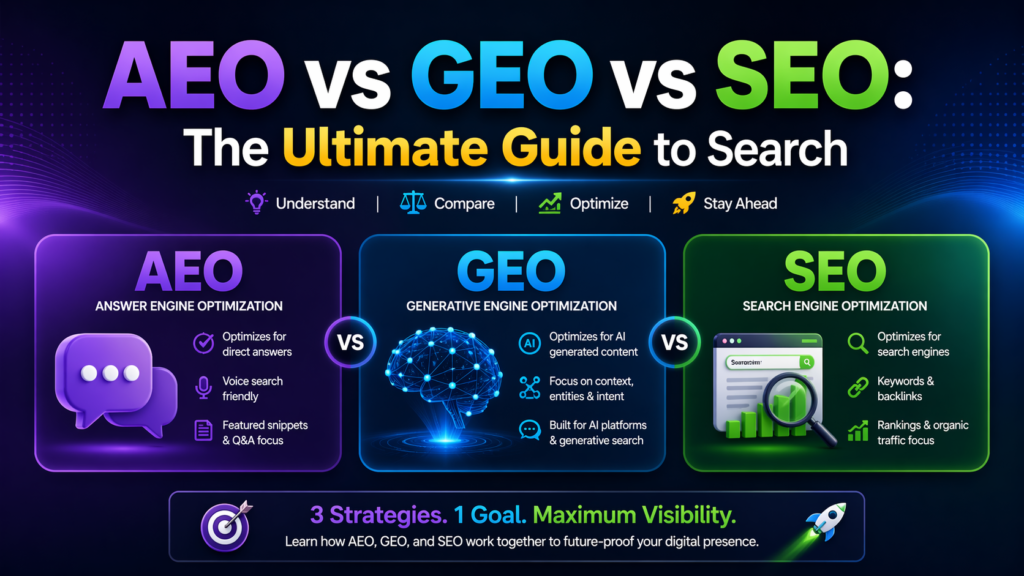
What is the difference between SEO, AEO, and GEO? AEO, GEO, and SEO represent the three pillars of modern digital visibility. SEO (Search Engine Optimization) ranks web pages on traditional search engines to drive organic click-through traffic. AEO (Answer Engine Optimization) structures content to appear in featured snippets and voice search results for zero-click queries. GEO (Generative Engine Optimization) optimizes content to be cited and recommended by AI chatbots and Large Language Models (LLMs) like ChatGPT and Gemini.
What is SEO (search engine optimization)
Search Engine Optimization (SEO) is the grandfather of digital visibility. It is the process of improving a website’s technical structure, content relevance, and link authority to rank higher on search engine results pages (SERPs) like Google and Bing.
The primary goal of search engine optimization in digital marketing is straightforward: get a user to click your link and visit your website. It relies heavily on matching user search intent with highly relevant, long-form content.
If you are completely new to this concept and need to build a foundation, I highly recommend starting with our beginner’s guide to digital marketing before diving into the deep end of AI search.
Core Tactics of SEO:
- Keyword Research: Finding the exact phrases users type into search bars.
- Technical SEO: Ensuring site speed, mobile-friendliness, and crawlability.
- On-Page Optimization: Strategic placement of keywords in titles, headers, and meta descriptions.
- Backlink Building: Acquiring links from other authoritative websites to prove trustworthiness.
In our experience working with clients, traditional SEO is far from dead, but its role has shifted. It is no longer the only source of traffic, but it remains the foundational infrastructure upon which AEO and GEO are built. If your site isn’t technically sound for Googlebot, it won’t be crawled by AI bots either.
What is AEO (answer engine optimization)
As mobile and voice search exploded, users stopped wanting to read 3,000-word articles just to find out what temperature to bake chicken. They wanted immediate answers. Enter AEO.
What is answer engine optimization? It is the practice of formatting and structuring your content so that search engines can easily extract short, definitive answers to feed directly to the user. This is the driving force behind “Zero-Click Searches,” where the user gets their answer on the search results page without ever clicking a link.
AEO targets Featured Snippets (the box at the top of Google), “People Also Ask” (PAA) sections, and voice assistants like Siri, Alexa, and Google Assistant.
🔹 Definition: Answer Engine Optimization (AEO) is the strategic structuring of content—using direct Q&A formats, lists, and schema markup—to satisfy informational queries instantly via voice search or featured SERP snippets.
🔹 Insight: AEO prioritizes clarity over length. While traditional SEO asks, “How can I keep them on my page?”, AEO asks, “How quickly and accurately can I give them the answer?”
Core Tactics of AEO:
- Inverted Pyramid Writing: Giving the direct answer in the first sentence, then expanding on the details.
- FAQ Sections: Creating dedicated blocks of question-and-answer text.
- Structured Data (Schema): Adding code to your site that explicitly tells the search engine, “This text is an FAQ,” or “This is a recipe.”
- Conversational Keywords: Targeting long-tail phrases like “how do I start a digital marketing agency” rather than “digital marketing agency startup.”
What is GEO (generative engine optimization)
This is the frontier. When ChatGPT launched, it fundamentally altered how humans access information. Instead of searching and browsing, users now prompt and converse.
What is GEO in AI search? Generative Engine Optimization is the process of optimizing your brand’s content so that Large Language Models (LLMs)—like OpenAI’s ChatGPT, Google’s Gemini, and Perplexity—cite, recommend, and feature your brand in their generated responses.
Unlike Google, which ranks web pages based on links, LLMs generate answers based on training data and real-time retrieval-augmented generation (RAG). To win in generative engine optimization, your content needs to be highly factual, heavily cited, logically structured, and rich in unique insights.
The “Information Gain” Mandate
One mistake most businesses make is treating GEO like traditional SEO by simply keyword-stuffing their articles. AI models don’t care about keyword density. They care about Information Gain. If your article says the exact same thing as the top 10 articles on Google, an AI model will ignore it. To be cited by AI, you must introduce net-new information: a proprietary statistic, a unique framework, a contrarian opinion, or a first-hand case study. If you aren’t adding to the global knowledge base, AI won’t cite you.
🔹 Definition: Generative Engine Optimization (GEO) is the discipline of enhancing digital content with unique data, strong logical structures, and clear entity relationships so that AI models recognize the brand as an authoritative source for synthesis.
🔹 Insight: GEO shifts the focus from optimizing for algorithms to optimizing for context. You are no longer trying to rank a page; you are trying to train an AI to trust your brand’s perspective.
Difference between SEO vs AEO vs GEO
To truly grasp the difference between seo aeo and geo, it helps to look at them side-by-side. They serve different intents, live on different platforms, and require different execution styles.
| Feature | SEO (Search Engine Optimization) | AEO (Answer Engine Optimization) | GEO (Generative Engine Optimization) |
|---|---|---|---|
| Primary Goal | Drive website traffic and clicks. | Provide instant answers; brand visibility. | Brand mentions, citations, and trust. |
| Target Platform | Google, Bing, Yahoo (Standard SERPs). | Google Featured Snippets, Alexa, Siri. | ChatGPT, Gemini, Perplexity, AI Overviews. |
| Content Format | Long-form guides, landing pages, blogs. | Short, direct paragraphs, lists, tables, FAQs. | Comprehensive, logically structured, data-rich text. |
| Key Ranking Factor | Backlinks, Keyword Intent, User Experience. | Schema markup, concise formatting, Q&A style. | Information Gain, Entity Authority, Factual Accuracy. |
| Success Metric | Organic Traffic, Rankings, Conversions. | Snippet Ownership, Voice Search Impressions. | Brand Mentions in AI outputs, Referral Traffic from citations. |
Industry context: According to research by Gartner, traditional search engine volume is expected to drop by 25% by 2026 due to AI chatbots. This is exactly why you cannot rely solely on SEO anymore.
AEO vs GEO vs SEO: Which is better in 2026?
A common question we hear from clients is: “Should we stop investing in SEO and put all our budget into GEO?”
The strong POV here is: Absolutely not. Asking which is better is like asking whether the engine, the steering wheel, or the tires are the best part of a car. You need all three to drive. None of these strategies exist in a vacuum; they form a modern visibility funnel.
What actually works in real campaigns is layering them:
- SEO is your foundation. If your site architecture is broken, if your pages load slowly, and if you have no domain authority, you don’t exist. LLMs often use traditional search indexes (like Bing for ChatGPT) to pull real-time data. If you don’t rank in SEO, the AI can’t find you to cite you.
- AEO is your conversion shortcut. For high-intent questions (“pricing for marketing software”), being the instant answer builds immediate trust and captures the impatient buyer.
- GEO is your future-proofing. As more users switch to Perplexity or ChatGPT for deep research, having your brand recommended natively by the AI positions you as the ultimate industry authority.
When NOT to do something: Do not try to optimize a single page for all three perfectly if the intents clash. A complex, 50-step technical manual (great for GEO and SEO) should not be forcefully crammed into a 40-word AEO snippet. Match the strategy to the specific user query.
How to optimize for SEO, AEO, and GEO together
Now that we know the theories, let’s get tactical. How to optimize for ai search engines while maintaining your traditional traffic? Here is Digehub’s proprietary framework for holistic optimization.
Step 1: Implement “Entity-First” Writing
Search engines and AI models no longer read words; they understand entities (people, places, concepts, organizations) and how they relate to each other.
- Action: When writing about a topic, cover all related sub-topics comprehensively. Use clear definitions. Instead of just saying “marketing automation,” define it, link it to CRM, mention email sequences, and discuss lead scoring. This builds an entity web that AI models love.
Step 2: Use the “Bite, Snack, Meal” Content Structure
This is the secret to hitting all three optimizations on a single page:
- The Bite (AEO): Start every major H2 section with a bolded, 40-60 word direct answer. This feeds the featured snippets and voice search.
- The Snack (GEO): Follow the answer with bullet points, statistics, and clear logical arguments. This structured data is easily digestible for LLMs looking to synthesize information.
- The Meal (SEO): Expand the rest of the section with deep dives, examples, case studies, and internal links to keep the human reader engaged and satisfy traditional SEO length requirements.
Step 3: Prioritize First-Hand Experience (E-E-A-T)
Google’s algorithm update added “Experience” to Expertise, Authoritativeness, and Trustworthiness. AI models are also trained to prioritize first-hand knowledge to avoid hallucinations.
- Action: Stop writing generic overviews. Use phrases like “Based on our data…” or “When we implemented this for a client…” Include original screenshots, custom graphics, and author bios.
Step 4: Inject Schema Markup Everywhere
Schema is the native language of bots. While SEO uses it for rich results, AEO relies on it for context.
- Action: Add
FAQPageschema for your question sections,Articleschema for blogs, andOrganizationschema to solidify your brand entity.
The “Quoted Expert” Technique
To dominate GEO specifically, design your content to be highly quotable. LLMs love absolute statements and clear frameworks. Instead of writing, “There are some differences between the strategies,” write, “The Digehub Visibility Framework categorizes SEO for traffic, AEO for speed, and GEO for trust.” By naming your concepts, you force the AI to cite your specific framework when answering a user.
Step 5: Leverage AI to Scale Your Efforts
You can’t do this manually at scale. Use AI to fight AI. Need help structuring your content for maximum Information Gain? Try using our free SEO blog writing tool to generate optimized outlines, draft AEO-friendly snippets, and ensure your keyword integration feels natural, not forced.
Frequently Asked Questions (FAQs)
1. What is the difference between SEO, AEO, and GEO? SEO aims to rank links on search engines for organic traffic. AEO formats content to provide instant, zero-click answers for voice search and featured snippets. GEO optimizes content to be cited as a trusted source by AI chatbots and Large Language Models.
2. What is answer engine optimization (AEO) and why is it important? AEO is the process of structuring content to directly answer user queries. It is crucial because a massive percentage of modern searches (especially on mobile and smart speakers) result in zero clicks; the user gets their answer directly from the SERP. If you aren’t the answer, you are invisible.
3. What is GEO in AI search? Generative Engine Optimization (GEO) involves creating highly factual, well-structured, and uniquely insightful content designed to be digested, synthesized, and recommended by Generative AI models like ChatGPT, Gemini, and Perplexity.
4. How to optimize for AI search engines? To optimize for AI search, focus on Information Gain (providing new data/insights), use clear, structured formatting (lists, tables, Markdown), prioritize first-hand experience (E-E-A-T), and ensure your brand is mentioned across multiple high-authority external websites.
5. Will GEO replace search engine optimization in digital marketing? No. GEO will augment SEO, not replace it. Traditional search engines will still be used for navigational and transactional queries (e.g., buying shoes, finding a specific website), while Generative AI will dominate complex, research-based informational queries. A successful strategy requires both.
Conclusion & Next Steps
The era of choosing between aeo vs geo vs seo is over. In 2026, they are three sides of the same coin.
- Use SEO to build a technically sound, high-authority foundation.
- Use AEO to capture high-intent, fast-paced queries and dominate voice search.
- Use GEO to future-proof your brand by ensuring AI models cite you as the definitive industry expert.
By adopting an entity-first mindset, restructuring your content to include clear, direct answers, and constantly pushing for original insights, you will not just survive the AI search revolution—you will lead it.
Stop Guessing. Start Dominating.
Adapting to AI search algorithms is complex, and getting it wrong means losing your digital footprint entirely. At Digehub, we don’t just write about these strategies; we execute them daily to drive real revenue for our clients.
Want to see how your website holds up against the new AI search standards? Explore our digital marketing blog for more insights, or contact our team to build a unified visibility strategy that actually converts.
Editorial Note: This article is written and reviewed by the Digehub team, combining practical experience in SEO, AI tools, and digital marketing strategies to ensure accuracy and real-world applicability.