AI Visibility for Hospitals and Clinics in Chennai: A Practical Guide
Patients are starting to ask AI tools questions they once typed into Google: which hospital for a knee replacement, what to expect from a cardiac check-up, how to find a good paediatrician near me. Health is a category where wrong answers do real harm, so the goal is not just to be mentioned but to be described accurately. This guide explains what is known, what is not, and what Chennai hospitals and clinics can do about it.
What is actually changing for patients
People now meet health information in three places: classic search results, AI summaries inside search, and standalone AI assistants. The first still matters most for clicks in India, where StatCounter data shows Google handling about 98 per cent of search in the country. But the second and third change what a patient sees before, or instead of, a list of links.
Two data points are worth knowing, with their limits. A Pew Research Center analysis found that users clicked a traditional result in about 8 per cent of visits when an AI summary appeared, compared with about 15 per cent without one. That study covered US adults. Ahrefs has reported that AI Overviews reduce click-through rates for top-ranking results, with a 2025 estimate of about 34.5 per cent lower and a 2026 update of about 58 per cent lower on desktop. These are measurements from other markets and other query sets, so do not treat them as Chennai numbers. Check your own Search Console trends for informational queries.
For a hospital, the implication is not to panic but to adjust. Informational visits may fall for some queries. Patients ready to act, who want a doctor, an appointment or directions, still need to find you and trust you. Our wider approach is explained on our AI SEO agency in Chennai page.
What Google and OpenAI actually say
Much advice on “ranking in AI” is guesswork. Here is what the platforms themselves have published:
| Source | What it says | What it means for a clinic |
|---|---|---|
| Google, AI features in Search | To be a supporting link in AI Overviews or AI Mode, a page must be indexed and eligible to appear with a snippet. No special optimisation is required, and the same SEO fundamentals apply. | Make sure your pages are crawlable, indexable and genuinely helpful. There is no separate trick. |
| OpenAI, crawlers | OAI-SearchBot is used for surfacing sites in ChatGPT search. GPTBot is used for training and is a separate setting. | Check robots.txt and your security tools. You can allow search visibility without allowing training use if you choose. |
| Google, helpful content and E-E-A-T | Trust is the most important element. Pages on health topics are held to a higher standard because they can affect wellbeing. Clear authorship is encouraged. | Name the doctor who reviewed each page, show credentials, and cite sources. |
| Google, spam policies | Using automation to generate content mainly to manipulate rankings is spam. | Do not mass produce symptom pages with AI. Fewer, better, reviewed pages win. |
The honest summary is that nobody outside these companies can promise a placement in an AI answer. What can be done is to remove obstacles and create material that a careful system would want to quote.
Build pages a careful system would want to quote
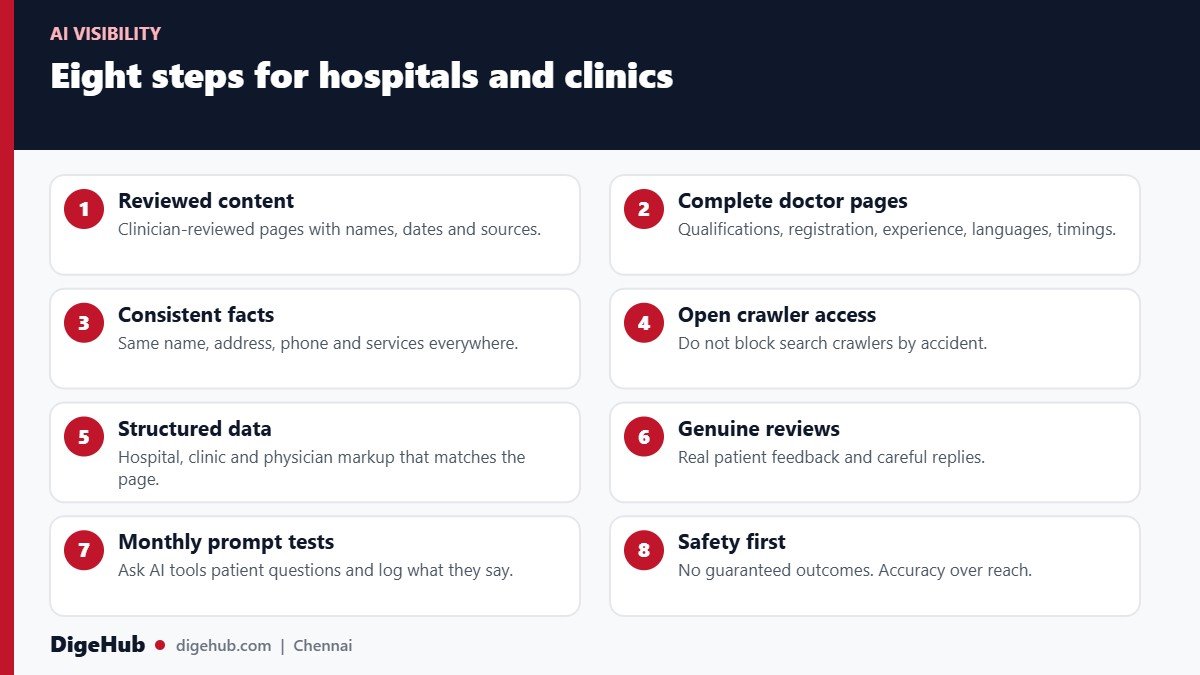
For health topics, “helpful” means accurate, current, and written by someone qualified. A practical standard for every clinical page:
- Name the reviewer. Show the doctor’s name, qualifications, registration details and role, with a link to their profile page.
- Date the page. Show when it was written and last reviewed, and actually review it on a schedule.
- Answer the patient’s question first. Begin with a clear two or three sentence answer, then add detail below. This helps people and gives systems a clean passage to quote.
- Explain the process locally. What happens at your hospital: who to see, how to book, what to bring, what it may cost in broad terms, how long it takes. This is the information AI tools cannot invent and patients need.
- Cite credible sources such as guidelines from recognised medical bodies, and link to them.
- State limits. Say what the page does not cover and when to seek urgent care.
- Avoid guarantees. No promised outcomes, no unverifiable “best” claims, no before and after claims that breach advertising rules.
Medical advertising in India is regulated, and the National Medical Commission and related bodies have published guidance on what doctors and clinics may say publicly. Check the current text and your professional council’s rules before publishing, and have a clinician and a compliance reviewer sign off. Our hospital SEO guide covers the site structure in more detail.
Doctor and department pages are the foundation
When someone asks an AI tool for a cardiologist or a fertility specialist in Chennai, the system looks for entities it can describe confidently: a doctor, a speciality, a place. Weak or missing doctor pages leave it guessing, or relying on third-party directories that may be out of date.
For each doctor, a complete page should include:
- Full name, photo, speciality and sub-speciality.
- Qualifications, registration details and years of experience.
- Conditions treated and procedures performed, in plain language.
- Languages spoken, including Tamil, which patients often want to know.
- Consulting locations, days and timings, and how to book.
- Published work, talks or memberships, if real.
For each department, explain what the department treats, the team, the facilities and technology, the patient journey and the booking route. Link doctors to departments and departments to doctors so the relationships are clear. On Google Business Profile, Google’s guidelines allow individual practitioners to have their own profiles only if they are public-facing at a verified location, with one profile per practitioner and the practitioner’s name as the title. Departments can have separate profiles only when they are distinct entities with their own category. Read the current rules before creating any, and see our Business Profile guide.
Keep your facts consistent everywhere
AI answers are assembled from many sources. If your website says one phone number, a directory says another, and an old listing shows a closed branch, a system may repeat any of them. Do a one-time clean-up and keep it current:
- Name, address and phone identical on your site, Business Profile, and major directories.
- Services and departments described the same way on every platform.
- Hours and emergency details accurate, including holiday changes.
- Insurance and cashless partners listed only if still active. Out-of-date claims create complaints.
- Accreditations such as NABH, stated with the correct scope and date. Do not claim one you do not hold.
Structured data helps machines read these facts. Google’s local business documentation recommends using the most specific type that fits and keeping markup consistent with the visible page. Schema.org includes types for hospitals, clinics and physicians. Treat markup as a supporting layer; it does not replace the content itself, and it is not a guarantee of any placement.
Check that crawlers can actually reach you
A surprising number of hospital websites block search and AI crawlers by accident, through a security plugin, a firewall rule, a CDN setting or an old robots.txt. Check these in order:
- robots.txt. Open yoursite.com/robots.txt and look for broad disallow rules or rules naming specific bots.
- Allow search bots deliberately. If you want visibility in ChatGPT search, OAI-SearchBot should not be blocked. Whether to allow GPTBot for training is a separate business decision.
- Security and CDN tools. Look at bot-protection logs. A rule that blocks unknown bots may block legitimate ones.
- Rendering. If doctor lists or timings load only through scripts, test whether the content is visible in the raw page.
- Indexing. In Search Console, confirm key pages are indexed and not marked noindex.
- Speed. Google’s good target for Largest Contentful Paint is 2.5 seconds or less, which matters for patients on mobile.
This is the same technical foundation covered in an SEO audit, and it is the part with the clearest payoff.
A monthly routine: test what AI tools say about you
You cannot optimise what you do not observe. Build a simple test set of 20 questions a real patient might ask, and run them every month across the tools your patients use, such as Google AI Overviews and AI Mode, ChatGPT, Gemini and Perplexity. Examples, in English and Tamil:
- “Best hospital for [procedure] in Chennai” and the same for each of your main departments.
- “Which doctor in [area] treats [condition]?”
- “[Your hospital name] reviews”, “[Your hospital name] cost for [procedure]”, “[Your doctor] consultation timings”.
- Questions about insurance acceptance, emergency services and visiting hours.
For each answer record: were you mentioned, was the information correct, which source was cited, and which competitors appeared. AI answers vary from run to run and by user, so treat results as a trend and not a ranking. Where something is wrong, trace it to its source and correct the source, whether that is your own page, a directory, or a news article. Where you are missing, check whether a page exists that directly answers that question.
Avoid tools or agencies that promise a guaranteed spot in AI answers. No one controls these systems, and in health the risk of overpromising is higher.
Reviews, reputation and patient safety
Systems that summarise a hospital often draw on public reviews. Respond to reviews carefully: thank the patient, do not discuss clinical details in public, and offer an offline route to resolve concerns. Do not offer incentives or filter who you invite to review. See Google reviews for Chennai businesses for the details.
If an AI tool gives a patient dangerous advice about your services, such as a wrong dose, a wrong eligibility rule or a claim that you offer a treatment you do not, take it seriously. Correct your own pages, update clear statements of what you do and do not provide, and use the feedback options in the tool. Accuracy is the first goal; visibility is second.
A 90-day plan and what it costs
| Period | Work |
|---|---|
| Days 1 to 30 | Audit crawler access, indexing, speed and Business Profiles. Clean up name, address, phone and service facts everywhere. Build the 20-question test set and record a baseline. |
| Days 31 to 60 | Complete doctor and department pages with clinician review. Add dated, sourced answers for the top ten patient questions. Add structured data that matches the pages. |
| Days 61 to 90 | Re-run the test set. Fix wrong or missing answers at the source. Publish Tamil versions of the most important pages. Review enquiries and appointments from organic search. |
For a single clinic, our Local SEO Starter plan (Rs40,000 to Rs60,000 a month) can cover the foundations. Hospitals and groups with many departments usually need Growth SEO (Rs65,000 to Rs1.2 lakh) or an enterprise scope (Rs1.2 lakh and above). Plans are month-to-month with no lock-in. Start with a free audit: send your website on WhatsApp and we reply within two business hours. For the wider plan, see our SEO agency in Chennai page.
Frequently asked questions
Can a hospital pay to appear in ChatGPT or Google AI answers?
What is the difference between OAI-SearchBot and GPTBot?
Should a clinic let AI crawlers in?
How do we check what AI says about our hospital?
Is AI-written health content a good idea?
Will AI reduce traffic to my hospital website?
Sources and further reading
- Google Search Central: AI features and your website
- OpenAI: Overview of OpenAI crawlers
- Google Search Central: Creating helpful, reliable, people-first content
- Google Search Central: Spam policies
- Google Search Central: Local business structured data
- Google Business Profile Help: Guidelines for representing your business
- Pew Research Center: Google users are less likely to click on links when an AI summary appears
- Ahrefs: AI Overviews reduce clicks
- StatCounter Global Stats: Search engine market share, India
Want this done for your Chennai business?
Tell us what you sell and where your customers are. We will send a straight answer on what is worth doing first, with no lock-in contract.
- Free audit of your site, Google Business Profile and AI answers
- Reply within 2 business hours on WhatsApp
- Month-to-month plans from ₹40,000