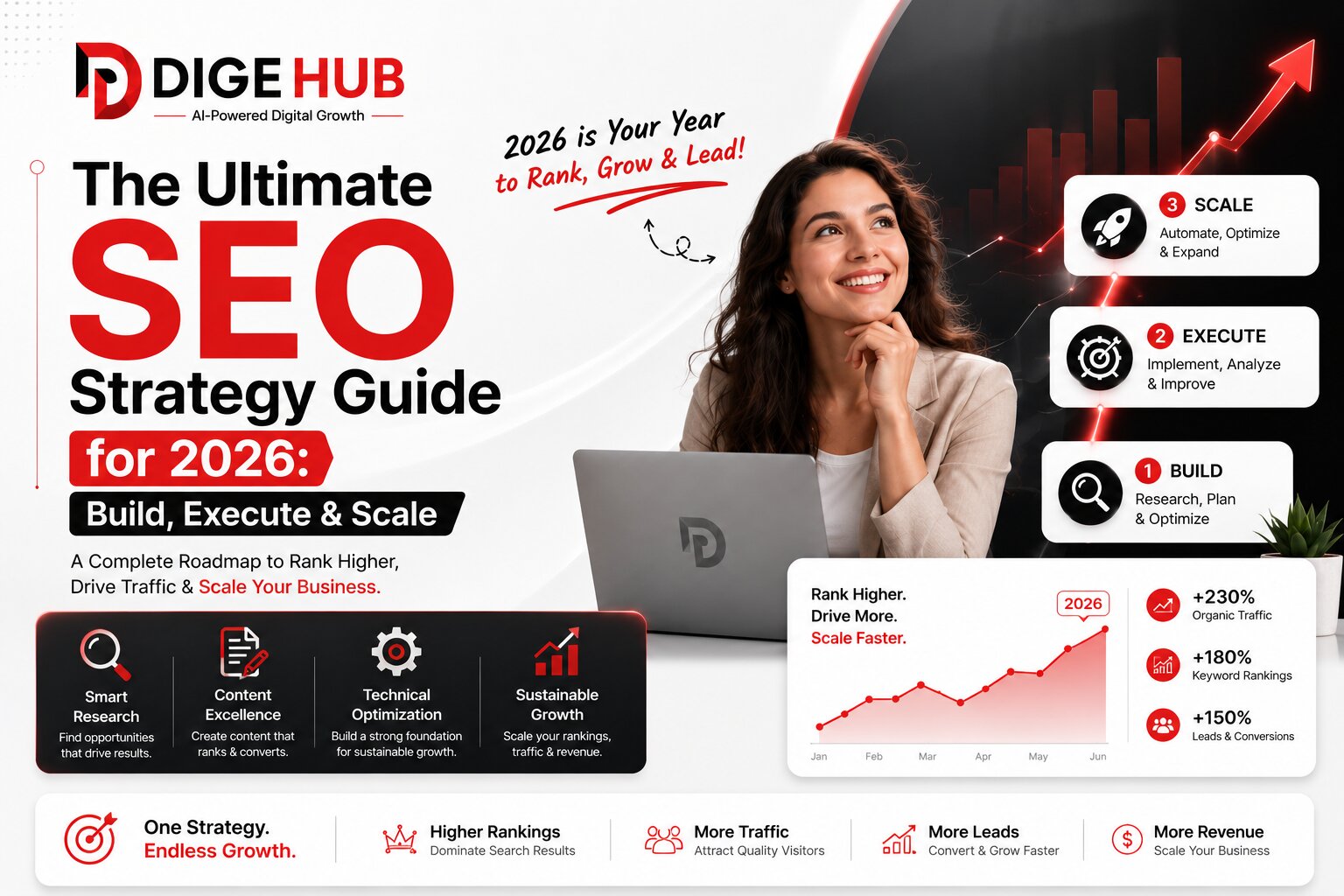
The Ultimate SEO Strategy Guide for 2026: Build, Execute, and Scale Organic Growth
Most businesses don’t have an SEO problem. They have a strategy problem.
They’re publishing content without a topical roadmap. They’re building backlinks without authority targeting. They’re tracking rankings without understanding what’s actually moving revenue. And increasingly, they’re optimising for a version of Google that no longer exists — while AI-powered search quietly reshapes who gets found and who gets ignored.
The data makes this stark: over 90% of web pages get zero organic traffic from Google. Not because the content is bad (though sometimes it is) — but because it exists without a coherent strategy connecting it to real business outcomes.
This guide changes that.
Whether you’re building your first SEO strategy from scratch, inheriting a broken one, or looking to evolve a working approach for the AI-era of search — what follows is the most complete, forward-looking SEO strategy framework we’ve built at Digehub. It’s the same architecture we use for ecommerce brands, SaaS companies, B2B service businesses, and global enterprises across the USA, UK, Canada, Australia, and beyond.
No recycled advice. No vague platitudes. Just strategy that works in 2026.
Quick Answer: What Is an SEO Strategy?
An SEO strategy is a structured, long-term plan to increase the quality and quantity of organic traffic to a website through search engines — primarily Google. A complete SEO strategy defines which keywords to target, how to structure content, how to earn authority, how to optimise technical infrastructure, and how to measure progress against business goals.
Unlike ad-hoc SEO tactics (fixing a title tag here, publishing a blog post there), a strategy connects every action to a deliberate outcome — ranking for the right queries, attracting the right audience, and converting that traffic into measurable business results.
What Is an SEO Marketing Strategy — and Why Does the Distinction Matter?
SEO strategy and SEO marketing strategy are often used interchangeably, but there’s a meaningful difference worth understanding.
An SEO strategy is primarily technical and architectural — it determines how your site will be structured, which content will be built, and how authority will be earned over time.
An SEO marketing strategy connects those technical decisions to your marketing funnel. It asks: which search queries represent buyers at which stages of awareness? What content converts organic visitors into email subscribers, trial sign-ups, or quote requests? How does SEO feed other channels — paid, social, email — rather than operating in a silo?
In 2026, the businesses winning at SEO aren’t thinking about rankings in isolation. They’re building search as a channel that feeds a system — and the strategy reflects that.
The 7 Pillars of a Winning SEO Strategy in 2026
Pillar 1: Goal Architecture — Know What You’re Actually Building Toward
The single biggest reason SEO strategies fail is the absence of a specific, commercially grounded goal. “Improve our rankings” is not a strategy goal. “Generate 500 qualified inbound leads per month from organic search within 18 months” is.
Your SEO goals need to connect to business metrics, not vanity metrics. Ask:
- What revenue contribution do we expect from organic search in 12 months?
- Which product lines, services, or audience segments should organic search serve first?
- What does a “conversion” from organic traffic actually look like for our business?
- Are we prioritising traffic growth, lead quality, revenue attribution, or brand authority?
Different answers produce radically different strategy structures. An ecommerce SEO strategy optimises category pages, product listings, and transactional long-tails. A B2B SaaS SEO strategy focuses on solution-aware queries, comparison content, and integration pages. A national SEO strategy for a service business looks nothing like a local SEO strategy for a multi-location franchise.
Start with the goal. Everything else derives from it.
Pillar 2: Keyword Strategy — Depth Over Volume
Keyword research in 2026 is not about finding the highest-volume terms and targeting them. That approach dominated early-era SEO because Google’s algorithm was simpler. Today, topical authority, search intent alignment, and entity relevance matter far more than keyword density.
The modern keyword strategy framework operates in three layers:
Layer 1 — Seed Keywords and Topic Domains: The 5–15 core topics your brand has genuine authority to address. These are not keywords; they’re conceptual territories. A cybersecurity company might own “zero trust architecture,” “endpoint security strategy,” and “cloud security compliance.” From these seeds, everything else branches.
Layer 2 — Intent-Mapped Keyword Clusters: For each seed topic, map out the full universe of questions people ask at different stages of awareness. Informational intent (“what is zero trust architecture”) sits at the top of the funnel. Commercial intent (“zero trust security vendors compared”) sits in the middle. Transactional intent (“enterprise zero trust implementation service”) converts.
Build content to cover all three layers across each topic domain — and you don’t just rank for individual keywords. You become the authoritative source on the topic in Google’s entity graph.
Layer 3 — Long-Tail Specificity: Long-tail keywords (3–6 word phrases with specific intent) are collectively responsible for more than 70% of search volume. They’re lower competition, higher intent, and easier to rank for — especially for newer sites building authority. A robust long-tail strategy compounds faster than chasing head terms and builds foundational authority that eventually carries into competitive keywords.
The tool stack that matters: Ahrefs and Semrush for competitive intelligence and gap analysis. Google Search Console for understanding what you already rank for and where intent-mismatch exists. Google’s “People Also Ask” boxes for identifying semantic sub-topics. Answer-the-public and AlsoAsked for question-format long-tails that feed AEO.
Pillar 3: Content Strategy — Topical Authority at Scale
Here’s the shift that defines content strategy in 2026: Google no longer evaluates individual pages in isolation. It evaluates them in the context of everything else on your domain about the same topic.
This is topical authority — and it’s the single most important structural concept in modern SEO content strategy.
The pillar-cluster model: Build one comprehensive pillar page (2,500–5,000 words) covering a topic broadly, then surround it with 8–15 cluster posts covering specific subtopics in depth. Internal links connect the cluster to the pillar and to each other. The structure signals to Google that your site has exhaustive, interconnected coverage of the topic — not just a single post that mentions it.
Content depth benchmarking: Before writing anything, audit the top five ranking pages for your target keyword. What questions do they answer? What do they miss? What angles are underrepresented? Your content should answer every question they answer — and several they don’t. This is how you create something genuinely better, not just longer.
Content formats beyond blog posts: In 2026, a text-only content strategy is incomplete for most industries. Structured comparison tables (high AI-Overview capture rate), step-by-step how-to content with schema markup, video content with transcripts and timestamps, and original data studies all attract different ranking opportunities and citation patterns from AI search tools.
Publishing cadence vs. publishing quality: The “publish X posts per week” model is dead. Google’s Helpful Content system actively demotes sites where a significant proportion of content appears machine-generated or created primarily for search engines. A cadence of 4–6 high-quality, deeply researched pieces per month consistently outperforms 20+ thin posts. Quality is the moat; volume is the trap.
For a full breakdown of how to structure and execute at scale, our complete SEO guide covers the implementation layer in detail.
Pillar 4: Technical SEO Strategy — Infrastructure That Multiplies Everything Else
Technical SEO is the multiplier layer. When it’s right, every content and link-building effort returns more. When it’s broken, even exceptional content underperforms.
The technical SEO strategy checklist for 2026:
Crawlability and Indexation: Configure your robots.txt to guide crawler attention to your highest-value pages. Submit an updated XML sitemap. Use Google Search Console’s Coverage report as a weekly diagnostic. If Google is choosing not to index pages it’s discovered — understand why before publishing more.
Core Web Vitals: LCP (load speed), INP (interactivity), and CLS (visual stability) are ranking signals with disproportionate impact on mobile. Run CWV audits in PageSpeed Insights monthly, not quarterly.
Site Architecture: Every important page should be reachable within three clicks from the homepage. Orphaned pages — those with no internal links pointing to them — receive near-zero crawl priority regardless of their content quality.
Schema Markup: In 2026, structured data is no longer optional for competitive SEO. FAQ schema, HowTo schema, Article schema, Product schema (for ecommerce SEO strategy), and Organization schema all increase the probability of enhanced SERP features and AI Overview citations. Implement and validate via Google’s Rich Results Test.
Page Experience Signals: HTTPS across all pages, no intrusive interstitials on mobile, and stable page layouts on load are foundational. These aren’t differentiators; they’re the cost of entry.
Duplicate Content Management: Canonical tags, hreflang for multilingual/multi-regional sites, and URL parameter handling in Search Console prevent indexation confusion that silently suppresses rankings.
Pillar 5: Backlinks SEO Strategy — Authority That Google Can’t Ignore
The backlinks SEO strategy conversation has matured significantly. It’s no longer about volume — it’s about velocity, relevance, and editorial legitimacy.
Google’s link evaluation in 2026 considers:
Topical relevance: A backlink from a site that covers adjacent topics in the same industry carries more weight than a generic high-DR link from an unrelated domain. A digital marketing tool linking to a digital marketing agency is worth more than a generic listicle directory linking to the same agency.
Editorial legitimacy: Links embedded naturally within the body of relevant, well-trafficked content outperform links in footers, sidebars, author bios, or low-traffic pages. The surrounding context matters to Google’s link evaluation models.
Link velocity: A sudden spike of 200 links in one month followed by nothing for six months looks manipulative regardless of link quality. A consistent acquisition of 10–20 high-quality links per month compounds without triggering algorithmic concern.
The best backlink strategy in 2026 combines four approaches:
Digital PR and original research: Publish data that journalists, bloggers, and industry analysts want to cite. An annual industry benchmark report, a contrarian study challenging common assumptions in your industry, or a free tool that solves a specific problem — these attract links passively at scale. One strong digital PR placement can generate 20–50 links simultaneously.
Strategic guest posting: Writing for authoritative, topically relevant publications in your vertical. Not “write-for-us” link farms — genuine industry publications with real editorial standards and real readership.
Resource page outreach: Identify “best resources” and “recommended tools” pages in your niche. If you have a genuinely useful asset that belongs on those lists, targeted outreach converts at a meaningful rate.
Competitor gap analysis: Use Ahrefs’ Link Intersect tool to find sites linking to multiple competitors but not to you. These are the warmest outreach targets available — they’ve already proven they link to content like yours.
Pillar 6: SEO Strategy by Business Type
Different business models require fundamentally different strategic emphasis. Here’s how the framework adapts:
Ecommerce SEO Strategy
Ecommerce SEO operates across three distinct page types, each requiring separate optimisation logic:
Category pages are the highest-value targets — they capture broad commercial intent at volume. They need unique, substantive content above and below the product grid (not just keyword-stuffed paragraphs), optimised H1s, internal links to subcategories, and structured data for product listings.
Product pages need unique descriptions (not manufacturer copy), schema markup with pricing and availability, review schema, and fast-loading image optimisation. Thin product pages are one of the leading causes of Panda-era penalties that still affect ecommerce sites.
Blog and comparison content captures the informational layer — “best wireless earbuds under $100,” “product A vs product B” — and feeds category pages through strategic internal linking.
B2B SEO Strategy
B2B SEO is fundamentally different from B2C in that the buying cycle is long, the decision-makers are multiple, and the content needs to serve different personas at different stages of awareness.
A strong B2B SEO strategy includes: solution-aware pages targeting the problem your product solves (not just the product category), comparison and alternative pages capturing buyers evaluating options, integration pages capturing technical buyers searching for compatibility, and case studies with schema markup that appear in rich results.
The SEO vs AEO vs GEO guide on our blog explains how B2B content strategy needs to extend into AI answer engine visibility — where many B2B research queries are now being answered without a traditional search click.
National SEO Strategy
A national SEO strategy is distinct from local SEO in that it targets broad, non-location-specific keywords at a country level rather than city or region level. For businesses operating nationally, the priorities are:
Building domain authority that can compete with established national brands. Targeting high-volume informational and commercial keywords that don’t include a location modifier. Creating industry thought leadership content that attracts editorial backlinks from national publications. Optimising for AI Overviews and featured snippets, which dominate national keyword SERPs at a higher rate than local ones.
HubSpot SEO Strategy and CRM-Connected SEO
One of the most underutilised capabilities in modern SEO strategy is connecting your SEO data to your CRM — which HubSpot enables natively. When you can see which organic search keywords are producing MQLs, not just traffic, your keyword prioritisation becomes dramatically more precise.
A HubSpot SEO strategy also leverages the platform’s topic cluster tool to map your pillar-cluster architecture, monitor page-level organic performance, and integrate SEO data with email nurture and lead scoring workflows. The insight this produces — “these five keyword clusters generate 80% of our organic-sourced revenue” — is impossible to reach with standard analytics.
Pillar 7: AI-Era SEO Strategy — Optimising for the Search Landscape That Exists Now
The search landscape has bifurcated. Traditional blue-link results still drive significant traffic — but AI Overviews, Perplexity answers, ChatGPT Search, and Gemini responses are capturing an expanding share of query resolutions, particularly for informational searches.
An SEO strategy that ignores this reality is already operating at partial capacity.
What AI-powered search selects for:
Direct, structured answers early in the content. Factual claims with citations to authoritative sources. Schema markup that identifies content type, authorship, and topic. Brand entity strength in Google’s Knowledge Graph. Consistent, accurate NAP and business information across the web.
What it penalises: Vague, opinion-heavy content without factual grounding. Content that takes too long to get to the point. Pages that aren’t associated with a recognisable, verifiable entity (brand, author, or organisation).
Monitoring AI search visibility: Standard rank tracking tools don’t track AI Overview citations. To understand your actual search visibility in 2026, you need dedicated monitoring for how your brand and content appear in AI-generated answers across Google, Bing Copilot, Perplexity, and ChatGPT Search. This is an emerging capability but an increasingly critical one.
Our AI Visibility services are built specifically to address this gap — helping brands get surfaced in AI-powered answers, not just traditional organic results.
How to Build an SEO Strategy: A 7-Step Framework
Step 1 — Audit your current position: Before building forward, understand where you stand. Run a full technical audit, keyword gap analysis against your top three competitors, and backlink profile review. You can’t chart a course without knowing your starting coordinates.
Step 2 — Define goals and KPIs: Set specific, time-bound targets aligned to business outcomes. Traffic targets, keyword ranking targets, lead volume targets, and revenue attribution targets — all connected to a timeline.
Step 3 — Define your topical territory: Choose 3–5 core topic domains that represent genuine expertise and commercial relevance. Resist the temptation to cover everything. Depth beats breadth for topical authority.
Step 4 — Build your keyword architecture: Map a full keyword universe across your topic domains — informational, commercial, and transactional intent — and prioritise by opportunity score (search volume × intent quality × competition gap).
Step 5 — Create your content calendar: Sequence your pillar pages first, then cluster content. Assign formats (long-form guides, comparison posts, how-to tutorials, data studies) based on intent and competitive gaps. Build in a realistic cadence — quality is the non-negotiable constraint.
Step 6 — Execute technical foundations: Ensure crawlability, Core Web Vitals, schema markup, internal linking, and mobile experience are all set before you scale content production.
Step 7 — Build authority in parallel: Start link acquisition from day one. Even while content is being built, digital PR outreach, strategic partnerships, and resource page placements can begin compounding your authority base.
Revisit and recalibrate the strategy every quarter — SEO is iterative, and the competitive landscape shifts. For a deep implementation walkthrough, see our local SEO for small businesses guide as a model for how pillar-cluster strategy works in practice across a niche.
SEO Strategy for Financial Services: A Special Case
Financial services SEO sits under one of Google’s most scrutinised YMYL (Your Money Your Life) categories. The standard for E-E-A-T signals is significantly higher — and the stakes of thin or misleading content are greater, both for rankings and regulatory compliance.
The best SEO strategies for financial services firms include:
Author credentialing: Every piece of content should be attributed to a named, credentialed author — ideally a licensed financial professional — with a detailed bio, professional credentials, and links to verifiable professional profiles. Anonymous or ghostwritten content performs significantly worse on financial service keywords.
Fact-checking and citation hygiene: All statistics, regulatory references, and product claims should be sourced from authoritative primary sources (government publications, regulatory bodies, major financial institutions). Outdated statistics — even by one year — can suppress rankings in YMYL categories.
Compliant commercial content: Service pages need to be honest, specific, and free of misleading claims. Exaggerated return promises or overstated claims not only violate compliance requirements but trigger manual review flags in Google’s quality rater assessments.
Trust signals at scale: SSL, clear authorship, visible regulatory disclosures, professional reviews, and a strong Google Business Profile all feed the trust signals Google prioritises for financial content.
SaaS Content Strategy vs. SEO Strategy: Which Wins?
This is a false choice — but the tension is real enough to deserve a direct answer.
SaaS content strategy prioritises thought leadership, product education, and brand narrative. It builds the kind of content that makes users understand why the product exists, not just what it does. It’s vital for retention, product adoption, and community building.
SEO strategy prioritises search-driven discovery — getting found by people who don’t know your product exists yet, at the moment they’re searching for a solution to the problem you solve.
In practice, the highest-performing SaaS growth engines integrate both. Thought leadership content that’s also keyword-optimised for the queries potential customers are searching captures demand at the awareness stage. Product-level SEO content (integration pages, feature comparison pages, use case pages) captures demand at the decision stage.
The sequencing depends on your growth stage. For a pre-PMF SaaS: prioritise content strategy for narrative clarity and investor/partner credibility. Post-PMF with a defined ICP: shift toward SEO strategy for demand capture at scale. At Series B and beyond: both engines should be running simultaneously with dedicated ownership.
Common SEO Strategy Mistakes That Compound Over Time
Building a strategy around vanity keywords: Targeting a top-10 keyword with 100,000 monthly searches sounds impressive in a board deck. But if the intent doesn’t align with your buyer stage and you have no realistic path to page one authority in a reasonable timeframe, it’s theatre. Strategic keyword targeting means prioritising keywords where you can win AND where winning drives revenue.
Treating the SEO strategy template as the strategy itself: There are hundreds of downloadable SEO strategy templates online. A template is a starting framework — not a strategy. A real strategy is grounded in your specific competitive landscape, business model, content capabilities, and commercial goals. Templates tell you what categories to fill in; strategy tells you what to fill them with.
Ignoring the SEO-to-revenue connection: Many SEO strategies track traffic and rankings but can’t demonstrate revenue impact. Without connecting organic visits to lead submissions, trial sign-ups, or purchase events through properly configured analytics and CRM attribution, you can’t defend the investment or optimise intelligently.
Under-resourcing link acquisition: Most companies invest heavily in content and neglect backlinks. Without earned authority, even exceptional content struggles to break into competitive keyword positions. Authority and content are co-dependent, not sequential.
Strategy misalignment with the sales cycle: An SEO strategy that drives top-of-funnel informational traffic to a product built for late-stage enterprise buyers produces traffic that doesn’t convert. The keywords, content, and CTAs need to match the actual buying journey.
Expert Insight: Why Most SEO Strategies Stall at Month Six
Here’s a pattern we’ve observed consistently across industries: an SEO strategy launches with good architecture, good content, and reasonable expectations. Rankings start moving. Traffic begins growing. At month four or five, early wins create momentum. Then, at month six or seven, growth plateaus — and the strategy gets questioned or abandoned.
The plateau almost always has the same cause: the easy wins (long-tail keywords, existing page optimisations, technical fixes) have been captured, but the medium-competition keywords the strategy was really built for haven’t moved yet. They need more authority, more content depth, and more time than the initial wins required.
This is not a failure state — it’s a normal inflection point in every SEO strategy lifecycle. The brands that push through it with consistency emerge on the other side with compound organic growth that outpaces every paid channel. The brands that abandon it restart from zero, over and over.
The fix is expectation architecture: before launching the strategy, map the timeline honestly. Quick wins happen in months one to three. Foundational growth happens in months four to eight. Compounding authority-driven growth begins in months nine through eighteen and beyond.
If you’re working with an SEO strategy company and they’re not communicating this timeline proactively, that’s a signal worth paying attention to.
Future Outlook: How SEO Strategy Will Evolve Through 2026 and Beyond
AI-generated content will require human signal differentiation: As AI-generated content floods the web, the differentiator will be verifiable first-hand experience, original data, and genuine expert perspective — the signals that AI tools can’t replicate. E-E-A-T (Experience, Expertise, Authoritativeness, Trustworthiness) will become the primary quality vector.
Entity-based SEO will outpace keyword-based SEO: Google’s Knowledge Graph is becoming increasingly central to how relevance is determined. Brands that build strong entity signals — consistent business information, Knowledge Panel presence, author entity markup, product entity associations — will have a structural advantage that keyword optimisation alone can’t match.
Multimodal search will expand the strategy surface area: Google Lens, voice search, video search, and AI-powered image understanding are all growing share. An SEO strategy that doesn’t account for how your content can be found through non-text queries is already incomplete for visual and local-intent queries.
Automation will separate scalable strategies from manual ones: The AI Automation layer of SEO — automated keyword clustering, AI-assisted content briefs, automated internal link suggestions, real-time rank monitoring, and competitive signal alerts — is now available to businesses of all sizes. The gap between teams using these capabilities and those doing everything manually will widen significantly through 2026.
Frequently Asked Questions
What is an SEO strategy? An SEO strategy is a structured, long-term plan to improve a website’s visibility in search engine results through technical optimisation, content development, and authority building — all aligned to specific business goals.
How do I create an SEO strategy? Start by auditing your current position, defining commercial goals, mapping your topical territory, building a keyword architecture, creating a content calendar, fixing technical foundations, and building authority in parallel. Revisit and recalibrate quarterly.
How do I develop an SEO strategy for B2B? A 7-step B2B SEO strategy includes: (1) defining your ICP’s search behaviour, (2) mapping keywords to buying stages, (3) building solution-aware content, (4) creating comparison and alternative pages, (5) developing technical integration content, (6) earning authority from industry publications, and (7) connecting SEO data to CRM for revenue attribution.
What is SEM vs SEO strategy? SEM (Search Engine Marketing) includes both paid search (PPC/Google Ads) and organic search (SEO). An SEO strategy focuses on organic rankings through content and authority. An SEM strategy encompasses both organic and paid tactics, often using paid search for immediate traffic while SEO builds long-term compounding returns.
What are the best SEO strategies for financial services firms? Financial services SEO requires credentialed authorship, primary source citation, YMYL-specific E-E-A-T signals, compliant commercial content, and strong trust signals (reviews, regulatory disclosures, professional credentials). Content depth and factual accuracy are prioritised more heavily than in non-YMYL verticals.
Which is better — SaaS content strategy or SEO strategy? They’re not competing approaches — the best SaaS growth engines integrate both. Content strategy builds brand narrative and product education; SEO strategy captures demand from people actively searching for the problem you solve. Sequence depends on your growth stage, but at scale, both should run simultaneously.
What are the best local SEO strategies for small businesses? Optimise your Google Business Profile fully, build consistent local citations, generate genuine customer reviews, create location-specific landing pages, and develop hyperlocal content targeting neighbourhood-level queries. For a full tactical playbook, see our local SEO for small businesses guide.
How can an AI search monitoring platform improve SEO strategy? AI search monitoring platforms track how your brand and content appear in AI-generated answers (Google AI Overviews, Perplexity, ChatGPT Search) — visibility that standard rank trackers don’t capture. This data allows you to identify which content formats, structured data types, and topic areas are generating AI citations, and adjust your strategy accordingly.
What are SEO strategies and techniques for ecommerce? Core ecommerce SEO techniques include: unique category page content with intent-matched copy, product schema markup, optimised product descriptions, faceted navigation management (to prevent indexation of low-value filter combinations), internal linking from blog content to category pages, and page speed optimisation for mobile product pages.
What is the best SEO strategy overall? The best SEO strategy is the one built specifically for your business model, competitive landscape, and commercial goals — not a generic template. It combines technical excellence, topical authority, intent-matched content, legitimate authority building, and AI-era visibility into a coherent, long-term compounding system.
Build Your SEO Strategy on a Foundation That Lasts
SEO in 2026 is not simpler than it was five years ago. But it is more knowable. The signals Google rewards are clearer. The content Google penalises is more predictable. The AI-era demands on brand visibility are better understood.
What hasn’t changed: the businesses that build a disciplined, well-architected SEO strategy and execute it consistently outperform those who treat search as a collection of one-off tactics. Every time.
The strategy framework in this guide — goal architecture, topical authority, technical foundations, backlinks, business-type customisation, and AI-era adaptation — is designed to compound. Each pillar strengthens the others. Each month of consistent execution builds on the last.
The only variable is whether you build it yourself, in-house, or with a team that’s already done it at scale.
Ready to Build an SEO Strategy That Actually Compounds?
At Digehub, we build SEO strategies from the ground up — custom-architected to your business model, competitive landscape, and growth targets. From ecommerce SEO strategy to national B2B campaigns to AI visibility optimisation, our team operates at the intersection of technical precision and strategic clarity.
If you’re in the USA, UK, Canada, or Australia — or scaling globally — we’d like to understand your situation and show you what a strategy built specifically for your business looks like.
→ Explore Digehub’s SEO Strategy Services