
SEO for Interior Designers and Architects in Chennai: Get Project Enquiries
A homeowner choosing a designer looks at photos first, then checks whether you work in their area, in their budget and in their style. Your website has to answer all three quickly. This guide shows how Chennai interior designers and architects can turn a portfolio into searchable pages that bring in serious project enquiries, and what architects must keep in mind about advertising rules.
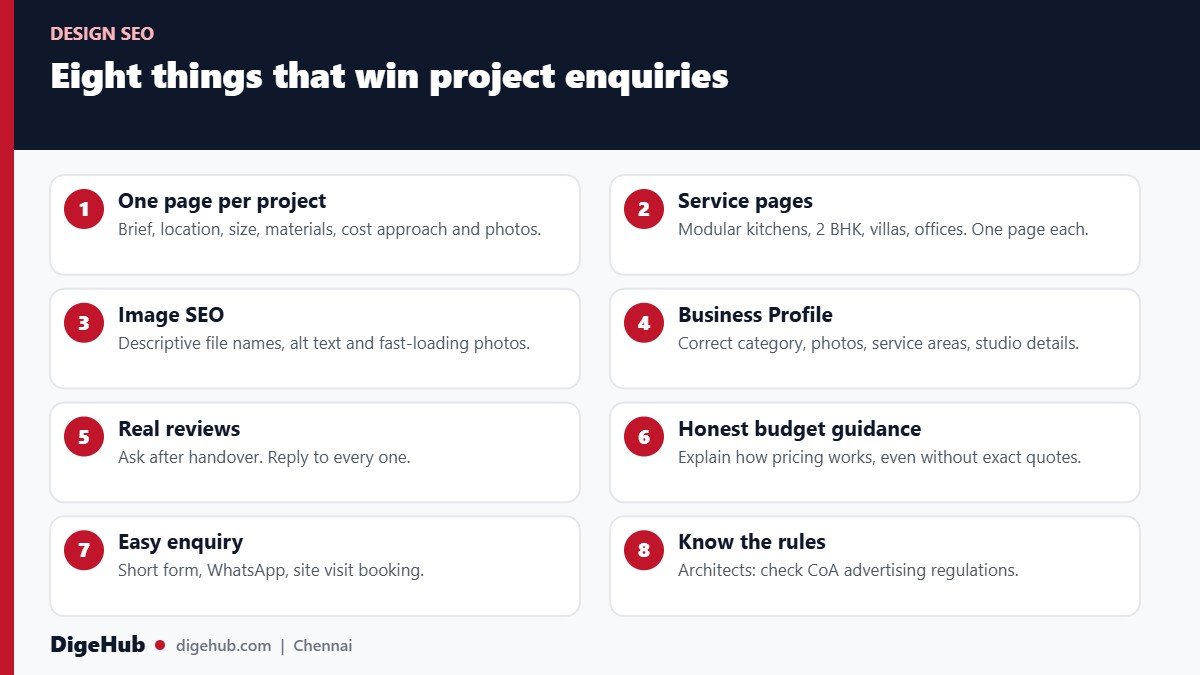
What people actually search before hiring a designer
In Google Keyword Planner (India, 5 November 2026), “interior designer seo” sits in the 100 to 1,000 monthly search range and “seo for architects” in the 10 to 100 range. That tells us designers are looking for this help, but the searches that matter for your own business come from homeowners. They fall into four groups:
| Intent | Example searches | What the page must do |
|---|---|---|
| Find a designer | “interior designers in Chennai”, “interior designers in Velachery” | Show you work in that area, with proof |
| Specific service | “modular kitchen Chennai”, “2 BHK interior design”, “villa architects ECR” | Explain the service, process, timeline and examples |
| Cost | “interior design cost per sq ft Chennai” | Explain how you price, what changes the cost, what is included |
| Inspiration | “pooja room design”, “small balcony ideas” | Show real work that suits Chennai homes and climate |
These are example searches to check against your own Search Console data, not volumes we are quoting. Each group needs a different kind of page, which is why a single “Portfolio” page rarely performs. Our SEO agency in Chennai work for design studios starts by mapping these searches to pages.
Turn each project into a page that sells the next one
Most design websites have a gallery of beautiful photos with no words. Google cannot see taste, and a buyer cannot judge fit from images alone. A project page that includes the following gives both what they need:
- The brief. Who the client was, what they wanted, and what constraints you worked within, such as a small flat or a rental.
- Location and size. “3 BHK apartment, Adyar, 1,450 sq ft” is more useful than “luxury home”. Keep client privacy in mind: the locality is enough, not the address.
- Materials and choices. Plywood grade, finishes, hardware, lighting, and why you chose them. This is where expertise shows.
- Timeline and process. How long it took and what happened at each stage.
- Cost context. Even a range or a “what drove the cost” note helps, as long as it is true.
- Before and after photos, with the client’s permission.
- A short client comment, only if it is real and permitted.
Link each project page to the relevant service page, and each service page back to its best projects. That internal linking tells search engines which work belongs to which service. See our on-page SEO checklist for titles, headings and link structure.
Image SEO: your photos are your biggest asset
Google says it uses image alt text and surrounding page text to understand an image, and recommends descriptive file names and alt text, standard HTML image tags and fast-loading pages. For a design studio, that translates into a few habits:
- Name files properly. “modular-kitchen-l-shape-adyar.jpg” beats “IMG_4821.jpg”.
- Write alt text for people. Describe what is in the photo in one plain sentence, for example “L-shaped modular kitchen with white cabinets and granite counter in an Adyar apartment”. Do not stuff keywords.
- Compress properly. Large uncompressed photos slow the page. Google’s guidance for a good Largest Contentful Paint is 2.5 seconds or less. Use modern formats such as WebP and size images to the layout.
- Put images in context. A photo next to a paragraph that explains it is easier to understand than a wall of thumbnails.
- Add captions where useful: room, material, designer’s note.
The photos must be yours. Using other studios’ images, or stock photos presented as your work, damages trust and may break copyright. Take time to photograph projects well after handover; it pays back for years.
Google Business Profile: studio or service-area
Searches like “interior designers near me” are answered from the map pack, so your Business Profile matters. The setup depends on how you work:
- If clients visit your studio or showroom, show the address and opening hours, and add photos of the space.
- If you work only at client sites and do not receive clients at a physical address, Google lets service-area businesses hide the address and list the areas they serve. Do not use a virtual office or a rented address you do not actually operate from, since Google’s guidelines prohibit that.
- Use the most specific primary category that fits, such as interior designer, and add secondary categories only if they are real services.
- Keep the name exact. The business name should match what is on your signage and site, without added keywords.
- Add project photos regularly, labelled by room and style.
Our Business Profile guide and local SEO guide walk through the details. Reviews are the other half; see the next section.
Reviews: the strongest proof for a high-value decision
An interior project is expensive and takes months. Buyers read reviews carefully, and a few detailed ones carry more weight than many one-liners. BrightLocal’s 2026 consumer review survey (US data) found that consumers read reviews closely and care about how recently they were posted, and the same habits are visible in Indian markets, although the data is American.
The best time to ask is at handover, when the client sees the finished home. Send a direct link to your profile on WhatsApp, thank them, and make it clear that honest feedback is welcome. Do not offer discounts or gifts for reviews, and do not write them yourself. Reply to every review: thank the happy ones and respond calmly to the unhappy ones with what you will do. Prospects read those replies. See Google reviews for Chennai businesses for message templates and rules.
A note for architects: advertising rules
Interior design is not regulated in the same way as architecture, but registered architects in India are bound by the Council of Architecture’s Professional Conduct Regulations, 1989. Clause xxv states that an architect shall not advertise professional services, with a list of exceptions that includes listing a name on a website directory and unpaid press coverage. In practice, this means an architect’s site should concentrate on facts: who you are, your registration, your qualifications, the type of work you do, and the projects you have completed, not promotional claims or paid placements. Only registered architects may use the title “architect” under the Architects Act, 1972, so interior designers who are not registered should describe themselves as designers or design consultants.
This is not legal advice. The regulations have been amended over time, so read the current text on the Council of Architecture’s website, ask your professional body if unsure, and have the final website content reviewed by someone qualified before publishing. Good SEO for an architect is largely about being easy to find and clearly informative, which sits comfortably within a factual approach. Compare how we handle another regulated profession in law firm SEO in Chennai.
Be honest about budget, and make enquiries easy
Most visitors cannot judge cost until they speak to someone, which is why many designers hide it. The result is wasted calls on both sides. A better approach is to explain how you price: per sq ft, per room, by scope, or by a design fee plus execution, what is included, and the main things that change the cost. You do not need to publish exact quotes. A clear explanation filters out poor matches and attracts clients who value transparency.
Then make the next step easy:
- A short enquiry form with property type, location, size, timeline and budget range.
- A click-to-call and WhatsApp button that works well on mobile.
- A site visit or consultation booking option.
- A reply promise. Fast responses win projects.
Track calls and WhatsApp clicks as well as form fills, because many Chennai clients call first.
Content that only a Chennai designer can write
Generic articles on “top interior trends” are everywhere. What a local studio can offer is knowledge of how homes in this city actually behave, and that is both useful to readers and hard for a national site to copy. Some topics worth a proper page, written from your own project experience:
- Humidity and coastal air. Which plywood, laminates and hardware hold up near the coast, and which warp or rust. Name the materials you use and why.
- Apartment layouts common in Chennai. Typical 2 BHK and 3 BHK plans in areas such as Velachery, OMR, Porur and Adyar, and how you handle awkward corners, small kitchens and limited storage.
- Vastu and traditional requirements. Many families ask for pooja rooms and vastu-aligned layouts. Explain how you handle those requests practically.
- Heat and light. False ceilings, balcony treatments and window choices for hot summers and heavy monsoon rain.
- Society and builder rules. Approvals, working hours, material movement and permitted changes in apartment communities.
- Timeline reality. How long a typical project takes and what delays it, such as approvals, material lead times and the monsoon.
Each of these answers a question a homeowner is already asking. They also show real experience, which Google’s guidance on helpful content rewards. Link them to your project pages as evidence, and link service pages to them for depth.
Mistakes we see on design studio websites
- A portfolio that is only images. No text means no signal for search engines and no reasoning for buyers. Add the brief, the choices and the result.
- Slow pages from huge photos. A homepage slider with twenty uncompressed images can take many seconds to load on a phone. Compress, size correctly and load lazily below the fold.
- One page for every service. “Interiors” on a single page cannot rank for kitchens, wardrobes, offices and villas at the same time. Give each a page.
- Copying competitor text. Many studios use almost identical descriptions of “bespoke, luxurious spaces”. Write what you actually do.
- Location mismatch. Listing ten neighbourhoods you have never worked in. Only name areas where you have real projects or a genuine service presence.
- No follow-up on enquiries. A lead that waits two days for a reply is often gone. Reply within hours and keep a simple log of source and outcome.
- Using the word “architect” loosely. If you are not a registered architect, say designer or design consultant.
Fixing these usually produces a quicker improvement than adding new pages. A thorough SEO audit lists them in order of effect so you know where to begin.
How to measure whether SEO is working for a design studio
Design is a high-value, low-volume business. You do not need thousands of visitors; you need a steady flow of the right ones. Track measures that reflect that:
- Qualified enquiries per month from organic search, defined by property type, location and budget fit and not just any form fill.
- Calls and WhatsApp clicks from the website and the Business Profile.
- Searches that bring visits, as reported by Search Console, grouped by service and area.
- Project page engagement: do visitors view a project and then open the enquiry page?
- Source of closed projects. Ask every new client how they found you and record it.
Review these monthly. If a service page gets visits but no enquiries, the page needs better proof or an easier next step. If a project page gets neither, it may need more detail or links from your service pages.
A 90-day plan and what it costs
| Period | Work |
|---|---|
| Days 1 to 30 | Audit the site, fix speed and image problems, set up tracking, correct the Business Profile, write the first three service pages. |
| Days 31 to 60 | Rebuild five best projects as full project pages. Collect reviews from recent clients. Add FAQs. |
| Days 61 to 90 | Publish area-specific content with real project evidence. Review Search Console, enquiries and calls. Adjust. |
A single studio usually fits our Local SEO Starter plan (Rs40,000 to Rs60,000 a month). Larger firms with several services or branches often need Growth SEO (Rs65,000 to Rs1.2 lakh). Plans are month-to-month with no lock-in, and we start with a free audit. Send us your website on WhatsApp and we reply within two business hours.
SEO is not instant. Ahrefs found only a small share of new pages reach the top ten within a year, and nobody can honestly guarantee a number one position. What you can do is build pages that are useful enough to deserve it.
Frequently asked questions
Do interior designers need SEO or is Instagram enough?
Can architects in India advertise?
How many projects should be on the website?
Should we publish prices?
I work only at client sites. Do I need a business address on Google?
How long does it take to see enquiries from SEO?
Sources and further reading
- Google Search Central: Google Image SEO best practices
- Google Business Profile Help: Guidelines for representing your business
- Google Search Central: Core Web Vitals
- Council of Architecture: Architects (Professional Conduct) Regulations, 1989
- BrightLocal: Local Consumer Review Survey
- Ahrefs: How long does it take to rank
- Google Keyword Planner (India, English), checked 5 November 2026
Want this done for your Chennai business?
Tell us what you sell and where your customers are. We will send a straight answer on what is worth doing first, with no lock-in contract.
- Free audit of your site, Google Business Profile and AI answers
- Reply within 2 business hours on WhatsApp
- Month-to-month plans from ₹40,000