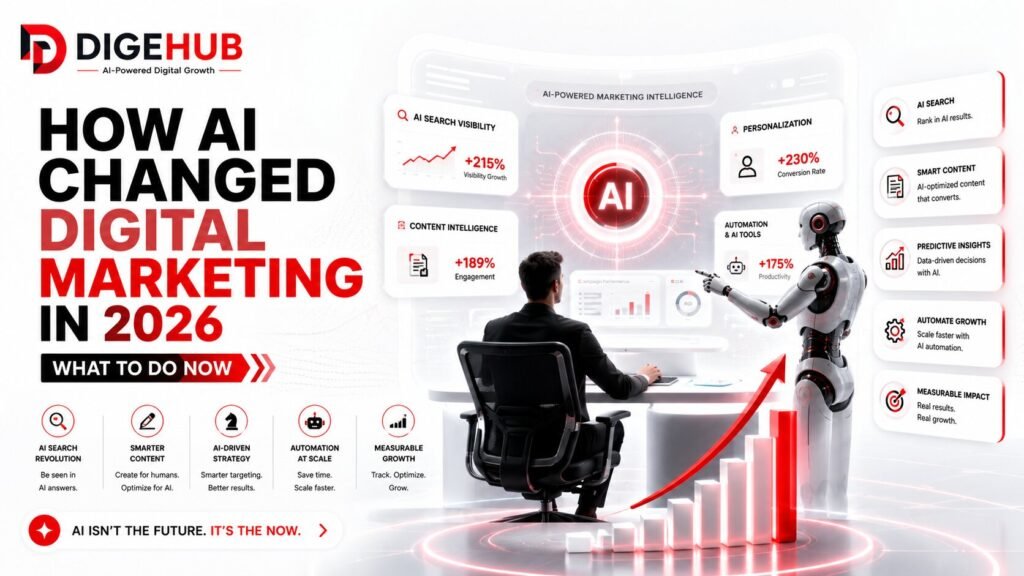
How AI Changed Digital Marketing in 2026 (And What Every Business Needs to Do Right Now)
The Real Disruption: What AI Actually Changed and What It Didn’t
How AI changed digital marketing is a question that gets answered too broadly or too narrowly in most coverage. Broadly: “AI is transforming everything.” Narrowly: “here are 10 AI tools for marketers.” Neither framing helps you make better decisions.
The honest answer is more specific. AI has fundamentally changed some functions of digital marketing while leaving others largely intact. Getting clear on which is which is the most operationally useful thing a marketing leader can do in 2026.
The changes that are structural and require strategic response: search behavior, content strategy, buyer research behavior, and measurement frameworks. These have shifted in ways that require different inputs, different tactics, and different success metrics from what most marketing teams have been running.
The changes that are tool-level and require tactical adoption: content production assistance, ad creative generation, audience segmentation, and campaign optimization. These matter, but they’re efficiency improvements within existing functions, not structural shifts that require strategic reinvention.
The changes that are overhyped and mostly haven’t materialized yet: AI agents fully replacing human marketing functions, fully autonomous campaign management, AI-generated content reliably outperforming expert human content at the authority level. These are coming but aren’t the present-tense strategic problem most marketing leaders need to solve today.
This blog focuses on the structural changes, because those are the ones that require decisions, not just tool subscriptions.
- How AI Changed Digital Marketing in 2026 (And What Every Business Needs to Do Right Now)
- The Real Disruption: What AI Actually Changed and What It Didn't
- Quick Answer: How Has AI Changed Digital Marketing in 2026?
- AI Changed Search: The Zero-Click Reality and What to Do About It
- AI Changed Content: From Volume Game to Authority Game
- AI Changed Paid Advertising: Automation, Audiences, and Creative
- AI Changed the Buyer Journey: Research Happens Inside AI Now
- AI Changed SEO: What Still Works and What Doesn't
- AI Changed Analytics: The Measurement Gap Most Brands Are Missing
- The Marketing Functions AI Has Not Changed (Yet)
- What to Do Now: A Prioritized Action Framework
- Industry-Specific Impact: Where AI Changed Marketing Most
- Common Mistakes Brands Are Making in Response to AI
- Expert Insights: What Separates Brands Winning in 2026
- Future Trends: Where AI Is Taking Digital Marketing Next
- FAQ: How AI Changed Digital Marketing
Quick Answer: How Has AI Changed Digital Marketing in 2026?
AI has changed digital marketing in 2026 in four structurally significant ways:
Search: Google AI Overviews now appear on 50 to 60% of queries. 60 to 70% of searches end without a click. Perplexity processes 30 million searches per day. ChatGPT has 900 million weekly active users. The surface on which buyers first encounter brands has shifted from ranked links to synthesized AI answers, which rewards different content and different infrastructure.
Content: AI-generated content has commoditized synthesis. The volume game is over. The authority game, which requires genuine expertise, original data, and verifiable credentials, is what drives citation and ranking in 2026. The brands winning are producing less generic content and more specific, experience-backed, citation-worthy content.
Buyer research: 65% of B2B buyers now use AI tools before making first contact with a vendor. 41% cite AI-assisted search as their primary discovery channel for new suppliers. Buyers have AI-mediated first impressions of your brand before they ever visit your website. That changes what brand authority means and where you need to build it.
Measurement: Standard GA4 and Search Console data now captures less than half of the search visibility picture. AI citation performance, Share of Model, and AI referral traffic attribution are measurement categories that didn’t exist three years ago and aren’t tracked by default analytics setups.
AI Changed Search: The Zero-Click Reality and What to Do About It
This is the structural shift with the broadest commercial impact, and it’s the one most marketing teams have been slowest to respond to.
Google AI Overviews appear on approximately 50% of all US queries, up from 6.49% in January 2025. That’s an 8x expansion in 15 months. Organic click-through rates on queries that trigger AI Overviews dropped 61%, from 1.76% to 0.61%, per Seer Interactive’s analysis of 2.43 billion impressions. 60% of all Google searches now end without any click at all.
The response most brands have had: watch the traffic data and worry. The response that actually addresses the problem: build citation authority inside the AI answers, so that when your potential customers get information from an AI Overview, Perplexity, or ChatGPT, your brand is the attributed source.
The distinction between being cited and not being cited on the same AI search query is significant. Brands cited inside AI Overviews earn 35% more organic clicks and 91% more paid clicks than uncited brands ranking in position one below the AI answer. On Perplexity, being citation [1] captures 60 to 70% of the resulting click-through traffic. Not being cited on a zero-click query means effectively not existing for that query.
The strategic response to AI-changed search is not to panic about click losses. It’s to compete for citation real estate inside the answers. This is what AI search visibility optimization covers as a discipline: building the content architecture, entity infrastructure, and multi-platform presence that earns consistent AI citations across the platforms where your buyers are searching.
Understanding how AI search differs from traditional search, at a structural level, is the prerequisite. Our analysis of AI search vs traditional SEO covers the specific differences that determine where to invest differently.
AI Changed Content: From Volume Game to Authority Game
This is the shift that has the most direct impact on how marketing teams should structure their content operations.
Before AI-generated content became ubiquitous, content volume was a meaningful competitive variable. Publishing more frequently, covering more topics, and building larger content archives produced compound traffic gains because more content meant more indexed pages and more ranking opportunities. That model still applies, but with a critical qualification: it only works if the content has genuine authority signals that AI-generated content can’t replicate.
The qualification matters because AI has commoditized synthesis. Any organization can now produce a readable, well-structured 1,500-word post on any topic at minimal cost. The marginal value of that kind of content is approaching zero from a citation standpoint, because AI search systems can synthesize that information without needing to cite any specific source.
What AI cannot commoditize, and what therefore has increasing competitive value, is content that contains information that exists nowhere else: original data from proprietary research, documented first-hand experience with specific measurable outcomes, genuine institutional expertise demonstrated through the specificity of claims rather than their generality, and verifiable credentials that distinguish the author as a real expert rather than a content producer.
The brands winning in 2026 are not producing more content. They’re producing more citable content. Fewer pieces with higher authority signals, rather than more pieces with lower differentiation. This is a fundamental shift in how content investment should be allocated and measured.
The content strategy implications are covered in depth in our content strategy for AI search guide, including the answer-forward writing system that makes content extractable by AI synthesis systems and genuinely more useful for human readers simultaneously.
The underlying content structures that produce citations, including how topical clusters work, how freshness maintenance operates as a standing operation, and why original data is now the most defensible content investment, are all practical decisions that marketing teams need to make now, not after AI search adoption grows further.
AI Changed Paid Advertising: Automation, Audiences, and Creative
The paid advertising function has been changed by AI in ways that are more tool-level than structural, but the tool-level changes are significant enough to affect strategy.
Creative generation. AI creative tools have materially reduced the cost and time of producing ad creative variants. The practical implication is that testing velocity has increased: marketing teams can now test 20 creative variants for the same budget that previously covered 5. This shifts the advantage toward teams that have strong creative testing frameworks, not toward teams that can produce more variants. The bottleneck has moved from production to strategy.
Audience intelligence. AI-powered audience segmentation and intent prediction has improved targeting precision significantly. Google’s and Meta’s AI bidding systems have become significantly more sophisticated, and the evidence consistently shows that giving these systems sufficient data and the right objective, rather than over-constraining them with manual targeting, produces better results for most campaign types.
Performance max and automation. Google’s Performance Max campaigns, which use AI to optimize across all Google channels, have become harder to avoid. The debate among practitioners is not whether to use them but how to structure creative assets and conversion goals to get the best results from them. Teams that understand how to feed these systems correctly outperform teams that resist automation or delegate entirely to it without strategic input.
What hasn’t changed: the fundamental business problem of reaching the right people with the right message at the right moment. AI improves the efficiency of solving this problem but doesn’t replace the strategic thinking required to define what “right” means for your specific business. Budget allocation decisions, customer lifetime value analysis, and brand positioning decisions remain human strategic inputs that AI optimizes around.
Our Google Ads Services and Meta Ads Services are built around integrating AI-native campaign management with the strategic inputs that automation can’t replace.
AI Changed the Buyer Journey: Research Happens Inside AI Now
This is the structural change with the most underappreciated commercial implications, and it’s the one that changes where brand authority needs to be built.
65% of B2B buyers now use AI tools before making first contact with a vendor. 41% cite AI-assisted search as their primary discovery channel for new suppliers, up from under 20% in 2024. 94% of B2B buyers used generative AI tools during their most recent purchase process. The research phase, which used to happen on Google and in industry publications, now increasingly happens inside ChatGPT, Perplexity, and Gemini.
The commercial implication is direct: buyers are forming opinions about your brand, your competitors, and your category before they ever visit your website. The AI tools they use to research will mention some vendors and not others, will characterize some brands positively and others neutrally or not at all, and will recommend some solutions and omit others.
If your brand is not being cited in AI-generated responses to the research queries your buyers are asking, you are missing from their consideration set before the evaluation stage even begins. This is a fundamentally different kind of invisibility from traditional SEO invisibility, where a buyer might not see you in search results but could still find you through other channels. AI search invisibility means a buyer asks an AI tool “what are the best options for X” and your brand is simply not in the answer.
Building presence in this pre-website research phase requires AI visibility optimization, which is different from and complementary to traditional SEO. The difference is covered in our how AI search engines choose content guide, which explains why traditional search rankings and AI citation probability are correlated but distinct outcomes requiring different strategies.
For businesses in specific markets, the urgency differs. Our market-specific guides for India, UK, Australia, UAE, and Singapore cover the local buyer behavior data and platform-specific priorities for each market.
AI Changed SEO: What Still Works and What Doesn’t
This section needs to be specific because the SEO conversation in 2026 has been muddied by two equally wrong framings: “SEO is dead because of AI” and “SEO is completely unchanged, just focus on the fundamentals.”
What still works:
Technical SEO fundamentals: page speed, crawlability, Core Web Vitals, clean URL structures, canonical tags. These haven’t changed and won’t change. They’re foundational to both traditional rankings and AI crawler accessibility.
Topical authority building: comprehensive coverage of a subject area across interconnected pieces. AI search systems reward this even more than traditional Google did, because they evaluate domain-level topical expertise, not just individual page quality.
Backlinks and domain authority: still relevant for traditional rankings and for ChatGPT citation specifically, which weights established domain authority more heavily than other AI platforms.
E-E-A-T signals: more important than ever, because AI reranking systems evaluate Experience, Expertise, Authoritativeness, and Trustworthiness explicitly. The full E-E-A-T framework for AI search covers how these signals need to be built structurally, not just demonstrated through content quality.
What has changed:
Schema markup has gone from a rich results enhancer to a citation prerequisite. Schema-enabled pages achieve 47% top-3 citation rates on Perplexity versus 28% for pages without schema. This is a performance gap too large to ignore.
Anonymous authorship is now a disqualifier, not just a missed opportunity. AI rerankers apply entity clarity tests that anonymous content consistently fails. Named, credentialed authors with Person schema are non-negotiable.
Single-page optimization is insufficient. AI search systems evaluate topical cluster authority across your domain, not just individual page quality. A single excellent page surrounded by thin or unrelated content earns weaker AI citation signals than the same page supported by a coherent cluster.
The SEO squared framework documents how to run traditional SEO and AI visibility optimization as parallel, integrated tracks rather than treating them as competing priorities.
AI Changed Analytics: The Measurement Gap Most Brands Are Missing
This is the section most marketing teams haven’t reached yet in their AI adaptation process, and it’s arguably the most practically urgent.
Standard GA4 and Google Search Console capture organic click traffic from traditional search results. They don’t capture AI citation visibility. A piece of content that gets cited in 300 Perplexity responses per month, each reaching a qualified buyer during their vendor research phase, generates zero sessions in GA4 unless those buyers click through. The ones who don’t click still received a brand impression in an AI-generated answer. That impression is commercially real and completely invisible to standard analytics.
The measurement gap creates a specific problem: brands are evaluating their content investments, their SEO programs, and their AI visibility investments using metrics that capture less than half of the actual value being generated. Teams that measure only click traffic will systematically undervalue informational content, AI visibility investment, and brand authority building, because those investments generate AI citation value that doesn’t show up in sessions.
The measurement additions required in 2026:
Share of Model: How often your brand appears in AI-generated responses for queries relevant to your business. Measured through systematic weekly prompt auditing across Perplexity, ChatGPT, and Google with AI Overviews active on your 20 to 30 most important queries.
Citation rate by platform: What percentage of relevant AI responses cite your content on each platform. Tracked separately for Perplexity, ChatGPT, AI Overviews, and Gemini, because each has distinct citation behavior.
Citation position: First-position citations capture 60 to 70% of resulting click-through traffic on Perplexity. Position within the citation set matters, not just presence.
AI referral traffic in GA4: Traffic from perplexity.ai, chatgpt.com, and claude.ai appears as referral traffic. AI-referred sessions convert at 14.2% versus Google organic’s 2.8%. Even small volumes are commercially significant.
Competitive citation share: Who else appears in AI responses for your most important queries? This tells you who your actual AI search competitors are, which may differ from your traditional organic competitors.
The Marketing Functions AI Has Not Changed (Yet)
Balance requires acknowledging what AI hasn’t changed, because the overclaiming in this space produces worse strategic decisions than the under-claiming.
Brand strategy and positioning. AI optimizes for reach and efficiency within a defined message. It doesn’t define what your brand stands for, who you serve, or why you’re different. The clarity of your positioning is still a human strategic input. Brands with weak positioning aren’t fixed by AI-generated content. They’re just more efficiently mediocre.
Customer relationships and trust building. The research phase is increasingly AI-mediated. The relationship-building phase isn’t. After a buyer has used AI to shortlist vendors and first contacts your team, what happens in those conversations, how you listen, how you respond to concerns, how you demonstrate understanding of the buyer’s specific context, none of this is AI-changeable. Brands that are winning AI citation battles but losing sales conversations have an AI-visible, conversion-invisible problem.
Product and service quality. AI helps buyers find you and form initial impressions. It doesn’t solve the problem of what they find when they look. A mediocre product that earns AI citations will generate qualified traffic that doesn’t convert. AI visibility amplifies what already works. It doesn’t substitute for it.
Strategic judgment. Which markets to enter, which customer segments to prioritize, when to invest versus preserve capital, how to price, how to differentiate. These decisions require context, judgment, and accountability that AI can inform but can’t replace.
What to Do Now: A Prioritized Action Framework
Given the structural changes above, here’s a prioritized action framework organized by urgency and leverage.
Priority 1 (Do immediately): Technical AI visibility foundation.
- Update robots.txt to explicitly allow PerplexityBot, OAI-SearchBot, GPTBot, and ClaudeBot
- Submit sitemap to Bing Webmaster Tools if not already done
- Implement Organization schema sitewide with
sameAslinking to LinkedIn, Wikidata, and other verifiable external profiles - Create or verify a Wikidata entity for your organization (critical for ChatGPT citation)
Priority 2 (This quarter): Author entity infrastructure.
- Create named author pages for every content contributor with credential documentation
- Implement Person schema with
sameAslinking to LinkedIn and any external publications - Update all existing content to replace generic team bylines with named author attribution
- Implement Article schema on all blog and guide content with accurate
dateModified
Priority 3 (This quarter): Content architecture and schema.
- Implement FAQ schema on every content piece that answers multiple questions
- Restructure your top 20 informational posts to answer-forward format (direct answer in first 100 words)
- Build or audit your topical content cluster: do you have comprehensive coverage of your core topic area, or isolated pages?
- Build a quarterly content refresh calendar and assign ownership
Priority 4 (This and next quarter): AI visibility measurement.
- Set up AI referral traffic tracking in GA4 (check for sessions from perplexity.ai, chatgpt.com, claude.ai)
- Run a baseline prompt audit: test your 20 most important queries in Perplexity, ChatGPT, and Google AI Overviews
- Document your current Share of Model baseline
- Identify which competitors are being cited where you aren’t
Priority 5 (Ongoing): Multi-platform presence and consensus signals.
- Establish authentic LinkedIn thought leadership under named individual profiles
- Identify and begin participating in 2 to 3 relevant Reddit communities
- Build YouTube content on your core topics
- Pursue industry publication contributions under named author bylines
Industry-Specific Impact: Where AI Changed Marketing Most
Healthcare: 88% of healthcare informational queries now trigger AI Overviews. Patients and caregivers are using AI for symptom research, treatment comparisons, and provider evaluation at scale. Healthcare brands that aren’t cited in these responses are absent from the most critical moments in the patient journey.
Financial services and fintech: 48% of UK adults have used AI for a financial question. 94% of B2B financial services buyers used AI during their last purchase decision. AI citations on queries about financial products, regulatory compliance, and investment options directly influence which providers reach consideration.
B2B SaaS: The category is heavily AI-search-mediated. Buyers research categories, compare vendors, and shortlist solutions primarily through AI tools before any vendor contact. Being cited on “best [category] software for [use case]” queries is the new version of ranking on page one of Google for those terms, and it’s more competitive because the citation pool is smaller.
Professional services: 55% of UK consumers research legal questions via AI before contacting a solicitor. 60% of UK SMEs used AI to research accounting or advisory services. For law firms, accountancies, and consultancies, AI search visibility has become a client acquisition variable, not a future consideration.
Education and EdTech: 83% AIO coverage on education queries. Students and parents are using AI to research programs, compare institutions, and evaluate career outcomes before any contact with admissions or enrollment teams.
Retail and e-commerce: The impact here is more nuanced. Transactional queries are largely protected from AI Overviews (4% trigger rate). But the research and comparison phase, which precedes most considered purchases, is increasingly AI-mediated. Informational and category content from retail brands earns AI citations that influence which brands enter the purchase consideration set.
Common Mistakes Brands Are Making in Response to AI
Producing more AI-generated content to compete with AI-generated content. This is the strategic equivalent of racing to the bottom. AI synthesis can produce content at unlimited scale. Competing on volume against AI is unwinnable. The competitive advantage is in content AI can’t produce: original data, documented experience, verifiable expertise.
Treating AI visibility as a variant of social media optimization. Some marketing teams are approaching AI visibility as a platform to “post on.” It’s not. It’s a retrieval system that pulls from web content you’ve published elsewhere. The optimization happens on your website and across your external presence, not inside the AI platforms.
Waiting for the dust to settle. The common version of this is “we’ll see how AI search develops before investing.” The problem: citation authority compounds. Brands establishing AI citation presence now are building recognition that becomes harder to displace over time. Waiting means starting from zero in a more competitive landscape.
Optimizing for one AI platform and ignoring others. Only 11% of domains are cited by both ChatGPT and Perplexity. Google AI Overviews and AI Mode cite the same URLs only 13.7% of the time. Platform-specific optimization is not optional.
Not updating measurement to include AI visibility. Marketing teams making investment decisions based on click traffic data alone are systematically undervaluing their AI visibility programs and overvaluing click-generating tactics. The measurement gap compounds the strategic gap.
Abandoning SEO in favor of AI visibility. Traditional SEO and AI visibility are parallel disciplines with significant signal overlap. Abandoning SEO reduces both traditional rankings and AI citation probability, because topical authority, E-E-A-T, and technical health underpin both.
Expert Insights: What Separates Brands Winning in 2026
From working across markets and disciplines in digital marketing through this transition, a few consistent patterns separate the brands that are adapting well from those that are struggling.
The winners have accepted that the goal of informational content has changed. In 2022, the goal of a good blog post was ranking in the top 3 on Google and generating click traffic. In 2026, the goal of a good informational piece is earning citation in AI-generated responses where the majority of research queries end without a click. These are different goals with different success criteria and different content structures. The brands that are still measuring informational content by organic sessions are measuring against an increasingly irrelevant benchmark.
The winners treat entity infrastructure as foundational investment, not housekeeping. Organization schema, author Person schema, Wikidata entity creation, and LinkedIn presence aren’t tasks on someone’s to-do list. They’re strategic assets with measurable citation impact. The 2.3x citation rate improvement from author Person schema, the Wikidata effect on ChatGPT visibility, the Organization sameAs impact on entity recognition across platforms: these are documented, measurable improvements that require intentional investment.
The winners are measuring things that didn’t exist as metrics two years ago. Share of Model, citation rate by platform, AI referral conversion rates. Not instead of traditional metrics, but alongside them. The brands flying blind on AI citation performance will be unable to diagnose why their qualified pipeline is shrinking even as their traditional organic traffic holds steady.
Future Trends: Where AI Is Taking Digital Marketing Next
Agentic AI will reshape the top of the funnel. As AI agents perform multi-step research, compile vendor shortlists, and make initial outreach on behalf of users, the “discovery” stage of the buyer journey will be increasingly agent-mediated. Brands that AI agents know and trust, established through citation authority and entity recognition built now, will have structural advantages in agentic discovery that won’t be available to brands starting from zero when agents become standard.
Multimodal AI search will expand the citation surface. Video transcripts, podcast content, and image-embedded text are increasingly being indexed and cited. The text-only content playbook will need to expand to include video and audio optimization as multimodal retrieval matures.
AI visibility will become a standard board-level KPI. Share of Model is currently tracked by a minority of sophisticated marketing teams. Within 12 to 18 months, as the correlation between AI citation and pipeline generation becomes more measurable, it will become a standard reported metric alongside traditional organic traffic share and brand search volume.
Personalization will fragment the citation landscape. As AI platforms incorporate user history and preference signals into retrieval decisions, the “right” AI-generated answer for the same query will differ by user. This is already happening in limited ways and will deepen. Brands with broad multi-platform presence are better positioned for personalized AI responses than brands with narrow single-channel coverage.
The paid-organic AI boundary will blur. Ads appearing alongside AI Overviews grew from 3% of SERPs in January 2025 to 40% by November 2025. ChatGPT Ads are rolling out globally. The companies that build organic AI citation authority now will have compounding advantages when paid AI advertising scales, because the organic authority signals reinforce paid visibility on the same queries.
The digital marketing landscape in 2026 is not simpler than it was in 2023. It’s more complex, more multi-platform, and more demanding in terms of the infrastructure required to be visible across the surfaces where buyers are spending their attention. The brands that understand this, invest accordingly, and measure rigorously across both traditional and AI surfaces are the ones that will compound their advantages through the next phase of this transition.
If you want to understand where your brand currently stands across both traditional SEO and AI visibility dimensions, our AI Visibility Services and SEO Services cover the full integrated audit and implementation. For businesses across the USA, UK, Canada, and Australia, we build this infrastructure as an integrated program rather than separate workstreams. And our Free SEO Blog Writing Tool gives you an immediate starting point for assessing your content’s AI-readiness.
FAQ: How AI Changed Digital Marketing
1. How has AI changed digital marketing in 2026? AI has changed digital marketing in four structurally significant ways: search behavior has shifted toward AI-generated answers with 60 to 70% of queries ending without a click; content strategy has shifted from volume to authority; the buyer research journey now happens primarily inside AI tools before vendor contact; and measurement frameworks need to include AI citation metrics alongside traditional analytics.
2. Is SEO dead because of AI? No. Technical SEO fundamentals, topical authority building, E-E-A-T signals, and domain authority are all still relevant and still drive both traditional rankings and AI citation probability. What has changed is the need to add AI-specific optimization (schema markup, named author infrastructure, multi-platform presence) alongside traditional SEO rather than treating them as alternative strategies.
3. How has AI changed content marketing? AI has commoditized generic synthesis content, making volume-based content strategies increasingly ineffective. The shift is from producing more content to producing more citable content: original data, documented expertise, verifiable credentials, and answer-forward structure that AI synthesis systems can extract and attribute. Fewer pieces with higher authority signals outperform more pieces with lower differentiation.
4. How has AI changed the buyer journey? 65% of B2B buyers now use AI tools before first contact with a vendor. 41% cite AI-assisted search as their primary discovery channel for new suppliers. Buyers form AI-mediated opinions about brands and vendors before visiting any website. Brands not cited in AI-generated research responses are absent from buyer consideration sets before the evaluation stage begins.
5. What should marketers do first in response to AI changes? The highest-priority immediate actions are: update robots.txt to allow AI crawlers, submit sitemap to Bing Webmaster Tools, implement Organization schema with sameAslinking, create a Wikidata entity, build named author pages with Person schema, and run a baseline prompt audit across your 20 most important queries in Perplexity, ChatGPT, and Google AI Overviews.
6. Has AI changed paid advertising? Yes at the tool level. AI-powered creative generation, audience segmentation, and bidding automation have improved campaign efficiency significantly. AI bidding systems now outperform manual targeting for most campaign types when given sufficient data and the right objectives. The strategic inputs (positioning, budget allocation, customer definition) remain human decisions that AI optimizes around.
7. How has AI changed SEO specifically? Schema markup has become a citation prerequisite (47% vs 28% top-3 citation rates with and without schema). Anonymous authorship now disqualifies content from AI citation. Single-page optimization is insufficient because AI systems evaluate topical cluster authority. And the measurement framework needs to include AI citation metrics that didn’t exist in traditional SEO reporting.
8. What is Share of Model and why does it matter? Share of Model measures how often your brand appears in AI-generated responses when users query your relevant topics. It’s the AI search equivalent of organic traffic share and brand search volume. As 60 to 70% of searches end without clicks, Share of Model captures brand visibility that click-based metrics completely miss.
9. Which industries have been most changed by AI in digital marketing? Healthcare (88% AI Overview coverage on informational queries), B2B SaaS (heavy AI-mediated vendor research), financial services (48% of UK adults using AI for financial questions), professional services (55% of UK consumers researching legal questions via AI), and education (83% AI Overview coverage) have seen the most significant buyer behavior shifts.
10. Will AI replace digital marketers? No. AI has changed the tools and surfaces digital marketers work with, not the strategic thinking required to define positioning, understand customers, allocate resources, and build brand relationships. The functions AI automates well (creative production, bid optimization, audience segmentation) are the functions that were already being partially automated. The functions requiring judgment, context, and accountability remain human.
DigeHub is a global digital marketing agency helping businesses navigate the AI-changed marketing landscape across the USA, UK, Canada, and Australia through integrated SEO, AI visibility, and content strategy.