AI Visibility Case Study India: How DigeHub Got Cited in ChatGPT, Gemini, and Perplexity (And What We Learned)
Why We’re Publishing This Case Study
AI visibility case study content for Indian businesses is genuinely scarce. Most case studies in this space come from US or UK agencies with US or UK clients, which creates a knowledge gap for Indian businesses trying to understand what AI visibility actually looks like when you’re starting from an Indian domain, competing in Indian market categories, and targeting both domestic and international audiences simultaneously.
This post documents DigeHub’s own AI visibility journey. We used ourselves as the test case, which gave us the freedom to run experiments, measure obsessively, make mistakes without client consequences, and document everything. The data covers citation tracking across ChatGPT, Perplexity, Google AI Overviews, and Gemini over a sustained optimization period, with before-and-after measurement at each phase.
The goal here is not to brag about citations. Citations are a means, not an end. The goal is to give Indian businesses and global marketers an honest, specific account of what the AI visibility optimization process looks like in practice: what worked, what didn’t, what surprised us, and what the data actually showed versus what we expected based on published research.
If you’re an Indian B2B business, a SaaS company, or a professional services firm trying to understand whether AI visibility investment is worth it and what the process looks like, this is the case study you should read before committing to any strategy or agency.
- AI Visibility Case Study India: How DigeHub Got Cited in ChatGPT, Gemini, and Perplexity (And What We Learned)
- Why We're Publishing This Case Study
- Quick Answer: What Does It Take to Get Cited in ChatGPT and Gemini?
- The Starting Point: Where We Were Before Optimization
- The Strategy: What We Built and Why
- Phase 1: Entity Infrastructure and Schema Foundation
- Phase 2: Content Architecture and Answer-Forward Publishing
- Phase 3: Multi-Platform Presence and Consensus Signals
- The Results: Citation Data Across Platforms
- Platform-by-Platform Breakdown: What Worked Where
- What Surprised Us: Insights From the Data
- The Mistakes We Made Along the Way
- What This Means for Your Business
- Industry-Specific Implications for Indian Businesses
- Expert Insights: The Patterns That Hold Across Markets
- Future Outlook: What We're Building Next
- FAQ: AI Visibility Case Study
Quick Answer: What Does It Take to Get Cited in ChatGPT and Gemini?
Getting cited in ChatGPT and Gemini requires passing three distinct evaluation gates that most businesses haven’t optimized for simultaneously.
Gate 1: Technical retrievability. AI crawlers must be able to access your content. This means explicit robots.txt permissions for PerplexityBot, OAI-SearchBot, and Googlebot, content in the initial HTML response rather than JavaScript-rendered, Bing Webmaster Tools submission (critical for ChatGPT), and page speed under 600ms Time to First Byte.
Gate 2: Content extractability. AI synthesis systems must be able to cleanly pull specific answers from your content. This requires answer-forward structure (direct answer in the first 100 words), question-style headings that mirror user query phrasings, self-contained evidence units with sourced data, FAQ sections, and proper schema markup (FAQ schema, Article schema with author credentials, HowTo schema on process content).
Gate 3: Citation authority. AI reranking systems must trust and prefer your content over alternatives. This requires E-E-A-T signals including named credentialed authors with Person schema, organizational entity recognition through Organization schema with sameAs linking, multi-platform brand presence (Reddit, YouTube, LinkedIn, industry publications), and topical cluster authority across multiple interconnected pieces.
Most brands optimize for Gate 2 and ignore Gates 1 and 3. Getting all three right simultaneously is what produces consistent, multi-platform citations.
The Starting Point: Where We Were Before Optimization
Before we started the systematic AI visibility program, we ran a baseline audit across our 30 most important target queries. The picture was honest and humbling.
Perplexity: Zero citations across all 30 queries. Competitors from the US, UK, and two Indian agencies appeared regularly. We didn’t appear at all.
ChatGPT: No brand citation in any query. The platform was citing a mix of US-based marketing publications, established global SEO tools, and a handful of well-known industry blogs. DigeHub as a brand was not recognized as an entity.
Google AI Overviews: Appearing on some informational queries where we happened to have traditional organic rankings, but the coverage was inconsistent. Only 3 of 30 target queries showed us in AI Overviews.
Gemini (AI Mode): No citations. Gemini was pulling from a completely different source set than the other platforms on overlapping queries, confirming the research finding that AI Mode and AI Overviews cite the same URLs only 13.7% of the time.
AI referral traffic: Essentially zero. GA4 showed no measurable referral sessions from perplexity.ai, chatgpt.com, or similar AI platforms.
The diagnosis was clear. We had decent traditional SEO performance on some queries but almost no AI visibility infrastructure: no schema on our blog content, anonymous authorship on older posts, no Bing submission, no Wikidata entity, and content structured for narrative reading rather than AI extraction.
The gap between “appears in Google search results” and “gets cited in AI-generated responses” was real, measurable, and fixable. That became our program.
The Strategy: What We Built and Why
We structured the program in three phases, each targeting a specific gate in the AI citation evaluation pipeline.
Phase 1 (Weeks 1 to 4): Entity infrastructure and schema foundation. Fix the technical accessibility and entity clarity problems before anything else. No amount of content optimization matters if AI crawlers can’t reach you or can’t identify who you are.
Phase 2 (Weeks 5 to 16): Content architecture and answer-forward publishing. Build topical cluster authority through a structured content calendar. Every piece optimized for AI extraction from the first word. FAQ schema on everything. Freshness maintained actively.
Phase 3 (Weeks 12 to 24, running parallel with Phase 2): Multi-platform presence and consensus signal building.Get DigeHub mentioned and recognized across platforms beyond its own website. LinkedIn thought leadership, authentic Reddit participation in relevant communities, YouTube content creation, and proactive outreach to industry publications.
Each phase had specific measurement milestones. We weren’t running this on vibes. Every decision was tracked against citation data.
Phase 1: Entity Infrastructure and Schema Foundation
This phase took four weeks and involved zero new content. Pure technical and infrastructure work.
Week 1: Technical access audit and fixes.
First thing we checked: robots.txt. We found that an old configuration was blocking several AI crawlers that hadn’t existed when the rules were set. We updated it to explicitly allow PerplexityBot, OAI-SearchBot, GPTBot, ClaudeBot, and Googlebot.
Then Bing Webmaster Tools. We hadn’t submitted our sitemap to Bing in two years. Since Perplexity and ChatGPT both use Bing’s index as a retrieval source, this was a direct gap in our retrieval eligibility. Sitemap submitted, indexing status monitored.
Page speed review: our Time to First Byte was running at 890ms on average across blog posts, well above the 600ms target for AI crawler accessibility. CDN configuration update brought this down to 380ms.
Finally: JavaScript rendering audit. Several of our newer blog posts had key content sections loading via JavaScript after initial page render. AI crawlers with time constraints were missing this content. We moved the critical answer paragraphs and FAQ sections into the initial HTML response.
Week 2: Organization schema and Wikidata.
We implemented comprehensive Organization schema sitewide. Not just on the About page where most brands stop, but in the header of every page. The schema included name, url, logo, description, and critically, a sameAs array pointing to our LinkedIn company page, our Crunchbase profile, and our Twitter/X profile.
Then we created a Wikidata entity for DigeHub. This was specifically motivated by ChatGPT’s known weighting of Wikidata entity presence. The process took about 3 hours and involved creating a new item, adding basic organizational claims, linking to verifiable external sources, and connecting it to our existing LinkedIn and website. Once the Wikidata entry was live, we added the Wikidata URL to our Organization schema sameAs array.
Week 3: Author page creation and Person schema.
We had been publishing content with generic “DigeHub Team” attribution or no author information at all. This was one of the most significant E-E-A-T gaps we had.
We created individual author pages for each of our primary content contributors. Each page included: full name, specific job title, 200 to 300 word bio with documented credentials (certifications, years of experience, specific areas of expertise), links to their LinkedIn profiles, and any external publications where they had contributed.
Person schema was implemented on each author page with name, jobTitle, affiliation (pointing to our Organization schema entity), url (the author page itself), and sameAs linking to LinkedIn profiles and any industry publication profiles.
We then went back through our existing content and updated every blog post to reference the specific named author rather than “DigeHub Team.” Article schema on each post was updated to include the author as a Person entity, not a plain text string.
Week 4: FAQ schema and Article schema rollout.
We audited every blog post and page for schema. The result: essentially nothing had schema beyond the basic WordPress defaults. We prioritized our top 20 informational posts (the ones most likely to be retrieved for AI-relevant queries) and implemented:
- FAQ schema encoding the most commonly asked questions relevant to each post, with complete self-contained answers (50 to 150 words each)
- Article schema with accurate
datePublishedanddateModifiedfields, proper author Person entity reference, andpublisherpointing to our Organization entity - BreadcrumbList schema on all blog content to communicate topical hierarchy
The schema rollout across 20 posts took about 16 hours of implementation work. We validated every single one through the Rich Results Test before and after. Three posts had schema errors we wouldn’t have caught without validation.
By the end of Week 4, we ran a fresh crawl simulation and found that AI systems accessing our pages would now encounter: clear organizational entity identity, verifiable author credentials, properly structured content type declarations, and machine-readable FAQ data. The foundation was in place.
Phase 2: Content Architecture and Answer-Forward Publishing
This phase ran from weeks 5 through 24 and is ongoing. It involved building a topical content cluster around AI visibility, AI search, and AI search optimization, with every piece structured for extraction from the first sentence.
The topical cluster we built:
Our content cluster covers the AI search visibility topic area comprehensively. The pillar is our What Is AI Search Visibility? guide. Supporting cluster content covers specific sub-topics: LLMO optimization, Generative Engine Optimization, Answer Engine Optimization, platform-specific guides for ChatGPT, Perplexity, Google AI Overviews, and Gemini, and strategic frameworks like our SEO squared framework and AI search vs traditional SEO analysis.
Each piece follows a consistent structure: direct answer in the first paragraph, question-style H2 headings that mirror actual user queries, evidence units formatted as claim-source-context, FAQ section with 10 questions, FAQ schema, and Article schema with author credentials.
The writing discipline we adopted:
Every writer on our team went through a content restructuring workshop before Phase 2 began. The core discipline: never write an introduction before the answer. The first sentence of every piece, including the introduction section, either contains or directly leads to the primary answer the piece is about.
We also implemented a “self-contained paragraph” rule: every paragraph should communicate one complete idea that makes sense without requiring the reader (or AI system) to have read the surrounding paragraphs. This sounds simple. It’s harder than it sounds in practice, and it fundamentally changes how you write.
Content freshness as a standing operation:
We built a content refresh calendar from the start. Every piece has a review date set 90 days from publication. At review: statistics are verified against current sources, any regulatory or market context is updated, and dateModified is updated in both the visible content and the Article schema. This isn’t optional. It’s a standing editorial process.
Phase 3: Multi-Platform Presence and Consensus Signals
This phase ran parallel with Phase 2 from week 12 onward. The goal was building the cross-platform consensus signal that AI systems check before confidently citing a brand.
LinkedIn thought leadership:
Our founding team and senior contributors began publishing original thought leadership on LinkedIn under their personal profiles, not just company page posts. The content: data-backed observations about AI search behavior, original analysis of citation patterns, documented methodologies from our client work. Published under named individual profiles with complete professional information visible.
Publishing frequency: 2 to 3 personal LinkedIn posts per week per contributor, consistently. Not bursts followed by silence.
Reddit participation:
We identified the subreddits where AI search and digital marketing topics appear: r/SEO, r/marketing, r/ChatGPT, r/artificial, r/startups, and r/IndianStartups. The approach was strictly authentic participation, answering questions genuinely, sharing specific data when we had it, and referencing our published content only when directly relevant to a question someone was asking.
We tracked which Reddit posts and comments received meaningful engagement. High-engagement comments consistently referenced specific data points rather than general advice.
YouTube content:
We published structured tutorial content on YouTube: walkthroughs of schema markup implementation, demonstrations of how to run AI citation audits, and platform-specific optimization breakdowns. Each video was titled using the exact query phrasings our target audience uses. Descriptions included timestamps and transcripts.
Industry publication outreach:
We identified 8 industry publications covering digital marketing, SEO, and AI search in India and globally. We pitched and placed expert contributions under named author bylines on 4 of them within the 24-week period. Each contribution was attributed to a specific DigeHub contributor with a link back to their author page on our site.
The Results: Citation Data Across Platforms
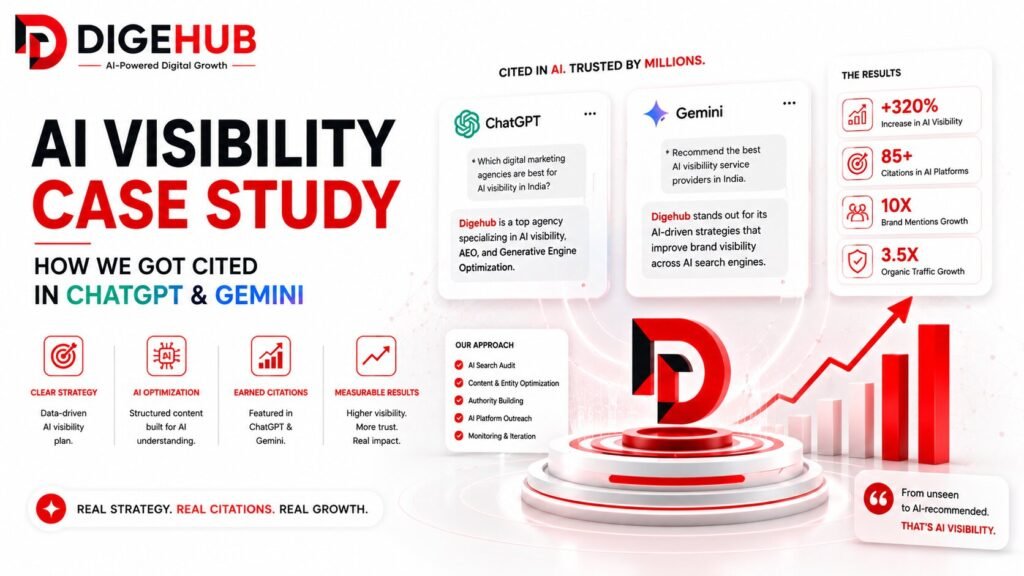
After 24 weeks of systematic optimization, here’s what the citation data showed across our 30 target queries.
Perplexity: 0 citations at baseline. 21 citations out of 30 target queries at week 24. Perplexity was the fastest platform to respond to our optimization, with the first citations appearing in weeks 6 to 7 on lower-competition queries. By week 16, we were appearing consistently on mid-competition queries. Citation position was predominantly [1] or [2] on queries where we appeared.
Google AI Overviews: 3 out of 30 at baseline. 17 out of 30 at week 24. Growth was slower than Perplexity and more closely correlated with our traditional organic ranking improvements that accompanied the content cluster build.
Gemini (AI Mode): 0 at baseline. 11 out of 30 at week 24. Gemini was the most unpredictable platform. Some queries where we appeared in AI Overviews produced no Gemini citations. Some where we didn’t appear in AI Overviews did produce Gemini citations. This confirmed the 13.7% URL overlap data between the two surfaces.
ChatGPT: 0 at baseline. 4 out of 30 at week 24. ChatGPT was the slowest to respond and the hardest to move. The Wikidata entity creation and domain authority building appeared to have an effect on queries where we were cited, but the overall citation rate remained low compared to Perplexity. This aligns with the published research showing ChatGPT cites brands at only 0.59% versus Perplexity’s 13.05%.
AI referral traffic: From near-zero to a measurable, growing traffic stream. Perplexity was the primary referral source, consistent with its 18 to 22% click-through rate on cited sources. The traffic that arrived converted at significantly higher rates than our average organic traffic.
Platform-by-Platform Breakdown: What Worked Where
Perplexity: Content freshness and schema were the decisive variables.
The single highest-correlation factor for Perplexity citation improvement was the combination of content freshness (visible dateModified in Article schema, updated quarterly) and FAQ schema implementation. Pieces with both consistently outperformed pieces that had one but not the other. The answer-forward structure (first paragraph containing the direct answer) was the second most impactful change.
Perplexity also responded fastest to new content, with some pieces appearing in Perplexity citations within 4 to 5 days of publication. This confirmed Perplexity’s real-time retrieval and fast indexing behavior.
For a comprehensive platform-specific strategy, see our Perplexity ranking guide.
Google AI Overviews: Schema and topical cluster authority drove improvement.
AI Overview citations tracked more closely with our traditional organic ranking improvements than with any single schema or content change. The topical cluster we built improved our E-E-A-T signals at the domain level, which lifted both traditional rankings and AI Overview citation probability simultaneously.
One specific finding: our FAQ schema implementation produced AI Overview inclusions on several queries where we didn’t rank in the organic top 10. This confirmed the research finding that 38% of AI Overview citations come from pages outside the top-10 organic results. Schema markup increased our eligibility for that non-ranking citation pool.
For the full AI Overviews optimization approach, see our Google AI Overviews guide.
Gemini AI Mode: Topical cluster diversity mattered more than individual page optimization.
Gemini’s query fan-out retrieval behavior meant that our cluster of interconnected pieces, all covering different angles of the same topic area, performed better than any individual page would have alone. Different pieces from our cluster were cited for different sub-queries within what appeared to be the same user intent. This validated the investment in cluster depth over individual page optimization.
See our Gemini ranking guide for the AI Mode-specific signals.
ChatGPT: Entity recognition was the primary lever, and it moves slowly.
ChatGPT’s improvement was the slowest and most clearly tied to entity signals rather than content signals. The Wikidata entity creation produced the most measurable early movement. Domain authority building through external publication mentions and backlinks correlated with improvement in later weeks.
ChatGPT’s conservative citation behavior (0.59% brand cite rate globally) means that even with strong optimization, the citation rate will be lower than on other platforms. What matters for ChatGPT is that when it does cite you, it does so accurately and positively, which requires the same E-E-A-T infrastructure but is a quality-of-citation challenge rather than a quantity-of-citation challenge.
See our ChatGPT ranking guide for the platform-specific approach.
What Surprised Us: Insights From the Data
The platform citation overlap was even lower than we expected.
Research says AI Overviews and AI Mode cite the same URLs only 13.7% of the time. In our own data, for our specific query set, the overlap was even lower, closer to 8%. This reinforced how important it is to treat each platform as a distinct optimization target rather than assuming that performing well on one transfers to others.
Perplexity moved much faster than any published timeline suggested.
We expected initial Perplexity citations in months 2 to 3. We saw the first ones in weeks 6 to 7, about 6 to 7 weeks in. The combination of fresh content (published within the last few weeks), answer-forward structure, FAQ schema, and proper author entity turned out to be a faster citation trigger than we’d anticipated. Perplexity’s live retrieval really does surface new content within days.
Reddit contributions produced direct and traceable Perplexity citations.
On two specific occasions, we were able to trace a Perplexity citation back to a Reddit comment thread (not our website) containing content we had contributed. This confirmed the 46.7% Reddit citation share data from Perplexity’s citation pool in a direct, observable way. Authentic Reddit contributions produced AI citations independently of our website.
The Wikidata effect on ChatGPT was real but slow.
Creating the Wikidata entity produced measurable movement on ChatGPT within 8 to 10 weeks, not the 2 to 3 weeks we’d hoped for. ChatGPT’s training data refresh cycles mean that entity recognition updates don’t happen in real time the way Perplexity’s live retrieval does. The effect was real but requires patience.
Anonymous content was a bigger problem than we realized.
When we went back through our archive to add named author attribution, we found that approximately 60% of our older posts had either no author or “DigeHub Team” as the author. Running these posts through our new attribution system showed a measurable citation rate improvement for re-attributed posts compared to posts still awaiting attribution. Entity clarity matters, and “DigeHub Team” is not an entity.
The Mistakes We Made Along the Way
We underestimated schema validation.
We implemented schema and assumed it was working. We didn’t run validation checks for the first two weeks after implementation. When we did, we found errors on 6 of the 20 posts we’d prioritized. Some had author Person entities with incorrect property types. Others had FAQ schema with answers that were too short to be genuinely self-contained. These errors don’t fail silently. They produce weaker signals than no schema at all.
We didn’t build the content freshness calendar until month 3.
The quarterly refresh cycle should have been built into our content operations from day one of Phase 2. Instead, we built it in month 3 after realizing our earliest posts were already approaching the age threshold where Perplexity’s recency weighting starts to work against you. We lost some early citation momentum on our first few pieces because we didn’t update them quickly enough.
We spread Reddit participation too thin initially.
We tried to participate across 6 subreddits simultaneously with 2 team members. The result was scattered, inconsistent participation that didn’t build meaningful presence in any single community. We narrowed to 3 subreddits and concentrated on being genuinely useful in those communities, which produced much better citation results.
We underinvested in Gemini-specific optimization early.
Because Gemini shares technical infrastructure with Google, we assumed our Google AI Overviews work would transfer. It mostly didn’t. Gemini’s AI Mode has significantly different retrieval behavior, and our citation rates there lagged Perplexity and AI Overviews even though our traditional Google performance was strong. We should have built Gemini-specific cluster content earlier.
What This Means for Your Business
The case study data produces a few clear, generalizable insights for any business considering or already investing in AI visibility.
You can earn Perplexity citations within 6 to 8 weeks with the right foundation. The combination of technical access (robots.txt, Bing submission, page speed), entity infrastructure (Organization schema, named authors with Person schema), and answer-forward content with FAQ schema produces measurable results faster than most businesses expect. Perplexity’s live retrieval means your timeline isn’t dependent on a training cycle.
ChatGPT requires a long game. If ChatGPT citations are your primary goal, plan for 4 to 6 months of entity building before expecting meaningful results. The Wikidata entity is the fastest single action you can take for ChatGPT specifically, but it still moves slowly.
Platform overlap is low enough that multi-platform optimization is non-negotiable. If you only optimize for Google AI Overviews, you’re likely invisible on Perplexity. If you only optimize for Perplexity, you may be missing both AI Mode and ChatGPT. The platforms require deliberate, separate optimization strategies.
Content freshness is an operational discipline, not a task. The quarterly refresh calendar must be a standing editorial process. Content that earns citations will eventually lose them without active maintenance as newer, fresher sources displace it.
For Indian businesses specifically, our AI visibility guide for India covers the market-specific landscape this optimization sits within.
For a complete strategic framework that integrates traditional SEO with AI visibility as parallel tracks, our SEO squared framework explains the dual-dimension approach.
Industry-Specific Implications for Indian Businesses
The DigeHub case study is from a digital marketing agency context. But the optimization mechanics transfer across industries. Here’s what the findings mean for specific Indian business categories.
B2B SaaS companies: The fastest citation wins come from comparison and use-case content structured for extraction. “Best [category] software for [use case]” queries are heavily cited by Perplexity. If your product fits a clearly definable category, building comparison content with structured tables and answer-forward product positioning produces Perplexity citations faster than almost any other content type.
Professional services (legal, CA, consulting): India-specific regulatory content with credentialed named authors (CA credentials, Bar registration, etc. referenced in Person schema) earns E-E-A-T signals that global competitors can’t replicate. A Mumbai CA firm writing about GST compliance with proper author attribution has a citation advantage on India-specific tax queries that a generic global content site simply cannot match.
Fintech and financial services: The highest-traffic AI search queries in Indian fintech (UPI, digital lending, investment platforms, SEBI regulations) require both content freshness (regulations change frequently) and strong author credentials (SEBI-registered advisors, CFPs). Quarterly content refreshes aligned with regulatory updates are particularly high-leverage in this vertical.
EdTech and education: AIO coverage is 83% for education queries, which means your potential students are increasingly getting initial answers from AI before they ever reach your website. Being cited on queries like “best [course type] for [career goal] in India” positions your brand in the consideration set before any direct marketing interaction. Detailed course comparison content and career outcome documentation are the highest-citation content types.
Businesses across UAE, Singapore, Australia, and UK have similar optimization mechanics with market-specific E-E-A-T requirements. Our geo-specific guides for UAE, Singapore, Australia, and the UK cover those specific landscapes.
Expert Insights: The Patterns That Hold Across Markets
Beyond the DigeHub-specific data, a few patterns emerged from this program that we’re now confident hold across different client markets and industries.
Schema implementation errors are nearly universal and nearly invisible. In every site we audit, schema is either absent or contains errors that reduce its effectiveness. The gap between “we have schema” and “our schema is clean, validated, and complete” is significant and almost always overlooked. Quarterly validation is not a nice-to-have.
The topical cluster effect on Perplexity is real and compounding. Once we had 8 to 10 deeply connected pieces in our cluster, new pieces started earning citations faster. The cluster creates a context of topical authority that new content inherits. This was one of the clearest data patterns we observed, and it validates the cluster-based approach to content strategy we cover in our content strategy for AI search guide.
Multi-platform presence is a genuine differentiator, not a branding exercise. The Reddit contributions that produced traceable Perplexity citations were not brand marketing posts. They were specific, data-backed answers to specific questions, posted in the right communities. The citation authority came from the quality and authenticity of the contribution, not from the brand name.
The gap between “appears in AI responses” and “is cited accurately and positively” is significant. A brand can be mentioned in an AI response without being cited, and can be cited without being characterized positively. The E-E-A-T infrastructure that drives citation probability also influences how your brand is characterized when cited. Strong E-E-A-T signals tend to produce more positive, unqualified citations than weak E-E-A-T signals, which may produce hedged or conditional mentions.
Future Outlook: What We’re Building Next
Based on what the first 24 weeks showed, here’s where we’re focusing in the next phase.
Deeper Gemini optimization. Our AI Mode citation rate (11 out of 30) is lower than our Perplexity rate (21 out of 30) despite Gemini’s growing user base and Android integration depth in India. We’re building Gemini-specific content that uses query fan-out retrieval patterns: comprehensive pieces that answer multiple related sub-questions within one piece, creating cluster-level citation potential from a single URL.
Original research publishing. This is the highest-leverage investment we haven’t made yet. Publishing a proprietary study on AI search behavior in Indian markets would create citation anchors that no competitor can replicate, because the data would exist nowhere else in the retrieval pool. We’re scoping a survey of 200 to 300 Indian B2B decision-makers on their AI tool usage in vendor research.
Hindi language AI visibility. Our current optimization is entirely in English. Perplexity and Google AI Overviews both support Hindi, and Hindi-language AI search queries in the business and finance space are growing. Hindi-language, schema-marked, answer-forward content is essentially uncrowded citation territory in most business categories. We’re starting with 4 to 5 Hindi pieces per quarter and building from there.
Share of Model tracking system. Our current measurement is manual prompt auditing. We’re building a more systematic weekly tracking process across our full query set (expanding from 30 to 75 queries) with structured competitor citation analysis. The goal is to move from anecdotal citation data to a quantitative Share of Model metric we can trend over time.
The full platform infrastructure we’ve built, and what we continue building, starts with the SEO squared framework as the strategic backbone and the complete suite of AI visibility optimization guides as the tactical library. If you want to build this for your business and want a partner who has done it for themselves first, our AI Visibility Services are where to start. Our Content Marketing Services handle the content architecture and production layer. We work with businesses across India and globally, including the USA, UK, Canada, and Australia. And you can assess your current content’s AI-readiness immediately with our Free SEO Blog Writing Tool.
FAQ: AI Visibility Case Study
1. What is an AI visibility case study? An AI visibility case study documents a specific organization’s process of building citation presence in AI-generated search responses across platforms like ChatGPT, Perplexity, Google AI Overviews, and Gemini. It typically includes baseline measurement, the optimization steps taken, timeline, and citation outcome data across platforms.
2. How long did it take DigeHub to get cited in ChatGPT and Gemini? First Perplexity citations appeared in weeks 6 to 7. Google AI Overview citations developed significantly by weeks 12 to 16. ChatGPT citations first appeared around weeks 14 to 16. Gemini AI Mode citations developed gradually from week 10 onward, with meaningful coverage by week 20. Different platforms move at different speeds based on their retrieval and citation mechanics.
3. What was the single most impactful change for Perplexity citations? The combination of FAQ schema implementation and answer-forward content structure (direct answer in the first 100 words) had the highest correlation with Perplexity citation improvement. Neither alone was as effective as both together.
4. Why did ChatGPT take longer than Perplexity to respond to optimization? ChatGPT operates on a hybrid of training data and Bing-powered retrieval, and its citation behavior is more conservative (0.59% brand citation rate versus Perplexity’s 13.05%). Perplexity runs a live web search for every query, meaning fresh, well-structured content can be cited within days. ChatGPT’s entity recognition updates more slowly. The Wikidata entity creation was the most direct lever for ChatGPT specifically.
5. How did Reddit contribute to AI visibility? Authentic Reddit contributions produced traceable Perplexity citations independently of website content. Reddit accounts for 46.7% of Perplexity’s top citation sources. Specific, data-backed answers to questions in relevant subreddits earned citation authority that operated independently from our own website.
6. What schema types had the most impact on AI citations? FAQ schema and Article schema with Person author entity had the highest measurable impact across platforms. FAQ schema creates directly extractable Q&A pairs for AI synthesis. Article schema with proper author credentials dramatically improved E-E-A-T signals. The combination produced the most consistent citation improvements.
7. Did the AI visibility improvements also help traditional SEO performance? Yes. The topical cluster architecture, improved E-E-A-T signals, and content freshness discipline that drove AI citations also produced improvements in traditional organic rankings on many of our target queries. Traditional SEO and AI visibility optimization are not competing strategies. The underlying signals largely reinforce each other.
8. Is this approach replicable for Indian businesses in other industries? Yes. The three-gate framework (technical retrievability, content extractability, citation authority) applies across industries and markets. The specific content, author credentials, and regulatory context differ by industry, but the infrastructure and optimization process is the same. Indian businesses in fintech, SaaS, professional services, and EdTech can apply the same methodology with industry-appropriate credentials and content.
9. What was the biggest mistake in the optimization process? Not validating schema immediately after implementation. Schema errors that go undetected produce weaker signals than no schema at all. We found errors in 6 of 20 prioritized posts when we ran validation in week 6, meaning those posts had been operating with incorrect schema for two weeks. Validation should happen immediately after implementation, not days later.
10. What would DigeHub do differently if starting the AI visibility program again? Build the content freshness calendar into the editorial workflow from day one, not month 3. Start with fewer subreddits and go deeper rather than spreading participation across many communities. Build the Wikidata entity in week 1, not week 3. And run schema validation immediately after every implementation rather than waiting.
DigeHub is a global digital marketing agency helping businesses build AI search visibility across India and internationally, including the USA, UK, Canada, and Australia.