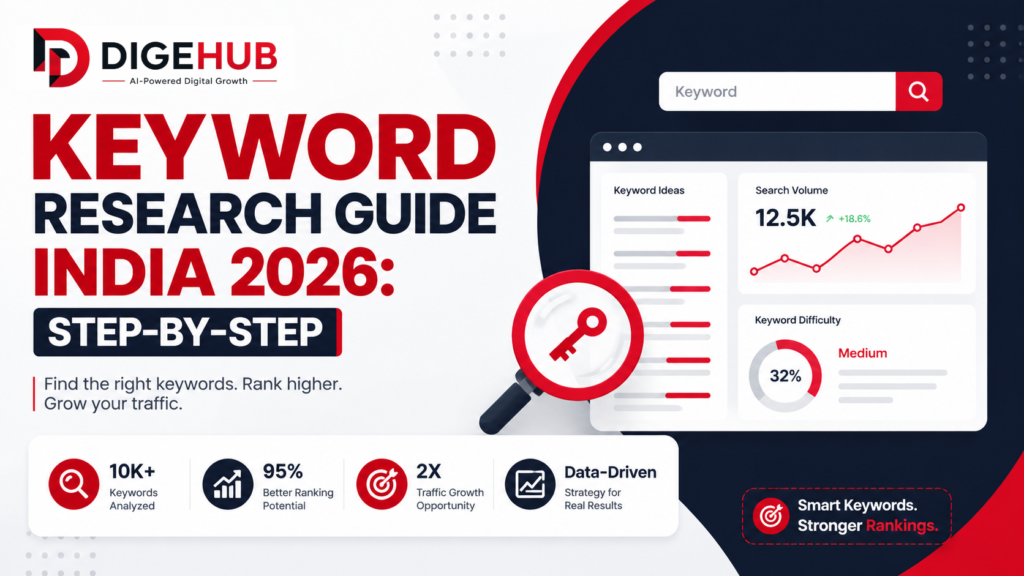
Keyword Research Guide India 2026: Step-by-Step Framework for Global Brands
Entering or scaling within the digital market brings a special challenge for global businesses, SaaS founders and marketing agencies. Search behavior in India is not one system. It is a multi-lingual very regional and mobile-first environment where usual western methods for keyword research often do not work.
If you use search volume numbers without considering regional words, local intent and AI-powered answer systems you waste money on traffic that never turns into sales.
Ranks alone do not bring in money. The change toward AI Overviews, speaking search models like ChatGPT and Perplexity and voice-activated questions means that finding keywords must take into account what people really want and how they plan to buy.
This guide offers a step-by-step keyword research plan for the Indian market in 2026 mixing traditional SEO techniques, with local market details AI search habits and practical keyword mapping plans.
Quick Answer: How to Master keyword research India for 2026
The Fast Framework is what you need for finding keywords in India by 2026. Before diving into localized keyword mapping, make sure your core architecture aligns with our primary guide on the Best SEO Agency in India 2026 to understand how technical search frameworks scale from base setups to multi-geo campaigns.You have to do this in three steps.
First you need to figure out what people are looking for and use intelligence to understand this. This is what we call Intent and AI Mapping. You have to put keywords into groups based on what people want when they search for something and also think about how artificial intelligence’s used to answer questions.
Next you have to think about where people’re searching from which is what we call Localized and Geo-Targeted Layering. You need to combine the words for your service with the city, area and words that people use in India like the cost in Indian money. For example you can say “service in my area” or “how much does it cost in money”.
Lastly you have to make a plan for your keywords, which’s what we call Structured Keyword Mapping. You need to give each page on your website its set of main keywords secondary keywords and other related keywords. This way you can avoid using the keywords too many times and get more people to visit your website from search engines. The Fast Framework and keyword research for India in 2026 are very important, for your website.
Why Keyword Research in India Requires a New Playbook in 2026
The Indian digital audience has crossed hundreds of millions of active internet users, driven by ultra-affordable mobile data and rapid digital adoption across Tier 1, Tier 2, and Tier 3 cities.
| Search Behavior Trend | Description |
|---|---|
| Multi-Lingual & Hinglish Searches | Indian users increasingly search using a mix of English, Hindi, and regional languages, making multilingual content essential for better visibility. |
| Mobile-First Voice Search | The rapid adoption of smartphones and voice assistants has led to a significant increase in conversational voice searches across India. |
| Hyper-Local Geo-Intent | Users frequently include city names, neighborhoods, landmarks, and “near me” modifiers when searching for businesses, products, and services. |
| AI Answer Engines | More users are discovering information through AI platforms such as ChatGPT, Gemini, and Perplexity, making AI visibility an important part of modern SEO strategies. |
People usually think that when searching for something everyone uses very specific phrases like “best CRM software”.. In India people actually search for things in their own way. They might use language look for cheap options like “low cost CRM for startup” use words from their local language or even just talk to their computer like it is a person.
If the words you use on your website do not match the way people in India search, for things then other companies will get all the people looking for those things before they even get to your website and try to buy something from you.
Step 1: Define Your Objective (SEO, Ads, Content, or Local Search)
Before pulling data from SEO tools, you must clarify your core campaign objective. A primary keyword for Google Ads is rarely identical to a primary keyword for a top-of-funnel blog post.
- Organic Search (SEO): This thing is about being in charge for a long time. It thinks about groups of words that have meanings, which are called semantic clusters. It also thinks about questions that people ask when they want to learn something and questions that people ask when they want to buy something. The people who made this thing want it to be good, at answering both kinds of questions the ones that a lot of people are asking. This thing is really focused on long-term authority and semantic clusters. It wants to answer high-volume informational and transactional queries.
- Paid Acquisition (Google Ads): Focuses on commercial terms that have a high chance of converting. This helps get the return for the money spent on ads. The goal is to get the value, from every ad dollar.
- Content Marketing: .People who have problems and want to solve them will ask questions look for guides and compare alternatives to find the best solution, for their problems. These problem-aware users are trying to find answers and make choices about the alternatives they are comparing to fix their problems.
- Local SEO:Focuses on geo-specific modifiers, city names, and neighborhood clusters that drive direct calls and local store visits.
Aligning your search strategy across both paid and organic channels prevents wasted budget. If you are balancing performance media alongside organic acquisition, reviewing our specialized Google Ads Services and targeted Meta Ads Services can help you structure cross-channel funnels efficiently.
Step 2: Build Your Initial Seed Keyword List
Seed keywords are the starting point, for your search setup. They show what your business sells or offers. These words are the products or subjects you focus on. They do not include details or numbers.
To build an effective seed list for the Indian market, collect input from four key sources:
- Customer Touchpoints: Review support tickets, sales call transcripts and customer emails to find out the words and phrases that Indian buyers use. I look through support tickets I look through sales call transcripts. I look through customer emails to find out the specific words and phrases that Indian buyers use. I want to know what Indian buyers say when they talk about products or services. I check each of these sources carefully to make sure I don’t miss any words or phrases. I pay attention to the way Indian buyers speak so I can understand their language better. I want to learn the words and phrases that Indian buyers use. I go through every support ticket every sales call transcript and every customer email to find out the words and phrases that Indian buyers use. I make sure I get the information by looking at all the sources carefully. I look for the words and phrases that Indian buyers use. I check each of these sources to find out the words and phrases that Indian buyers use. I want to know the words and phrases that Indian buyers use when they talk about products or services. I look at support tickets sales call transcripts and customer emails to find out the words and phrases that Indian buyers use.
- Competitor Landings: Look at the websites of Indian companies and check the pages where they talk about their services. Take note of the words and phrases they use.
- Internal Stakeholders: You should talk to the people who work with customers at your office like the sales team or the account management team. They are the ones who meet with customers like prospects, on a regular basis.
- Platform Search Suggestions:Type core terms into Google India search bars, YouTube India, and local marketplaces to capture real-time autocomplete queries.
Example of seed keyword expansion for an enterprise software brand in India:
| Keyword Type | Example Keyword | Search Intent |
|---|---|---|
| Core Seed Term | Payroll Software | Broad, high-volume keyword targeting users looking for payroll software solutions. |
| Local Modifier | Payroll Software India | Targets users specifically searching for payroll software designed for the Indian market. |
| Price Modifier | Payroll Software Price in INR | Captures users comparing pricing, subscription plans, and software costs in Indian Rupees. |
| Audience Modifier | Payroll Software for Small Business in India | Focuses on small business owners seeking payroll solutions tailored to their needs. |
| Feature Modifier | PF ESIC Compliance Payroll Software | Attracts users looking for payroll software with mandatory Indian compliance features such as PF and ESIC management. |
Step 3: Expand Keyword Variations Using Modern Research Tools
When you have your list of seeds you can use tools to find ideas and get a lot of different versions that are related to what you are looking for.
If you are working in the market it is not a good idea to use just one tool. This is because you might miss some information. Different websites and platforms give ideas about how many people are searching for something and how hard it is to get a good spot for a keyword. They do not always. This can be a problem, in different parts of the country.
Key Tools for Indian Keyword Discovery
- Google Keyword Planner: It is essential for obtaining location-specific search volume data across individual Indian states, metro regions like Mumbai and Delhi, and tier-2/tier-3 growth hubs.. We need to know the search volume data for parts of India like individual states big cities like Mumbai and Delhi and smaller local areas. This location-specific search volume data is crucial, for states and cities.
- Semrush / Ahrefs:Ideal for analyzing competitor organic gaps, backlink profiles, and semantic variations.
- AnswerThePublic / AlsoAsked: Excellent for uncovering direct questions asked by Indian consumers for informational content strategies.
- Google Search Console (GSC):This is the place to find out what people are really searching for when they visit your website. It shows you the things that people type into search engines to get to your domain and what makes them click on your links. The information you get from this source is very reliable. It helps you understand what your users are looking for. This source gives you the accurate information, about the real user queries that are driving impressions and clicks to your domain.
If you want to accelerate your content research and draft well-structured, search-optimized content quickly, try our Free SEO Blog Writing Tool to build content around your expanded keyword lists.
Step 4: Group Keywords by Search Intent & Indian Market Nuances
Raw keyword volume is a vanity metric if the user’s search intent does not match your page content. In 2026, search engines categorize queries into four primary intent pillars, with additional layers specific to the Indian market.
| Search Intent | Example Query | User Goal |
|---|---|---|
| Informational | How to calculate income tax in India 2026 | The user wants to learn or understand a topic without an immediate intention to make a purchase. |
| Commercial | Best ERP software for manufacturing companies in India | The user is researching and comparing products or services before making a buying decision. |
| Transactional | Buy HR software online India pricing | The user is ready to purchase, subscribe, or request a demo of a product or service. |
| Navigational | Digehub SEO services contact | The user wants to visit a specific website, business, or webpage directly. |
Additional Intent Layers for India
To outperform generic guides, incorporate these localized intent triggers into your research:
- Price & Value Intent: Terms containing “cost ” “charges,” “pricing, in INR ” “affordable,” or “packages.”
- Trust & Legitimacy Intent: Indian buyers really want to know that they can trust the people they are buying from. So when they are looking for something they often search for things like reviews to see what other people think. They also want to make sure that the things they are buying are authentic and that the sellers are trusted. Some Indian buyers even look for words, like legal or government approved to feel safe when they are buying something. Indian buyers think that these things are very important when they are deciding what to buy.
- Colloquial & Hinglish Phrasing: Users often blend English and Hindi phrasing (e.g., “best budget phone under 20000” or “how to register company in India fast”).
Step 5: Master Local and Geo-Targeted Keyword Research
Local SEO is really important for businesses in India. Most business happens in cities like Mumbai, Bengaluru, Delhi NCR, Hyderabad, Chennai and Pune.. Local SEO is also important in smaller cities like Ahmedabad, Jaipur, Kochi and Chandigarh that are growing fast. Local SEO helps businesses in these cities to get customers. Local SEO is a factor for businesses, in India to grow and succeed.
Local Keyword Structuring Matrix
To capture localized commercial intent, structure your geo-targeted keywords into clear categories:
| Target Level | Pattern Format | Practical Example |
| City-Wide | [Service] + [City] | “Digital marketing agency in Bengaluru” |
| Locality / Area | [Service] + [Neighborhood] | “SEO company in Bandra Mumbai” |
| Urgency / Call | [Service] + [City] + Contact / Near Me | “IT support team in Gurugram phone number” |
| Price / Local | [Service] + [City] + Pricing | “Office space rent in Indiranagar price” |
When your brand offers services to countries or areas it is really important to have special pages for each place. For example brands that are getting bigger and moving to countries have separate pages for each region like we do for our agency hubs in the USA, UK, Canada, and Australia. This helps people, in each area find the information they need about your brand services.
Step 6: Build a Bulletproof Keyword Map (Preventing Cannibalization)
When you have lots of pages on your website that’re all about the same thing it gets confusing for Google. Google has to pick which page is the one for a particular search and that is called keyword cannibalization. This makes it harder for any of your pages to be considered good and it hurts how high they show up in search results.
Making a plan for the keywords on your website can help with this. You can make a list that says which keywords are the important, for each page. For each page you choose one keyword that you want people to find when they search for that thing. Then you can also choose some keywords that are related to the main one and those can help the page show up in search results too.
Master Keyword Mapping Template
| Page Type | Page URL | Primary Keyword | Secondary Keywords | Primary Search Intent |
|---|---|---|---|---|
| Homepage | / | Digital Marketing Agency India | Brand terms, Digital Marketing Company India | Primary brand visibility and commercial intent. |
| Service Page | /services/seo-services/ | SEO Services India | Organic Growth Agency India, Enterprise SEO Consultant | Users looking to hire professional SEO services. |
| Service Page | /services/content-marketing-services/ | Content Marketing Services India | B2B Content Strategy, Copywriting Agency | Businesses seeking content marketing and copywriting solutions. |
| Location Landing Page | /location/mumbai/ | Digital Marketing Agency in Mumbai | SEO Company South Mumbai | Capture location-specific searches and attract local customers. |
| Editorial / Blog Page | /blog/keyword-research-guide-india-2026/ | Keyword Research Guide India 2026 | How to Find Keywords for the Indian Market, Local Keyword Strategy India | Educate readers and attract informational search traffic while supporting topical authority. |
By mapping keywords explicitly, you ensure every page has a distinct purpose in your site’s architecture. To explore how we structure site architectures for maximum organic search performance, visit our comprehensive SEO Services and Content Marketing Services.
Step 7: Prioritize Keywords Based on Commercial Opportunity
Attempting to target thousands of keywords simultaneously leads to scattered execution. Prioritize your keyword list using a balanced opportunity score based on four criteria:
- Business Value (1-5 Scale): This keyword is really important. We need to figure out how closely it is connected to something we sell or to getting someone to sign up for something. How directly does this keyword connect to a paid offering or, to a lead conversion? We have to think about how this keyword can help us get people to buy something from us or give us their information so we can sell to them later. Does this keyword have a lot to do with a paid offering or lead conversion?
- Search Volume: Does the query have sufficient monthly volume in your target region?
- Keyword Difficulty (KD): Can your domain’s current authority compete against existing SERP results?
- Search Intent Match: Do you have the resources to build the exact content format (e.g., tool, guide, service page) required to win the click?
Prioritize high-business-value keywords with moderate difficulty first. These quick wins generate early revenue that can fund longer-term targets.
Step 8: Integrate AI and Modern Search Engine Optimization (AEO/GEO)
Search engine optimization is not just about Google on a computer and Google on a phone anymore. Now we have Google AI Overviews and things like ChatGPT and other conversational engines such as Gemini and Perplexity. This means the way people search for things has changed and they want answers from search engine optimization. Search engine optimization is, about giving people direct answers now.
| Search Engine Type | Optimization Strategy | Key Focus |
|---|---|---|
| Traditional SERPs | On-page keyword optimization, high-quality backlinks, technical SEO, and crawlability improvements. | Improve organic rankings and search visibility. |
| Google AI Overviews | Create concise, fact-based answers, use structured tables, FAQs, and Schema Markup to increase AI visibility. | Maximize inclusion in AI-generated search summaries. |
| Conversational AI | Strengthen entity recognition, build digital PR, earn authoritative mentions, and increase brand co-occurrences across trusted websites. | Improve brand visibility in AI answer engines such as ChatGPT, Gemini, and Perplexity. |
Optimizing Keywords for Generative Engine Optimization (GEO)
To ensure your keyword strategy captures AI search citations:
- Target Natural Language Questions:AI models prefer sentences when people ask questions. Using sentences helps the models understand what is being asked. Fragmented keyword phrases do not give information. The models work better when the queries are clear and complete. Full-sentence queries are better for getting answers. People should try to use sentences when they talk to AI models. This makes it easier for the models to respond properly. Full sentences help the models know exactly what is needed. It is better to use sentences instead of just a few words. AI models are designed to handle sentences more effectively. Using sentences leads to better results. Always try to form sentences when interacting with AI. This way the models can provide the possible help. Full-sentence queries are more useful, than phrases. The models can process them easily. People who use sentences get better responses. It is a habit to use full sentences. AI models rely on complete information. Full sentences make the information clearer. This is why AI models favor full-sentence queries.
- Inject Structured Data:Use JSON-LD Schema markup to state the entities that are involved. Use JSON-LD Schema markup to state the services that are offered. Use JSON-LD Schema markup to state the prices that are charged. Use JSON-LD Schema markup to state the locations that are available.
- Publish Direct Answers: Place concise, definition-style summaries at the top of key content sections to capture AI snippet extractions.
Learn more about positioning your brand within conversational AI models by exploring our specialized AI Visibility Services and AI Automation Services.
Common Keyword Research Mistakes in the Indian Market
Even experienced marketers make predictable errors when building search strategies for India. Avoid these critical traps:
- Relying Solely on Global Volume Data: Global tools often underestimate regional Indian search volume or miss local modifier variations entirely.
- Ignoring Hinglish and Regional Terms: Failing to research how local users blend English with regional phrasing leads to missed market opportunities.
- Neglecting Mobile Search Intent: In India most people use their phones to search for things on the internet. Than ninety percent of searches are done on mobile devices. When people search they like to use keywords that help them do things quickly. For example keywords that let them make calls or find things easily work really well. These types of keywords perform a lot better than others because they are simple and easy to use on devices like smartphones. People, in India like to use their phones to search for things and they want to be able to do it quickly and easily.
- Publishing Thin AI Content:When you write articles that sound like they were made by a computer and you do not include information about the area or get feedback from experts the search engines will punish you for having content that is not very good. This is what happens when you have articles that all sound the same and do not have anything, about the local area and that is why you get what is called algorithmic content penalties. The algorithmic content penalties happen because the articles are not unique and do not have insights or expert validation.
- Overlooking Website Engineering: When a website takes a time to load it can really hurt the websites ranking for certain keywords. This is especially true for people who are browsing the internet on their phones. If the websites technical platform is old and needs to be updated it might be time to take a look at our Website Development Services to make the website load faster and pass Core Web Vitals checks.
Frequently Asked Questions (FAQ)
How do I find high-intent local keywords for Indian cities?
To find the keywords use the location filter in Google Keyword Planner and set it to specific cities or states in India. For example you can use the name of the city where your business is located.
You can also combine the service you offer with the name of the city or neighborhood like “Bandra” or “Indiranagar” or “Cyber City”.
This will help you get an idea of what people are searching for in that area.
You should also try using Google Autocomplete when you search for something and do this when you have a VPN or location setting turned on.
This will give you suggestions that are specific to the area you are searching in like the city or state you chose in Google Keyword Planner.
So you will get a list of keywords that’re relevant to your business and the location you are targeting such as a specific city, in India.
What is the best free tool for keyword research in India?
Google Keyword Planner remains the best free tool for accurate location-specific volume data within India. Combining Keyword Planner with Google Search Console, Google Trends India, and AnswerThePublic provides a comprehensive dataset without requiring paid software.
How does keyword research for Google Ads differ from SEO keyword research in India?
Google Ads keyword research is, about finding words that people use when they want to buy something. These words are very important because they help Google Ads make money. On the hand SEO keyword research is different. It looks at what people search for at every step of the way when they are thinking about buying something.
This includes when people are just starting to learn about something and they have a lot of questions. Google Ads keyword research and SEO keyword research are used for things. SEO keyword research also looks at what people search for when they are trying to decide what to buy.
Google Ads keyword research is mostly used for words that people use when they are ready to buy something. SEO keyword research is used for all kinds of searches including when people’re just looking for information when they are comparing different options and when they are ready to buy something from a service page.
Google Ads keyword research and SEO keyword research are both important. They are used in different ways.
Should I target English or regional language keywords in India?
The thing is it really depends on the people you are trying to reach and the kind of product you are selling. When we talk about B2B enterprise software and professional services people usually search for these things in English or a mix of English and Hindi.. When it comes to things that people use every day like consumer products or services that are only available in certain areas or healthcare or learning about money people are really interested in these topics in their own languages, like Hindi, Tamil, Telugu, Marathi and Bengali.
How do I avoid keyword cannibalization when targeting multiple Indian cities?
When we make a webpage for a city we should make it special for that city. We should not just copy the information and change the city name. Each city webpage should have its special words that people in that city might use to search for something. We should also add things that people from that city say about us. The address on the webpage should be the address of our place in that city.. We should use special computer code that helps the webpage show up when people search for things in that city. We should do this for each city webpage. This way each city webpage will be about that city. Will have information that is just for people, in that city.
How many keywords should I target per page?
When you are creating a page it is an idea to focus on one main keyword that is the central idea of the page. This main keyword should have some related keywords that support it. You should have between 3 to 10 of these keywords that are closely related to the main keyword. The secondary keywords should naturally fit with the subject and help to explain it better. The main keyword is important so make sure the secondary keywords support the keyword and help people understand what the page is, about, which is the main keyword.
What is keyword clustering and why is it important for SEO in 2026?
The idea of keyword clustering is that we group keywords that are related in meaning. We then target these keyword clusters with one good page instead of making lots of separate pages for small variations of the keywords. This way of doing things works well with the way search engines work today. They like it when a page is really good at covering a topic than just being about one specific keyword. Keyword clustering is a way to show search engines that a page has a lot of good information, about a topic. We use keyword clustering to make sure that our pages are comprehensive and cover all the keyword clusters that are related to the topic.
How to Target Voice Search and Hinglish Keywords in Your SEO Strategy
The use of multilingual and voice search is growing rapidly in India. To capture Hinglish (Hindi + English) search queries, create conversational content with dedicated Q&A sections and natural language phrasing. Instead of using only standard keywords like “Best SEO Agency,” include long-tail queries in your headings and FAQs such as “How to choose the best SEO agency in India?” or “How much do SEO services cost in India?”
How to Optimize Keywords for Google AI Overviews (AIO) and Perplexity
AI Overviews and conversational answer engines prioritize content that is intent-driven, well-structured, and easy to understand. To optimize your keywords:
- When you are writing something make sure you talk about the thing, like the target keyword, right at the start. This means you should mention the target keyword in the few lines of the page.
- You can use things like lists and tables to make your content easier to understand. The target keyword is important so use it in a way that makes sense. You can also use Schema Markup, which’s, like a special code that helps computers understand what you are saying. This code is written in a language called JSON-LD.
What Is the Best Keyword Research Strategy for Tier-2 and Tier-3 Cities?
When people in cities like Jaipur, Lucknow, Indore and Surat search for things online they really care about how much things cost and if they can trust the person or company they are buying from. So when we are trying to figure out what words people are using to search we should add the name of the city to words, like low cost, top-rated and near me. For example:
“Affordable digital marketing course in Lucknow”
This approach helps target highly relevant local search intent.
How Should Your Keyword Strategy Change as Zero-Click Searches Increase?
As Google increasingly displays direct answers through AI Overviews, Featured Snippets, and Knowledge Panels, informational keywords often receive fewer clicks. To adapt your strategy:
Focus on high-commercial-intent and transactional keywords instead of broad informational queries.
Target long-tail keywords where users need in-depth research, comparison, tools, or professional services rather than a simple one-line answer.
Scaling Your Organic Traffic with Strategic Research
Keyword research in India for 2026 is not about finding words that have a lot of searches and putting them in articles. It is about understanding how people in areas behave organizing keywords in a clear way targeting specific places and using new AI methods to optimize answers.
When done right a smart search plan builds lasting value that brings in customers reduces the cost of getting new customers and helps establish a strong position, in the market.
If you are willing to update your search marketing plan and grow your traffic across India or other countries:
- Discover our custom search growth frameworks through our dedicated SEO Services.
- Accelerate your content production using our Free SEO Blog Writing Tool.
- Connect with our strategy teams directly through our global agency portals in the USA, UK, Canada, and Australia.
Published by Digehub, a global digital marketing agency that helps businesses rank, scale and convert through strategic SEO, content and AI-powered marketing.