AI Search vs Traditional SEO: What Changed in 2026? (And What Didn’t)
I keep getting the same question from clients lately, usually with a slightly panicked edge to it. “Is SEO still worth doing, or do we need to throw our whole strategy out and chase AI search instead?”
The honest answer is that the question itself is a little off. AI search vs traditional SEO is not a fight where one side wins and the other shuts down. It is two overlapping systems that now run side by side, pulling from a lot of the same content but rewarding different things at the margins. Businesses that treat 2026 as a clean break from everything that worked before are making just as big a mistake as the ones still pretending nothing has changed.
This guide breaks down exactly what shifted this year, what stayed the same, and how to build a strategy that actually works across both systems instead of betting everything on one.
Quick Answer
AI search vs traditional SEO in 2026 comes down to this: traditional SEO still determines whether Google trusts and ranks your pages, while AI search (Google AI Overviews, ChatGPT, Perplexity, Gemini) determines whether your content gets pulled into a synthesized answer that may appear above or instead of those rankings. The two are not separate channels competing for budget. AI search is built largely on top of traditional search signals, especially for Google’s own AI Overviews, while platforms like ChatGPT and Perplexity weigh independent crawling, recency, and extractability more heavily. The practical shift in 2026 is that businesses now need to optimize for two outcomes at once: ranking well and being citation-ready, since a page can do one without the other.
- AI Search vs Traditional SEO: What Changed in 2026? (And What Didn't)
- Quick Answer
- Why This Comparison Actually Matters in 2026
- AI Search vs Traditional SEO: The Core Differences
- What Actually Changed in 2026
- What Has Not Changed (Despite the Noise)
- A Practical Framework for Optimizing for Both
- Common Mistakes Businesses Are Making Right Now
- Expert Insight: What We Are Seeing Across Client Accounts
- Where This Goes Next
- FAQs
- Where to Go From Here
Why This Comparison Actually Matters in 2026
For years, SEO meant one thing. Rank higher, get more clicks, convert more of those clicks. That model is not dead, but it is no longer the whole picture.
When an AI Overview, a ChatGPT answer, or a Perplexity summary appears, it can sit above or entirely replace the traditional results a user would have scrolled through. The user gets an answer without clicking anything. Multiply that across millions of queries a day and you start to see why marketing teams across the USA, UK, Canada, and Australia are recalculating what “visibility” even means.
This is not a reason to panic. It is a reason to get specific about where your traffic and trust actually come from, because lumping “organic search” into one bucket the way most teams did in 2023 no longer tells you the full story. A page can rank at position 3 and get cited constantly in AI answers. Another page can rank at position 2 and never get pulled into a single AI summary. Those are two different problems with two different fixes, and most businesses are still measuring them as if they were one thing.
AI Search vs Traditional SEO: The Core Differences
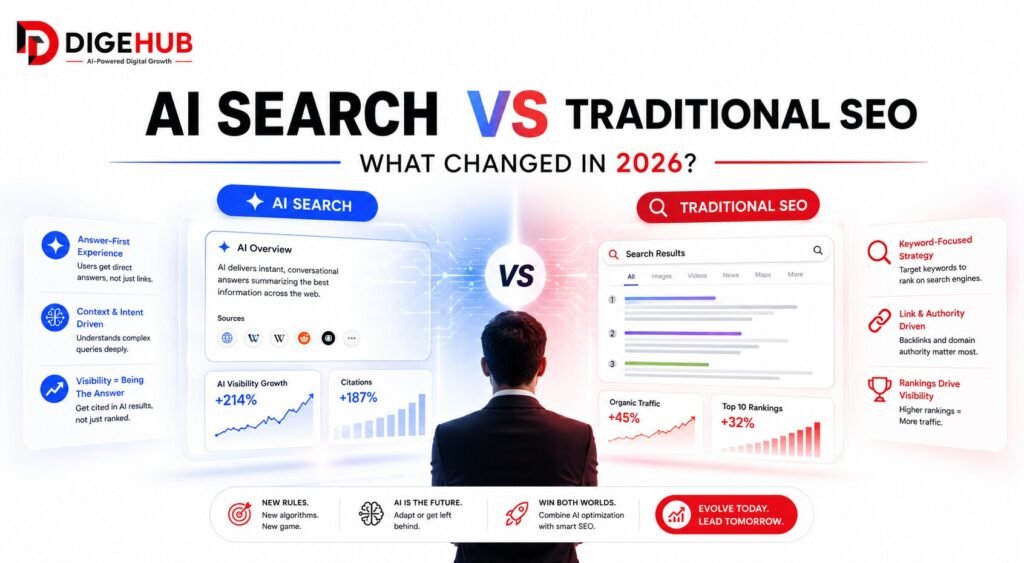
| Factor | Traditional SEO | AI Search |
|---|---|---|
| What it optimizes for | Ranking position in a list of links | Inclusion in a synthesized answer |
| How success is measured | Rankings, organic sessions, CTR | Citation frequency, mentions, AI referral traffic |
| Primary signal | Backlinks, on-page relevance, technical health | Extractability, freshness, source diversity, entity trust |
| Content format that wins | Comprehensive, keyword-aligned pages | Self-contained, answer-first sections |
| Where it shows up | Google, Bing organic results | AI Overviews, ChatGPT, Perplexity, Gemini, AI Mode |
| Click behavior | User clicks through to read | User often gets the answer without clicking |
| Update cadence that matters | Periodic refreshes for relevance | Frequent updates for fast-moving topics, less critical for evergreen ones |
The table above is useful, but it can also be misleading if you read it as “pick one.” In practice, the two systems are not independent. Google’s own AI Overviews draw heavily from pages that are already ranking well organically, so weak traditional SEO usually means weak AI visibility too, at least on Google’s surfaces. ChatGPT and Perplexity behave differently, since they run their own crawling and weigh recency and independent authority more than Google’s existing rankings. That difference matters more than most comparison guides admit, because it means your strategy genuinely needs to branch depending on which AI surface you care most about.
What Actually Changed in 2026
A lot of “AI changed everything” content out there is recycled from 2024 predictions dressed up with a new year in the title. Here is what genuinely shifted.
Click-through rates dropped for queries that trigger AI summaries. This is no longer a theory. Across client accounts, we have watched CTR fall noticeably on informational queries the moment an AI Overview starts appearing for them, even when the underlying ranking position barely moved. The traffic loss is concentrated in “how to,” “what is,” and comparison-style searches, which used to be reliable top-of-funnel traffic drivers for content marketing.
AI referral traffic became a measurable, if still small, channel. A couple of years ago, traffic from ChatGPT or Perplexity was a rounding error for most sites. That is no longer true everywhere. Smaller, niche-focused businesses in particular have started seeing real, attributable sessions from AI tools, especially when their content answers specific, narrow questions that broader competitors gloss over.
Query length and complexity increased. People are not typing fragments anymore. They are asking full, scenario-specific questions because they expect a direct answer rather than a list of links to dig through. Content built around short, generic keywords is losing ground to content that mirrors how people actually phrase complex questions.
Citation became a separate KPI from ranking. Search Console and most major SEO platforms have started surfacing AI Overview impression and citation data as a distinct metric, not bundled in with regular organic performance. Teams that are still reporting “organic” as a single number are missing the part of the story that actually explains why traffic patterns look strange.
Multimodal and visual search expanded meaningfully. Image-based and voice-based queries are no longer a side feature. Content with descriptive alt text, transcripts, and clear visual context is getting pulled into AI-generated answers in ways that plain text alone is not.
What Has Not Changed (Despite the Noise)
This is the part most “AI is taking over” content skips, and it is arguably more important than the changes above.
Technical SEO is still the foundation. If your site is not crawlable, indexable, and fast, neither Google’s algorithm nor any AI system can do much with it. AI search did not remove the floor. It raised the ceiling above it.
Backlinks and authority still matter, a lot. Gemini in particular inherits Google’s existing trust assessment of your domain, which is built substantially on link signals and historical performance. Brands hoping AI optimization is a shortcut around earning real authority are going to be disappointed.
Content still needs to be genuinely useful, not just structured. Formatting tricks like bullet points and FAQ blocks help with extractability, but they do not substitute for actually answering the question well. AI systems, like Google’s classic algorithm before them, are increasingly good at spotting thin content dressed up in the right format.
E-E-A-T is still the trust framework, just with higher stakes. Experience, expertise, authoritativeness, and trustworthiness were already central to Google rankings before AI search existed. AI systems lean on the same signals, partly because they often draw from pages Google has already vetted, and partly because synthesized answers carry more risk if the underlying source is unreliable.
ROI still takes time. Nothing about AI search changes the fact that earning sustained visibility, whether through rankings or citations, is a months-long process built on consistency, not a single optimization sprint.
A Practical Framework for Optimizing for Both
Step 1: Split your reporting before you split your strategy
You cannot fix what you are not measuring separately. Break your search performance into three buckets: classic organic (rankings, CTR, sessions), AI visibility (citation frequency, AI Overview impressions, mentions across ChatGPT and Perplexity), and assisted outcomes (conversions that started with an AI referral). Most teams skip this step and wonder why their strategy feels unfocused.
Step 2: Fix the technical and authority foundation first
If your organic rankings are weak, no amount of AI-specific formatting will compensate. Run a real technical audit, fix indexation and crawl issues, and make sure your core pages are actually competitive in regular search before layering on AI-specific optimization. This is the unglamorous part of the work, and it is also the part that determines whether everything downstream of it has a chance of working. A proper SEO services engagement should catch this early instead of treating it as an afterthought.
Step 3: Rewrite key sections to be self-contained
Go through your highest-value pages and check whether each section makes sense in isolation. If a paragraph only works because of three paragraphs of setup before it, it is unlikely to get extracted cleanly by an AI system. Lead with the direct answer, then add supporting detail.
Step 4: Match content format to query type
Comparison questions need tables. Step-by-step questions need numbered lists. Definitions need a tight one or two sentence answer up front. This single habit improves both featured snippet eligibility and AI citation odds, since the formats AI systems prefer largely overlap with what Google already rewards for snippets.
Step 5: Build visible trust signals, not buried ones
Author bios, sourcing, and update dates need to be visible near the content itself, not tucked away on a separate page nobody visits. This is a small lift with an outsized effect on whether AI systems treat your claims as safe to reuse.
Step 6: Track AI referral traffic separately starting now
Set up segmented tracking for sessions arriving from chatgpt.com, perplexity.ai, and gemini.google.com in your analytics. Even if the volume is small today, having the baseline in place means you can actually prove growth later instead of guessing.
Step 7: Treat AI visibility tools as monitoring, not magic
There is a growing category of platforms promising near full automation of AI search optimization. Some of that is genuinely useful for opportunity detection and monitoring at scale. None of it replaces the judgment of someone reviewing what actually gets published. If your content strategy needs a heavier engine behind it, pairing structural work with consistent execution through AI visibility services tends to outperform a tool subscription used without a strategy behind it.
Common Mistakes Businesses Are Making Right Now
Treating AI optimization as a replacement for SEO instead of an addition to it. This is the single most common and most costly mistake we see. AI search, especially on Google’s own surfaces, draws heavily from your existing organic standing. Skipping the fundamentals to chase AI tactics is building on sand.
Reporting “organic traffic” as one number. If you cannot separate classic clicks from AI-influenced visibility, you cannot diagnose why traffic patterns are shifting, and you will likely misattribute a citation win or loss to the wrong cause.
Publishing more content instead of clearer content. Volume was a defensible strategy a few years ago. In 2026, thin variations of the same topic dilute topical authority rather than build it, and AI systems are increasingly good at recognizing repetitive, low-value scaled content.
Ignoring page speed and Core Web Vitals. Since AI Overviews draw from pages that are already performing well in regular search, a slow site that struggles to rank organically also struggles to make it into the AI citation pool in the first place.
Chasing every AI platform with the same playbook. Gemini behaves differently from ChatGPT, which behaves differently from Perplexity. A strategy that ignores those differences ends up optimized for none of them particularly well.
Expert Insight: What We Are Seeing Across Client Accounts
One pattern that keeps showing up: the businesses gaining the most ground are not the ones publishing the most content. They are the ones revisiting a smaller set of high-value pages and making each section genuinely stand on its own, sometimes rewriting only a handful of paragraphs per page rather than producing something new from scratch.
We have also noticed that AI referral traffic, while still small in absolute terms for most clients, converts at a noticeably different rate than classic organic traffic. Visitors arriving from an AI tool tend to have already had part of their question answered before they land on the page, which means they are often further along in their decision-making. That is a meaningful signal for how you should design the page they land on, since it may need less general education and more specific next-step guidance than a page built for a cold organic visitor.
Another consistent finding is that source diversity matters more than most people assume. AI systems generally avoid pulling every citation from a single dominant domain in a given topic area, which means being one of several credible voices on a subject can outperform trying to be the single, all-encompassing resource. This has real implications for how you plan a content cluster, since five genuinely different angles on a topic will usually outperform five versions of the same article with different headlines.
Where This Goes Next
AI Overview coverage will keep expanding. The percentage of queries triggering an AI-generated answer has climbed steadily, and there is no indication that trend reverses. Businesses still treating this as a temporary phase are planning for a search landscape that no longer exists.
Measurement and attribution tooling will mature quickly. Analytics platforms and SEO tools are racing to make AI citation and referral tracking as standard as rank tracking is today. Teams that build the habit of separating these metrics now will have a real head start once that tooling becomes table stakes.
Multimodal content will open new citation opportunities. As AI systems get better at processing images, video, and audio, brands with strong visual or data assets that have historically been hard to “rank” through text alone may find new visibility through formats that were previously invisible to search.
Automation will widen the gap between fast movers and slow ones. Manually tracking AI citations across dozens of queries every month does not scale past a handful of pages. Teams that lean on AI automation to monitor and flag content needing attention will be able to react before traffic actually drops, rather than after.
The compounding advantage will go to early, consistent effort. Once an AI system has learned to trust and repeatedly cite a domain for a topic, that trust tends to persist and becomes harder for competitors to displace later. The cost of waiting another year to take this seriously keeps going up.
If you want a faster starting point for drafting content that is structured for both classic SEO and AI extractability from the first draft, our free SEO blog writing tool builds that structure in by default.
FAQs
Is traditional SEO dead because of AI search? No. Traditional SEO is the foundation that most AI search systems, especially Google’s AI Overviews, still draw from. What changed is that ranking well no longer guarantees visibility on its own. You now need both strong organic performance and content built for extraction.
Do I need a completely separate strategy for AI search? Not separate, but distinct enough to track and plan for individually. The technical and authority foundation overlaps heavily with traditional SEO. The content formatting and citation tracking layer on top of that foundation and need their own attention.
How is Google’s AI Overview different from ChatGPT or Perplexity in terms of optimization? Google’s AI Overviews draw mostly from pages already ranking well in Google’s own index, so strong traditional SEO is close to a prerequisite. ChatGPT and Perplexity run more independent crawling and weigh recency and niche authority more heavily, which means newer or smaller sites have a more realistic shot at citations there than they do in AI Overviews.
How much traffic is actually coming from AI search right now? For most businesses, it is still a small percentage of total organic traffic, though it has grown meaningfully over the past year, particularly for niche, specific-question content. It is worth tracking even at small volumes because the growth trend is consistent and the conversion behavior of that traffic is often different from classic organic visitors.
What is the single biggest mistake businesses make when adapting to AI search? Abandoning or deprioritizing core SEO fundamentals to chase AI-specific tactics. Since most AI search systems still lean on traditional ranking and authority signals, weakening that foundation tends to hurt both forms of visibility at once.
Does content length matter more or less in AI search? Less than people assume. Clear, complete answers in shorter, well-structured sections tend to outperform long, sprawling pages, because AI systems are extracting specific passages rather than rewarding overall page length the way some older SEO advice assumed.
Should small businesses worry about AI search yet, or is this mainly an enterprise issue? Small businesses arguably have more to gain right now. Niche, specific content tends to do well in AI citations precisely because larger competitors often cover topics too broadly to be the cleanest, most extractable answer to a narrow question.
Will schema markup help me show up in AI search results? It helps, particularly FAQ, Article, and HowTo schema, but it is not a substitute for genuinely clear, well-organized content. Schema makes it easier for both Google and AI systems to understand what is on the page. It does not fix a page that is poorly structured or thin to begin with.
How do I know if AI search is actually affecting my traffic? Check Search Console for queries where impressions have stayed flat or grown but clicks have dropped, since that pattern often points to an AI Overview intercepting clicks. Pair that with segmented analytics tracking for referral traffic from AI platforms to get the fuller picture.
Is it worth paying for AI visibility tracking tools right now? For businesses with meaningful organic traffic and a content team actively publishing, yes, since the alternative is flying blind on a part of search performance that is only going to matter more. For very small sites just getting started, fixing the core SEO foundation usually delivers more value before adding another tool to the stack.
Where to Go From Here
AI search vs traditional SEO is not a competition with a winner. It is two systems that increasingly run on the same foundation but reward slightly different things at the edges, and 2026 is the year that distinction stopped being optional to understand.
If your team is trying to manage technical SEO, content production, and AI visibility tracking all at once without a dedicated system for it, that is exactly the kind of layered work a dedicated SEO services partner is built to handle, especially across markets like the USA, UK, Canada, and Australia where AI Overview rollout and search behavior vary more than most teams account for.