SEO Squared Framework: How DigeHub’s AI-First Methodology Is Redefining Search in 2026
- SEO Squared Framework: How DigeHub's AI-First Methodology Is Redefining Search in 2026
- Why Traditional SEO Alone Is No Longer Enough
- Quick Answer: What Is the SEO² Framework?
- The Two Dimensions of SEO² Explained
- Layer 1: Traditional SEO, Rebuilt for 2026
- Layer 2: AI Visibility, The Second Dimension
- How SEO² Works in Practice: The Integrated Workflow
- SEO² by Channel: Google, ChatGPT, Perplexity, Gemini
- Content Architecture Under SEO²
- Technical Foundations the SEO² Framework Demands
- Industry Applications: Where SEO² Has the Most Impact
- Common Mistakes Brands Make Without an SEO² Approach
- Expert Insights: Why SEO² Is the Right Framework for Now
- Future Trends: Where SEO² Is Heading
- The Bottom Line
- FAQ: SEO Squared Framework
Why Traditional SEO Alone Is No Longer Enough
SEO squared framework thinking starts with a problem most brands haven’t fully admitted yet: the search landscape they built their strategy around no longer exists.
Here’s the reality as of mid-2026. Google AI Overviews now appear on nearly 50% of all US search queries, up from 6.49% in January 2025. That’s an 8x expansion in 15 months. Perplexity processes over 30 million searches per day with 230 million monthly active users. ChatGPT’s search function is active across hundreds of millions of sessions weekly. Google AI Mode surpassed 1 billion monthly users. And 60% of all Google searches now end without a single click.
If you’re optimizing only for Google rankings, you’re playing a smaller and smaller game. The brands winning in 2026 aren’t just ranking. They’re being cited, recommended, and surfaced across a web of AI surfaces that collectively handle as much query volume as traditional search.
The challenge isn’t that SEO is dead. It’s that SEO now operates on two parallel tracks simultaneously, and most brands are only running on one of them.
That’s the gap DigeHub’s SEO² framework was built to close.
Quick Answer: What Is the SEO² Framework?
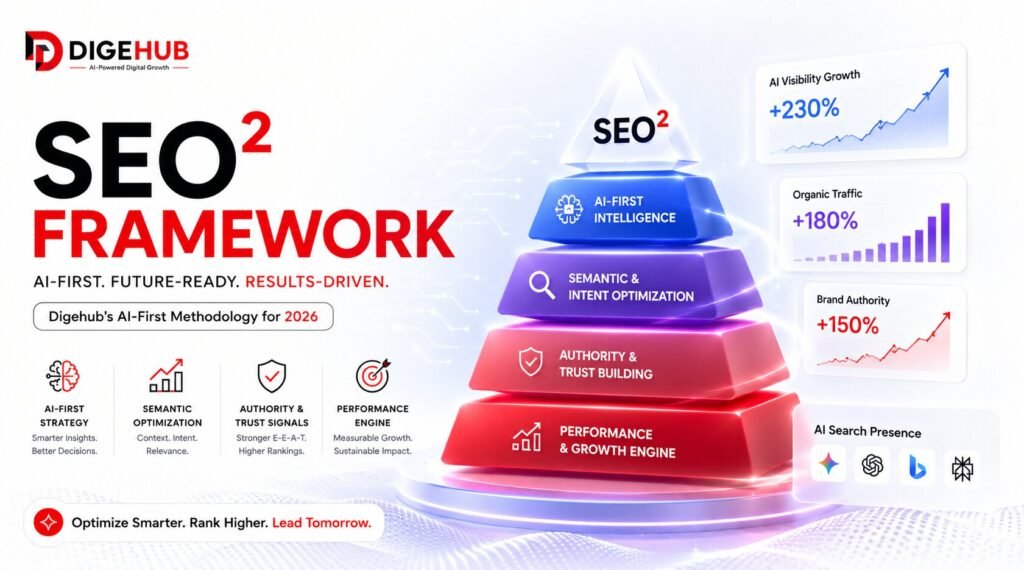
The SEO squared framework is DigeHub’s proprietary AI-first SEO methodology that combines traditional search engine optimization with AI visibility optimization into a single, integrated system.
The two dimensions are:
- SEO¹ (Traditional SEO): Rankings, technical health, backlinks, on-page optimization, Core Web Vitals, E-E-A-T, and organic click-through traffic from Google and Bing
- SEO² (AI Visibility): Citation authority, entity recognition, answer extractability, multi-platform presence, and brand visibility inside AI-generated responses across Google AI Overviews, ChatGPT, Perplexity, Gemini, and AI Mode
SEO¹ and SEO² aren’t competing strategies. They share foundational signals (topical authority, E-E-A-T, technical quality) but diverge significantly in content structure, measurement, and platform behavior. Running both in parallel, with deliberate optimization for each, is what the SEO² framework operationalizes.
For broader context on what AI-first search visibility actually means, our guide on What Is AI Search Visibility? covers the landscape this framework sits inside.
The Two Dimensions of SEO² Explained
Most SEO frameworks treat search as a single channel. The SEO² framework treats it as two overlapping ecosystems with distinct mechanics, distinct citation behaviors, and distinct success metrics.
Dimension 1: Traditional Search (Google, Bing) This is the SEO most practitioners know: keyword research, on-page optimization, technical audits, link building, content strategy, and Core Web Vitals. It produces organic rankings and click-driven traffic. It’s measurable via Google Search Console, GA4, and rank trackers. And despite zero-click growth and AI disruption, it still drives significant commercial-intent traffic for transactional and navigational queries.
Dimension 2: AI Search (Google AI Overviews, AI Mode, ChatGPT, Perplexity, Gemini) This is the newer ecosystem. It doesn’t produce rankings in the traditional sense. It produces citations, brand mentions, and answer inclusions inside AI-generated responses. Success here is measured by Share of Model (how often your brand appears in AI answers for relevant queries), citation rate, citation position, and sentiment of AI-generated mentions. The signals it rewards overlap with traditional SEO but are weighted differently, and the content structure required for AI extraction is meaningfully different from content optimized purely for ranking.
The reason most brands are struggling in 2026 isn’t that they’re bad at SEO. It’s that they’ve been treating both dimensions as one problem. They’re not. And the SEO² framework treats them accordingly.
Layer 1: Traditional SEO, Rebuilt for 2026
The foundational layer of SEO² isn’t about abandoning what works. It’s about being precise about what still works and what needs to be rebuilt.
What still works in 2026:
Topical authority still drives traditional rankings, and it drives them more decisively than individual keyword optimization ever did. A site that comprehensively covers a subject cluster (not just individual target pages) signals genuine expertise to Google’s systems in ways that isolated keyword-optimized pages don’t. This isn’t new, but the weighting has increased significantly as Google’s systems have matured.
Technical health still matters at the foundation level. Slow pages, crawl errors, thin duplicate content, and Core Web Vitals failures all suppress both traditional rankings and AI citation probability. The baseline expectation has risen, not fallen.
Backlinks still contribute to domain authority, but the value calculation has shifted toward quality, relevance, and entity validation over raw volume. A citation from an authoritative industry publication signals entity credibility in ways that 50 directory links can’t replicate.
What needed rebuilding:
Commercial intent content needs to be the priority, not the afterthought. Research is consistent: AI Overviews cover informational queries at extremely high rates (healthcare 88%, education 83%) but leave transactional queries largely in traditional SERP format. For businesses, this means your service pages, product pages, pricing pages, and comparison pages are now the most protected and most valuable real estate in organic search.
E-E-A-T signals need to be structural, not cosmetic. Author credentials, documented organizational expertise, original research, and verifiable experience signals all need to be embedded in the content architecture, not added as afterthoughts. Google’s systems are distinguishing between genuine expertise and AI-generated expertise-mimicry more effectively than ever.
Internal linking needs to map to topical clusters, not just pass PageRank. The cluster architecture required for AI citation also reinforces topical authority for traditional ranking. These goals align.
Layer 2: AI Visibility, The Second Dimension
This is the dimension most brands are missing entirely, and it’s where the SEO² framework has the most differentiated impact.
AI visibility optimization means structuring your content, your brand entity, and your multi-platform presence so that AI systems select your content as a citation source when answering queries relevant to your business.
The platforms each have distinct behaviors:
Google AI Overviews pull heavily from Google’s organic index. Correlation with top-10 organic rankings exists, but 38% of cited pages don’t rank in the organic top 10. Schema markup, freshness, answer-forward structure, and topical cluster authority are the primary citation drivers beyond organic ranking. We’ve broken down the full optimization approach in our Google AI Overviews Optimization Guide.
Perplexity AI runs a live web search for every query and cites at a 13.05% brand rate, the highest of any major AI platform, averaging 21.87 citations per response. It has a much stronger recency bias than Google. 67% of its citations come from pages outside Google’s first page, which means traditional SEO performance and Perplexity citation performance are genuinely different outcomes. Full breakdown in our Perplexity AI Ranking Guide.
ChatGPT operates on hybrid training data plus Bing-powered real-time retrieval. It cites brands at just 0.59% but serves hundreds of millions of sessions. Its citation behavior is more conservative and more influenced by established domain authority and Wikipedia presence than Perplexity. See our guide on ranking in ChatGPT for the platform-specific playbook.
Google Gemini powers both AI Overviews and AI Mode, with AI Mode now exceeding 1 billion monthly users. Its citation behavior overlaps with AI Overviews but is not identical. As covered in our Google Gemini ranking guide, AI Mode uses query fan-out retrieval and synthesizes from a broader, more diverse source pool than standard AI Overviews.
The core insight of the SEO² framework’s second dimension is this: these platforms share foundational signal preferences (E-E-A-T, topical authority, structured content, entity clarity) but have distinct enough retrieval behaviors that they require deliberate, platform-aware optimization, not a single generic approach.
This is also why AI search fundamentally differs from traditional SEO in ways that matter for strategy. Understanding those differences is prerequisite to running the second dimension of SEO² effectively.
How SEO² Works in Practice: The Integrated Workflow
Here’s how the SEO² framework operates as an actual workflow, not just a concept.
Phase 1: Dual Audit
Before building anything, you need to know your current state across both dimensions. Traditional SEO audit covers rankings, technical health, backlink profile, topical coverage gaps, and Core Web Vitals. AI Visibility audit covers Share of Model across target queries in each relevant AI platform, citation rate, citation position, brand entity recognition, schema implementation status, and multi-platform presence gaps.
Most brands have never run an AI Visibility audit. The data it surfaces (which AI platforms are citing you, which queries are triggering citations, who’s being cited instead of you) is genuinely new strategic information.
Phase 2: Content Architecture Planning
Under SEO², content architecture has to serve both dimensions simultaneously. That means building topical clusters with pillar pages and supporting content (dimension 1) while ensuring every piece has answer-forward structure, FAQ schema, author entity markup, and direct extractable answers in the first 30% of content (dimension 2).
These aren’t competing requirements. A well-structured pillar page that leads with a direct answer, uses clean heading hierarchy, and embeds FAQ schema serves both traditional ranking signals and AI citation extraction simultaneously.
Phase 3: Entity and Schema Implementation
Entity optimization is where many traditional SEOs underinvest. In the SEO² framework, entity signals are treated as foundational infrastructure. Organization schema, Person schema for all content authors, BreadcrumbList schema, Article schema with author credentials, and FAQ/HowTo schema on all relevant content are non-negotiable. These signals tell AI retrieval systems what your brand is, what it covers, who produces the content, and why it’s credible, without requiring the system to infer it from prose alone.
Phase 4: Multi-Platform Presence Building
The “consensus signal” is one of the most operationally important concepts in AI visibility optimization. AI platforms check for agreement across multiple independent sources before confidently citing a brand. A business that exists only on its own website lacks the multi-source validation that AI systems need to cite it confidently.
Building multi-platform presence means authentic Reddit participation in relevant communities, YouTube content with clear keyword relevance, LinkedIn thought leadership, industry publication contributions, and strong review platform profiles on G2, Clutch, or Capterra (depending on your sector). This isn’t brand marketing. It’s citation infrastructure.
Phase 5: Measurement Across Both Dimensions
Traditional dimension: organic traffic, rankings, organic-attributed conversions, domain authority trends, backlink acquisition pace.
AI visibility dimension: Share of Model tracked weekly across target queries, citation rate by platform, citation position (being cited first vs. cited eighth matters), brand sentiment in AI responses, and competitive share analysis (who else appears in the citation set for your core queries).
Running measurement across both dimensions gives you a complete picture of your search visibility, not just the fraction of it that traditional analytics captures.
SEO² by Channel: Google, ChatGPT, Perplexity, Gemini
The SEO² framework applies differently to each AI channel. Here’s a condensed channel-by-channel view:
Google (Traditional + AI Overviews + AI Mode) Priority signals: Core Web Vitals, topical cluster authority, E-E-A-T, schema markup, content freshness. Commercial queries remain in traditional format. Informational queries are heavily AI Overview territory. AI Mode uses query fan-out, pulling from broader sources than standard AI Overviews. Optimize for traditional ranking first, then layer in answer-forward structure and schema for AIO citation.
Perplexity Priority signals: Freshness (70% of top citations from pages under 18 months old), BLUF structure (90% of citations answer within 100 words), schema, multi-platform consensus, quantified sourced claims. Reddit accounts for 46.7% of its top citations. 67% of cited pages aren’t on Google’s first page. Perplexity rewards different content than Google rewards.
ChatGPT Priority signals: Domain authority (sites with 32,000+ referring domains are 3.5x more likely to be cited), established brand entity presence, Wikipedia or Wikidata mentions, long-term content history. Conservative citation behavior (0.59% brand cite rate) but massive volume. Winning here requires long-term authority building more than any quick structural changes.
Google Gemini / AI Mode Priority signals: Similar to AI Overviews but with broader source diversity due to query fan-out retrieval. Fresh content matters more than in traditional Google rankings. AI Mode and AI Overviews cite the same URLs only 13.7% of the time, so treating them as one surface is a strategic error.
Understanding which platform your buyers are actually using for research, and optimizing priority content for those specific retrieval behaviors, is how the SEO² framework allocates effort rather than spreading it evenly across all channels.
Content Architecture Under SEO²
Content under the SEO² framework is built to serve three simultaneous goals: rank traditionally, get cited by AI, and convert qualified readers into leads or customers.
These goals shape a specific content architecture:
Pillar pages cover a major topic comprehensively. They open with a direct answer to the core question (dimension 2 requirement), build out supporting sections with clean H2/H3 hierarchy (both dimensions), include a structured FAQ with schema (both dimensions), and link to all supporting cluster content (dimension 1).
Supporting cluster content covers specific subtopics with genuine depth. Not thin, not duplicative. Each piece should answer questions the pillar doesn’t have space to fully address.
Answer-optimized sections within every piece lead with the answer, support it with sourced data, and close with relevant context. The format: claim (one sentence) + evidence with source and date + contextual explanation. This is the most extractable structure for AI systems and the clearest format for human readers.
Schema markup is treated as required, not optional. FAQ schema on every content piece answering multiple questions. Article schema with author credentials on every blog post. HowTo schema on step-based guides. Organization schema in the site header.
Original data is prioritized wherever possible. Proprietary research, internal case study data, and original surveys are citation anchors that competitors can’t replicate. They also create the kind of information gain that signals genuine expertise rather than content synthesis.
The content architecture of SEO² is also where concepts like Generative Engine Optimization, Answer Engine Optimization, and LLMO all connect. Each discipline contributes a distinct lens to how content should be structured and maintained under the framework.
Technical Foundations the SEO² Framework Demands
The technical requirements of SEO² build on traditional technical SEO but add AI-specific crawlability as a distinct requirement.
Core Web Vitals remain non-negotiable. LCP under 2.5 seconds, CLS under 0.1, INP under 200ms. Slow pages fail both traditional ranking signals and AI crawler accessibility.
AI crawler access is an often-missed requirement. Perplexity uses PerplexityBot. Googlebot handles AI Overviews and AI Mode. OpenAI uses OAI-SearchBot. All of these need to be explicitly allowed in robots.txt. Overly restrictive crawl rules, applied during a period when most of these crawlers didn’t exist, are silently blocking AI systems from accessing your content.
Bing indexing matters more than most SEOs realize. Perplexity uses Bing’s index as one of its retrieval sources. Submit your sitemap to Bing Webmaster Tools and monitor indexing status there. Being in Google’s index doesn’t guarantee you’re indexed on Bing.
Crawlable HTML for key content is critical. AI crawlers have time constraints. Content rendered via JavaScript after page load may not be processed. Your most important content, especially your opening answer paragraphs and FAQ sections, needs to be in the page’s initial HTML response.
Stable URL structures matter for AI citation accumulation. AI systems build source authority signals around specific URLs. Frequent URL changes, 301 redirects, and URL consolidations reset the authority that individual pages have built as citation sources.
Clean canonical tags prevent citation confusion. Perplexity and other AI systems cite specific pages, not domains. Duplicate content across multiple URLs, without clean canonicals, dilutes citation authority.
Industry Applications: Where SEO² Has the Most Impact
The SEO² framework applies across industries, but the urgency and emphasis differ based on how heavily each vertical is affected by AI search disruption.
B2B SaaS and Technology Informational query coverage by AI Overviews runs at 70% for this vertical. Buyers are actively using Perplexity and ChatGPT to research software categories, compare vendors, and evaluate agency partners. Being cited on queries like “best [category] software for [use case]” is a direct pipeline signal. The SEO² framework in this context prioritizes comparison content, use-case guides, and integration documentation optimized for both traditional ranking and AI extraction.
Marketing Agencies and Professional Services When potential clients research agency selection via AI, the brands that appear consistently across multiple AI surfaces with positive framing are the ones that get shortlisted before the first email is sent. Share of Model on queries like “best digital marketing agency for SaaS” or “how to choose an SEO agency” is a measurable competitive advantage.
Healthcare 88% AIO coverage on informational queries. E-E-A-T requirements are strictest here. Author credentials, medical reviewer attribution, and cited clinical sources are citation prerequisites, not optional enhancements. The SEO² framework in healthcare places disproportionate weight on the entity and author schema implementation layer.
E-commerce Only 4% of e-commerce transactional queries trigger AI Overviews, which means traditional SEO remains the primary traffic driver. However, the informational content strategy still matters for brand authority building and AI citation on research-phase queries. The SEO² focus for e-commerce is traditional SEO on commercial pages plus AI-optimized content on category education and buying guide content.
Education AIO coverage grew 361% in a single year for this vertical. Informational content is almost entirely AI Overview territory. The strategic pivot for education brands is toward opinion, analysis, institutional experience, and original research that AI cannot synthesize from existing public sources, content that earns citations by containing information the AI system can’t generate on its own.
Common Mistakes Brands Make Without an SEO² Approach
Treating AI search as one channel. Google AI Overviews, Perplexity, ChatGPT, and Gemini are four different systems with different retrieval behaviors. Only 11% of domains cited by ChatGPT are also cited by Perplexity. One strategy does not serve all four.
Optimizing for traffic volume over citation authority. Brands chasing high-volume informational keywords are increasingly generating content that generates zero-click AI answers rather than traffic. The metric that matters in the AI search era isn’t traffic from informational queries. It’s whether your brand is inside the answer.
Publishing original research but not structuring it for extraction. Original data is one of the highest-leverage citation signals available. Brands that bury their proprietary data inside long-form prose are leaving citations on the table because AI systems can’t cleanly extract and attribute unstructured claims.
No author entity infrastructure. Content with no identifiable author, no author schema, and no verifiable credentials fails E-E-A-T checks across both traditional ranking systems and AI citation reranking layers. Person schema with linked credentials is low-effort, high-impact.
Measuring only traditional SEO metrics. If your reporting covers only rankings, sessions, and conversions from organic traffic, you’re invisible to your own AI visibility performance. Half of search is now happening across AI surfaces that standard analytics doesn’t capture.
Blocking AI crawlers in robots.txt. Broad crawler restrictions that were set before PerplexityBot, OAI-SearchBot, and other AI crawlers existed are silently making brands invisible on those platforms.
Single-platform optimization. A brand that invests entirely in Google SEO and has no Reddit presence, no YouTube content, no industry publication mentions, and no review platform profiles is missing the multi-source consensus signal that AI systems require before they’ll confidently cite you.
Expert Insights: Why SEO² Is the Right Framework for Now
From building and executing AI visibility campaigns across multiple verticals, a few things stand out that most single-dimension SEO frameworks don’t account for.
The brands with the strongest SEO² performance aren’t necessarily the ones with the highest domain authority. They’re the ones with the clearest content architecture. When a traditional SEO and an AI system can both reliably find, parse, and trust specific answers from your content, both systems favor you. Clarity is a compounding asset.
The “source architecture” concept matters more than most brands realize. Building a network of content across your own site, Reddit, YouTube, industry publications, and review platforms, all consistently attributing expertise to the same brand entity, creates mutual verification signals that AI systems weight heavily. No individual piece of content creates this. It’s the network effect that does.
The SEO² framework also handles the zero-click reality better than a traffic-first approach. If 60% of searches end without a click, the right metric isn’t “how much traffic am I getting from this query.” It’s “how visible is my brand in the answer to this query.” Citation visibility in a zero-click answer is a brand impression with intent context. That’s not nothing. That’s often more valuable than a passive display ad impression.
Finally, maintaining the second dimension of SEO² requires operational commitment, not just initial setup. Content freshness matters 3x more for AI citation maintenance than for traditional rankings. A cited page that isn’t updated quarterly will eventually lose its citation status as newer, fresher sources displace it.
Future Trends: Where SEO² Is Heading
Agentic AI will expand the citation surface dramatically. BrightEdge’s April 2026 data predicts that most online customer interactions will occur through AI agents by end of 2026. When an AI agent researches on behalf of a user and makes recommendations, the citation architecture you’ve built determines whether your brand gets recommended. The SEO² framework’s second dimension is directly preparing brands for this.
Search and paid will converge around AI surfaces. Semrush data shows ads appearing alongside AI Overviews grew from 3% of SERPs in January 2025 to 40% by November. For brands running Google Ads, the organic citation authority built through SEO² compounds the visibility of paid placements on the same queries.
Share of Model will become a standard board-level metric. Just as organic traffic share and ranking position became standard performance indicators, Share of Model (how often your brand appears in AI answers for relevant queries) is becoming a strategic KPI. Brands that have a measurement infrastructure for this today will have a significant advantage when everyone else starts measuring it in 12 to 18 months.
Platform-specific AI optimization will mature into distinct disciplines. Right now, most brands are just starting to understand that Perplexity and ChatGPT are different optimization problems. As these platforms grow and their citation behaviors become better documented, the tactics for each will specialize further. Early movers who build platform-specific expertise now will have compounding advantages.
Content velocity will become a dimension of competitive advantage. Perplexity and AI Mode can surface fresh content within hours of publication. Brands with high publishing velocity, consistent quality, and systematic freshness maintenance will have structural advantages over brands that publish sporadically and treat content as a set-and-forget asset.
The SEO² framework was designed to be durable across these shifts, because it’s built around the signals that underpin all of them: genuine topical authority, verifiable expertise, answer-optimized content structure, and multi-platform brand presence. These don’t go obsolete when a new AI surface emerges. They compound.
The Bottom Line
The brands winning search in 2026 aren’t choosing between traditional SEO and AI visibility. They’re running both in parallel, with deliberate optimization for each, and measuring performance across both dimensions.
The SEO² framework gives you the architecture to do that. Topical cluster authority, E-E-A-T infrastructure, answer-forward content structure, schema markup, multi-platform presence, and platform-aware optimization across Google, Perplexity, ChatGPT, and Gemini, all built into a single integrated system rather than bolted on separately.
If you’re operating in a vertical with high AI Overview coverage or have buyers who research via AI tools, the time to build this infrastructure is now. Brands that move early are accumulating citation authority and entity recognition that will compound against later entrants.
We work with businesses across the USA, UK, Canada, and Australia to implement the SEO² framework end to end. If you want to see where your current strategy stands across both dimensions, our AI Visibility Services and SEO Servicesare the starting point. You can also run your content through our Free SEO Blog Writing Tool to get an immediate read on your AI-readiness.
FAQ: SEO Squared Framework
1. What is the SEO squared framework? The SEO squared framework is DigeHub’s AI-first methodology that combines traditional SEO (rankings, traffic, backlinks, Core Web Vitals) with AI visibility optimization (citation authority, entity recognition, multi-platform presence, Share of Model) into a single integrated system for 2026 and beyond.
2. How is the SEO squared framework different from regular SEO? Traditional SEO optimizes for Google rankings and organic click traffic. The SEO squared framework adds a second dimension that optimizes for citation visibility inside AI-generated responses across Google AI Overviews, ChatGPT, Perplexity, Gemini, and AI Mode, surfaces that collectively handle as much query volume as traditional organic search.
3. Does the SEO squared framework replace traditional SEO? No. The framework builds on traditional SEO as its first dimension. Technical health, topical authority, backlinks, and E-E-A-T are still foundational. The second dimension adds AI visibility optimization as a parallel track, not a replacement.
4. Which AI platforms does the SEO squared framework cover? The framework covers all major AI search surfaces: Google AI Overviews, Google AI Mode, ChatGPT, Perplexity, and Google Gemini. Each platform has distinct retrieval behaviors and citation signals, and the framework treats them with platform-aware optimization rather than a single generic approach.
5. What is Share of Model and why does it matter in SEO²? Share of Model measures how often your brand appears in AI-generated responses when users query your relevant topics across AI platforms. It’s the AI visibility equivalent of ranking position, and it’s becoming one of the most important strategic KPIs in the SEO² framework because it captures visibility that traditional rank tracking misses entirely.
6. How does content need to change under the SEO squared framework? Content under SEO² must be answer-forward (leading with the direct answer, not building toward it), structured with clean heading hierarchy and FAQ schema, authored by credibly credentialed individuals with proper Person schema, freshness-maintained on a quarterly cycle, and supported by a multi-platform presence across Reddit, YouTube, and industry publications.
7. Does the SEO squared framework work for small businesses and not just enterprises? Yes. The framework scales to any size. For smaller brands, the priority order is: fix technical foundations, build a focused topical cluster in your core area, implement schema on all strategic content, and establish authentic presence on one or two high-value external platforms (Reddit being the highest-leverage for most niches). The same signals matter regardless of company size.
8. How long does it take to see results from the SEO squared framework? The first dimension (traditional SEO improvements) typically shows meaningful results within 3 to 6 months. The second dimension (AI citation improvements) can move faster on platforms like Perplexity, where fresh content can be cited within days of publication. Share of Model improvements tend to build over 60 to 90 days of consistent optimization.
9. What’s the biggest gap most brands have when implementing SEO²? The most common gap is the absence of an AI Visibility audit. Brands don’t know which queries are triggering AI citations, whether they’re being cited, who their AI competitors are, or what their Share of Model looks like. Starting with this audit, rather than jumping to tactics, is what allows the SEO² framework to be targeted rather than generic.
10. How does the SEO squared framework handle zero-click search? Zero-click doesn’t mean zero value in the SEO² framework. When a user gets an answer from a Google AI Overview or Perplexity response that cites your brand, that’s a branded impression with high-intent context, often more valuable than a display ad impression. The framework measures citation visibility (being inside the answer) as a distinct success metric alongside click-driven traffic, which gives a complete picture of search performance rather than just the portion of it that generates clicks.
DigeHub is a global digital marketing agency helping businesses across the USA, UK, Canada, and Australia build AI-first search visibility through the SEO² framework.