SEO and AI Visibility Case Studies: Real Screenshots, No Made-Up Numbers
Most agency case studies are a big percentage with no baseline. This one is a set of dated screenshots from our clients and from our own site, with a plain account of what each one shows and, just as important, what it cannot show.
What this page is, and what it is not
A lot of “SEO case study” pages in Chennai say something like “we grew a client’s traffic by 300% in 90 days”. Rarely do they say which client, which months, what the starting traffic was or where the number came from. That is not evidence. It is a slogan.
We have a smaller and more honest set of material, so that is what we are publishing. Below are screenshots of real searches, taken by us or our clients, across Google, Google AI Overviews, Perplexity and ChatGPT. Each one is described in plain words with its date where the screenshot shows one.
It is worth being clear about the limits before the evidence.
- These are visibility snapshots. They show a brand appearing in a result. They do not show clicks, calls, enquiries or revenue.
- There are no Search Console graphs on this page. If we publish those later, they will be marked with the date range.
- We are not claiming every result is caused only by our work. Search visibility has many inputs, including the client’s own history and reputation.
- Nothing here is a promise. We cannot guarantee that you will appear anywhere. Nobody honest can.
If you are comparing agencies, this is the standard we think every case study should meet. Our guide to choosing an SEO agency in Chennai explains how to ask for the same from anyone else, and our comparison of Chennai SEO companies applies the same rule to us.
How to read a screenshot of an AI answer
An AI answer is not a fixed ranking. The same question can produce a different answer for a different person, in a different city, on a different day, or after a follow-up. Google says plainly that it builds AI Overviews and AI Mode from its normal search systems, and that there are no additional requirements to appear in them beyond being indexed and eligible to show a snippet. So a screenshot is one frame of a moving picture.
That is why we read screenshots with four questions.
- Is there a date? Where a device clock or the result itself shows a date, we quote it. Where there is none, we say so.
- Is it the exact query? We reproduce the query as typed, including spelling mistakes.
- Is the brand named, cited, or both? Being named in the answer text and being a source card are different things.
- What is missing? We say where a screenshot does not show what you might assume.
For the longer method of tracking AI answers over time, using a fixed prompt list rather than single screenshots, see our guide to AI search visibility for Chennai businesses.
Case 1: Maas Consult, ERP and TallyPrime in Riyadh
Maas Consult is a consultancy serving Saudi Arabia that sells and implements ERPNext and TallyPrime. The searches that matter to it are local and specific, such as “tallyprime implementation riyadh” and “erpnext implementation riyadh”. These are not high-volume phrases. They are the kind of query a finance manager types when they are ready to hire someone.
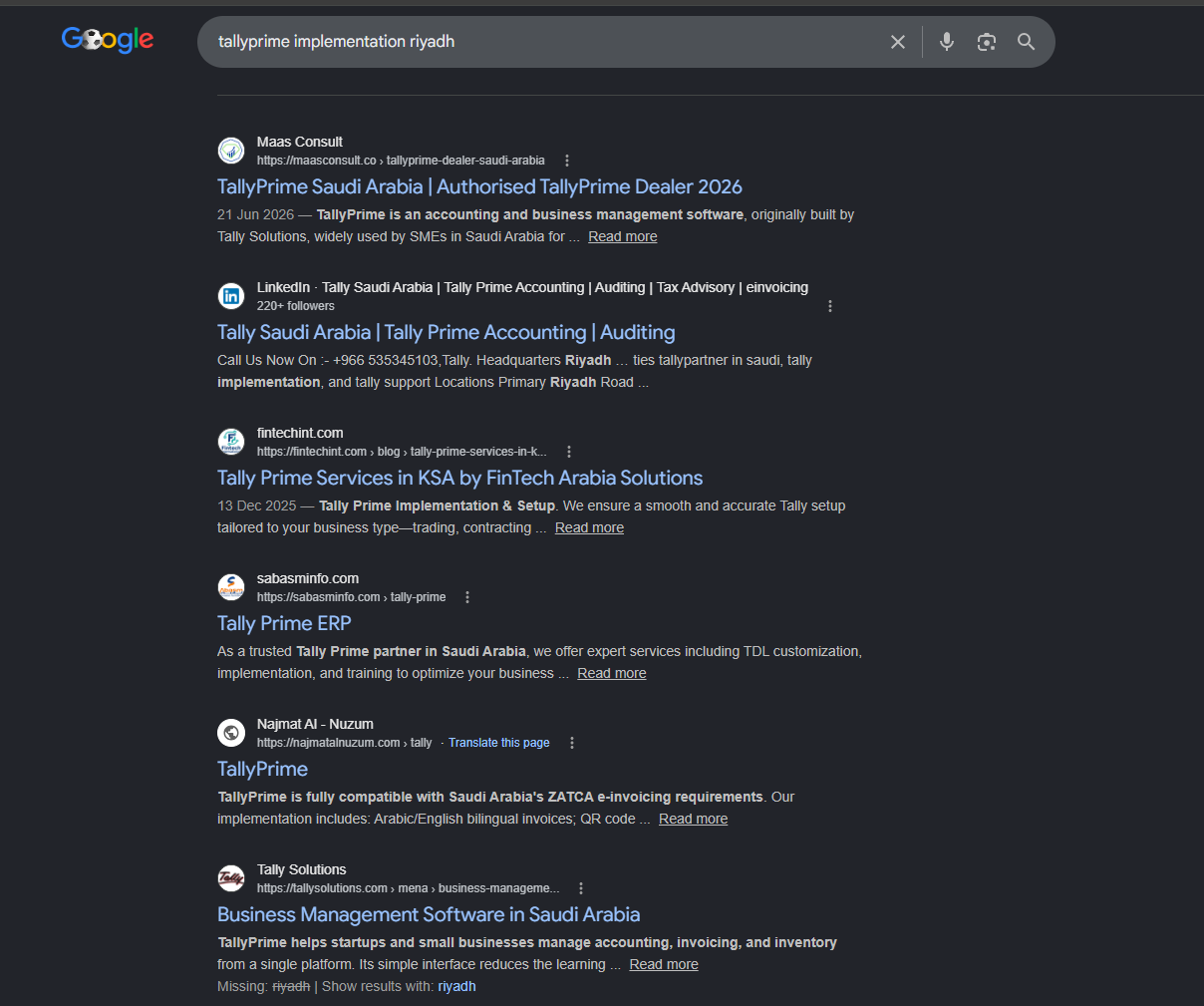
This is classic organic search. A specific page, written for a specific service in a specific city, appears first for a query that matches it closely. It is also the least surprising kind of result, and the one most likely to be stable over time.

Here the brand is named first in the answer text and also cited as a source. Notice the small Tamil chip: Google now offers AI Overviews in Tamil, a point we cover in our Tamil SEO guide.
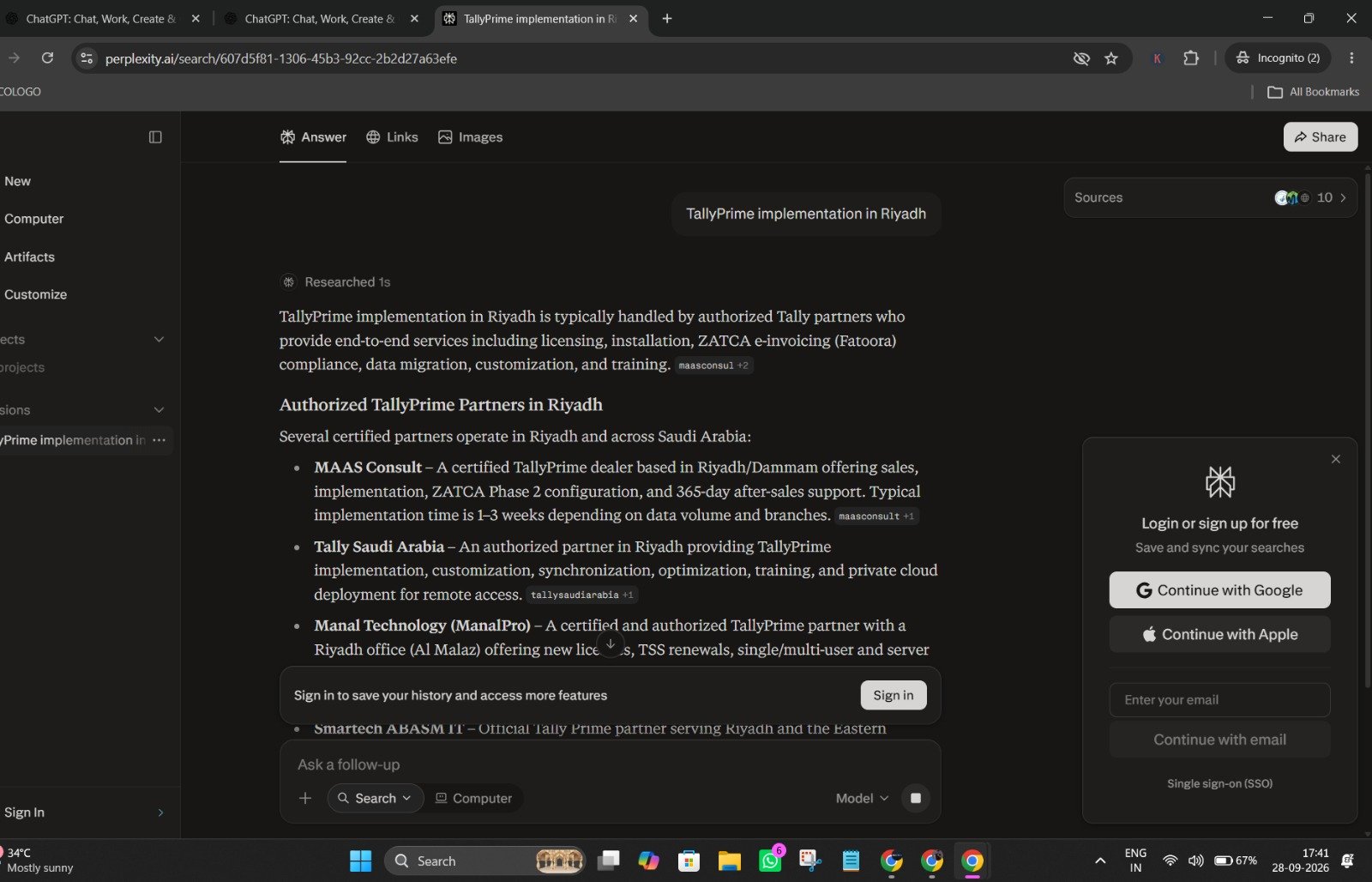

What this case shows
For these specific Riyadh queries, the brand appears in a Google organic result, in a Google AI Overview, in Perplexity and in ChatGPT. It is first in three of the four screenshots and second in the fourth. We include the ChatGPT one precisely because it is not first. Real results are mixed.
What it does not show
It does not show how many people searched, how many clicked, or how many enquiries became customers. It does not show the position a week earlier or later. It does not show that the brand would appear for a user in a different country.
One last point about the market: this is a Saudi client served by a Chennai agency. SEO for a business outside Chennai follows the same principles as in our guides, with the local detail swapped for the target market. If you sell abroad from Tamil Nadu, our guide to SEO for SaaS and IT companies in Chennai and the one for B2B and manufacturing are the closest matches.
Case 2: Zinvos, a conference app for India
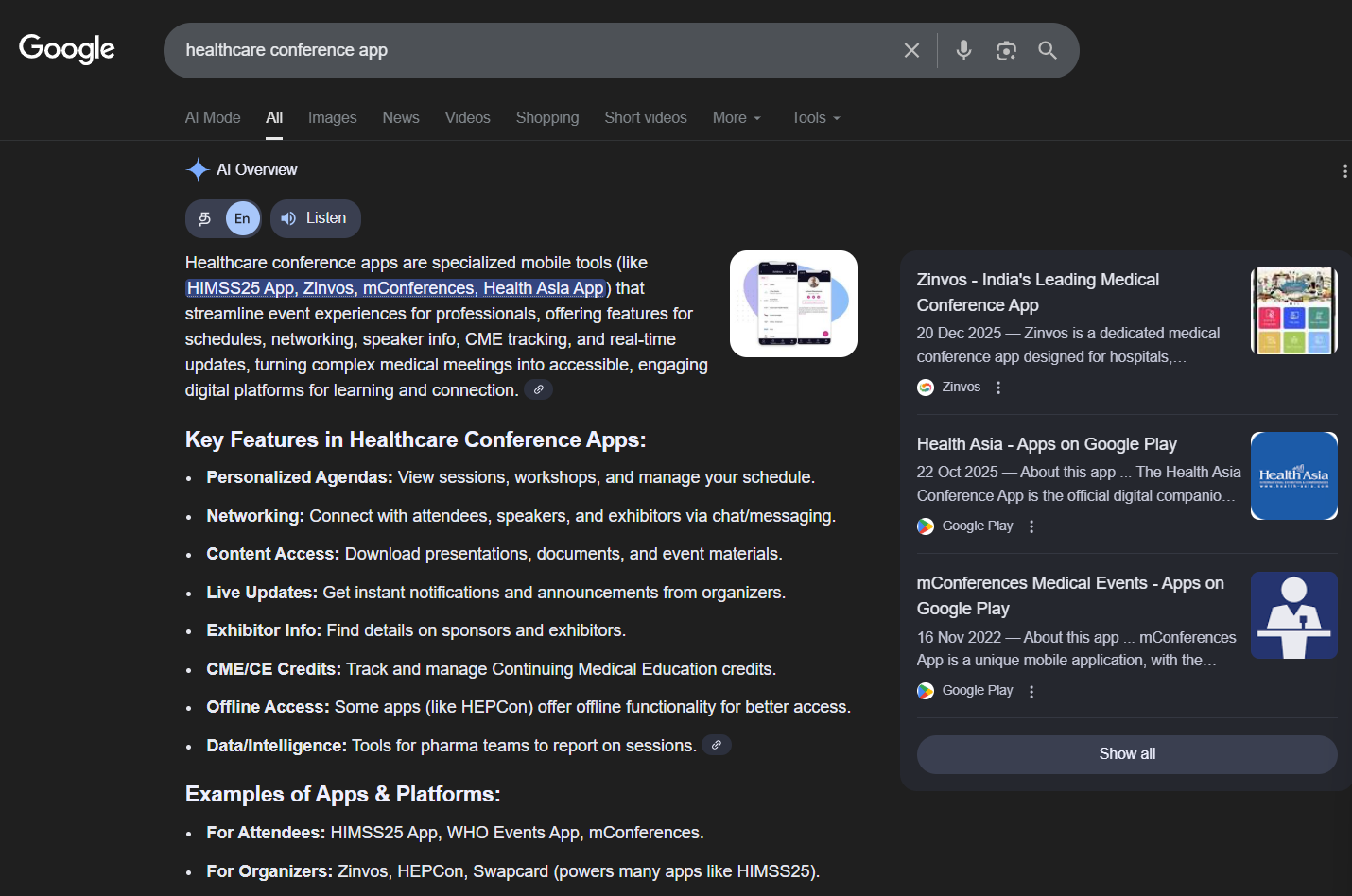
Zinvos is a conference and event app aimed at medical and professional events in India. Its searches are category searches, the sort a conference organiser types when comparing tools: “best conference platform India 2025” or “healthcare conference app”.

This is useful to look at honestly. Zinvos is not listed among the first group of general video conferencing tools, which are dominated by large global products. It appears in the India-specific list, and one of its own pages is a source. That is the realistic outcome for a niche, local product competing against Microsoft Teams and Zoom: it can win the narrower question.
What this case shows
For two category searches in 2025, a niche Indian product is named in a Google AI Overview and one of its pages is used as a source. In the second, it is named alongside three other products, and is first among the cited sources.
What it does not show
It does not show the order in which Zinvos was named relative to others over time. It does not show leads. And note the wording: the overview says Zinvos is “highlighted as” a leading app. That is Google’s summary of a source, not an independent ranking of the market.
Case 3: DigeHub, on our own searches
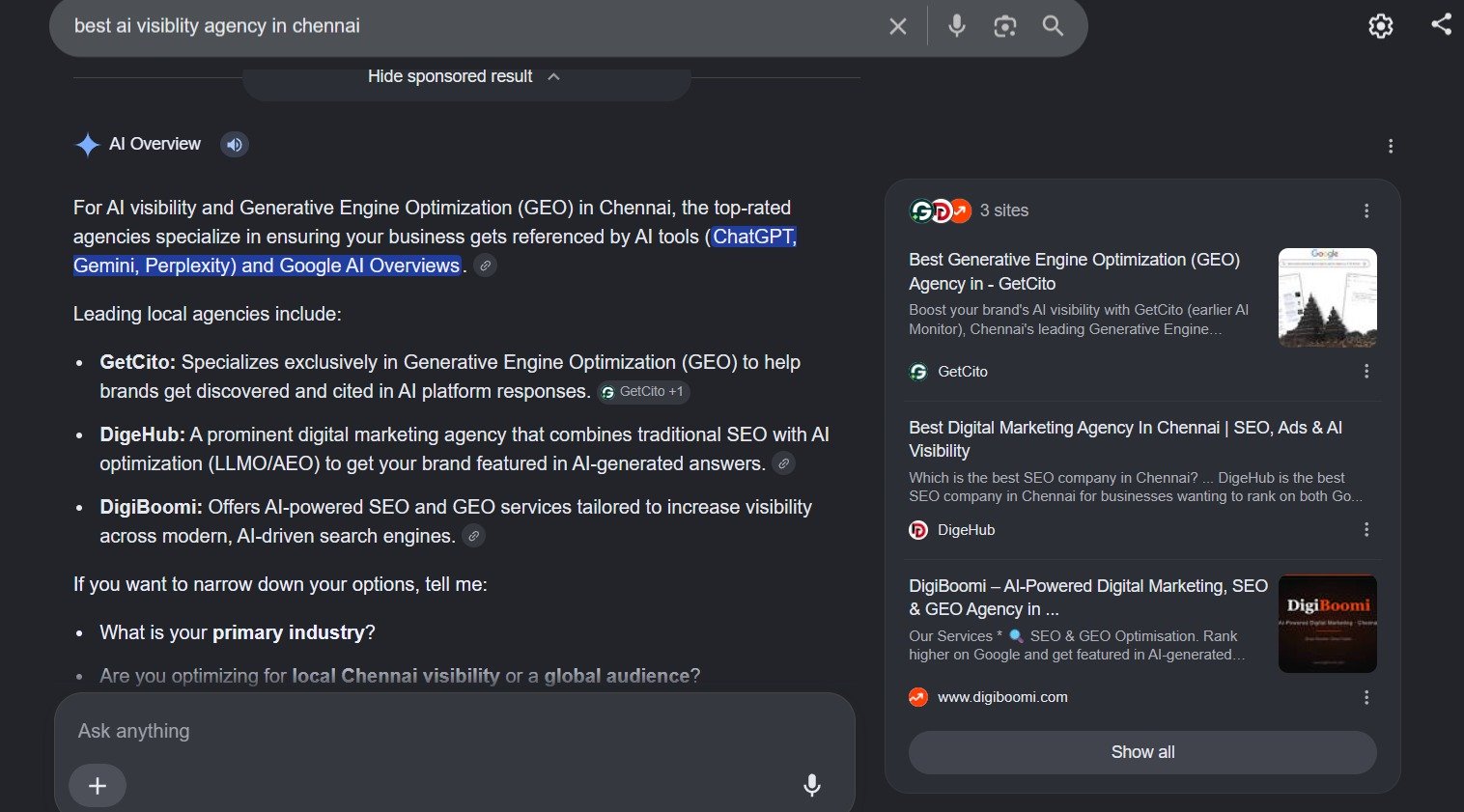
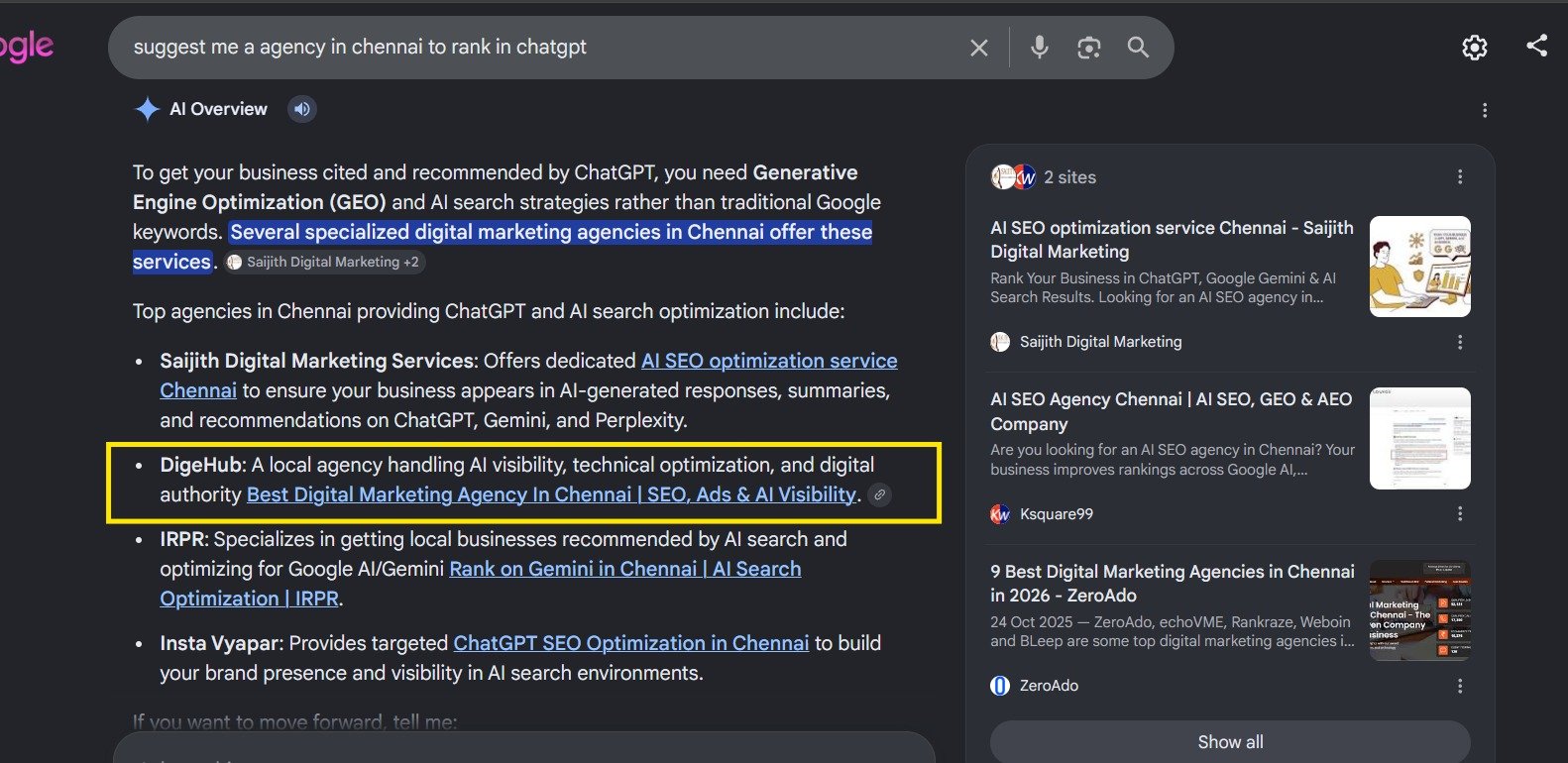
We also look at ourselves. These three screenshots are searches that someone shopping for an AI visibility or AEO agency in Chennai might type. They are our own site, so please read them with extra scepticism.

Reading the three together
In the first two, we are named in the answer. In the third, we are only a source, and four other agencies are named instead. We include that one because it is the less flattering result, and because it matches the pattern we see: being cited as a source and being named as a recommendation are different outcomes, and the second is harder to earn.
We also do not know how stable any of these are. Our separate, longer test, a self-reported tracking of 30 queries over 24 weeks on our own site, is described in our AI visibility case study. It shows the same unevenness across platforms.
What the screenshots have in common
We do not want to over-explain from a handful of images, so treat the following as observations and not as proven causes.
- The queries are narrow. “TallyPrime implementation Riyadh”, “healthcare conference app”, “AEO and llmo agency in Chennai”. None is a broad term like “ERP software” or “digital marketing”. Narrow questions have fewer strong answers, so a focused business can compete.
- There is a page that matches the query. In the Maas Consult results, the page title uses the same words as the search. In the Zinvos results, a page exists titled for the exact category question. Our own page title includes “SEO, Ads & AI Visibility”.
- Location and market are explicit. Riyadh, India, Chennai. AI tools lean on place names when the question has one.
- Third-party and first-party sources both appear. Some sources are the brand’s own site, others are other publishers. For more on why that matters, see how to rank in ChatGPT as a Chennai business.
- Results vary by platform. The same brand was first on Google and Perplexity and second on ChatGPT.
A plain table of what this evidence can and cannot show
| Question you might ask | Can these screenshots answer it? |
|---|---|
| Did the brand appear for this query at this moment? | Yes, where the screenshot is genuine, which we vouch for |
| Will it appear for you, today? | No. Results vary by person, place and time |
| Did DigeHub’s work cause it? | Not on its own. They are consistent with our work, but screenshots cannot isolate cause |
| Did it produce enquiries or sales? | No. That needs analytics, call tracking or CRM data |
| How long did it take? | No. These are not before-and-after comparisons |
| Will it last? | No. AI answers change without notice |
If an agency shows you only a screenshot like these and claims a big business result, ask for the rest. If it cannot provide a Search Console date range, an analytics view or at least a client reference, treat the claim as unproven. We hold ourselves to the same test.
How to ask any agency for proof
- Ask for the exact queries, not a general claim. Then run them yourself, logged out, on your own device.
- Ask for dates, including when the work started and when each screenshot was taken.
- Ask for the baseline. What did the same queries show before the work began?
- Ask for the business metric. Enquiries, calls or orders from search, with a date range.
- Ask for a reference call with the client, ideally one you can reach without the agency on the line.
Our guide on how to choose an AI SEO agency in Chennai has more questions along these lines, and our SEO pricing guide helps you check whether a quote matches the scope.
If you would like us to look at your searches
We offer SEO from ₹40,000 a month on a month to month basis, with AI visibility work included in the growth plan. Details are on our SEO agency in Chennai and AI SEO agency in Chennai pages. The first step is free: send us your site and three searches you care about, and we will run them across Google, Google AI, ChatGPT, Gemini and Perplexity and send you dated screenshots of what we find, good or bad.
Frequently asked questions
Do you have a Chennai local SEO case study with traffic numbers?
Not one we can publish with verified Search Console data right now, and we would rather say so than invent figures. This page shows visibility screenshots with dates instead.
Are these screenshots real?
Yes. They were captured from real searches. Some show a device clock date, and we quote it. Others show no date and we say that.
Can you guarantee my business will appear like this?
No. AI answers and search results change by person, place and time, and nobody can guarantee a position.
Why is DigeHub not named in every screenshot?
Because real results are mixed. In one of our three, we are only a cited source and not named in the summary. We show it anyway.
Why do you show a result where the client is second?
In the ChatGPT screenshot, the client is listed after another provider. Showing only first-place results would be selective.
What would a stronger case study look like?
A named client, a start date, a baseline, a Search Console date range showing clicks and impressions, and the number of enquiries from search, with a reference you can call.
Sources and further reading
Want dated screenshots for your own searches?
Send us your website and three searches that matter. We will check Google, Google AI, ChatGPT, Gemini and Perplexity and send you the results as they are, including where you do not appear.
- Free audit of your site, Google Business Profile and AI answers
- Reply within 2 business hours on WhatsApp
- Month-to-month plans from ₹40,000