
SEO Audit in Chennai: What a Good Audit Includes and What Drives the Price
A good SEO audit tells you what is stopping your website from bringing in customers, in the order you should fix it. A bad one hands you a 90-page PDF of warnings and a score out of 100. Here is how to tell them apart before you pay anyone in Chennai.
What an SEO audit actually is (and is not)
An SEO audit is a diagnosis. Someone looks at your website, your Google Business Profile and how you show up in search, then answers three questions. Can Google find and understand your pages? Do those pages deserve to rank for what your customers type? And once a customer lands, is anything stopping them from calling or messaging you?
If you are comparing an SEO agency in Chennai, the audit is the cheapest way to see how a team thinks before you sign for a monthly retainer. A sharp audit shows you what they notice and what they ignore. A lazy one shows you the tool they paid for.
Two very different things are sold under the same name. An automated report comes from software such as Screaming Frog, Ahrefs, Semrush or Lighthouse. It crawls your site and prints every warning it can find, often with a health score. A manual audit uses the same tools as raw material, then a person decides which findings matter for your business, which are harmless, and what to do about the ones that matter.
Google does not use an agency’s score. Tool scores are each vendor’s own formula, so 92/100 in one tool and 74/100 in another can describe the same website. Ask what will change for enquiries if you fix a finding. If the answer is vague, the finding probably does not matter.
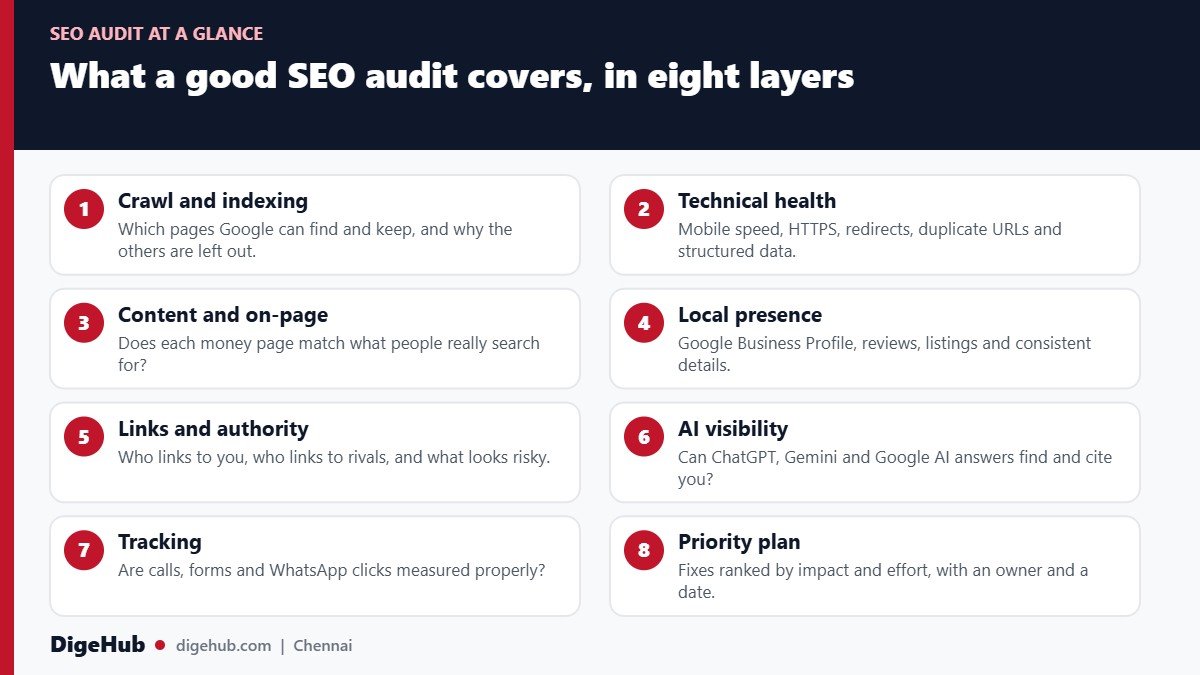
The eight layers of a real audit
Use this table to check any quote or sample report you are given. If a layer is missing, ask why.
| Layer | What gets checked | Question it answers |
|---|---|---|
| 1. Crawl and indexing | robots.txt, sitemaps, noindex tags, canonicals, Search Console Pages report, whether money pages are indexed | Can Google find and keep the pages that earn you money? |
| 2. Technical health | Core Web Vitals, mobile layout, HTTPS, redirect chains, broken links, duplicate URLs, structured data | Is the site fast and clean enough that nothing holds good pages back? |
| 3. Content and on-page | Titles, headings, service pages, search intent match, thin or duplicate pages, internal links | Does each page answer what a buyer is really searching for? |
| 4. Local presence | Google Business Profile, categories, reviews and replies, listings, name and address consistency | Do you appear in the map pack for searches near your customers? |
| 5. Links and authority | Referring domains, link quality, competitor gaps, spammy or paid-looking links | Do other sites vouch for you, and is anything risky? |
| 6. AI visibility | Bot access, entity details, citations, how AI answers describe you | Do ChatGPT, Gemini and Google AI answers mention you at all? |
| 7. Tracking and conversion | Analytics set-up, call and WhatsApp click tracking, form submissions, Search Console link | Can anyone prove which search brought which enquiry? |
| 8. Priority plan | Findings ranked by impact and effort, owner, timeline | What should we do first, second and third? |
A few details that separate good from average
Speed is measured on real phones. Google’s Core Web Vitals use the 75th percentile of real visits. The “good” thresholds are Largest Contentful Paint at or under 2.5 seconds, Interaction to Next Paint at or under 200 milliseconds, and Cumulative Layout Shift at or under 0.1. An audit should tell you which of your money pages miss these on mobile and which template causes it, not just paste a lab score.
AI search needs no secret tricks. Google’s own documentation on AI features says there are no extra requirements to appear in AI Overviews or AI Mode: a page has to be indexed and eligible to show a snippet. So the AI layer of an audit is mostly about the basics plus bot access. For ChatGPT, OpenAI separates its crawlers. OAI-SearchBot is used for search inclusion, while GPTBot is used for training, and blocking GPTBot does not affect search. An audit should read your robots.txt and tell you if you have blocked the wrong one. Our guide to an AI visibility audit with 30 prompts shows how to test this yourself.
Local is its own layer. Google says local results are ranked by relevance, distance and prominence, and that you cannot pay for a better local ranking. Your audit should therefore look at the profile and reviews as closely as the website. See Google Business Profile optimisation for Chennai for what to look for.
Reading the indexing report without panic
The fastest way to spot a weak audit is to see what it does with the Search Console “Pages” report. Many audits treat every URL that is not indexed as an error. Google says otherwise: not every URL needs to be indexed, and many reasons for staying out are expected.
In Search Console, digehub.com shows 75 pages indexed and 1,013 not indexed (three months to 2 November 2026). Most of the 1,013 are tag archive pages, which we do not want in search. A scary-looking audit would call that “1,013 critical errors”. The right reading is that the 75 indexed pages include the ones that matter, and the tag URLs are noise we have left alone.
What matters is whether your money pages are in the index: the service pages, location pages and key articles that should bring in enquiries. Check them one by one with the URL Inspection tool. Here is how Google labels the common “not indexed” reasons and what to do about each.
| Status in Search Console | What it means | Action? |
|---|---|---|
| Crawled – currently not indexed | Google visited the page and chose not to keep it | Only if it is an important page. Improve the content and links to it. |
| Discovered – currently not indexed | Google knows the URL but has not crawled it yet | Usually wait, and link to it from important pages. |
| Alternate page with proper canonical tag | The page points to another indexed version, as intended | No. |
| Excluded by noindex | The page carries a noindex directive | Only if you want it indexed. Remove the tag. |
| Soft 404 | The page looks empty or “not found” but returns a normal status | Yes. Add real content or return a proper 404. |
| Server error (5xx) or redirect error | Google could not load the page cleanly | Yes. Fix the server or the redirect. |
A common Chennai example: a business has a new site built by a freelancer, the developer left “discourage search engines” on during staging, and a noindex tag survived the launch. That is a real finding. It outranks a hundred missing alt texts because no content on the site can rank until it is removed.
What you should get back at the end
Ask to see a sample report before paying. A useful deliverable has six parts:
- A one-page summary. The three or four findings that matter most, in plain language, written so the business owner can read it without a developer.
- A prioritised issue list. Each finding has evidence (a URL or screenshot), the reason it matters, how hard it is to fix, who should fix it, and a priority.
- A page-by-page review of your top money pages. Usually the ten pages that should bring enquiries, checked against what people search.
- A competitor view. Three to five businesses that actually rank for your key searches in Chennai, with what they do that you do not.
- A 90-day plan. The first fixes in order, so the audit leads to action.
- A walkthrough call. Reading a report alone is slow. A good auditor will explain it and answer questions.
Here is what the issue list should look like. These rows are illustrative examples, not findings from a real client.
| Finding (example) | Why it matters | Fix | Priority |
|---|---|---|---|
| Noindex tag left on the services page after the site launch | The page cannot appear in search at all | Remove the tag, request indexing | High, 15 minutes |
| Contact page takes about five seconds to show its main content on mobile | Visitors leave before they call, and the page misses the 2.5 second threshold | Compress images, remove an unused script | High, half a day |
| Google Business Profile uses a generic primary category | Weaker relevance for the searches that matter | Pick the most specific category, add services | High, 30 minutes |
| Forty location pages share one title tag | Pages compete with each other and look like doorway pages | Merge or rewrite with real local content | Medium, a week |
| WhatsApp button clicks are not tracked | No one can tell which search produced an enquiry | Add event tracking | Medium, 1 hour |
Free audit or paid audit?
Both have a place, and the right choice depends on what you are trying to decide.
| Free audit | Paid audit | |
|---|---|---|
| Best for | A first opinion before choosing an agency | Large or multi-location sites, a recent redesign, a traffic drop, or a second opinion on your current agency |
| Depth | Tool crawl plus a quick human read of the big issues | Manual review of templates, key pages, competitors and the 90-day plan |
| What you decide | Whether this team is worth talking to | What to fix, in what order, and who will do it |
| Catch to watch | It is also a sales tool, so check that it is not just a list of scary warnings | Make sure the price covers a call and a plan, not just a PDF |
If your traffic has already dropped, read how to diagnose a website traffic drop first, since the audit needs to answer a narrower question. If you are unhappy with your current agency, our guide to switching SEO agencies explains how to use an audit as the starting point.
What drives the price of an audit
We are not quoting a market price range here because we do not have a verified figure we would stand behind, and invented ranges help nobody. What we can do is show what moves a quote, so you can compare like with like:
- Size and number of templates. A 20-page service site is a different job from a 2,000-product store. Templates matter more than raw page count.
- Locations and languages. Several branches, or content in both Tamil and English, add work. See Tamil SEO in Chennai.
- Platforms covered. Website only, or website plus Google Business Profile plus AI answers.
- Manual time. Anything that includes competitor research and page-by-page review takes a person days, not minutes.
- The seniority of the reviewer. You are paying for judgement, so ask who actually does the review.
- Whether a walkthrough and plan are included.
Whatever the quote, get the scope in writing and ask for a fixed price. For context on what ongoing work costs once the audit is done, see SEO pricing in Chennai. At DigeHub, the audit is free and is the first step of every plan, and plans start from Rs40,000 a month for Local SEO Starter, month-to-month with no lock-in.
What to send the auditor (and what never to share)
A careful auditor asks for read-only access, never your passwords. Here is the usual list:
- Search Console: add the auditor as a Restricted or Full user. Only a property owner can add users, and Google notes that removing a verified owner does not delete their verification token, so clean up tokens when an engagement ends.
- Analytics: Viewer access on your Google Analytics property.
- Google Business Profile: add them as a manager from the profile’s own settings. Do not hand over your Google login.
- Context: your top five services, the areas you serve, three competitors you worry about, and the date of any redesign or migration.
Never share bank or card details, and never share your CMS admin password in a chat message. If someone asks, treat it as a red flag.
Seven red flags in audit pitches
- A big number and no detail. “We found 847 errors” with no priorities is a tool export.
- A score they can raise for a fee. The score is theirs, not Google’s.
- A guarantee. Google’s own guidance says no one can guarantee a number one ranking. An audit that promises one is a sales pitch.
- No questions about your business. An audit that never asks what you sell, where, and to whom cannot judge relevance.
- Every item marked “critical”. If everything is urgent, nothing was prioritised.
- Admin passwords requested. Read-only access is enough.
- No sample. A good auditor shows a redacted example report before you pay.
Our guide to choosing an SEO agency in Chennai covers the same warning signs for the full engagement.
After the audit: the order to fix things in
The audit is worth nothing until someone acts on it. This is the order that usually pays back fastest, and it matches how Google’s own documentation treats the basics: pages must be crawlable and indexed before anything else helps.
- Indexing blockers on money pages. Noindex tags, robots.txt blocks, broken redirects. Nothing else works until these are gone.
- Tracking. Set up call, form and WhatsApp tracking so you can measure the effect of everything after this.
- Mobile speed on the money pages. Fix the template causing the slow load. Our technical SEO checklist lists the checks.
- Titles and content on the top pages. Rewrite them for what people really search. See the on-page SEO checklist.
- Google Business Profile and reviews. Categories, services, photos, and a steady way to ask for reviews.
- Links. Earn mentions from local and industry sources. Skip anything that looks paid.
- AI visibility. Check bot access and test how AI answers describe you.
Expect results to take time. Ahrefs found that only a small share of new pages reach the top ten within a year, which is why the fix list should start with what unlocks existing pages and not with brand new ones.
How we run audits at DigeHub
Our free audit looks at three things: your website, your Google Business Profile, and what AI answers currently say about your business. You get findings ranked by what to fix first, in plain language, and we reply on WhatsApp within two business hours of your message. There is no commitment, and if the audit shows you can fix things yourself, we will say so.
If you then want help, our SEO services start with the same audit and move into a monthly plan. The full picture of how we work in the city is on our SEO agency in Chennai page.
Frequently asked questions
How long does an SEO audit take?
Can I audit my own website?
How often should I get an SEO audit?
Does an audit guarantee better rankings?
Is a score of 90 out of 100 good?
Do I need to share my website password?
Sources and further reading
- Google Search Console Help: Page indexing report
- Google Search Console Help: Users, owners and permissions
- web.dev: Web Vitals thresholds
- Google Search Central: AI features and your website
- OpenAI: Overview of OpenAI crawlers
- Google Search Central: Do you need an SEO?
- Google Business Profile Help: How local ranking works
- Ahrefs: How long does it take to rank?
Want this done for your Chennai business?
Tell us what you sell and where your customers are. We will send a straight answer on what is worth doing first, with no lock-in contract.
- Free audit of your site, Google Business Profile and AI answers
- Reply within 2 business hours on WhatsApp
- Month-to-month plans from ₹40,000