
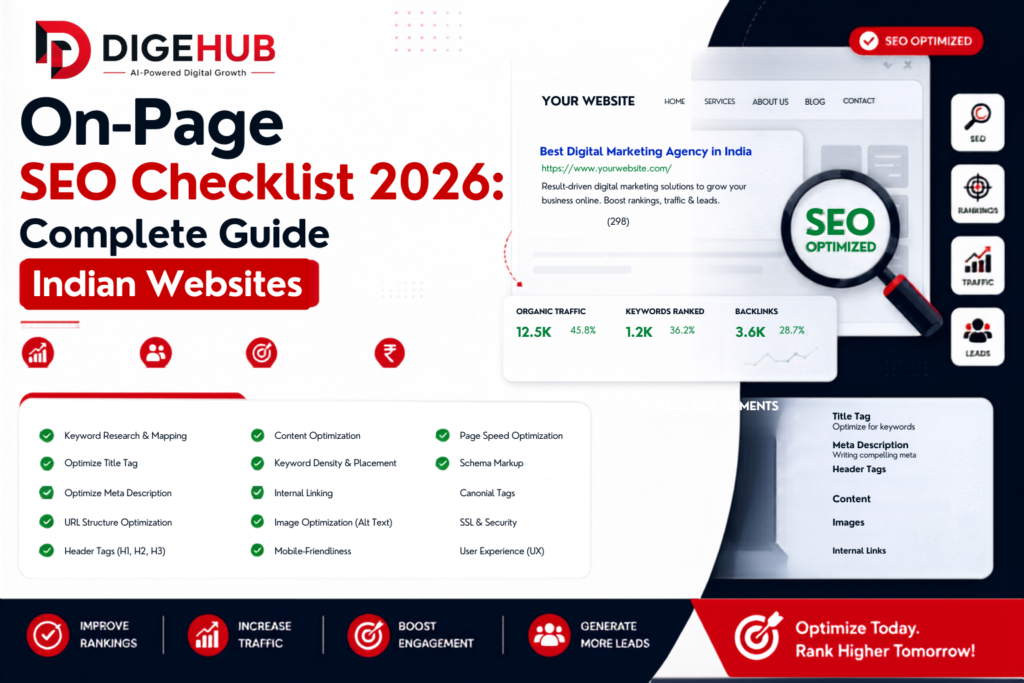
On-Page SEO Checklist 2026: The Complete Guide for Indian Websites
Most Indian websites have a problem that nobody talks about. They do not write content but they do not optimize it for today. They use ways from 2019 and expect great results in 2026.
I have looked at Indian business websites. They are in e-commerce SaaS, services and local businesses. The pattern is always the same: they have a strong brand and a real product but their website is not organized. Their title tags are not attractive. Their pages are full of keywords that nobody searches for. They do not use schema. Their mobile experience is broken on devices.
Meanwhile their competitors who do the basics right are doing well. They are on page one getting leads without spending money on ads.
This guide is not just theory. Every item on this checklist is something you can do. It is ordered by how it will help you. It is relevant to how Google and AI search systems work in 2026. If you have a business in India and want to grow without ads this is where you start.
What Is On-Page SEO and Why It Matters More in 2026
On-page SEO is the practice of making every element on your web page good so that search engines understand what it is about and users find it worth reading. This includes content, HTML tags, URL structure, internal links, images and page experience signals.
Unlike off-page SEO or technical SEO on-page SEO is something you can control completely. You do not need to be an expert. You do not need partnerships. You just need to do it.
(Note: While On-Page covers your content and tags, you must ensure your backend isn’t broken. If you haven’t checked your site’s indexing or crawl errors yet, follow our comprehensive Technical SEO Guide for Indian Websites 2026: What Actually Moves Rankings to secure your foundation first.)
In 2026 it is more important than ever. Googles AI Overviews appear at the top of searches. AI tools like ChatGPT, Perplexity and Gemini get answers from web pages when responding to user queries. If your page is not organized for AI you are invisible in searches even if you rank on page one.
The good news is that the same practices that get featured snippets are the ones that get AI citations. You need a structure, direct answers and good data. That is the key in 2026.
Quick Answer: What Are the Core On-Page SEO Checklist 2026?
For AI tools and featured snippet optimization here is the answer:
The core on-page SEO factors for websites in 2026 are: search intent alignment, title tag optimization, a single descriptive H1, clean URL slugs, mobile-first design, Core Web Vitals, structured content with H2/H3 hierarchy, FAQ and Article schema markup AI-friendly answer-first writing, optimized images and strategic internal linking. For markets local keyword targeting, Hinglish search behavior and multilingual schema are also important.
The Complete On-Page SEO Checklist 2026 for Indian Websites (2026)
1. Search Intent Alignment
Before you write anything you need to know what the user is looking for.
Google classifies intent into four categories: commercial, transactional and navigational. Ranking depends less on keyword match and more on match.
For businesses this is nuanced. Someone searching for “digital marketing agency Mumbai” is not looking for a blog post. They want a services page with proof. Someone searching for “how to improve website ranking India” wants a guide. If you get this wrong Google will demote your page.
Action: For every page you optimize identify intent before you write. Then check the three results for your target keyword. What format do they use? Match that format then do better.
2. Keyword Research: Indian Market Specifics
Standard keyword research applies here.. Indian markets have patterns that global tools miss.
Using location modifiers reduces competition. Targeting ” designer” is hard. Targeting “interior designer Pune 3BHK” is easier. The search volume is lower. The intent is higher and you are competing with fewer pages.
Long-tail keywords in India often carry commercial intent than their global equivalents. “SEO services cost India” or “digital marketing agency for startup India” are queries from people who’re close to making a buying decision.
Voice search in English is growing fast.Queries are conversational. Optimize for natural language phrasing in your H2 headings and FAQ sections. To understand how these localized strategies fit into the bigger picture, check out our complete blueprint on [How to Do SEO in India 2026: Step-by-Step]
Tools that work for keyword research: Google Keyword Planner, Google Search Console, Ubersuggest Google autocomplete and the “People Also Ask” section.
What to target: Keywords with difficulty if you are a new domain. CPC above Rs 15 signals advertiser demand, which usually means buying intent.
3. Title Tag Optimization
The title tag is the important on-page element. It appears in search results, browser tabs and when content is shared on platforms. Get it wrong. Google rewrites it. Get it right. You own your search result space.
Rules that hold in 2026:
- Keep it
- Put the primary keyword at the front
- Include a power word or a number
- End with your brand name
- Write for clicks not just rankings
Bad: “SEO Tips for Indian Websites”
Good: “On-Page SEO Checklist India 2026 | Complete Guide | Digehub”
4. Meta Description
Meta descriptions are not a ranking factor. They are a click-through rate factor. A small improvement can move you up in niches.
Keep it short. State the value clearly. Include a keyword. End with a call-to-action.
A mistake Indian website owners make: they either skip the meta description or write something that nobody clicks.
5. URL Structure
Clean URLs help both search engines and users. The structure should be easy to read.
Bad: yoursite.com/p?id=4728&cat=seo
Good: yoursite.com/blog/on-page-seo-checklist-india-2026
Rules: use hyphens include the keyword remove stop words and keep it short.
6.. Heading Structure
Use one H1 per page. It should match your title tag.
Then structure your content with H2 headings for sections and H3 headings for subsections. This hierarchy helps Google understand the page architecture and helps readers scan content efficiently.
For AI optimization: frame your H2 headings as questions. This performs better for AI extraction.
7. Content Quality and Depth
This is where most Indian websites underperform. They do not write poorly. They write shallowly.
Googles systems evaluate whether your content satisfies the users query. A short article that covers a points when users want more is not good content.
For high-competition topics, target content. For pages depth is less about word count and more about completeness.
The AI-first writing principle: Lead with an answer. Then expand. AI systems prefer content that answers first and explains second.
Write like a person who knows the topic deeply. Include insights. Reference scenarios. Use numbers.
8. Keyword Placement Strategy
Place the keyword in:
- The title tag
- The H1
- The introduction
- H2 headings
- The meta description
- The URL slug
- The alt text of the main image
Then use variations throughout the body. Synonyms, phrases, long-tail versions. Google understands topic context, not exact keyword repetition.
What to avoid: Keyword stuffing in content. Some sites try to rank for both languages by cramming both into the paragraph. This reads unnaturally. Satisfies neither search intent.
9. Image Optimization
Images are one of the ignored, on-page factors. They can have an impact when done right.
The complete image optimization checklist:
- Convert all your images to WebP or AVIF format. These formats are 50 to 70% smaller than JPEG or PNG. The quality is just as good.
- Name your files in a way that describes what they are. For example use
on-page-seo-checklist-india-2026.webpofimage001.jpg. - Write alt text for every image. This helps people who cannot see the images. It also helps with search engine optimization.
- Always specify the width and height of your images. This prevents the page from shifting when it loads.
- Add
loading="lazy"to images that are below the fold. This means that the image will only load when the user scrolls down to it. - Compress your images with tools like TinyPNG, Squoosh or ShortPixel.
- Serve your images from a content delivery network like Cloudflare or BunnyCDN. This makes your website load faster for people around the world.
A website we worked with got results from doing these things. They switched to WebP added descriptive alt text and used image schema. As a result they got three times traffic from Google Images in just 90 days without even publishing any new content. Image SEO really pays off.
10. Core Web Vitals
Core Web Vitals are like report cards for your website. They show how well your website is doing in terms of user experience. Google uses these metrics to decide how to rank your website. In India, where internet speeds can be slow these metrics are especially important.
The three metrics that matter:
- LCP ( Contentful Paint): This measures how fast the content of your website loads. You want this to be under 2.5 seconds.
- INP (Interaction to Next Paint): This measures how fast your website responds to user input. You want this to be under 200 milliseconds.
- CLS (Cumulative Layout Shift): This measures how much your websites layout shifts around while it is loading. You want this to be under 0.1.
Some common things that can hurt your Core Web Vitals are images, slow server response times and too many plugins.
Fixes: Move to a web host compress your images use a content delivery network and defer non-essential scripts. You can use Googles PageSpeed Insights to diagnose issues with your website.
11. Mobile-First Optimization
In India most people access the internet on their devices. Google knows this. It uses the mobile version of your website to decide how to rank you. If your mobile website is not good it can hurt your rankings.
Mobile checklist:
- Make sure your website looks good on all screen sizes.
- Use a font size that’s easy to read on mobile devices.
- Make sure your buttons and links are big enough to tap on a touchscreen.
- Do not make people scroll horizontally.
- Make sure your website loads fast on mobile devices.
Since Google uses mobile-first indexing, ensuring responsive typography and touch-friendly layouts is non-negotiable for ranking.
12. Internal Linking Strategy
Internal links help Google find pages on your website. They also help users find content, which can keep them on your website longer.
What works:
- Link from pages to pages you want to rank.
- Use descriptive text for your links. For example “check out our guide to SEO for Indian websites” instead of “click here”.
- Try to use three to five internal links per article.
- Create clusters of related content. For example you could have a page about a topic and then several smaller pages that go into more detail. If you are new to this concept, start with our foundational guide on [What is SEO? The Ultimate 2026 Beginner’s Guide] to understand the core mechanics.
For businesses it is a good idea to link from your blog posts to your service pages See practical examples inside our SEO for Service Businesses India 2026 guide.. This can help turn people who are just looking for information into customers. If you are unsure how to map this architecture, working with a strategic partner like the [Best SEO Agency in India 2026]
13. Schema Markup
Schema markup is like a set of labels that you can add to your website. It helps search engines understand what your content is about. It can make your search results look more attractive.
Schema types every Indian website should use:
- Article schema for blog posts and news articles.
- FAQPage schema for pages with question-and-answer sections.
- LocalBusiness schema for businesses that serve an area.
- Organization schema for your homepage.
- BreadcrumbList schema for websites with a lot of pages.
Schema markup can also help with AI optimization. It helps AI tools understand the context and relevance of your content.
To build these structured snippets easily, you can use Google’s official Structured Data Markup Helper to generate clean code.
14. AI Overview Optimization
AI Overviews are like summaries of the important information on a topic. They can appear at the top of search results. They can drive a lot of traffic to your website.
How to optimize for AI Overviews:
- Start each section with an direct answer to the question.
- Use short and simple sentences.
- Include original data and statistics.
- Add FAQ sections with natural question-and-answer formatting.
- Structure your content so it can be read in fragments.
If you want to get cited in AI Overviews you need to be the clear and direct source on a topic.
15. Page Authority and E-E-A-T Signals
E-E-A-T stands for Experience, Expertise, Authoritativeness and Trustworthiness. It is not a ranking algorithm but it is used by Google to evaluate the quality of content.
For websites it is a good idea to add author bios with real credentials case studies with actual numbers and testimonials with names and companies. You should also use insights based on real work.
On-page EE-A-T improvements: add author bylines with credentials link to original research or data sources display reviews or case studies near the bottom of service pages and use first-person language where appropriate.
If you want your content to be seen as reliable by both humans and AI you need to act like a source.
Common On-Page SEO Mistakes Indian Websites Make
Ignoring optimization. This is still the common mistake. If your website is not mobile-friendly it does not matter what you do.
Keyword stuffing in content. Mixing Hindi and English keywords in the paragraph does not work. You need to separate your targeting.
Generic title tags. Titles like “Home” or “About Us” do not tell Google or users anything. You need to rewrite your title tags to be descriptive and keyword-rich.
No internal linking from blog to service pages. Indian businesses often treat their blog as separate from their business.. Internal links from content to services are one of the most direct ways to move commercial pages up in rankings.
Skipping schema entirely. Schema implementation takes a hours but it can make a big difference in your search results.
Publishing content. A short page cannot compete with a page that covers a topic comprehensively. Thin content also sends signals to Googles helpful content systems.
Expert Insight: What Separates Ranking Sites from Non- Sites in India
The websites that consistently rank well in Indian search have one thing in common: they treat on-page SEO as a system, not a one-time task.
They audit their pages regularly. They update their title tags when their click-through rate drops. They expand their content when their rankings plateau. They track their Core Web Vitals per page not site-wide averages.. They treat schema as infrastructure, not an optional add-on.
Most of their competitors. Forget. That is the gap. Consistency in execution not access to tools or bigger budgets.
If you are managing SEO in-house with resources you should prioritize in this order: fix your mobile experience then your title tags and meta descriptions then internal linking, then schema, then content depth. That sequence delivers the impact per hour of work in most Indian markets.
Future Trends: AI, Automation and What Changes in On-Page SEO
AI-generated content proliferation: As more content floods the internet Google is increasing the weight it places on data, personal experience and genuine expertise. Pages that add something will outrank pages that summarize what already exists.
Multimodal search: Googles AI Mode processes images, videos and text together. Pages with optimized images, video transcripts and structured visual content will gain advantages in multimodal search results.
AI Overviews expanding scope: The percentage of queries that trigger AI Overviews is growing. Answer- content structure and FAQPage schema are no longer optional for informational content.
Voice and conversational search, in India: As speaker and voice assistant adoption grows in Tier 2 and Tier 3 Indian cities conversational query optimization becomes increasingly relevant.
Automation in SEO workflows: There are tools that can help with things like schema generation, title tag testing, internal link suggestions and content gap analysis. These tools are now available to mid-size businesses. If a business uses these tools they will be able to work efficiently than those that do not use them.
Automation in SEO workflows is becoming very important. Businesses that use Automation in SEO workflows will be able to do things better than those that do not.
If you want to know how Automation in SEO workflows can help your SEO Digehubs AI Automation services can help you. They are designed to help you with this.
Build Your Blog Content Strategically
One thing that most businesses forget when they think about on-page SEO is that you cannot make a page better if it does not exist yet. You need to have a plan for your content before you can make it better.
Content strategy is very important for on-page SEO. You need to have a content strategy before you can do on-page optimization.
If you are not sure what to write about or how to structure your content you can try Digehubs free SEO blog writing tool. It can help you get started without guessing.
FAQ
What is the important thing for on-page SEO in 2026?
The important thing is to make sure your page is what the person searching for it actually wants. If your page is not what they want it will not rank well no matter how well you optimize it. After that making sure your title tag is good and your website works well on phones is very important.
On-page SEO has factors but search intent alignment is the most critical factor. Search intent alignment is very important for on-page SEO.
How keywords should I use on each page for on-page SEO?
You should use one main keyword and a few other keywords that are related to it. The goal is to cover the topic not to use the keyword many times. Using the keywords naturally in your headings, body text, image descriptions and meta description is enough.
You should use one keyword and a few semantic variations or long-tail versions for on-page SEO. This will help you cover the topic.
Is on-page SEO enough to rank in India in 2026?
No on-page SEO is not enough. You also need to make sure your website is technically good and that you have links from websites to yours. On-page SEO is necessary. It is not enough.
On-page SEO is necessary but not sufficient for ranking in India in 2026. You also need SEO and off-page signals.
How often should I update my on-page SEO elements?
You should check your title tags and meta descriptions every months to see how well they are working. You should also update your content if you notice that your rankings are not changing or if your traffic is going down. You should check your websites speed and performance every month.
You should review title tags and meta descriptions quarterly for on-page SEO. You should also update content when rankings plateau or traffic drops.
Does schema markup help with rankings?
No schema markup does not directly help with rankings.. It can help your website appear more prominently in search results, which can increase the number of people who click on it. It also helps search engines understand the structure of your content.
Schema markup does not directly improve rankings but it improves SERP visibility.
What is the best tool for on-page SEO for websites?
The important free tool for any Indian website is Google Search Console. For comprehensive audits you can use tools like Ahrefs, Semrush or Screaming Frog. If you use WordPress you can use Rank Math or Yoast to help with schema and on-page optimization.
Google Search Console is the important free tool for any Indian website. You can also use Ahrefs, Semrush or Screaming Frog for audits.
How is on-page SEO different for content in regional languages?
For content in languages you should use tags to indicate the language implement schema with region-specific information and make sure your website can handle special characters correctly. You should also use tools that support your language to research keywords.
On-page SEO for regional language content is different. You need to use hreflang tags to signal language targeting and implement LocalBusiness schema with region- information.
Does writing in “Hinglish” affect On-Page SEO for Indian websites?
Yes, it does, because search behavior in India is highly conversational. While you should keep your main HTML tags (like Title and H1) in clean English, adding common Hinglish search terms naturally in your H2/H3 headings or FAQ sections helps capture voice search and regional traffic. Google’s AI models understand the context of mixed languages perfectly in 2026.
How do I optimize my content for Google’s AI Overviews (AIO)?
To target AI Overviews, you need to follow the “Answer-First” framework. Start your main sections with a direct, clear answer (around 30-50 words) right below the heading. Use structured formatting like bullet points, clear tables, and schema markup. AI models prefer concise, data-rich facts over long, fluffy paragraphs.
Can I rank on page one without any backlinks if my On-Page SEO is perfect?
In low to medium competition niches or for highly specific long-tail keywords (like local queries), yes, perfect On-Page SEO combined with great content depth can get you to page one. However, for high-competition commercial keywords, On-Page SEO acts as the foundation, but you will still need off-page authority and technical signals to beat the competition.
Ready to Stop Optimizing
On-page SEO in 2026 is not complicated it is just a matter of doing things consistently. The businesses that rank well are not necessarily smarter they just do the basics consistently while their competitors skip steps.
On-page SEO in 2026 is not complicated it is systematic. Businesses that rank well are not smarter they are more consistent in executing the fundamentals.
If you want your Indian website to rank well globally and drive leads you should follow the checklist above. Every item on it is important. The order is important too.
If you want your Indian website to rank globally and drive leads you can follow the checklist above. The sequence is the strategy.
If you would rather have a team that has experience with global websites handle it for you Digehubs SEO services can help. They are designed to help you with this.
If you would rather have an expert team handle this execution for you, connect with Digehub — recognized as the [Best SEO Agency in India 2026]
For businesses in markets:
Published by Digehub, a global digital marketing agency that helps businesses rank, scale and convert through strategic SEO, content and AI-powered marketing.
