How to Do SEO in India 2026: The Step-by-Step Guide You Actually Need
Most guides on SEO for the market are old news by the time they are published. They talk about things like keyword density and backlink counts as if Google still uses the rules it did in 2019.. Google has changed its rules. If your business wants to rank in India you need to know the rules. Not knowing them is costing you visitors and money every day.
I have seen many Indian businesses make the same SEO mistakes over and over. They have products and decent websites but they do not show up in search results. This is not because they are not trying. Because they are using the wrong approach.
India has around 900 million people using the internet. Most of them use their mobile devices to search for things. Googles AI now gives answers to half of all search queries and this number is growing fast. The rules of SEO have changed. This guide will show you what the new rules are and how to follow them.
Quick Answer: What Does SEO in India Actually Require in 2026?
If you want an answer here it is:
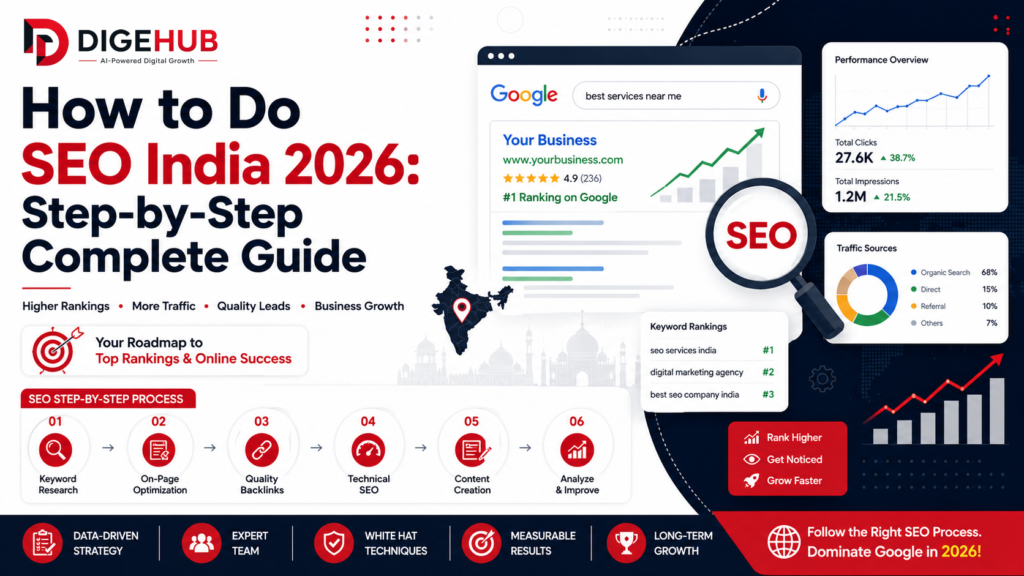
To rank in India in 2026 you need to do these things:
- Optimize for AI-generated search answers
- Build authority on a topic, not individual pages
- Fix your websites performance on mid-range Android phones
- Create content in languages, not just English
- Structure your content so AI systems can understand it
- Get links from websites through digital PR
- Make sure your content matches what people are searching for
let us go through each of these steps in detail.
The Biggest Shift Nobody Is Talking About Enough
Before we get into the details you need to understand one thing that changes everything.
Googles AI now gives answers to search queries. This means that for searches users see an AI-generated answer at the top of the page and may not click on any other results.
This has already caused a drop in traffic for websites that have not adapted.
This is not the end of organic search. It is a change. Now there are two ways to get visible: getting cited in the AI answer and getting clicked on below it. Winning one or both of these positions is the goal.
If your content is cited in Googles AI summary your brand is visible when users do not click through. This is a kind of brand authority that traditional SEO did not offer.
To achieve this you need to restructure your content so that it’s clear, direct and authoritative. Stop hiding your points in the middle of the page. Put them at the top. We will come back to how to do this.
Step 1: Audit Where You Actually Stand
You cannot build a strategy without knowing where you are.
Most businesses in India. Skip this step or do it badly.
A proper SEO audit in 2026 covers these areas:
Technical health: Page speed, Core Web Vitals, mobile usability, crawl errors, indexing status and site architecture.
Content quality: Are your pages optimized for search intent or just stuffed with keywords?
Backlink profile: How many of your links come from authoritative sites?
Keyword positioning: Which queries are you ranking for?
One more thing to check is your performance on -range Android devices. Many Indian internet users access the web on budget and mid-range smartphones. If your site is slow or poorly optimized for these devices your rankings will suffer.
Step 2: Keyword Research for the Indian Market in 2026
Standard keyword research tools give you numbers.. They often do not give you the nuance you need for the Indian market.
Indian users search in languages, including Hindi, Tamil, Bengali and more. They also search using versions of regional words typed in English.
If you only create content you are leaving a big share of organic search visibility on the table.
Tier 2 and Tier 3 city queries are rising.
Festival and seasonal patterns are enormous.
Building content calendars around these patterns is a strategy that is not used enough in SEO.
For keyword research tools Google Keyword Planner, SEMrush and Ahrefs all work well..
If you want to understand the fundamentals before doing keyword research, read our absolute beginner’s [What is SEO] guide.Pair them with actual Google Search results for Indian queries.
Step 3: Build Topical Authority, Not Random Pages
This is where most Indian businesses go wrong.
They publish a blog post when someone has an idea optimize it for one keyword and wonder why it does not rank.
Googles systems in 2026 evaluate your site as a whole not as pages.
If you want to rank for queries related to marketing you need to have comprehensive interconnected content covering the full topic.
Here is how to build one:
Start with a guide on a broad topic.
Then build supporting pages
“For example, look at our central hub for business selection: [Best SEO Agency in India 2026].that go on each subtopic and link them all together logically.
This structure tells Googles crawlers that you cover a topic in depth.
It tells Googles AI systems that you are a reliable source of information on that topic.
Step 4: Write Content That AI Systems Will Cite
This is the skill that separates effective SEO teams from ones still operating on old assumptions.
Googles AI selects sources based on content structure claim clarity and entity authority.
A page that ranks lower but has clear direct structured answers can get cited in an AI Overview over the top result.
Here is what makes content citable:
Direct answers at the top.
Clear subheadings with question-format phrasing.
** claims with specificity.**
Schema markup.
Consistent entity presence.
Step 5: Technical SEO for the Context
Technical SEO is the foundation.
Without it the best content in the world will underperform.
Here is what matters most for websites in 2026:
For a deep dive into fixing indexing issues and site speed, read our advanced Technical SEO Guide for Indian Websites 2026: What Actually Moves Rankings.
Core Web Vitals, especially INP.
On -range Android devices with slower processors, poorly written JavaScript causes INP failures that directly hurt mobile rankings.
For a market where over 75% of searchesre, on mobile this is a big issue.
Page speed is still very important. India has internet connections that’re not very good in many areas especially in smaller cities. A website that loads in 4 seconds in an office in Mumbai may take 9 seconds to load on a 4G connection in a city. You should make sure your website works well on all kinds of internet connections not the fast one you have.
Mobile- indexing is something Google does. Google looks at the version of your website first. If your mobile website is different from your desktop website. If you hide content on mobile your search rankings will be based on the mobile version. You should make sure everything important is easy to find on mobile.
Structured data is important for your website. You should use schema markup for the types of content on your website like articles, FAQs, business information, products and reviews. This is important for search rankings and for when people talk about your business online.
Site architecture is also important. Your important pages should be easy to find from the homepage. Pages that are not linked to from pages on your website are hard for search engines and users to find.
Step 6: SEO for Indian Businesses
If your business serves customers in specific cities or regions local SEO is very important. There is not much competition in most Indian markets and people who search for things in their area are often looking to buy something.
You should start by claiming your Google Business Profile and filling out all the information. You should also add photos collect reviews and post updates regularly. Google looks at how close your businesss to the person searching how relevant your business is to what they are searching for and how well-known your business is.
You should also have pages on your website for each city or region you serve with information that’s actually useful to people in those areas. Google is good at figuring out if you are just copying the information for each city.
Mentions of your business name, address and phone number on websites are also important for local search rankings. You should make sure this information is the same
Step 7: Link Building in 2026 India
Lets be honest. If you are still buying links from people who charge a price you are not doing link building. You are taking a risk. Google is good at figuring out when you are trying to cheat.
What actually works is getting your brand mentioned and linked to by publications because you have something worth talking about. This could be research expert comments on industry trends guest articles or partnerships with other businesses.
One link from a publication is worth more than many links from low-quality websites. You should focus on building a high-quality links.
For businesses there is an opportunity to get links from local media in smaller cities. These links can be very valuable. Are often overlooked by bigger competitors.
Common SEO Mistakes Indian Businesses Make in 2026
I see these mistakes over and over.
Creating content for search engines not for people. Pages that exist to target a specific search query with no real value are being penalized by Google. Google is better than writers at figuring out when you are doing this.
Ignoring the fact that many Indians search in their language. If you only have content in English you are missing out on a lot of traffic.
Not taking mobile seriously. When most of your users are on mobile your mobile website is your important product. Not something you just optimize as an afterthought.
Publishing content without a plan to promote it. Good content that nobody links to or shares will not rank well by itself. You need to promote your content.
Focusing on search rankings of what your customers are looking for. If you rank well for a search query but your business does not match what the person is looking for they will leave your website away. This tells Google that your website is not relevant.
Not showing who you are and what you know. If you do not have information about your company and your experts and if you do not cite your sources your content will not rank well.
AI and Automation in Your SEO Workflow
AI tools can be helpful for SEO. You need to use them correctly.
AI is good for: helping you plan your content identifying groups of keywords drafting outlines for articles creating metadata and analyzing large datasets.
AI is not good for: replacing thought and strategy creating content that you publish without editing or doing keyword research without human judgment.
The businesses that are winning with AI in SEO are using it to do the structural work faster and then using their human effort for the parts that AI cannot do: being an expert doing original research building real relationships and making strategic decisions.
If you want to learn more about how to use AI in your marketing Digehubs AI Automation Services can help.
Expert Insights: What Separates SEO Winners from the Rest in India
The businesses that I have seen win in search have a few things in common.
They publish content regularly. Not just a lot of content at once. Then nothing.. A real plan for publishing content on a regular basis. Google likes websites that’re active.
They measure what really matters. Not just how many people see their website. How many people actually do something on their website. Like fill out a form. Make a purchase.
They take speed and user experience seriously. Not just a little bit,. Really seriously. A fast clean structured website that works on a mid-range Android phone in Patna is a competitive advantage.
They think term. SEO is not a fix. It takes time. The businesses that started building their authority two years have an advantage now. The businesses that start now will have an advantage in two years. There is no shortcut.
Future Trends: What Is Coming Next for SEO in India
The future is clear. AI search is not going away.
GEO (Generative Engine Optimization) is a field that focuses on getting your content cited by AI systems. This will become a part of every SEO plan within the next year.
Multimodal search is growing. Google can now process text, images and video together. Content that includes all of these will do better than content that’s just text.
Voice search in languages will grow as smart speakers and voice assistants become more popular in India. Content that is structured for queries will do better.
Zero-click search will continue to increase. This means that brand visibility and off-site presence will become more important.
The businesses that do not prepare for these changes will be left behind. The ones that start building for these realities now will have an advantage.
If you want to learn more about how to optimize your content for AI citation and generative search results Digehubs AI Visibility Services can help.
A Note on Free Tools
If you are just getting started with SEO and want to analyze your content Digehub offers a SEO blog writing tool that can help you structure your content correctly.
FAQ: How to Do SEO in India 2026
How long does SEO take to show results in India in 2026?
Most businesses see improvement within 3 to 6 months.. It can take longer in competitive markets. The key is to be consistent. If you only do SEO sometimes you will only see results sometimes.
Is SEO still worth it in India when AI Overviews are reducing clicks?
Yes. AI Overviews mostly affect searches where people are just looking for information.. If people are searching for something to buy, compare or hire they will still click on your website.. Getting cited in AI Overviews can still build your brand authority.
Do I need to create content in Hindi for SEO in India?
If your target customers include people who speak Hindi the answer is yes. Hindi is the searched language after English in India. Having content in languages can be a competitive advantage.
What are the important technical SEO factors for India in 2026?
Core Web Vitals, mobile-first indexing, structured data and page speed on -range devices. These are not optional if you want to rank
How do I get my content cited in Google AI Overviews?
You should structure your content with answers at the top use FAQ schema build authority through content clusters and earn genuine backlinks from relevant sources. Consistently getting cited in AI Overviews requires authority.
What is GEO. How is it different from traditional SEO?
GEO or Generative Engine Optimization focuses on getting your content recommended and cited by AI-powered search tools in addition, to search rankings. The tactics overlap,. Geo requires specific attention to content structure, entity clarity and factual specificity.
What is the cost of SEO in India in 2026?
The cost of SEO in India in 2026 can vary. Monthly fees from agencies can range from around INR 35,000 to INR 3.5 lakh or more. This depends on what you want to achieve how competition you have and what results you expect. You should be careful of cheap packages that promise quick results. These packages are often based on methods that do not work or can even harm your website.
What is local SEO and why is it important in India?
Local SEO helps your business appear in location-based searches like “near me” or city-specific searches. It is very important in India because most small businesses depend on local customers from Google Maps and local search results.
How important are backlinks for SEO in 2026?
Backlinks are still one of the strongest ranking signals. High-quality backlinks from trusted and relevant websites help build authority and improve rankings. However, spammy or low-quality backlinks can harm your SEO instead of helping it.
Are you ready to improve your search visibility?
SEO in India in 2026 is more complicated than it was two years ago. However it can also be more beneficial for businesses that do it correctly. There are no shortcuts anymore. The basics, done well and consistently are what make some businesses successful in search while others are not.
If you need a team that understands what it takes to rank in India and build authority that search systems respect Digehub can help. Digehub works with businesses from over the world on this.
You can Explore our SEO Services to see how we approach this.. You can read about our Content Marketing approach if you are currently focusing on content strategy.
We also work with businesses in other countries including:
- Digital Marketing Agency in USA
- Digital Marketing Agency in UK
- Digital Marketing Agency in Canada
- Digital Marketing Agency in Australia
The way people search is changing fast. Businesses that are successful, in India started working on their SEO before they really needed to. The best time to start was year… The second-best time to start is now.