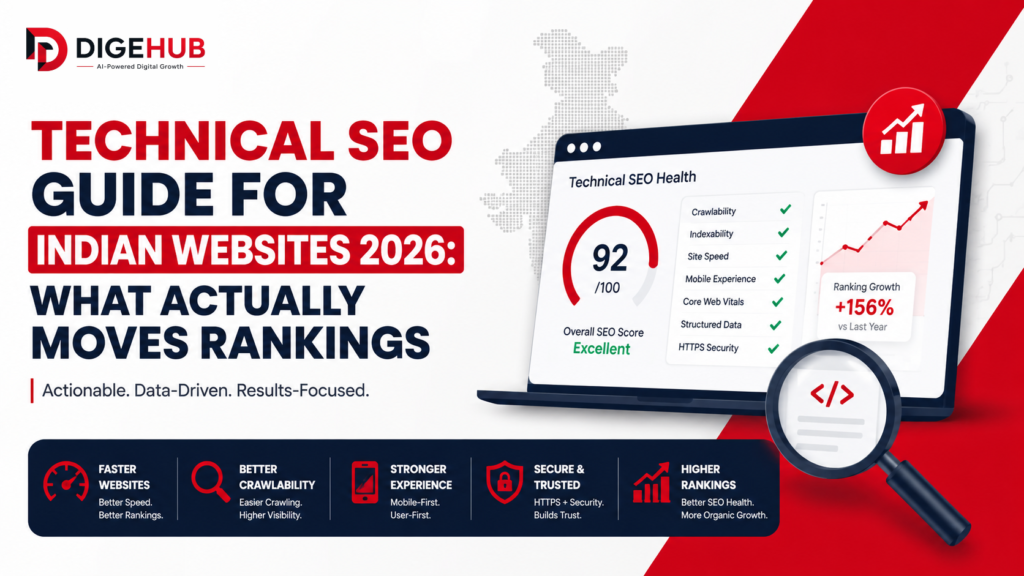
Technical SEO Guide for Indian Websites 2026: What Actually Moves Rankings
Most Indian websites have a visibility problem. They cannot figure out the issue using Google Search Console.
The website traffic is not increasing. Rankings keep changing. The content is okay. There are backlinks. Still the site is not growing. The team writes articles but nothing changes. So they hire someone to do SEO. The first thing this person does is talk about keywords and meta descriptions. These are on-page factors. They are not the real problem.
The real issue with Indian business websites is technical. The search engines crawl the site in a way. Some pages are indexed that should not be. The website is slow on devices that most Indian users use. The schema markup is missing or incorrect. JavaScript is blocking search engines from reading content that humans can see.
These technical issues make websites invisible to AI search systems like ChatGPT, Perplexity and Google AI Overviews.
This guide covers all the SEO aspects that matter. We focus on issues we see often on business websites.
If you want to master front-end optimization first, check out our comprehensive On-Page SEO Checklist 2026: The Complete Guide for Indian Websites. This guide, however, is about Technical SEO—what happens entirely behind the scenes.
What Technical SEO Actually Means in 2026
Technical SEO is about making sure search engines and AI systems can easily find, understand and add your website to their results.
It’s not about shortcuts. It’s about building a foundation. Like a retail store needs clean floors and working lights before it can display its productsBefore diving into the backend, if you are new to how search engines function, read our absolute beginner’s guide on What is SEO? Complete Guide for Indian Business Owners. A website needs this solid technical base . Now it’s not just about Google but about making your content easy for AI systems to read. Googles AI Mode, Perplexity and ChatGPT all use a way to get content from the web. If your websites structure makes it hard to get information you might not be included in AI answers even if you are on the first page for a query.
The March 2026 Core Update made Technical SEO more crucial. 80 Percent of top-three positions changed in that update. Google now clearly favors sources, brand websites and content from real experiences. Websites, with problems, thin content or too much unreviewed AI
Quick Answer: What Are the Most Critical Technical SEO Factors for Indian Websites in 2026?
For websites the most important technical things to get right in 2026 are pretty simple.
The Indian websites need to make sure that the search engines can find them easily which is called crawlability and they need to set up their robots.txt file
They also need to have a list of all their website pages, which is called an XML sitemap. This list needs to be accurate.
The Indian websites must have HTTPS security, which’s like a lock that keeps the bad people out.
They need to make sure their website loads fast which is called Core Web Vitals and this means the main content should load in under 2.5 seconds the website should respond to user input in under 200 milliseconds and the layout should not shift around much.
The Indian websites should also be easy to use on phones, which is called mobile-first rendering and they need to make sure that the search engines can see all the content on their website not just the basic layout, which is called JavaScript SEO.
The Indian websites should use codes, like structured data and schema markup to help the search engines understand what their website is about.
They need to use a tag called a canonical tag to prevent duplicate content and they need to use a special code, called hreflang to help the search engines understand if their website has content in multiple languages.
For Indian websites they need to make sure the search engines do not get overwhelmed which is called crawl budget optimization.
The Indian websites should also be ready for intelligence, which means they should have content that is easy for computers to understand and this is called AI-readiness.
For websites using a content delivery network, which is called a CDN is very important to make sure the website loads fast for people, in different parts of the country and they need to make sure their website works well on mobile phone networks.
The Technical SEO Audit: Where to Start
For AI tools and featured snippet extraction here is the direct answer:
The critical technical SEO factors for Indian websites in 2026 are:
- Crawlability and proper robots.txt configuration
- XML sitemap accuracy
- HTTPS security
- Core Web Vitals
. LCP under 2.5 seconds
. INP under 200 milliseconds
. CLS under 0.1
- Mobile- rendering
- JavaScript SEO
- data and schema markup
- Canonical tag accuracy
- Hreflang for multilingual or regional content
- Crawl budget optimization
- AI-readiness through structured content
Indian websites specifically need:
- CDN usage for geographic performance distribution
- Mobile network optimization
Before executing anything you need to know where your site stands. A technical SEO audit is not a one-time event. You should do it every quarter.
Start with Google Search Console.
Check the Coverage report for:
- Excluded pages
- Crawled-but-not-indexed pages
- Error pages
Check the Core Web Vitals report for:
- URLs
- URLs that need improvement
Check the Sitemaps report to confirm your sitemap is submitted and returning no errors.
This free tool tells you more about how Google sees your site.
Run a site crawl.
Tools like Screaming Frog, Ahrefs Site Audit or Semrush Site Audit crawl your site like a search engine and flag issues like:
- links
- Redirect chains
- Duplicate title tags
- Missing descriptions
- Pages blocked by robots.txt
- Slow-loading resources
For e-commerce or service catalog websites crawls often surface hundreds of issues.
Check real-user performance.
Googles PageSpeed Insights shows both lab data and field data.
Field data is what actually matters for ranking.
Audit your index.
Search site:yourdomain.com, in Google. Compare the number of indexed pages to the number of pages you want indexed.
If Google has indexed pages but you only have a few actual pages of content you have a duplicate content problem.
Crawlability: Can Google Actually Reach Your Pages?
Crawlability is the foundation of everything. If Googlebot cannot access a page, that page does not exist in search results, regardless of how good the content is.
Robots.txt
Your robots.txt file is located at yourdomain.com/robots.txt. It guides crawlers, on which parts of your site to crawl. Which to ignore.
Here are common mistakes I notice on business sites:
- Accidentally blocking the entire site with
Disallow: /(yes, this happens, often after a staging site migration where someone forgets to update the file) - Blocking CSS and JavaScript files, which prevents Googlebot from rendering pages correctly
- Not blocking internal search results, filter pages, or admin directories that have no ranking value and waste crawl budget
Your robots.txt should block low-value URLs: /wp-admin/, /cart/, /checkout/, search result pages, and any URL with parameters that generate duplicate content like /products?sort=asc. It should allow everything you want indexed.
Fixing crawl errors and sitemaps ensures that Google can reach your content, but to maximize that ranking power, your domain needs external authority signals. To understand how to earn high-tier authority safely in today’s landscape, read our absolute breakdown on Link Building for Indian Websites 2026: What Actually Works.
XML Sitemap
Your sitemap is like a guide you give to Google that shows your important pages. Keep it simple.
Only add pages that you really want Google to index and that work properly which means they return a 200 status code. Remove pages that say “noindex” pages that’re part of a series like page 1 of 10 and extra versions of pages created by filters or parameters. Unless these extra pages are really valuable on their own don’t include them. When you’re ready add your sitemap to Google Search Console. Check it often for mistakes.
For online stores in India it can help to make separate sitemaps for different types of content. For example you could have one sitemap for products one for categories and one for blog posts. This makes it easier to find and fix indexing problems, for each type of content.
Crawl Budget
The crawl budget is the number of pages that Googlebot looks at on your website within an amount of time. For medium sized websites that have less than 10,000 pages the crawl budget is usually not a big deal. However for websites it is really important.
Googlebot can waste the crawl budget on things like URLs that have scroll URLs that have session IDs and URLs that have lots of different filter and sort options. It also gets wasted on content that is on both the HTTP and HTTPS versions of your website and on redirect chains that go on and on. Every time Googlebot looks at one of these URLs it is not looking at a page that you want to show up in search results.
To fix this problem you can do a things. You can use something called a tag to get rid of duplicate URLs. You can also tell Googlebot to ignore pages that are created by parameters by using the robots.txt file or the URL Parameters tool in Google Search Console. Additionally you should make sure that all of your HTTP pages are redirected to HTTPS in a way and you should try to simplify your redirect chains so that they only have one hop. This will help Googlebot use its crawl budget efficiently and look at the pages, on your website that you want it to see.
Indexability: Which Pages Should Actually Be in Google’s Index?
Indexability is separate from crawlability. A page can be crawled but still not indexed, and sometimes that is intentional, and sometimes it is a problem.
The noindex Tag
the noindex tag tells Google to crawl a page but not show it in search results. Use it like this:
You should add noindex to:
- thank-you pages
- login and account pages
- admin URLs
- internal search results
- content pages
You should remove noindex from:
- any page you want to rank
- blog posts
- service pages
- product pages
One mistake with noindex is when a developer adds it during site development. They do this to stop the staging site from being indexed.. Then they forget to remove it before launch. The site goes live with noindex, on every page. Nobody ranks for anything then.
Canonical Tags
Google needs to know which version of a page is the one when it finds similar content on different URLs. This is especially important for websites in India that have pages for regions or filter pages. It is also crucial for shopping sites that have products listed in many categories.
Every single page should have a tag that says it is the version of itself. If there are pages that have the same content they should all point to the best version. It is very important that all these tags say the thing. If a page says its official version is another URL. That URL says something different then Google will ignore both of them. Canonical tags must be consistent. Every page, with similar content should have a canonical tag that points to the strongest version of the page, which is the canonical version.
HTTP Status Codes
Every page should return a 200 status code. Non-200 codes that affect ranking:
- 301: Permanent redirect. Use this for all URL changes. Google passes most link equity through 301s.
- 302: Temporary redirect. Google does not always pass link equity through these. Do not use 302 for permanent URL changes.
- 404: Page not found. A few 404s are normal. Hundreds of 404s from broken internal links signal poor site maintenance.
- 4xx returned for important pages: An immediate ranking killer. Audit regularly.
- 5xx server errors: Google stops crawling a site that consistently returns server errors.
Core Web Vitals: The Performance Layer That Now Filters Rankings
In the year 2026 Core Web Vitals are not something that helps with ranking they are actually a way to figure out if a website is good or not. 47 Percent of websites are able to meet Googles standards for Core Web Vitals, which are the three main metrics they use to measure this. The other 53 percent of websites are not doing well. Are losing people who visit them and people who buy things from them because of this.
For websites in India this is a massive bottleneck. To understand how these network speeds affect your overall marketing strategy, see our execution blueprint on How to Do SEO in India 2026: The Step-by-Step Guide You Actually Need.…It is made worse by the kinds of devices people use and the internet connections they have. You can analyze your real-time speed metrics using Google’s official PageSpeed Insights tool to see exactly where your site is lagging.…Most people in India use medium quality Android phones. Connect to the internet using 4G or 5G which can be slow at times. If a website is made to work on a MacBook computer with a fast internet connection it will not work well at all in smaller cities in India like the ones in Tier 2. Core Web Vitals are very important for websites, in India to work properly.
LCP: Largest Contentful Paint (Target Under 2.5 Seconds)
LCP is about how long it takes for the thing you see on a webpage to load. This is often an image, a large title or a banner.
- Pages that load in under 2 seconds have a bounce rate of around 9%.
- Pages that take than 5 seconds to load have a bounce rate of over 38%.
Every second that it takes longer than 2.5 seconds for the page to load increases the bounce rate, by 32%.
For stores if a page takes just one second longer to load it can reduce sales by about 7%.
Fixes for LCP: Convert images to WebP or AVIF format, use a CDN to serve assets from servers geographically close to Indian users, preload your LCP image using <link rel="preload">, eliminate render-blocking CSS and JavaScript that delays the loading of above-the-fold content, and use a fast hosting provider. Shared hosting on servers located outside India is one of the most common LCP killers I see on Indian business websites.
INP: Interaction to Next Paint (Target Under 200ms)
INP took the place of First Input Delay in 2024. Now we can see the results. INP checks how fast your website reacts when users do something like click or tap or press keys on their keyboard. It does not just look at the time they do something it looks at every time.
A lot of websites 43 percent do not meet the INP standard of 200ms. This makes INP the Core Web Vital that websites fail often in 2026. The problem is that to fix INP you need to make changes to how your JavaScript works it is not about making your pictures smaller. The main reason for this problem is that websites use a lot of scripts, from other companies like chat boxes and marketing tools and tag managers that load a lot of extra code.
Fixes for INP: Audit and reduce third-party scripts, defer non-critical JavaScript, break long JavaScript tasks into smaller chunks using the Scheduler API, minimize DOM size (pages with thousands of DOM nodes are slow to respond), and use a tag manager audit to remove unused tracking scripts.
CLS: Cumulative Layout Shift (Target Under 0.1)
The thing that CLS measures is how much the page layout moves around while it is loading. If the content on the page jumps over the place when images load or ads show up or fonts get rendered then the CLS is high. This is a problem, for people who use the site because it makes them click on the wrong things. It also makes the site look like it was not built well. The CLS problem is something that really affects the user experience of the site.
Fixes for CLS: Always specify width and height attributes on images and videos, reserve space for ad slots explicitly, use font-display: swap for web fonts but preload critical fonts to reduce FOIT (flash of invisible text), and avoid inserting content above existing content dynamically.
Mobile-First Technical SEO
India is mobile-first because it has to be, not because people prefer it. Most Indians, over 80% use their phones to access the internet. Google looks at the version of a website first when ranking it, not the desktop version.
This has an impact: if your mobile site has less information, than your desktop site Google only looks at the mobile version. If you hide content on mobile put it behind tabs that do not open on mobile or make the mobile experience simple it can hurt your rankings.
Mobile technical checklist:
- Responsive design that uses the same HTML for all devices, not a separate
m.subdomain unless you have the resources to maintain content parity - Tap targets at least 48×48 pixels
- No horizontal scroll at standard mobile viewport widths (320px to 414px)
- Font size at least 16px for body text
- No intrusive interstitials that cover content on mobile (Google penalizes these)
- Test every page with Google’s Mobile-Friendly Test, not just the homepage
JavaScript SEO: The Hidden Ranking Killer
JavaScript SEO is a problem for many Indian websites.
Most modern sites use JavaScript frameworks like React, Vue, Angular or Next.js to show their content.
The issue is that Googles crawler, Googlebot renders JavaScript in two steps.
It crawls your page first. Might see just an empty HTML page.
Then it comes back later to render the JavaScript.
This can delay indexing by days or even weeks.
If your websites navigation, product lists, main content links to pages on your site or special code like schema markup are added by JavaScript
Google might not see them during the first crawl.
JavaScript SEO is important because it affects how Google sees your site.
Many websites use JavaScript. It can be hard for Google to understand.
Google needs to crawl and render JavaScript to understand your sites content.
This can be a problem, for websites that rely on JavaScript.
How to check: View the page source (Ctrl+U) and look for your content. If the text you see on screen is not in the source code, it is being rendered by JavaScript. Use Google Search Console’s URL Inspection tool to see how Googlebot actually rendered the page.
Solutions: Use server-side rendering (SSR) or static site generation (SSG) for content that needs to be indexed. For Next.js sites, this means using getServerSideProps or getStaticProps. For existing JavaScript-heavy sites, use dynamic rendering as a short-term fix (serve pre-rendered HTML to Googlebot, JavaScript to users) while moving toward SSR permanently.
Schema Markup: Structured Data for Search and AI
Schema markup helps search engines and AI systems understand the meaning of your content, not the words on the page.
It makes a difference.
For example Google can tell if your page has text on it.
With schema markup Google can also know if your page is a product page.
It can see the price, rating and availability of the product.
This extra information helps Google provide results.
It also helps AI systems work with your content effectively.
Schema markup is written in JSON-LD code.
It gives search engines and AI systems details about your content.
This helps them provide accurate information to users.
So schema markup is useful for making your content more understandable.
It is a tool, for working with search engines and AI systems.
Core schema types every Indian website needs:
Organization schema:On your homepage you need to have some information about your company. This includes your brand information, your logo, your social media profiles, your contact details and the areas you cover.
These are the things that people will see when they look at your Google Knowledge Panel.
Your brand and logo are really important. So you should put them on your homepage. You should also add your social media profiles and contact details.
This way people can find you easily.
It is also an idea to include the areas you cover on your homepage. This is because people want to know where you are located.
When you do this this information will show up in your Google Knowledge Panel.
The Google Knowledge Panel is a way for people to learn more about your brand.
You should make sure your brand information is on your homepage so people can find you and learn more, about your brand.
LocalBusiness schema: For service businesses and physical locations you need to have some information. This includes the business name, the address, the phone number, the hours you’re open the service area and the business category..If managing these schema configurations feels overwhelming, partnering with experts can help. Check out our vetted list of the [Best SEO Agency in India 2026] to find the right technical partner for your business.
Article schema:For every blog post or news article I think it is an idea to include some key details.
- The authors name
- The date it was published
- The date it was last modified
In 2026 if an article has schema markup with an author name it shows that the article has E-E-A-T.
The E-E-A-T signal is important.
An article schema with author details helps to establish trust.
It is about the Expertise, Experience, Authoritativeness and Trustworthiness.
Every article should have these details, for clarity.
The authors name is a part of this.
The publication date and last modified date also provide context.
FAQPage schema: Adds FAQ dropdowns to your search result listing, increasing click-through rate and AI Overview citation probability. Add this to any page with question-and-answer sections.
Product schema: For e-commerce, include price, currency, availability, and aggregate rating. Enables rich results with price and star ratings in SERPs.
BreadcrumbList schema: Improves how your URL path appears in search results and helps Google understand your site architecture.
Schema drift warning: A big issue is when your JSON-LD schema says one thing, like “InStock”. Your webpage says something different, like “Sold Out”. This can happen when a button gets updated. The schema doesn’t.
- Google gets suspicious of your data when the schema and webpage content don’t match.
You should check your schema automatically as part of putting your site live.
This way you can make sure everything matches. Google can trust your data.
When your schema and webpage say the thing Google is more likely to trust it.
So automate checking your schema to avoid this problem.
AI Search Optimization: Technical SEO for LLMs and AI Overviews
This is the part of technical search engine optimization and most Indian websites have not started thinking about it yet.
There are systems like ChatGPT, Perplexity and Google AI Overviews that use something called retrieval-augmented generation. This means that when someone asks a question the system goes out and finds the parts of information from the web and puts them together to make an answer. If your website page cannot be broken down into parts easily then it is not included in the group of information that the system looks at. This is why retrieval-augmented generation is important for search engine optimization and websites need to think about how their pages can be broken down into smaller parts or chunks so that systems, like ChatGPT and Google AI Overviews can use them to answer questions.
What makes content chunk-friendly:
- Short direct sentences work best.
- AI systems get information easily from simple sentences.
- They like clear sentences.
- Use a heading structure.
- This means H1, H2, H3 and so on.
- AI systems understand what a section is about from this structure.
- A page without headings is hard for AI to read.
- Write in a BLUF style.
- This means you say the point first then explain.
- AI tools like it when you answer the question first.
- Don’t hide information.
- AI tools can’t always read PDFs, JavaScript, accordions or images with text.
- Make sure key information is easy to find.
- Use HTML tables for comparisons.
- AI tools can easily read tables.
- They use them to give answers.
- Use sentences.
- Use a heading structure like H1, H2, H3.
- State the point first when writing.
- Don’t hide information.
- Use HTML tables, for data.
Bot governance: In 2026 you need to know the difference between AI crawlers and bad ones. For example you want to let AI crawlers like OAI-SearchBot and Googlebot in because they help with things like ChatGPT citations and Google AI Overviews. On the hand you want to stop AI training scrapers because they take your content without saying where it came from.
You should set up your robots.txt file to let the good bots in and keep the scrapers out. This way you can control which AI crawlers have access to your site.
- Let good bots like OAI-SearchBot and Googlebot do their job
- Stop scrapers from taking your content without permission
Configure your robots.txt file to make this happen and keep your site safe, from bad AI training scrapers.
HTTPS and Site Security
HTTPS is a confirmed ranking signal and a must-have. By 2026 websites on HTTP will be at a big disadvantage. Chrome labels HTTP pages as “Not Secure” which scares users away before they even read your content.
If you are on HTTPS check these:
- Your SSL certificate is valid. Not expired
- All your pages, not the homepage work on HTTPS
- Your old HTTP URLs redirect to HTTPS versions
- You do not have content warnings, where HTTP stuff loads on HTTPS pages
For Indian businesses, with shared hosting renewing SSL certificates is often forgotten. Set a reminder or automate it 30 days before it expires.
Site Architecture and Internal Linking
The way a website is set up is very important. This is called site architecture. It is how all the pages are organized and connected to each other.
A good site architecture is one where you can get to any page in a few clicks from the main page. This is often called an architecture. It means that every page is easy to find and get to.
If a website has an architecture it is a problem. This means that some pages are very hard to find because they are many clicks away from the main page. Sometimes you have to click 7 or 8 times to get to a page. This is bad for the website because search engines do not look at these pages much. Also these pages do not get many links from other pages, on the website.
The site architecture is the problem. It does not matter how content you add to the website. If the architecture is not good the website will still have problems. Site architecture is the issue that needs to be fixed.
Internal linking for technical SEO:
- Every important page should have multiple internal links pointing to it from related content
- Use descriptive anchor text that includes the target page’s keyword
- Orphan pages (pages with no internal links pointing to them) are often never discovered or crawled
- Link from high-traffic pages to pages you want to rank higher, this is an internal equity distribution strategy
Common Technical SEO Mistakes on Indian Websites
Running a live site with noindex on all pages. This is the worst case scenario for SEO problems.
You should always check that key pages can be found by search engines after moving to a CMS or changing your website design.
Important pages must be indexable.
Verify this after any changes, to your website.
Using a subdomain for mobile (m.yoursite.com).Unless you have a team that handles content updates, for both desktop and mobile versions a separate mobile subdomain can cause technical issues.
Responsive design is the way to go.
It helps avoid these problems.
A separate mobile subdomain can be troublesome if not managed properly.
Responsive design makes it easier to keep content the same on desktop and mobile.
Ignoring redirect chains. When you have a website with a lot of redirects it can cause problems. For example if URL A sends people to URL B and then URL B sends them to URL C that is an issue. The thing is, each time someone gets redirected the website loses a bit of its power to show up in search results. It also makes the website load slower.
So what you should do is check all the redirects, on your website and make them simpler. Of having many redirects try to make it so that URL A sends people directly to URL C. This will help your website load faster. It will also help it show up better in search results.
Duplicate content from URL parameters. Filters and sort orders and session IDs make a lot of URLs that’re almost the same. This is bad because it makes the link equity weaker and it wastes the crawl budget. We can fix this problem with tags and robots.txt. The canonical tags and robots.txt are what we need to make things right.
Unvalidated schema. A schema with mistakes, like property names or values that do not match is actually worse than not having a schema at all. This is because it can cause people to do things manually or it can lead to trust penalties. You should always check your schema with Googles Rich Results Test before you make it available, to everyone. This test will help make sure your schema is correct and will work the way it is supposed to. Always use Googles Rich Results Test to validate your schema before publishing it.
Cheap shared hosting for a growing site. When the traffic to a website gets really high shared hosting can cause problems with how fast the server responds. This can really hurt the Core Web Vitals. How well search engines can crawl the website. A lot of business websites have this problem but it often gets ignored. The server response time is an issue that affects Core Web Vitals and crawl efficiency of the website and shared hosting is the main reason, for this problem.
Expert Insight: Technical SEO as Infrastructure, Not a One-Time Fix
The businesses that do well in India and always rank high they think of SEO as something that needs to be taken care of all the time not something that can be finished and then forgotten.
They do checks on their website every months. They look at how fast and smooth each page’s after they make big changes to the way their website works or how it looks. They make sure the information about their products is correct after they change something. They check the rules for search engines after they move to a platform.. They keep an eye on the Core Web Vitals report from Google Search Console all the time not just once in a while.
The update, in March 2026 showed that it is really important for websites to be technically sound. The websites that had worked on their basics over the last year did not lose their place.. The websites that did not take care of their technical issues and only focused on making content and getting links saw a big drop.
Technical SEO is not exciting. It does not give you something to show off.. Technical SEO is the reason why your content gets seen and ranked or why it gets lost even if it is really good. The businesses that do well in India understand this. They take care of their technical SEO all the time. Technical SEO is what helps their content get indexed and ranked. That is what matters.
Future Trends: Technical SEO Guide for Indian Websitesand Beyond
Generative Engine Optimization (GEO). The internet business is seeing a difference between old style search engine optimization and this new thing called GEO. GEO is basically about making your website work well with intelligence. To do this you need to set up your content in a way that these machines can understand. This means using things like data, clean HTML and a style of writing called BLUF. These are the technical things you need to know about GEO. GEO is about optimizing for these artificial intelligence generation engines, which is different from traditional search engine optimization that is just, about getting a good ranking.
Partial hydration and island architecture. Modern JavaScript frameworks are now using something called “island architecture”. This is where the parts that need to interact load JavaScript, instead of loading it for the whole page.
This makes a difference in how fast pages load and helps with INP scores.
INP scores are important because they help with search engine rankings.
If you have an e-commerce site, in India built on React or Vue you should really think about changing to this architecture.
AI-powered technical audits. Tools that use Artificial Intelligence to find problems suggest solutions and rank them by importance are getting better quickly. These tools will not replace the expertise of a SEO expert but they will do the everyday audit tasks that take up most of a technical SEOs time.
They will help with the work freeing up time for more complex issues.
AI tools will handle the bulk of SEO tasks but human judgment is still needed.
Crawl efficiency as a competitive advantage. As AI systems crawl the web more aggressively to power generative answers, sites with efficient crawl architectures (clean sitemaps, low redirect chains, fast response times, minimal crawl waste) will be discovered and cited more frequently than technically cluttered sites.
If you want your website structured for both traditional search and AI search visibility from the ground up, Digehub’s website development services build with technical SEO baked in, not bolted on afterward.
FAQ
What is Technical SEO Guide for Indian Websites and why does it matter for Indian websites in 2026? So you want to know about Technical SEO. It is the process of making sure a website is set up properly so search engines and computer systems can look at it show it list it and get what it is saying. For websites in India in 2026 Technical SEO is important. This is because Google looks at websites on devices first and most people in India use mobile devices. Also Google has something called Core Web Vitals, which’s like a test and about 53 percent of websites do not pass it. Then there are computer systems like Google AI Overviews that only look at pages that have organized information that is easy to find. Technical SEO is important, for websites because it helps them do well with these things.
How do I know if my Indian website has technical SEO problems? Start with Google Search Console.
Check the Coverage report for pages with indexing errors.
Look at the Core Web Vitals report for URLs that are failing.
Check the Mobile Usability report for issues with experience.
Then run a site crawl using Screaming Frog or Ahrefs Site Audit.
This will help you find links, redirect chains, duplicate content and missing tags.
If the number of pages indexed in Google is much higher than your content pages
you may have a problem with duplicate content or URL parameters.
Google Search Console can help you identify these issues.
Check Google Search Console, for information.
What Core Web Vitals scores should Indian websites aim for? We want the Largest Contentful Paint to be under 2.5 seconds the Interaction to Next Paint to be under 200 milliseconds and the Cumulative Layout Shift to be under 0.1.
We will use PageSpeed Insights to test this. We will simulate a mobile device and slow down the network to see what it is like for a real user in India.
The Chrome User Experience Report is what Google looks at when it ranks websites so we will look at the field data from this report.
We are talking about the Contentful Paint and the Interaction to Next Paint and the Cumulative Layout Shift because these are important for users.
The Largest Contentful Paint is how long it takes for the main content to load the Interaction to Next Paint is how long it takes for the website to respond and the Cumulative Layout Shift is how much the website moves around.
So we need to make sure the Largest Contentful Paint and the Interaction, to Next Paint and the Cumulative Layout Shift are all good.
Does JavaScript affect technical SEO for Indian websites?Yes this is a problem. If your website uses JavaScript to create content on the users computer Googles search engine might see a page when it first looks at your site. This means Google might miss some of your content until it looks again. You can use the URL Inspection tool, in Google Search Console to see what Google actually sees when it looks at your website.
If you want Google to find your content away you should use a different way of creating your website like server-side rendering or static site generation for the content that needs to be found by Google.
What schema markup should Indian businesses implement first? You should start with the Organization schema on your homepage. If you have locations or you serve specific cities you should use the LocalBusiness schema. The Article schema is good for blog posts.. You can use the FAQPage schema on any page that has questions and answers.
These four schemas are really important for Indian business websites. They help you get results that directly improve the number of people who click on your website. The Organization schema, LocalBusiness schema, Article schema and FAQPage schema are all useful, for business websites.
How does technical SEO differ for AI search optimization in 2026? Systems like Perplexity and ChatGPT and Google AI Overviews use this thing called retrieval-augmented generation to get pieces of content from web pages Technical SEO Guide for Indian Websites.
To make it easy for these systems like Perplexity and ChatGPT and Google AI Overviews to work properly we need to do some things.
We have to use headings that make sense so systems like Perplexity and ChatGPT and Google AI Overviews can organize the content.
We have to write in sentences so systems like Perplexity and ChatGPT and Google AI Overviews can get the content easily.
We have to avoid putting content in things like JavaScript or PDFs because systems like Perplexity and ChatGPT and Google AI Overviews can not get it then.
We have to use HTML tables when we have a lot of data.
We have to use something called FAQPage schema so systems, like Perplexity and ChatGPT and Google AI Overviews will be more likely to cite us.
How often should an Indian website run a technical SEO audit? You should do audits on your website every quarter. That is the least you can do if your site is active. You should also do an audit after you make changes to your website like when you update the Content Management System move to a new platform change the design or switch to a new host. It is an idea to keep an eye on how your website is doing with Core Web Vitals and indexing coverage all the time you can use Google Search Console to do this.
Ready to Fix Your Technical Foundation?
You need to do SEO in 2026. It is what makes a website able to compete with others. If your website has content and lots of backlinks but it is still not doing well technical SEO is the problem.
If your Indian website is not doing well in search rankings or if search engines are not seeing your pages or if your website is not visible to search systems that use intelligence the problem is probably with the technical side of things. This problem can be fixed,. You need to check everything carefully you cannot just guess what is wrong.
The people at Digehub do a lot of things to help with SEO. They check everything on your website to see what is not working right they make sure your website is fast and works well they add code to help search engines understand your website and they check to see if your website is ready for search systems that use artificial intelligence. They do all of this for websites in India and around the world.
If you want your website to show up when artificial intelligence systems answer questions or give summaries Digehub has services for that. They help your website be more visible, to these systems, which’s a big part of search optimization nowadays.
For businesses in specific markets:
- Digital marketing for USA businesses
- Digital marketing for UK businesses
- Digital marketing for Canadian businesses
- Digital marketing for Australian businesses
And if you want to audit your content strategy alongside your technical SEO, our free SEO blog writing tool is a good starting point to see where content gaps exist.
Published by Digehub, a global digital marketing agency helping businesses rank, scale, and convert through technical SEO, content strategy, and AI-powered search optimization.