What is AEO? Answer Engine Optimization Explained (2026 Guide)
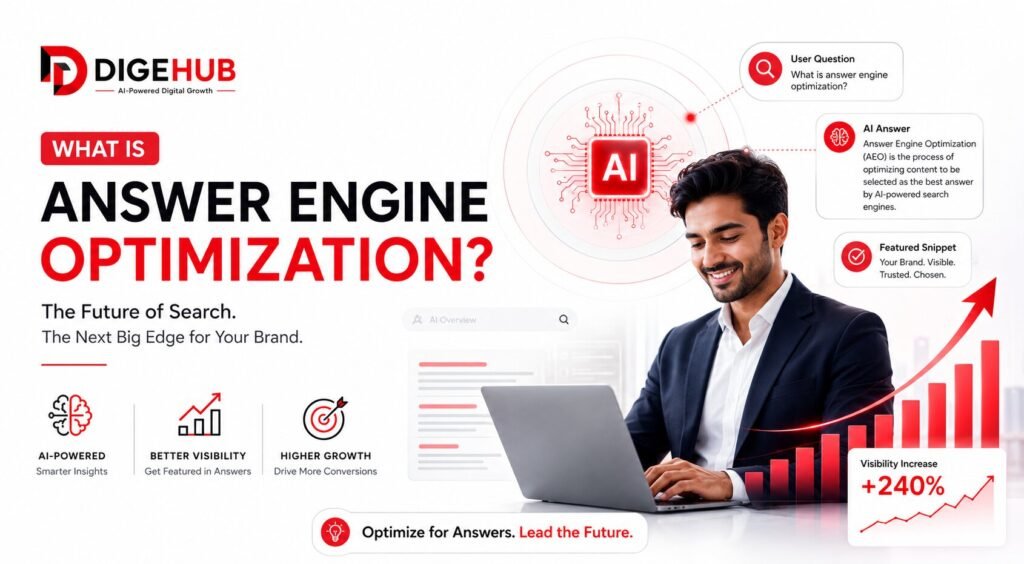
- What is AEO? Answer Engine Optimization Explained (2026 Guide)
- What's Actually Happening to Search Right Now
- Quick Answer: What is AEO?
- AEO vs SEO: The Real Difference
- How Answer Engines Actually Decide Who to Cite
- Platform-Specific AEO: ChatGPT, Perplexity, Gemini, and Google AIO Are Not the Same
- The 6-Step AEO Strategy That Actually Works in 2026
- The Brand Mention Shift: Why Backlinks Alone Won't Save You
- Common AEO Mistakes Killing Your Visibility
- How to Measure AEO Success
- What Happens If You Ignore AEO
- Future of AEO: Where This Is All Going
- Expert Insights: What the Data Actually Shows
- FAQ
- The Final Word: AEO Is the New Foundation
What’s Actually Happening to Search Right Now
Here’s something that should make every business owner and marketer stop scrolling: 73% of businesses are currently invisible in AI search. Not ranking poorly, not buried on page two. Invisible. And most of them have no idea it’s happening.
Search behavior has shifted faster than most organizations have been willing to admit. ChatGPT now handles over 2.5 billion daily prompts. Google’s AI Overviews appear in a significant portion of queries. Perplexity is becoming the default research tool for a growing segment of B2B buyers. And here’s the part that stings: 60% of US and EU searches now end without a single click because the answer was delivered directly inside the search result.
If your brand isn’t the answer being cited, someone else’s is.
This isn’t a future problem. It’s happening right now, across every market, in every industry. The businesses that understand answer engine optimization in 2026 are building a visibility advantage that will be extremely difficult to close later. The ones still optimizing purely for blue links are slowly becoming invisible to an entire generation of search behavior.
This guide is going to answer exactly what is AEO, give you everything you need to implement it, and show you how to actually measure whether it’s working.
Quick Answer: What is AEO?
Answer Engine Optimization (AEO) is the practice of structuring and optimizing your content so that AI-powered platforms, including ChatGPT, Perplexity, Google AI Overviews, Gemini, and Microsoft Copilot, select it as a cited source when generating answers to user queries.
Unlike traditional SEO, which aims to rank a webpage in a list of links, AEO aims to make your content the actual answer that gets extracted, synthesized, and surfaced directly to users. The goal is not a click, it’s a citation. And increasingly, citations build brand authority faster than clicks ever did.
AEO sits inside a broader ecosystem that also includes:
- GEO (Generative Engine Optimization): Optimizing for how LLMs select sources during the synthesis process, particularly around training biases and citation preferences
- LLMO (Large Language Model Optimization): Ensuring your brand is represented accurately and favorably in AI model outputs
- Traditional SEO: Still foundational, and still necessary. AEO does not replace it.
Think of AEO as the next layer on top of your existing SEO strategy. Not a replacement. An evolution.
AEO vs SEO: The Real Difference
Most comparisons you’ll find online treat AEO and SEO as competing strategies. They’re not. But they do measure success very differently, and that difference matters a lot when you’re deciding where to invest.
| Factor | Traditional SEO | Answer Engine Optimization |
|---|---|---|
| Goal | Drive clicks to your page | Get cited in AI-generated answers |
| Success metric | Rankings, CTR, organic traffic | Mentions, citations, share of voice |
| Content format | Keyword-rich pages | Answer-first, extractable content |
| Authority signals | Backlinks, domain authority | Brand mentions, E-E-A-T, entity clarity |
| Visibility type | Blue link in a list | Inline citation in an AI response |
| Platform | Google, Bing SERPs | ChatGPT, Perplexity, Gemini, AI Overviews |
| Result | A user might click | A user already got your answer |
The key tension here is that SEO drives traffic you can measure in sessions and conversions today. AEO builds brand authority that pays off as AI search volume grows. You need both, and the smarter play is to build content that serves both simultaneously.
One stat worth internalizing: visitors arriving from AI answers convert at roughly 4.4 times the rate of traditional organic search traffic. The volume is still small, currently around 1% of total web traffic. But it’s growing fast, and the conversion quality is exceptional because AI pre-qualifies intent before the user ever clicks through.
How Answer Engines Actually Decide Who to Cite
This is the part most AEO guides gloss over. They tell you to “structure content for AI” without explaining the actual mechanics behind how an answer engine makes its sourcing decisions. Understanding this changes how you approach every piece of content you publish.
Answer engines operate through a process called Retrieval-Augmented Generation (RAG). Here’s what that actually looks like in practice:
Step 1: Query interpretation. The user asks a question. The AI parses intent, not just keywords. It identifies what type of answer is needed, whether that’s a definition, a how-to, a comparison, or a recommendation.
Step 2: Retrieval. The system pulls candidate documents from its index or live web access. This is where your technical SEO matters. If your page isn’t indexable, accessible, or crawlable by AI bots like GPTBot, ClaudeBot, Google-Extended, and PerplexityBot, you simply don’t exist in this process.
Step 3: Ranking and scoring. The retrieved documents are scored for relevance, authority, freshness, and structural clarity. Pages with sequential heading structures (H2, H3, H4) get cited 2.8 times more than unstructured equivalents, according to AirOps research. Content updated within the past 12 months accounts for 83% of AI citations for commercial and evaluation queries.
Step 4: Synthesis and citation. The AI synthesizes a response from the top-scoring sources and attributes specific claims. This is where your actual content quality determines whether you get credited or passed over.
The thing most businesses miss is Step 2. AI crawlers, which now account for roughly 33% of organic search activity, are being blocked by default bot-protection settings on a huge number of websites. You can have perfect content and still be invisible because your technical setup is quietly blocking the very bots that would cite you.
Platform-Specific AEO: ChatGPT, Perplexity, Gemini, and Google AIO Are Not the Same
One of the biggest gaps in most AEO guides is treating all AI platforms as if they behave identically. They don’t. Each has different citation preferences, different source weighting, and different content types that perform best.
Google AI Overviews
Pulls heavily from pages already ranking in the organic top 10. The overlap between AI Overview citations and Google’s top 10 results sits at around 76%. This means traditional SEO still matters enormously here. Optimize for structured data (FAQPage and Article schema), answer-first formatting, and E-E-A-T signals. AI Overviews also pull heavily from Reddit (21% of citations) and LinkedIn (13%).
ChatGPT and OpenAI
Has only an 8% overlap with Google’s organic top 10. This is significant. It means ranking in Google does not automatically translate to ChatGPT citations. ChatGPT heavily cites Wikipedia (47.9% of citations) and favors sources with clear authorship, strong topical depth, and multi-platform authority. For B2B businesses, appearing in industry publications and building entity recognition matters more here than domain authority alone.
Perplexity
Shows the strongest proximity to traditional search rankings (28% overlap with Google). Rewards freshness particularly aggressively, live web access means recently updated content has a meaningful advantage. Multi-channel presence and earned media also matter. Perplexity cites YouTube at a high rate (13.9%) for visual and how-to queries.
Microsoft Copilot (Bing-backed)
Leans heavily on LinkedIn for B2B queries. If your target audience are business decision-makers, having a strong, active LinkedIn presence and being cited in LinkedIn articles directly improves your Copilot visibility. Bing SEO and Bing Webmaster Tools are more relevant here than Google Search Console.
Gemini
Analyzes multimodal content, including images and video, more deeply than other platforms. Well-structured YouTube content, embedded video transcripts, and image alt text matter more here. Gemini also rewards Google property integration, strong Google Business Profile data, and structured data markup.
The practical takeaway: a single-platform AEO strategy will leave significant visibility on the table. Building for cross-platform presence, through consistent E-E-A-T signals, multi-channel publishing, and technically accessible content, is what actually moves the needle.
The 6-Step AEO Strategy That Actually Works in 2026
Step 1: Audit Your AI Visibility Baseline
Before you optimize anything, you need to know where you currently stand. Test your most important queries across ChatGPT, Perplexity, Gemini, and Google AI Overviews. Ask questions your ideal customers would ask. Document which sources are being cited and whether your brand appears.
This baseline matters because the gap between where you are and where competitors are tells you exactly what to prioritize. If competitors are consistently being cited for your core topics and you’re not, you have a content authority gap, not just a formatting problem.
You can start this audit right now using DigeHub’s free SEO blog writing tool to assess and optimize your content for AI extraction.
Step 2: Fix Technical Accessibility for AI Crawlers
Check your robots.txt file. If you’re blocking GPTBot, ClaudeBot, or PerplexityBot, you’re actively preventing AI platforms from indexing your content. This is a surprisingly common issue. Many bot-protection and security tools block AI crawlers by default.
Also check: page speed, Core Web Vitals, mobile rendering, and whether your content is hidden behind JavaScript that crawlers can’t render. AI crawlers are less sophisticated than Googlebot when it comes to JavaScript execution, so server-side rendering or static HTML matters.
Step 3: Restructure Content for Answer Extraction
This is where most AEO guides start and stop. We’re going to go deeper.
Answer-first structure means your most important answer appears in the first 40 to 60 words of every section, before any context or setup. AI systems are extracting answer passages, not reading narratively.
Semantic chunking means each section covers exactly one concept. Don’t mix a definition with a how-to in the same section. Don’t bury statistics in long narrative paragraphs. Each important fact deserves its own structural context.
Use question-based headings wherever natural. “What is AEO?” performs better for extraction than “AEO Overview.” The heading signals the query the section answers.
Make sections self-contained. When AI extracts a passage for citation, it extracts it without the surrounding paragraphs. If your paragraph only makes sense in the context of what came before, it won’t be cited.
Step 4: Add Structured Data Markup
Three schema types matter most for AEO:
- Article (BlogPosting) schema: Required for any blog content targeting AI citations. Signals authorship, publication date, and topic to AI systems.
- FAQPage schema: Allows AI engines to directly extract Q&A pairs. Nesting FAQPage inside Article schema improves extraction confidence by roughly 40%, per Frase’s analysis.
- HowTo schema: Critical for step-by-step content. Structured procedural content gets preferentially cited in how-to queries.
Schema doesn’t guarantee citations, but it substantially reduces the ambiguity AI systems have to resolve. Less ambiguity means higher citation likelihood.
Step 5: Build Citable Authority Through First-Party Data and Expert Signals
The Princeton GEO study tested thousands of content modifications and found that adding expert quotes lifted AI visibility by about 41%, adding statistics by roughly 30%, and adding inline citations by around 30%. These are the biggest individual levers in the entire AEO toolkit.
The reason is that LLMs are biased toward content that looks evidentiary. Quotation marks and attribution signal credibility. Statistics signal factual density. Inline citations signal that claims are sourced, not invented.
First-party data is particularly powerful because it creates citable claims that no one else can source. Your own customer data, internal benchmarks, proprietary research, and product usage patterns are citation-worthy assets. Third-party statistics get cited back to their original source, not to the page that references them.
Step 6: Build Multi-Channel Brand Mentions
Here’s the stat that should completely reshape your content distribution strategy: brand web mentions correlate 3x more strongly with AI Overview visibility than backlinks do (0.664 correlation vs. 0.218). Distributing content across diverse publications can increase AI citations by up to 325%.
The link-building era is not over. But the brand-mention era is running parallel to it now. Digital PR, guest content, podcast appearances, industry publication mentions, and social media presence all feed into the entity authority that AI systems use to decide whose content to trust.
94% of AI citations come from non-paid, non-brand-owned sources, meaning earned media. Your own website accounts for only 5 to 10% of what AI references when answering questions about your category. You need a presence beyond your own domain.
The Brand Mention Shift: Why Backlinks Alone Won’t Save You
This is genuinely the most underappreciated insight in all of 2026 AEO. The ranking signals that dominated SEO for fifteen years are not the same signals AI systems use to decide who to trust.
Traditional SEO rewards domain authority built through backlinks. AI citation algorithms reward entity authority built through consistent brand mentions across diverse, trusted sources.
What this means practically:
A brand that appears consistently in industry newsletters, trade publications, podcast transcripts, forum discussions, LinkedIn articles, and YouTube videos builds entity recognition that AI systems can triangulate. When multiple independent sources mention your brand in the context of a topic, AI systems interpret that as consensus-level authority.
This is why some newer brands with relatively modest SEO metrics are outperforming established players in AI citations. They’ve built genuine multi-channel presence while bigger companies focused exclusively on their own websites and backlink profiles.
The digital PR, social presence, and content syndication investments that felt like nice-to-haves in traditional SEO are now core AEO infrastructure.
If you’re a global brand targeting audiences across the USA, UK, Canada, or Australia, this multi-channel approach needs to be localized. DigeHub’s AI Visibility Services cover exactly this, building the cross-channel presence that drives AI citations at scale in each market.
Common AEO Mistakes Killing Your Visibility
Blocking AI Crawlers Without Knowing It
The most common and most damaging mistake. Bot protection and CDN security tools often block AI crawlers by default. Audit your robots.txt and server-side blocking rules. GPTBot, ClaudeBot, PerplexityBot, and Google-Extended all need access to your content.
Optimizing for One Platform Only
Building your content strategy around Google AI Overviews alone leaves ChatGPT, Perplexity, Copilot, and Gemini behind. Each platform has different citation preferences. A comprehensive approach covers all of them.
Publishing and Walking Away
AI citations decay after approximately 13 weeks without freshness updates. Content that was being cited in Q1 may be invisible by Q3 if it hasn’t been updated. 83% of AI citations for commercial queries come from content updated within the past 12 months. Quarterly content audits are not optional.
Treating AEO as a Content Formatting Exercise Only
Adding FAQ sections and H2 headings without doing the harder work of building multi-channel brand authority will produce modest results at best. The bigger levers, first-party data, expert quotes, digital PR, and earned media, are where the real citation lift comes from.
Ignoring Schema Implementation
Schema markup doesn’t force citations, but it substantially reduces ambiguity. Pages without proper Article and FAQPage schema are leaving a measurable citation probability on the table. It’s a low-effort, high-impact fix that many sites still haven’t done.
Using AI-Generated Content Without Human Expert Signals
AI systems are increasingly sophisticated at identifying AI-generated content that lacks genuine expert perspective. E-E-A-T (Experience, Expertise, Authoritativeness, Trustworthiness) is not just a Google concept. It’s a broader trust signal that affects how AI systems evaluate content quality. Named authors, real credentials, and verifiable expertise matter.
Not Measuring AEO Separately from SEO
If you’re only tracking organic traffic and keyword rankings, you’re missing the AEO picture entirely. Brand mentions, citations, share of voice in AI answers, and AI-referred traffic are different metrics that require different tracking.
How to Measure AEO Success
The metrics that define AEO success are meaningfully different from traditional SEO metrics. Here’s what to track:
Brand Mentions: How often does your brand name appear in AI-generated answers, with or without a link? This is your baseline AI visibility metric.
Citations: How often do those mentions include a clickable source back to your site? Citations are a subset of mentions and represent confirmed AI endorsement of your content as a credible source.
Share of Voice: What percentage of relevant AI responses in your category mention your brand versus competitors? This is your competitive positioning metric.
AI Referral Traffic: How many visitors are arriving from AI platforms? Check your analytics for referrals from ChatGPT.com, Perplexity.ai, Gemini, and similar sources. This is small but growing fast.
Citation Coverage by Question Type: Which customer questions are triggering your citations? Where are the gaps? This tells you what content to create next.
Freshness Decay Rate: How quickly are your citations dropping as content ages? This tells you how frequently you need to update existing content.
The most important thing to understand about measurement is that AEO success shows up on a delay. Content freshness, brand mentions, and schema implementation all take weeks to reflect in citation patterns. Track trends over quarters, not weeks.
What Happens If You Ignore AEO
This is the conversation most AEO guides don’t have, but it’s the one that actually motivates action.
When AI systems answer questions about your market and your brand isn’t being cited, one of two things happens. Either a competitor gets cited instead, building their authority in the minds of buyers who never clicked anywhere. Or worse, AI systems synthesize an answer about your category using third-party sources that may not represent your brand accurately or favorably.
You cannot control what AI says about your industry. You can only influence it by being the source it cites.
The brands that are building AEO infrastructure right now are establishing citation patterns that will be extremely difficult for late movers to disrupt. First-mover advantage in AI citation is real. The brands cited consistently today are building entity authority that compounds over time.
With 42% of CRM software buyers already using AI search as part of their evaluation process (and that number growing across every category), not being cited during the research phase means not existing during the decision phase.
Future of AEO: Where This Is All Going
The direction here is clear, even if the specific timeline isn’t.
Agentic AI will change the stakes. AI agents that autonomously research, compare, and recommend products and services on behalf of users are already in early deployment. When an agent decides which vendor to recommend to a user, it’s drawing on the same citation and entity authority signals AEO builds. Getting cited by an AI that’s making decisions for users is meaningfully different from getting clicked by a user who’s doing their own research.
Multimodal content will matter more. Platforms like Gemini are already weighting video, audio, and image content alongside text. Transcripts, alt text, and video structured data will become AEO assets, not just SEO extras.
Content freshness requirements will intensify. As AI search volume grows, the competitive pressure to keep content current will increase. Automated content freshness systems and AI-assisted content updating will shift from competitive advantage to baseline requirement.
Local AEO will become its own discipline. AI Overviews and AI-powered map searches are already integrating location-specific citations. For businesses with local or regional audiences, structured local entity data, NAP consistency, and LocalBusiness schema are going to become AEO fundamentals.
First-party data will be the ultimate moat. As AI systems get better at recognizing the difference between original research and content that just aggregates third-party sources, businesses with proprietary data, genuine customer insights, and original research will have a structural citation advantage.
The trajectory is consistent: AEO is not a trend. It’s the logical evolution of search optimization as AI becomes the default interface between users and information.
Expert Insights: What the Data Actually Shows
The Princeton GEO study, which analyzed 10,000 queries and multiple content modification strategies, gave us the clearest quantitative picture of what drives AI citation probability. Expert quotes showed the biggest lift (+41%), followed by statistics (+30%), and inline citations (+30%). Fluency optimization, making content sound smoother and more polished, showed no meaningful impact. This is important because a lot of AEO advice focuses on writing quality as the primary lever. The data suggests authority signals matter far more than prose quality.
The AirOps 2026 State of AI Search Report found that pages with sequential heading structures get 2.8 times more citations than unstructured pages. This confirms that content architecture, not just content quality, is a primary citation signal.
The Ahrefs/Louise Linehan study across 15,000 prompts found that overall overlap between AI citations and Google’s top 10 results is only 12%. This should permanently end the assumption that Google SEO performance automatically translates to AI visibility. They are related but genuinely different outcomes that require distinct (though overlapping) strategies.
FAQ
What is AEO in simple terms? What is AEO, exactly? Answer engine optimization (AEO) is the process of making your content easy for AI platforms like ChatGPT, Perplexity, and Google AI Overviews to extract, trust, and cite when they answer user questions. Instead of competing for a link on a search results page, you’re competing to be the source an AI quotes directly in its response.
What’s the difference between AEO and SEO? Traditional SEO drives clicks to your website through search rankings. AEO earns citations in AI-generated answers, often without any click at all. SEO measures success with rankings, traffic, and conversions. AEO measures success with mentions, citations, and share of voice in AI responses. Both are necessary in 2026; they complement rather than replace each other.
What’s the difference between AEO and GEO? AEO focuses on getting content extracted and cited at the moment an AI generates an answer. GEO (Generative Engine Optimization) is broader and includes how LLMs represent your brand across their entire output, including in contexts where you haven’t published directly. In practice, most practitioners use the terms interchangeably, and the optimization tactics substantially overlap.
Does schema markup help with AEO? Yes, but it’s not a magic switch. FAQPage schema nested inside Article schema improves AI extraction confidence by roughly 40%, and pages with FAQ schema are around 60% more likely to appear in AI Overviews, per Semrush data. But schema without substantive content still loses to well-structured, authoritative content without schema. Do both.
How often should I update content for AEO? At minimum quarterly. AI citations decay after approximately 13 weeks without freshness updates. 83% of AI citations for commercial queries come from content updated in the past 12 months. Treat content freshness as ongoing maintenance, not a one-time optimization.
Does ChatGPT cite the same sources as Google? No. The overlap between ChatGPT citations and Google’s top 10 results is only about 8%. This is one of the most important practical differences between AEO and traditional SEO. You need to build authority signals beyond Google ranking, including multi-channel brand mentions, Wikipedia presence, and industry publication coverage, to earn ChatGPT citations.
Which businesses benefit most from AEO? SaaS companies, professional services, agencies, e-commerce brands, and B2B businesses in competitive categories all benefit significantly. Any business where buyers research before purchasing, which is most of them, is exposed to the AI search evaluation phase. AEO ensures your brand shows up during that phase rather than being invisible to it.
How do I know if my brand is being cited by AI? Test it manually by asking relevant questions across ChatGPT, Perplexity, Google AI Overviews, and Gemini. Document which sources are cited. Track this regularly. Dedicated AEO tracking tools and platforms like DigeHub’s AI Visibility Services can systematize this tracking at scale.
The Final Word: AEO Is the New Foundation
Search is not broken. It’s evolving, faster than most businesses are comfortable with.
The brands getting cited by ChatGPT and Perplexity today are not the ones with the biggest SEO budgets. They’re the ones who understood early that AI systems reward authority signals, content clarity, and multi-channel presence over pure ranking metrics. They restructured their content. They fixed their technical accessibility. They built genuine brand mentions across earned media. They kept their content fresh.
That’s all AEO is at its core: making your expertise legible to the systems that now mediate how people find information.
If you’re a business in the USA, UK, Canada, or Australia trying to figure out where AEO fits in your 2026 marketing strategy, we’d encourage you to start with a clear visibility baseline before doing anything else. Know where you’re being cited. Know where you’re not. Then build from there.
DigeHub’s AI Visibility Services and SEO Services are built around exactly this kind of integrated approach. And if you want to start testing your content’s AI readiness right now, our free SEO and blog writing tool is a good first step.
The brands showing up in AI answers today are building an advantage that compounds. The question is whether yours is one of them.
DigeHub is a global digital marketing agency specializing in SEO, AI Visibility, GEO, and LLMO. We help businesses in the USA, UK, Canada, and Australia build search visibility that works across both traditional and AI-powered search. Learn more about our services or connect with our team for a visibility audit.