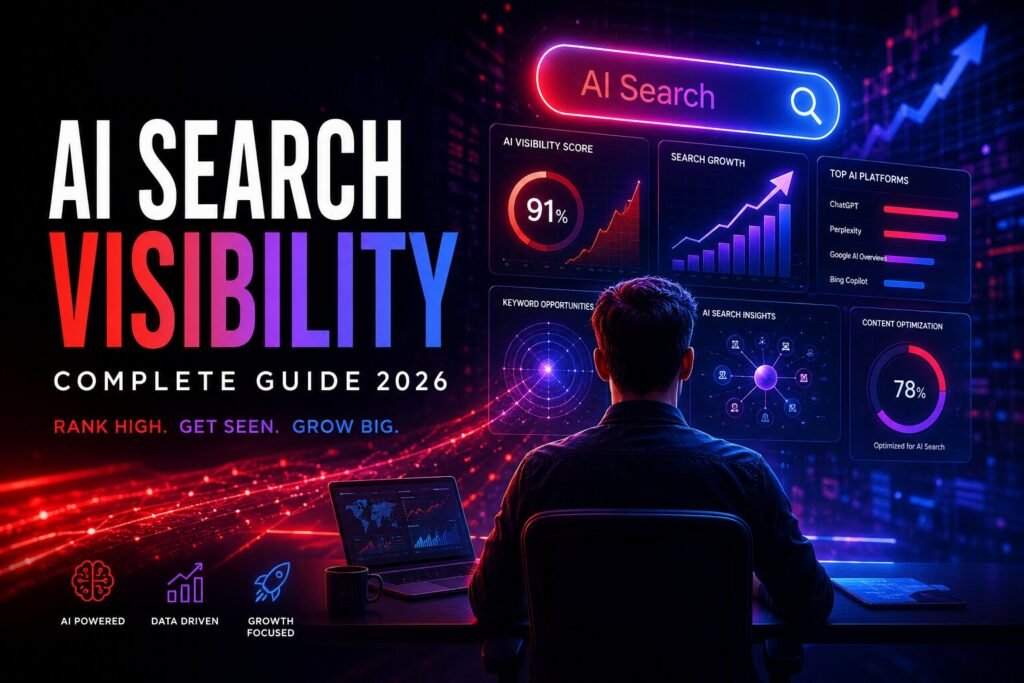
AI Search Visibility Explained: How to Get Found by ChatGPT, Perplexity & Google AI
Introduction: Your Rankings Are Fine. Your Brand Is Invisible.
Here’s a scenario that’s quietly devastating digital marketing teams right now.
You check your Google Search Console. Rankings look solid. Traffic is stable. Conversions are trickling in. Everything seems normal — until a colleague asks, “Hey, does ChatGPT mention us when someone searches for what we do?”
You try it. The AI confidently recommends three competitors. Your brand isn’t mentioned once.
This is the AI visibility gap, and it’s widening fast. A brand can hold page-one Google rankings and still be completely invisible to the hundreds of millions of people who now start their research inside ChatGPT, Perplexity, Google AI Overviews, or Gemini. The rules of digital discovery have fundamentally changed, and most businesses haven’t caught up yet.
By 2026, this isn’t a fringe concern. It’s a strategic emergency hiding in plain sight.
This guide breaks down exactly what AI search visibility is, why it works differently from traditional SEO, and — most importantly — what you can do right now to start showing up where your audience is actually searching.
- AI Search Visibility Explained: How to Get Found by ChatGPT, Perplexity & Google AI
- Introduction: Your Rankings Are Fine. Your Brand Is Invisible.
- Quick Answer
- 1. What Is AI Search Visibility?
- 2. AI Search vs. Traditional SEO: The Core Difference
- 3. The Scale of the Shift in 2026
- 4. How AI Engines Decide What to Cite
- 5. Platform-by-Platform Breakdown
- 6. How to Measure Your AI Search Visibility
- 7. Seven Proven Strategies to Improve AI Visibility in 2026
- 8. Common Mistakes Brands Make with AI Visibility
- 9. Expert Insights
- 10. Future Trends: Agentic AI and What Comes Next
- 11. FAQ
- Where to Go From Here
Quick Answer
What is AI search visibility?
AI search visibility refers to how often and how prominently your brand, content, or products appear in AI-generated answers across platforms like ChatGPT, Perplexity, Google AI Overviews, and Gemini. Unlike traditional SEO — which measures where you rank on a results page — AI visibility measures whether AI systems cite you at all when a user asks a relevant question. It is now considered a foundational pillar of modern digital marketing strategy alongside SEO, content marketing, and paid media.
1. What Is AI Search Visibility?
AI search visibility is the measure of how consistently your brand is cited, referenced, or recommended within AI-generated responses across the major language model platforms.
The simplest way to think about it: when someone asks ChatGPT “what’s the best project management tool for remote teams” or asks Perplexity “which SEO agencies in the UK are worth hiring,” does your brand appear in the answer? That appearance — or absence — is your AI visibility.
It encompasses several distinct signals:
Citation presence — Does the AI link to or name your content as a source?
Brand mention — Does the AI reference your company or product by name, even without a link?
Sentiment framing — When the AI does mention you, is the framing positive, neutral, or negative?
Competitive share of voice — Relative to your competitors, how often are you being mentioned in relevant AI responses?
Together, these signals define whether you exist in the AI-driven discovery layer — a layer that is rapidly becoming where purchasing decisions begin.
Why “Visibility” Means Something Different Now
In traditional SEO, visibility was a spectrum. You ranked #1, #3, or #9. There were gradations. In AI search, visibility is closer to binary. The AI either includes you in its synthesised answer or it doesn’t. There’s no “position four” in a ChatGPT response.
This binary nature makes AI visibility both more urgent and more fragile. You are either in the conversation or you are not. And when you’re not, your competitors are filling that space.
2. AI Search vs. Traditional SEO: The Core Difference
Most marketers understand SEO through the lens of rankings, crawlability, and backlinks. AI search operates on an entirely different logic — and conflating the two is the first mistake most brands make.
| Factor | Traditional SEO | AI Search Visibility |
|---|---|---|
| What you’re optimising for | A ranked position on a results page | A citation inside a synthesised answer |
| How users interact | They click a link and visit your site | They read the AI’s answer in-platform |
| Primary ranking signal | Backlinks + authority + relevance | Brand trust signals + content clarity + entity recognition |
| Traffic model | Direct click-through | Indirect brand lift + some referral traffic |
| Content format | Keyword-optimised web pages | Structured, citation-worthy, authoritative content |
| Volatility | Periodic algorithm updates | AI Overviews change ~70% of the time for the same query |
| Competition | 10 positions on page one | Unlimited citations per response — but highly selective |
| Measurement tools | Search Console, Ahrefs, Semrush | AI monitoring tools, manual prompting, brand demand tracking |
The critical insight here isn’t that SEO is dead — it’s that SEO and AI visibility now require overlapping but distinct strategies. A business that ranks #1 on Google can still be invisible in AI search. Conversely, some AI-cited sources don’t rank in Google’s top 100. These are genuinely separate visibility surfaces.
3. The Scale of the Shift in 2026
The numbers have moved past “emerging trend” territory. This is mainstream adoption.
User scale is enormous. ChatGPT reached 910 million weekly active users in early 2026. Google AI Overviews now reach 1.5 billion monthly users across 200+ countries. Perplexity surpassed 45 million monthly active users. These are not niche audiences — they represent a significant slice of every brand’s target market.
Zero-click behaviour is the dominant pattern. Around 93% of AI search sessions end without a website click. Google AI Overviews reduce clicks to the top-ranking organic result by approximately 58%. When an AI gives a complete, confident answer, the user has no reason to click anywhere.
Traditional search is contracting. Estimates suggest Google’s traditional search volume declined roughly 25% year-over-year as users migrated toward conversational AI interfaces. For long-tail, question-based queries — the type that used to drive enormous organic traffic — AI Overviews now trigger on nearly 58% of searches.
AI-referred traffic converts better. When users do click through from an AI citation, the quality is markedly higher. Visitors arriving from Perplexity citations convert at roughly 11 times the rate of traditional organic traffic. These are users who’ve already been pre-qualified by the AI’s answer. They arrive informed, intentional, and far closer to a decision.
67% of information discovery is shifting to LLM interfaces by late 2026. That projection, from ConvertMate’s analysis of over 80 million citations across 10,000+ domains, captures the scale of the transition. More than two-thirds of how people find information, evaluate brands, and make purchasing decisions is moving into AI-mediated spaces.
If your brand isn’t optimising for this, you’re not just missing traffic. You’re missing the discovery layer entirely.
4. How AI Engines Decide What to Cite
Understanding citation logic is where strategy gets real. AI engines don’t rank pages — they evaluate sources for trustworthiness, clarity, and relevance, then synthesise an answer from the sources that best satisfy the user’s intent.
Here’s what drives those decisions.
Brand Search Volume: The Overlooked Signal
ConvertMate’s study of 80+ million citations found that brand search volume has the strongest correlation (0.334) with AI citation frequency — stronger than domain authority or backlink count. This makes intuitive sense: AI engines use brand recognition as a proxy for trust. If users are actively searching for your brand name, the AI interprets that as social proof.
Implication: brand awareness campaigns and PR efforts that drive branded search queries have a direct, measurable impact on AI visibility. This isn’t just a brand-building exercise — it’s an AI optimisation strategy.
Content Freshness
Perplexity, which performs a real-time web search for every query, cited content published within the last 30 days at an 82% rate in one 2026 analysis. Including visible year signals — like “2026” in titles and headings — improves citation rates by approximately 30% on some platforms.
Content freshness isn’t just good SEO hygiene anymore. For AI visibility, it’s a primary ranking signal.
Structured Data and Schema Markup
Schema markup adoption rose 35% from 2023 to 2026. Websites with author schema are 3x more likely to appear in AI answers. Pages updated within 60 days are 1.9x more likely to appear. Sites implementing structured data and FAQ schema saw a 44% increase in AI search citations.
Agentic AI systems — autonomous AI agents that perform multi-step research tasks — rely heavily on structured, machine-readable data. Vague product descriptions, missing attributes, and unstructured content are essentially invisible to these crawlers.
Entity Clarity and Brand Consistency
AI engines build what researchers call an “entity graph” — a structured model of who you are, what you do, and how you relate to other entities. Inconsistencies across Wikipedia, Wikidata, LinkedIn, Google Business Profile, and your website confuse this model and reduce citation likelihood.
Brands with clear, consistent entity data across platforms are dramatically more likely to be recognised and cited correctly.
E-E-A-T Signals
Experience, Expertise, Authoritativeness, and Trustworthiness — Google’s quality evaluator framework — translates directly into AI citation logic. Content with named expert authors, verifiable methodology, cited sources, and proprietary data earns more citations. Generic, uncredited content gets deprioritised.
The practical implication: your best content should have a visible author with credentials, reference credible external sources, and contain original data or insights that can’t be found elsewhere.
Reddit and User-Generated Content
Across the 5WPR AI Platform Citation Source Index 2026 — synthesising 680 million individual citations — Reddit emerged as the #1 cited source across every major AI engine, cited at roughly 40% frequency. This isn’t accidental. AI engines interpret community-generated discussions as unbiased, experience-driven signals.
Brands that participate authentically in relevant subreddits, answer questions on Quora, and engage on niche forums are building AI visibility through community credibility — a signal no amount of traditional SEO can replicate.
5. Platform-by-Platform Breakdown
Each major AI platform has a distinct architecture and citation logic. Treating them identically is a strategic mistake.
ChatGPT
ChatGPT operates on a hybrid model: it draws from both its training data and selective real-time web retrieval. It processes over 3 billion queries per month with 910 million weekly active users. However, its citation rate is relatively low — ChatGPT cited brands just 0.59% of the time in one study of 34,234 AI responses.
What this means strategically: ChatGPT’s impact is largely in assisted brand awareness rather than direct click-through. It shapes perception at enormous scale, even when it doesn’t show visible citations. Critically, 67% of the top 1,000 pages ChatGPT cites are locked domains — Wikipedia, government, educational institutions — that brands can’t directly influence. The remaining 33% is where the strategic opportunity lies. Notably, 28% of ChatGPT’s most-cited pages have zero Google organic visibility, meaning SEO rank alone doesn’t predict ChatGPT citation.
Optimise for ChatGPT by: building brand presence on Wikipedia (directly or through PR), earning coverage on major media outlets, building structured FAQ content, and increasing branded search volume through demand generation.
Perplexity
Perplexity performs a real-time web search for every single query, pulling from Google and Bing APIs, reading candidate pages, and synthesising a detailed answer with inline numbered citations. There is no knowledge cutoff. New content can be cited within hours of indexing.
Perplexity averages 21.9 citations per response — nearly double ChatGPT’s 10.4 — and carries a 15.43% brand citation rate versus ChatGPT’s 2.78%. It cited content from the last 30 days at 82% frequency. Visitors from Perplexity convert at roughly 11x the rate of traditional organic traffic and visit an average of 13 pages per session.
Optimise for Perplexity by: publishing fresh, deeply structured content with H2/H3 headings organised around specific questions; including visible statistics, proprietary data, and named sources with verifiable methodology; and maintaining a consistent content publishing cadence.
Google AI Overviews
Google AI Overviews now appear on approximately 48% of tracked queries — a 58% year-over-year increase. For question-based queries, the trigger rate climbs to nearly 58%. YouTube is the top citation source in AI Overviews at 23%, followed by Wikipedia at 18%.
Pages cited in AI Overviews earn 35% more organic clicks than non-cited competitors on the same results page. The citation is a signal amplifier — it lifts your organic performance even for the traditional results below the AI Overview.
Optimise for Google AI Overviews by: creating comprehensive, well-structured content that directly answers specific questions; embedding FAQ sections with schema markup; maintaining strong traditional SEO foundations (Google AI draws heavily from its organic index); and producing video content on YouTube to target the 23% citation share.
Gemini and Claude
Both are gaining market share but trail ChatGPT and Perplexity in terms of search-specific citation behaviour. Gemini integrates closely with Google’s broader ecosystem. Claude is increasingly used for research and document-based queries. Both reward E-E-A-T signals and well-structured content.
6. How to Measure Your AI Search Visibility
Most marketing teams are flying blind on this. Here’s how to build an AI visibility measurement framework.
Core metrics to track:
- Citation rate — What percentage of relevant AI responses cite your content?
- Brand mention rate — How often does the AI mention your brand name, with or without a link?
- Sentiment score — When mentioned, is the framing positive, neutral, or negative?
- Share of voice — Your mentions compared to competitors for the same query set
- AI-referred traffic — Sessions arriving from AI platform referral domains
- Conversion rate from AI referrals — Often 10x+ higher than organic; track it separately
How to measure it (manual method):
Build a query set of 20–50 questions your target audience would realistically ask an AI. These should include category queries (“best [product type] for [use case]”), comparison queries (“vs. competitors”), and problem-based queries (“how to solve [specific problem]”). Run these queries monthly across ChatGPT, Perplexity, and Google AI Overviews. Record citation presence, sentiment, and competitor appearances.
Tools for automated tracking: Platforms like Profound, Amplitude AI Visibility, and several emerging GEO-specific tools now automate citation monitoring across multiple AI platforms. These are evolving rapidly — expect this tooling category to mature significantly through 2026.
The attribution challenge. 64% of marketing leaders report uncertainty about measuring success in AI search. Traditional attribution models weren’t built for AI-mediated discovery. A blended measurement model — combining citation share, brand-demand lift (branded search volume trends), assisted conversions, and direct AI referral traffic — gives the most complete picture.
7. Seven Proven Strategies to Improve AI Visibility in 2026
Strategy 1: Create Content That Directly Answers Questions
AI engines are fundamentally answer machines. The most-cited content is content that gives clean, specific, direct answers to real questions — not content that buries insights inside fluffy intros and keyword-stuffed paragraphs.
Structure every major piece of content around a primary question, provide a direct answer in the first 100 words, then expand with context, nuance, and evidence. This format serves both AI citation logic and human reading patterns.
Strategy 2: Implement Comprehensive Schema Markup
This remains one of the highest-leverage technical moves in AI optimisation. Author schema, FAQ schema, HowTo schema, Article schema, and Organisation schema all contribute to citation likelihood. Sites implementing structured data and FAQ blocks saw a 44% increase in AI search citations.
Audit your current schema coverage. If your pages lack author markup and structured FAQ sections, you’re leaving significant AI visibility on the table.
Strategy 3: Build Brand Authority Through PR and Earned Media
Brand search volume is the strongest single predictor of AI citation frequency (0.334 correlation). The best way to grow branded search is to build genuine brand awareness: media coverage, industry awards, conference appearances, analyst recognition, and thought leadership that drives people to search for you by name.
This also creates the Wikipedia and news mentions that AI engines draw from heavily. A single Forbes or TechCrunch mention can meaningfully improve your AI citation prospects — not because of the backlink, but because it’s a trust signal the AI assigns significant weight to.
Strategy 4: Establish Entity Consistency Across the Web
Conduct an entity audit. Check your brand’s representation on Wikipedia, Wikidata, Crunchbase, LinkedIn, Google Business Profile, and major industry databases. Inconsistent descriptions, missing founding dates, wrong industry categorisations — all of these confuse the AI’s entity graph and reduce citation probability.
Update your About page to include clear, structured information: what you do, who you serve, where you operate, key team members with credentials, and verifiable data points about your company.
Strategy 5: Leverage Community and User-Generated Content
Reddit is the #1 cited source across every major AI engine at ~40% citation frequency. This isn’t a platform to fear — it’s an opportunity. Participate genuinely in relevant communities. Answer questions in your area of expertise. Build a presence on Quora, industry-specific forums, and LinkedIn communities.
Brands that have authentic community presences are building AI citation assets that can’t be replicated through traditional content production.
Strategy 6: Publish Fresh, Dated, Data-Rich Content Consistently
Perplexity’s 82% preference for content published within 30 days means content freshness is non-negotiable for AI visibility. Establish a publishing cadence that keeps your key topic clusters refreshed. Update existing content with new data, statistics, and year-dated references.
Original research, proprietary data, and unique case studies are citation magnets. AI engines prioritise content that contains information unavailable elsewhere — data that makes the AI’s answer better.
Strategy 7: Optimise for Voice and Conversational Queries
AI search is inherently conversational. People ask questions in natural language, not keyword fragments. Optimise your content for how people actually speak: “What’s the best way to…”, “How does X compare to Y…”, “Why is my [problem] happening and how do I fix it…”
FAQ sections with direct, conversational answers are particularly effective for both Google AI Overviews and voice-based AI queries.
Need help building an AI visibility strategy from scratch? Digehub’s AI Visibility Services are built specifically for brands that want to show up in the AI-driven discovery layer — not just traditional search results. We combine technical optimisation, content strategy, and entity management to build lasting citation presence.
8. Common Mistakes Brands Make with AI Visibility
Assuming SEO rank equals AI visibility. It doesn’t. 80% of AI-cited URLs don’t rank in Google’s top 100. These are genuinely separate surfaces that require distinct strategies. Brands that treat AI optimisation as just “better SEO” will underinvest in the signals that actually drive citation.
Ignoring brand entity management. Most brands have messy, inconsistent entity data across the web. This is one of the most impactful fixes available — and one of the most overlooked. A well-structured entity presence across Wikipedia, Wikidata, and industry databases can meaningfully improve citation rates within weeks.
Creating content without named authors. Anonymous content signals low E-E-A-T to AI systems. Every major piece of content should have a named author with verifiable expertise. This single change increases citation likelihood by 3x according to BrightEdge data.
Publishing once and never updating. AI engines heavily penalise stale content. A comprehensive guide published in 2023 without updates is less likely to be cited than a newer, less polished piece on the same topic. Build content refresh cycles into your editorial calendar.
Measuring only traffic. AI-referred sessions may be small in volume but extremely high in quality. Brands that dismiss AI visibility because “it doesn’t drive enough traffic” are misreading the metrics. Measure conversion rates, pipeline contribution, and brand demand lift — not just sessions.
Expecting immediate results. AI visibility builds over time. Citation consistency is low — only about 30% of brands remain visible in back-to-back AI responses for the same query. This volatility means the goal is building sustained presence through volume and consistency of signals, not gaming any single factor.
9. Expert Insights
The brands winning AI visibility in 2026 share a common pattern: they stopped thinking about “AI optimisation” as a separate initiative and started treating it as the natural output of doing content marketing, PR, and brand-building properly.
The underlying logic is consistent across every data point. AI engines are trying to answer questions accurately and helpfully. They cite sources that have demonstrated expertise, earned trust signals across multiple channels, and produced content that genuinely serves the user’s intent. Every legitimate brand-building activity — earned media, original research, authentic community engagement, clear expert authorship — contributes to that foundation.
What’s different is the feedback loop. Traditional SEO rewards patience; you could build authority slowly and still compete. AI visibility rewards brands that are already perceived as credible authorities. Early movers are building citation presence that will compound over time as AI adoption grows, making the window for catching up progressively narrower.
The other insight worth naming: AI visibility isn’t just about appearing in answers. It’s about how you appear. Sentiment, framing, and context matter. A citation that says “Brand X has faced criticism for…” is technically a mention, but it’s negative brand exposure at enormous scale. AI visibility strategy needs to include reputation management — ensuring your brand’s narrative is accurate, positive, and consistent across every source the AI draws from.
10. Future Trends: Agentic AI and What Comes Next
The current moment in AI search — where users type questions and get cited answers — is actually the relatively simple phase. What’s coming is significantly more complex and consequential for marketers.
Agentic AI: From Answering to Acting
Agentic AI refers to autonomous systems that don’t just answer questions but execute multi-step tasks: researching products, comparing options, checking inventory, and making recommendations — or even purchases — on behalf of users. The agentic AI market reached $8.5 billion in 2026, with 75% of enterprises deploying some form of AI agent for research, procurement, or customer service.
For brands, this means your content isn’t just being read by humans anymore. It’s being parsed by AI agents that are making recommendations with real commercial consequences. An agent researching software vendors doesn’t click through ten product pages — it scrapes structured data, reads reviews, cross-references citations, and delivers a shortlist. If your brand’s content isn’t machine-readable and your entity data isn’t clean, the agent skips you entirely.
AI Search Is Becoming Multimodal
Text is no longer the only citation surface. Google AI Overviews pull heavily from YouTube (23% of citations). AI systems are increasingly processing images, video transcripts, and audio content. Brands that create rich multimedia content with properly structured metadata and transcripts will expand their citation surface area significantly.
Personalised AI Answers Will Fragment the Market
As AI systems become better at personalising responses to individual users, the concept of “universal AI visibility” will give way to more nuanced, persona-specific optimisation. The most forward-thinking brands are already thinking about which specific user intents and persona profiles they want to dominate, rather than chasing generic keyword categories.
The Convergence of SEO, AEO, GEO, and LLMO
The optimisation landscape is converging around a unified concept: being findable, citable, and trustworthy across every discovery surface — human search, AI search, voice, agents, and whatever comes next. The brands that build integrated strategies across all these surfaces simultaneously will maintain discovery advantage regardless of how individual platforms evolve.
11. FAQ
What is AI search visibility in simple terms? AI search visibility is how often your brand or content gets cited or mentioned when someone asks an AI tool like ChatGPT, Perplexity, or Google AI a question related to your business. If the AI mentions you, you have AI visibility. If it doesn’t, you’re invisible on that platform.
Is AI search visibility the same as SEO? No. Traditional SEO optimises for ranked positions on a Google results page. AI visibility optimises for citations inside AI-generated answers. These require different strategies, though they share some foundational signals like E-E-A-T and content quality. Many businesses need both.
How do I check my AI search visibility? The simplest method: build a list of 20–30 questions your target customers would ask an AI. Run them manually in ChatGPT, Perplexity, and Google AI Overviews. Note whether your brand appears, how it’s framed, and which competitors are cited instead. For ongoing monitoring, tools like Profound and Amplitude AI Visibility automate this process.
Why does my brand rank on Google but not appear in AI results? Because AI citation and Google ranking are separate systems. 80% of AI-cited URLs don’t rank in Google’s top 100. AI engines weight brand trust signals, content freshness, entity clarity, and author credibility differently than traditional search algorithms.
Does Reddit really help with AI visibility? Yes, significantly. Reddit is the #1 cited source across all major AI platforms at roughly 40% citation frequency. Authentic community participation and helpful answers on Reddit contribute to AI visibility in ways that traditional content creation can’t replicate.
How long does it take to improve AI search visibility? Results vary depending on your starting point, but brands typically see measurable improvement in citation rates within 60–90 days of implementing structured content updates, schema markup, and entity management. Brand authority signals (PR, earned media) take longer to compound but have sustained impact.
What’s the difference between GEO and AEO? Generative Engine Optimisation (GEO) focuses specifically on appearing in the outputs of generative AI models like ChatGPT, Gemini, and Perplexity. Answer Engine Optimisation (AEO) is the broader discipline of optimising for any platform that gives direct answers — including featured snippets and voice search. Both fall under the umbrella of AI visibility strategy.
Is AI visibility worth investing in for small businesses? Absolutely. AI visibility favours clarity, expertise, and community trust — not just budget. A focused small business with well-structured content, active community presence, and consistent brand messaging can outperform larger competitors in AI citation frequency. The opportunity is most accessible right now, before the channel becomes as saturated as traditional SEO.
Where to Go From Here
AI search visibility isn’t a future problem to plan for. It’s a present-day gap that’s already costing brands revenue, awareness, and competitive position.
The good news: the playbook is clear. Brands that build structured, authoritative, consistently updated content — backed by strong brand signals, entity management, and community presence — are the ones getting cited. None of this is beyond reach.
The window for first-mover advantage is still open, but it’s closing. The brands investing in AI visibility today are building citation presence that compounds as AI adoption continues its upward trajectory. Those waiting are ceding ground that becomes progressively harder to reclaim.
Ready to build a strategy that gets your brand cited across ChatGPT, Perplexity, and Google AI? Digehub’s team of global digital marketing strategists specialises in exactly this. Our AI Visibility Services combine technical optimisation, content strategy, and brand authority building into a unified framework designed for the 2026 search landscape.
We work with businesses across the USA, UK, Canada, and Australia. If you’re not sure where your AI visibility stands right now, start with our Free SEO Blog Writing Tool to assess and improve your content’s citation potential — no commitment required.