What Is LLMO? A Practical Breakdown for 2026
What Is LLMO? The Large Language Model Optimization Guide That Actually Prepares You for 2026
Here’s the reality most marketing teams haven’t fully processed yet. Ranking number one on Google is no longer the finish line. After Google rolled out AI Overviews, click-through rates on top-ranking results dropped by 34%. You can own the first position and still lose the traffic. Because the AI already answered the question before the user ever needed to click.
That’s the world we’re operating in now.
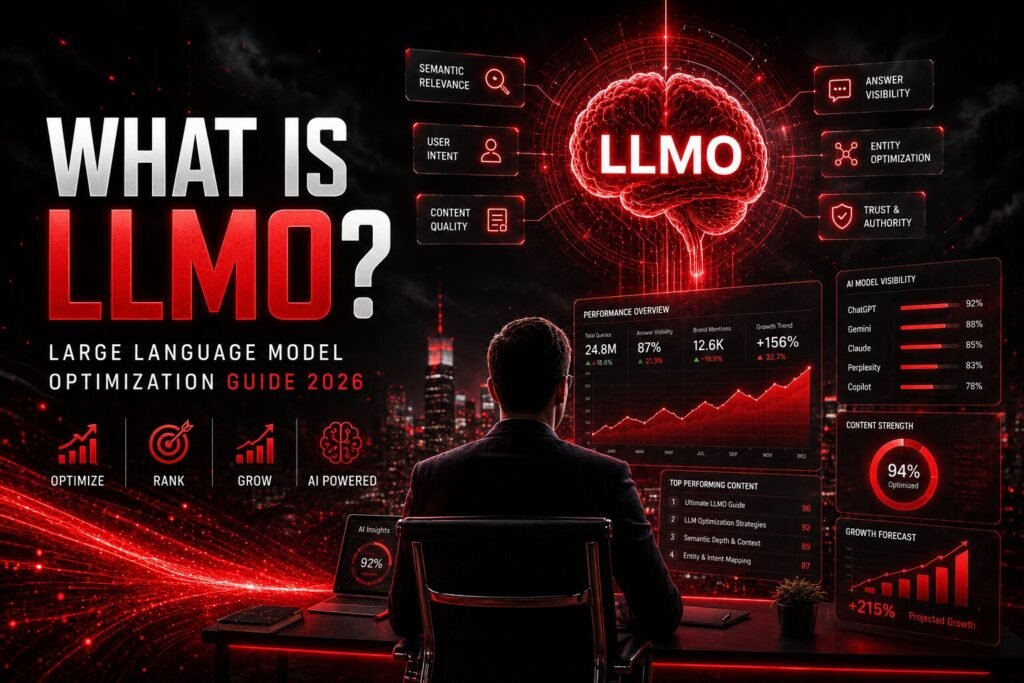
LLMO, or Large Language Model Optimization, is the discipline that addresses exactly this problem. It’s not a rebrand of SEO. It’s not a buzzword layered on top of content marketing. It’s a fundamentally different approach to visibility, one built for a world where AI systems like ChatGPT, Perplexity, Google Gemini, and Claude are the first point of contact between your brand and your potential customer.
And here’s the urgency: Gartner predicts traditional search volume will fall 25% by 2026 as users migrate toward AI chatbots. Semrush data shows AI-generated responses appeared on 13.14% of all U.S. search pages in March 2025, more than double the 6.49% rate from just two months earlier. That curve is not flattening.
If your brand isn’t appearing in AI-generated answers right now, you’re already losing ground. This guide covers what LLMO actually is, how it differs from what you already know, the real technical and strategic levers that make it work, and the mistakes that most businesses are silently making.
- What Is LLMO? A Practical Breakdown for 2026
- What Is LLMO? The Large Language Model Optimization Guide That Actually Prepares You for 2026
- Quick Answer: What Is LLMO?
- LLMO vs. SEO vs. GEO vs. AEO: What's Actually Different
- The Numbers That Should Change Your Strategy Today
- How Large Language Models Actually Decide What to Cite
- The 6 Core Pillars of an LLMO Strategy
- Real-World Use Cases Across Industries
- Common LLMO Mistakes Most Brands Are Making Right Now
- Expert Insight: The Compounding Advantage of Starting Now
- Future Trends: Where LLMO Goes From Here
- Step-by-Step: Your LLMO Audit Checklist for 2026
- FAQ: What Businesses Are Actually Asking About LLMO
- The Bottom Line
Quick Answer: What Is LLMO?
LLMO (Large Language Model Optimization) is the practice of structuring, optimizing, and distributing your content so that AI language models can accurately understand, trust, and cite your brand when generating responses to user queries.
Unlike traditional SEO, which optimizes for search engine ranking algorithms, LLMO optimizes for how AI models interpret and retrieve information. The goal isn’t just to rank. It’s to be the source the AI quotes, cites, or recommends, even when the user never visits your website.
LLMO works across platforms including Google AI Overviews, ChatGPT Search, Perplexity, Gemini, Microsoft Copilot, and any other AI-powered answer engine pulling real-time or indexed web data.
LLMO vs. SEO vs. GEO vs. AEO: What’s Actually Different
This is where most guides blur the lines and confuse everyone. Let me break it down cleanly.
SEO (Search Engine Optimization) is about ranking your pages in traditional search engine results pages. Signals include backlinks, on-page content quality, technical site health, and Core Web Vitals. The user clicks your link and visits your site.
GEO (Generative Engine Optimization) is about appearing across AI search platforms as a cited or referenced source. It targets all major AI-powered answer engines collectively, Google SGE, ChatGPT Search, Bing Chat, Perplexity, and others.
AEO (Answer Engine Optimization) focuses on getting your content selected as the direct, featured answer to a specific query. It’s closely tied to voice search and featured snippets.
LLMO is the most specific and technical of the four. It targets the internal reasoning of large language models themselves, influencing how these systems ingest, interpret, weight, and retrieve your content during inference. Where GEO asks “does my brand appear in AI answers?”, LLMO asks “how do I make my content structurally and semantically trustworthy to the model generating those answers?”
In practice, the strategies overlap significantly. But the mindset shift matters. LLMO treats AI models as the primary audience, not just readers or crawlers.
The Numbers That Should Change Your Strategy Today
Before getting into tactics, the data needs to land.
According to Semrush research, generative AI traffic is projected to exceed Google’s organic traffic by 2028. Adobe data shows that between November and December 2024, AI-generated referral traffic to U.S. retail sites increased by 1,300% compared to the same period the year before. ChatGPT alone commands around 73% to 75% of the chatbot market as of early 2026, and the platform collectively with peers like Claude and Gemini attracted over 600 million unique visitors in May 2025 alone.
Perhaps the most operationally important stat: 60% of AI citations come from URLs that are not in the organic top 20 search results. That means a brand that ranks on page two, or doesn’t rank at all through traditional SEO, can still get cited by an LLM if the content is structured correctly.
That completely upends the assumption that SEO rank equals AI visibility. They’re related, but they’re not the same thing.
How Large Language Models Actually Decide What to Cite
This is the part that most LLMO guides skip, but it’s the most important piece.
LLMs don’t “read” your content the way a human does. They were trained on massive corpora of text, and during that training, they developed internal representations of entities, concepts, and relationships. When a user submits a query, the model generates a response by predicting likely, contextually appropriate, and “trusted” continuations of language.
Retrieval-Augmented Generation (RAG) adds another layer. Many modern AI tools, including Perplexity and ChatGPT with web search enabled, use RAG frameworks to pull real-time or indexed web content into the model’s response window. The model then synthesizes that retrieved content with its trained knowledge.
So your content has to win at two levels. First, it has to be in the model’s training data or RAG retrieval pool. Second, it has to be structured in a way that the model can extract, paraphrase, and cite it confidently.
What the model looks for, based on observable behavior and research:
Factual density and precision. Vague, fluffy content gets ignored. Specific claims, statistics, named entities, and dates give the model something to latch onto.
Entity clarity. If your brand name, products, team, or domain isn’t consistently referenced across multiple authoritative sources, the model can’t confidently include you. Schema markup using sameAs connections to Wikidata, LinkedIn, and Crunchbase helps anchor your entity in the model’s knowledge graph.
Structural extractability. Content organized with clear semantic headings, short focused paragraphs, and standalone answer blocks is far easier for LLMs to extract and use. Having a proper H2/H3 hierarchy has been shown to increase citation probability by 2.8x in independent studies.
Source authority signals. 85% of AI citations originate from third-party sources, not brand-owned domains. Digital PR, guest posts on authoritative publications, and being mentioned in industry research dramatically increases your chances of being cited.
Consistency and accuracy. LLMs flag contradictions. If your website says one thing, your LinkedIn says another, and a press release says a third, the model either ignores you or cites you with reduced confidence. Consistency across all indexed brand properties matters.
The 6 Core Pillars of an LLMO Strategy
1. Entity-Based Content Architecture
Your brand needs to exist clearly in the AI’s “mental model” of the world. This means creating a structured entity footprint.
Build a definitive “about” page that reads like an encyclopedia entry, not a sales pitch. It should state what your company does, when it was founded, where it operates, what problems it solves, and who it serves. Link out to your LinkedIn, Crunchbase, Google Business Profile, and any industry directories.
Use Organization, Person, and Product schema markup throughout your site. Connect these to authoritative external profiles using sameAs properties. When the LLM encounters these signals across multiple crawled pages, it builds a coherent and trustworthy entity representation.
2. Content That Answers at Every Depth Level
Most content either answers too shallowly (“SEO is important because it drives traffic”) or buries the answer in walls of context. LLMO-optimized content answers the question directly, then expands.
Structure your articles like this: lead with the direct answer in the first 50 to 100 words, then build out layers of context, nuance, examples, and supporting data. This mirrors how RAG systems retrieve and use content, grabbing the most answer-dense passage first, then supplementing.
Every major section should be able to stand alone as an answer to a likely user query. Think of each H2 as a mini article with its own question, answer, and evidence.
3. Topical Authority Over Keyword Targeting
LLMs don’t think in keywords. They think in semantic clusters and entities. A brand that has published 40 shallow articles around a topic holds less weight than a brand with 10 genuinely deep, cross-referenced pieces that cover a topic from every relevant angle.
Build content pillars. Link internally with intention, not just for link equity, but to create a visible topical graph that both AI crawlers and model training pipelines can recognize as authoritative coverage.
4. Third-Party Mention and Citation Building
Since 85% of AI citations come from third-party sources, getting your brand mentioned on authoritative external sites is critical. This isn’t just link building for domain authority. It’s reputation building for AI visibility.
Target mentions in:
- Industry publications and trade media
- Research reports and whitepapers
- High-authority Q&A platforms like Reddit, Quora, and Stack Exchange
- LinkedIn articles and thought leadership pieces
- Podcast transcripts (increasingly indexed by AI systems)
- Wikipedia, if your brand meets notability thresholds
A brand that appears consistently across these channels gets ingested repeatedly into AI training data, and gets retrieved consistently during RAG-powered response generation.
5. Technical Optimization for AI Crawlers
Your site needs to be clean, fast, and crawlable for the same reasons it always did, but now add AI-specific considerations.
Keep robots.txt permissive for legitimate AI crawlers, including GPTBot, PerplexityBot, ClaudeBot, and Google’s AI crawlers. Many brands are inadvertently blocking these by copying restrictive robots.txt configurations from templates.
Implement structured data comprehensively. FAQ schema, HowTo schema, Speakable schema (for voice and AI audio), and Article schema are all highly relevant. Mark up your most important answer blocks so extraction is as effortless as possible.
Maintain a well-organized sitemap and avoid orphan pages. Content the AI crawler can’t discover can’t be cited.
6. Brand Accuracy and Consistency Auditing
This is the most overlooked pillar. LLMs propagate what they learn. If a model ingests incorrect information about your brand in 2025, it may continue surfacing that inaccuracy through 2026 and into 2027 unless you correct it at the source.
Audit all indexed brand properties regularly: your website, social profiles, Google Business Profile, Crunchbase, Wikipedia, third-party review sites, and any press coverage. Conflicting information signals unreliability to the model. Consistent, accurate, up-to-date information across all touchpoints builds the kind of entity trust that translates directly into citation frequency.
Real-World Use Cases Across Industries
SaaS brands benefit enormously from LLMO because their buyers use AI tools to research software categories before ever visiting a vendor site. A SaaS company optimizing for LLMO will appear in ChatGPT and Perplexity responses when someone asks “what’s the best [category] tool for [use case],” effectively entering the decision-making process before the sales funnel even begins.
E-commerce brands saw a 1,300% increase in AI-generated referral traffic through late 2024. Brands that have built LLMO-friendly product pages with detailed, structured, entity-rich descriptions are capturing this wave. Those that haven’t are invisible in product recommendation queries.
Professional service firms (agencies, consultants, law firms) live and die by reputation. LLMO ensures that when a potential client asks an AI for a recommendation in their category, the firm’s name appears, with the right context and credibility signals attached.
B2B companies increasingly find that procurement and evaluation research is happening inside AI tools rather than search engines. LLMO is now a direct revenue lever in B2B contexts.
Common LLMO Mistakes Most Brands Are Making Right Now
Blocking AI crawlers without realizing it. Check your robots.txt. If you’ve blocked all bots or used a catch-all block directive, AI indexing crawlers may be excluded.
Publishing thin content at scale. The idea that publishing lots of content increases AI visibility is backwards. LLMs reward depth and specificity. A hundred thin articles do less than ten genuinely comprehensive ones.
Ignoring entity building. Brands that invest only in on-site content but don’t build an entity footprint across authoritative third-party sources are invisible to models relying on multi-source corroboration.
Over-optimizing for keywords instead of questions. AI systems interpret intent, not keyword density. Content built around exact-match phrases often reads unnaturally to both humans and models. Content built around genuine, specific questions performs significantly better.
Treating LLMO as a one-time project. AI models are updated, retrained, and augmented continuously. Your LLMO strategy needs an ongoing maintenance cycle, including regular citation monitoring, content freshness updates, and entity accuracy audits.
Neglecting non-English content and international visibility. If your brand operates globally, your LLMO strategy needs to account for how models in different geographies represent your brand. Models serving UK, Australian, or Canadian users may draw on different indexed sources.
Expert Insight: The Compounding Advantage of Starting Now
Here’s something the data makes clear: only 30% of brands maintain consistent visibility from one AI response to another. The volatility is high. And that volatility is actually an opportunity.
Brands that build their LLMO infrastructure now, before their competitors treat it as a priority, establish the kind of entity authority and citation density that becomes self-reinforcing. The more consistently your brand is cited, the more likely it is to be ingested into future model training data, which increases the likelihood of future citations. It’s compounding.
Conversely, brands that wait are building a visibility gap that gets harder to close with every model update cycle.
If you’re a global business, this matters right now. Whether you’re in the USA, UK, Canada, or Australia, the AI tools your target buyers are using don’t respect geographic search algorithms. They respond to entity authority, content quality, and citation density. Those are universal signals.
At Digehub, this is precisely why we developed dedicated AI Visibility Services designed specifically around helping brands build the kind of multi-platform AI presence that traditional SEO alone can’t create.
Future Trends: Where LLMO Goes From Here
Multimodal content will matter more. Current LLMs are primarily text-based in their indexing behavior, but multimodal models that interpret images, video, and audio are already live. Brands that build rich, well-labeled multimedia content alongside text are positioning for the next wave.
Real-time RAG will dominate. The shift from models relying solely on training data to models using live retrieval is accelerating. This means freshness of content becomes a direct visibility signal. Pages that are regularly updated and consistently accurate will outperform static, aging content.
AI-to-AI referrals will emerge. We’re already seeing cases where one AI tool cites a source, and users of other AI tools use that citation to inform their own queries. Brand mentions in AI outputs create a secondary citation loop that amplifies visibility.
Structured knowledge bases and APIs will feed models directly. Forward-thinking brands are already exploring direct data partnerships and API access points that feed structured brand information to AI platforms. This is the next frontier of LLMO, moving beyond passive optimization to active knowledge graph participation.
Personalization will complicate everything. As AI models become more personalized, a single LLMO strategy may not be sufficient. Brands will need to think about how their entity is represented across different user intent profiles, buyer stages, and geographic contexts simultaneously.
If you’re also thinking about AI Automation Services to scale content creation and entity building, that infrastructure investment compounds with LLMO strategy, creating a faster execution cycle.
Step-by-Step: Your LLMO Audit Checklist for 2026
Use this as your starting framework:
Week 1, Entity Audit
- Search your brand name in ChatGPT, Perplexity, and Gemini. What does each model say?
- Identify inaccuracies, outdated information, or missing context
- Map all indexed brand properties (website, social, directories, press)
Week 2, Technical Review
- Audit robots.txt for inadvertent AI crawler blocks
- Check schema markup coverage across key pages
- Verify sitemap completeness and crawl accessibility
Week 3, Content Gap Analysis
- Identify the top 20 questions your buyers ask AI tools in your category
- Map existing content against those questions
- Identify which questions you’re not answering, or not answering clearly
Week 4, Authority Building Plan
- List target publications and platforms for third-party mentions
- Identify Wikipedia opportunities if applicable
- Plan a quarterly digital PR calendar focused on citation-generating placements
Ongoing Monthly
- Monitor AI citation mentions using tools like Brand24, Mention, or Semrush’s AI tracking features
- Update outdated content with fresh data and examples
- Track which third-party mentions are generating AI citation activity
You can also try our Free SEO Blog Writing Tool to accelerate content creation that’s structured for both traditional SEO and LLM ingestion.
FAQ: What Businesses Are Actually Asking About LLMO
What is LLMO in simple terms? LLMO stands for Large Language Model Optimization. It’s the practice of making your content readable, trustworthy, and citable by AI systems like ChatGPT, Gemini, and Perplexity, so your brand appears in AI-generated answers even when users don’t search Google.
How is LLMO different from SEO? Traditional SEO helps you rank on search engine results pages. LLMO helps you get cited by AI language models generating direct answers. You can rank #1 on Google and still be invisible in AI answers if your content isn’t optimized for how LLMs interpret and retrieve information.
Does LLMO replace SEO? No. Both are necessary right now. SEO drives organic traffic through traditional search. LLMO drives brand visibility through AI-generated answers. The strategies overlap, but each has unique requirements. Abandoning SEO for LLMO, or vice versa, leaves traffic and visibility on the table.
Can small businesses benefit from LLMO? Yes, and this is one of the most underappreciated points. Because 60% of AI citations come from URLs outside the top 20 organic results, smaller brands with focused, high-quality content can earn AI visibility even without massive domain authority.
How do I know if my brand is appearing in AI responses? Manually query ChatGPT, Perplexity, and Gemini with your brand name and category-relevant questions. Tools like Brand24, Semrush’s AI monitoring, and Mention can help automate this tracking at scale.
What content types does LLMO favor? Long-form, factually dense, well-structured content. Original research and statistics. Content with clear entity references, schema markup, and standalone answer sections. Third-party mentions in authoritative publications also weigh heavily.
How long does it take to see LLMO results? It depends on your existing entity authority. Brands with strong existing backlink profiles and third-party mentions may see citation frequency increase within weeks of structural changes. For newer brands, building the necessary entity footprint takes three to six months of consistent effort.
Is LLMO relevant for global businesses? Extremely. AI tools like ChatGPT and Perplexity serve users globally. Your brand’s AI visibility is borderless in a way that geo-targeted SEO is not. For businesses operating across the USA, UK, Canada, and Australia, LLMO creates unified brand presence across all markets simultaneously.
The Bottom Line
LLMO isn’t a prediction about where search is going. It’s a description of where it already is.
The businesses winning AI-generated visibility in 2026 started building their entity authority, content depth, and third-party citation presence 12 to 18 months ago. The brands that recognize this now still have a real window to move. But that window closes as the competitive gap compounds.
This isn’t about abandoning what works. Strong SEO Services and quality Content Marketing are still the foundation. LLMO builds on top of that foundation, extending your visibility into the AI-answer layer where your buyers are increasingly spending their research time.
If you want to understand exactly where your brand stands in AI-generated answers today, and build a strategy to improve it, our team at Digehub works with businesses globally to develop and execute LLMO programs that integrate with existing digital marketing infrastructure.
Businesses in the USA, UK, Canada, and Australia are already working with us on this. The question is whether your competitors get there first.
Start with the AI Visibility Services page and let’s assess your current AI presence together.