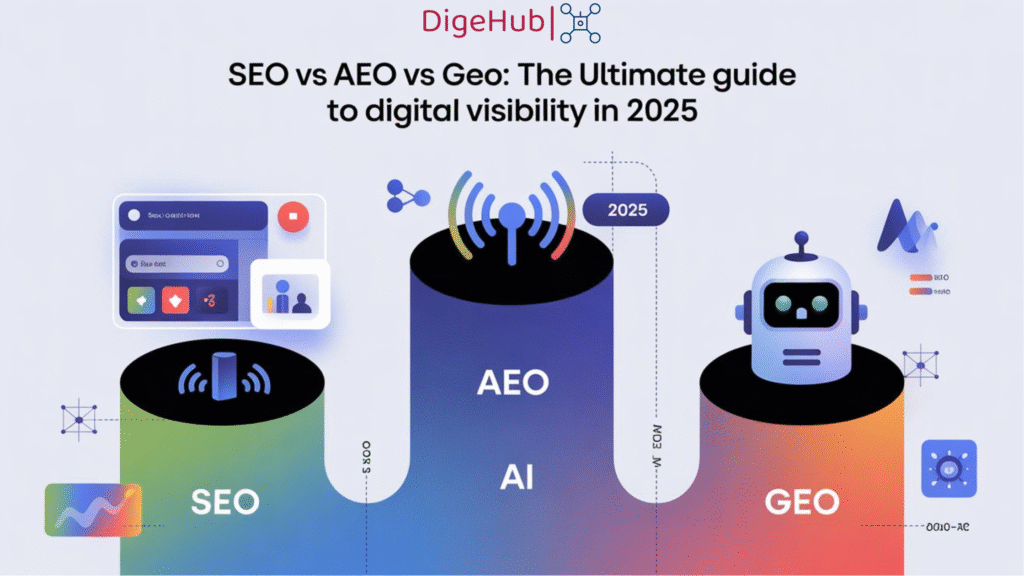
Generative Engine Optimization (GEO) for Chennai Businesses: A Practical Guide
Generative engine optimization is the practice of making your content easy for AI tools to use when they write an answer. The original research behind it is public, and it says some things most agency blog posts skip: what worked, what did not, and for whom.
What GEO actually is
Generative engine optimization, usually shortened to GEO, is the work of increasing the chance that a generative AI system uses your content when it writes an answer. A “generative engine” here means a tool that retrieves information from the web and then produces a written response: Google’s AI Overviews and AI Mode, ChatGPT search, Perplexity, Gemini and similar.
The term came out of a research paper, “GEO: Generative Engine Optimization” by Pranjal Aggarwal and colleagues, accepted to KDD 2024. Since then it has been adopted, and sometimes abused, as a marketing label. Our explainer on what GEO is covers the definition. This guide is about doing it, in a Chennai context, without the hype.
GEO overlaps with two other terms you will see. Answer engine optimization focuses on being the direct answer to a question, and LLMO focuses on how language models describe your business. In practice a good plan covers all three, and it still rests on ordinary SEO, as we explain in AI SEO vs traditional SEO.
What the research actually found
The paper built a benchmark called GEO-bench with 10,000 queries across 25 domains, then tested nine ways of rewriting content to see which made a source more visible in a generative engine’s answer. The authors report that the best methods can boost visibility by up to 40%. The details are more useful than the headline.
| Method tested | Result | What it means in plain terms |
|---|---|---|
| Quotation addition | Among the best on the position-adjusted measure | Include real, attributed quotes from named people or documents |
| Statistics addition | Close behind the best | Replace vague claims with specific, sourced numbers |
| Cite sources | Strong, especially for lower-ranked sites | Link to and name the evidence you rely on |
| Authoritative tone | Highest on the subjective impression score | Confident, expert phrasing reads as more credible |
| Fluency, easy-to-understand, technical terms | Modest effects | Clear writing helps a little, it is not a breakthrough |
| Keyword stuffing | Scored below the unoptimised baseline | The classic SEO trick does not work here and can hurt |
The finding that matters most for smaller businesses is who gained. For the “cite sources” method, a site ranked fifth in the original results gained about 115% in visibility, while the site ranked first lost about 30%. The authors conclude that GEO is especially helpful for lower-ranked websites. That is an encouraging result for a Chennai company that does not yet dominate classic rankings.
How to read the study responsibly
- It was run on a research benchmark and an experimental generative engine, not on every live product as it behaves today.
- The authors themselves note that effectiveness varies across domains.
- Rewriting a page to include real quotes and statistics only works if the quotes and statistics are real. Inventing them is both unethical and risky.
- The paper is from 2023 and 2024. Live systems have changed since, so treat it as a useful direction, not a guarantee.
What Google itself says
Google’s documentation on AI features and your website is blunt: there are no additional requirements to appear in AI Overviews or AI Mode, and no special optimisations are necessary. A page can be shown as a supporting link if it is indexed and eligible to appear in Search with a snippet.
The same document explains that these features may run several related searches across subtopics, a technique it calls query fan-out, and then show a wider set of links than a classic search. Its advice for site owners is the familiar list:
- Create helpful, reliable, people-first content.
- Allow crawling, including through any CDN or hosting layer.
- Use internal links and provide a good page experience.
- Keep important information in text, not only in images.
- Keep structured data consistent with what is visible on the page.
- Keep your Business Profile information current.
It also says you do not need to create new machine-readable files or special AI text files. That is worth knowing, because many vendors sell exactly that. Preview controls such as nosnippet can limit what is shown, and they affect eligibility, so do not apply them casually to pages you want quoted.
The on-page GEO checklist
Taking the research and Google’s guidance together, this is the practical list we use when we review a page.
- Answer first. Put a direct, specific answer in the first one or two sentences under each heading, then explain. This makes a passage easy to lift out.
- Use real numbers, with sources. “Most clinics” becomes “of the 30 clinics we reviewed, 22 had no pricing page.” Name where the figure comes from and link to it.
- Quote real people. A named doctor, engineer or customer, with permission, adds evidence a generic paragraph cannot.
- Cite your sources visibly. A short source list at the end, as on this page, helps readers and gives machines something to verify.
- Define the entity clearly. State who you are, what you do, where you operate and who you serve in plain words near the top of key pages.
- Use headings that match real questions. A heading such as “How much does a root canal cost in Chennai” is clearer than “Pricing overview”.
- Add tables where comparison helps. Tables are easy to read and to extract.
- Show who wrote it. Named authors with real credentials support the trust signals covered in E-E-A-T and AI search.
- Keep it current. Show a last updated date and actually update the facts.
- Use structured data that matches the page. See schema markup for AI search. It supports understanding but is not a guarantee.
What not to do
- Do not stuff keywords. The research shows it performs worse than doing nothing.
- Do not invent statistics or quotes.
- Do not publish dozens of near-identical city pages. Thin pages do not help any system.
- Do not hide important facts in images or scripts that crawlers may not read.
A before and after: rewriting one paragraph
This example is illustrative. The business and the figures are invented to show the technique, so do not quote them as real data.
| Before | After |
|---|---|
| We are the best choice for CNC machining in Chennai with years of experience and top quality. Contact us today for a great price. | A typical small-batch CNC order from our Ambattur workshop is delivered in 7 to 10 working days. We hold a tolerance of plus or minus 0.02 mm on aluminium parts and publish our inspection report with every batch. Our prices depend on material, quantity and finish, and a quote usually takes one working day. [Source: our delivery records for the last 12 months, summarised on this page.] |
The first version has nothing a machine, or a buyer, can use. The second gives a lead time, a tolerance, a process and a price logic, all of which answer the questions a purchasing manager would ask, and all of which can be checked. If your numbers are not that tidy, say so honestly: “Lead time ranges from 7 to 15 working days depending on finish” is still far more useful than a slogan.
Common GEO mistakes we see
- Treating it as a trick. People look for a hidden switch. There is none. The gains in the research came from adding genuine evidence.
- Publishing unreviewed AI-written pages at scale. Generic text gives an AI tool nothing distinctive to quote, and Google’s spam policies target scaled low-value content.
- Blocking the wrong bots. A blanket block in robots.txt, or a security setting on your host, can stop search crawlers you actually want. Check what your site returns to each major crawler.
- Ignoring the profile layer. Many Chennai businesses perfect their website and leave an outdated Business Profile with the wrong hours or category.
- Measuring once. A single test is a snapshot. Answers vary, so use a monthly log.
- Chasing every platform separately. The same strong, sourced, consistent content serves all of them.
Off-page GEO: what other sites say about you
Generative tools do not rely only on your site. They also read what others say about you, so your reputation across the web shapes how you are described. For a Chennai business the useful work is:
- Consistent profiles. The same name, address, services and description on your site, your Google Business Profile and the main directories.
- Genuine reviews. Detailed, recent reviews that mention the service and neighbourhood.
- Trusted mentions. Trade bodies, college pages, partner pages and local media, as in our guide to link building in Chennai.
- Useful presence where people ask. Answers in professional communities, where you add real value and disclose who you are, can build recognition. Do not post fake reviews or disguised ads.
GEO in the Chennai context
Chennai adds a few practical wrinkles.
- Language. Google added Tamil to AI Mode in October 2025. A clear page in Tamil for a high-value question can be one of few good sources. Quality matters: use natural Tamil written by a native speaker, not machine output. See Tamil SEO in Chennai.
- Local detail. Mention the areas you serve, the landmarks customers use and real local facts such as regulations or typical costs. Generic national text gives an AI nothing specific about Chennai to use.
- Sector fit. Industries like manufacturing, healthcare and IT services have specialist vocabulary. Explain terms the way a customer would ask them.
For a worked picture of results from a tracked programme, see our AI visibility case study, which reports its limits as well as its gains.
How to measure whether GEO is working
Rankings will not tell you. Use a fixed test instead.
- List 25 questions your customers ask, including comparison and price questions.
- Ask each one on Google (with AI features), ChatGPT, Perplexity and Gemini once a month, in the same way.
- Record whether you are named, whether you are linked, your position in any list and whether the description is accurate.
- Note the pages cited so you can see which content is being used.
- Check Search Console for traffic from AI features, which Google reports under the Web search type, and your analytics for referrals from AI tools.
Expect the answers to vary from run to run, so look at the trend across months rather than a single result. The full method is in our AI visibility audit guide.
What GEO cannot do
GEO cannot guarantee a mention. Nobody controls these answers, and a provider promising a fixed outcome is guessing. It cannot rescue a weak business either: if reviews are poor and the offer is unclear, better formatting will not change that. And it is not a substitute for the fundamentals. A site that cannot be crawled or that loads slowly will fail in both classic and generative search.
If you want help, our AI SEO agency page describes how we work, and our guide on ranking in ChatGPT as a Chennai business covers the ChatGPT side in detail.
A 30-day GEO start for a small business
| Week | Task |
|---|---|
| 1 | Write the 25 questions, run the first test and save the results |
| 2 | Fix the technical basics: crawl access, speed, and any blocked bots you want to allow |
| 3 | Rewrite your three most important pages: answer first, real figures, sources, a named author and a clear entity description |
| 4 | Align your Business Profile and main directory listings, then ask five happy customers for detailed reviews |
Then repeat the test and compare. If a page you improved starts to be cited, extend the same approach to the next one.
Frequently asked questions
What is GEO in simple words?
It is the practice of making your content easy for AI tools to find, trust and quote when they write answers to questions.
Is GEO different from SEO?
It builds on SEO. Google says AI features need no extra requirements, so the foundation is the same. GEO adds answer-ready writing, sourced facts and consistent entity information.
Does keyword stuffing work for AI search?
No. In the main GEO study it scored below the unoptimised baseline, while adding quotations, statistics and cited sources did better.
Can a small Chennai business benefit from GEO?
Yes. The study found lower-ranked sites gained the most from methods like citing sources, though results vary by domain and platform.
Do I need an llms.txt file or special markup?
Google says no new machine-readable files or special schema are needed to appear in its AI features.
How long does GEO take?
Page changes can be picked up within days to weeks, but answers vary, so judge the trend over two to three months of monthly tests.
Sources and further reading
Want to see how AI tools describe your business today?
Send us your website and the questions your customers ask. We will run the test across the main AI tools and show you what comes back.
- Free audit of your site, Google Business Profile and AI answers
- Reply within 2 business hours on WhatsApp
- Month-to-month plans from ₹40,000