E-E-A-T AI Search 2026: The Authority Framework That Gets You Ranked and Cited
- E-E-A-T AI Search 2026: The Authority Framework That Gets You Ranked and Cited
- Why E-E-A-T Hits Different in the Age of AI Search
- Quick Answer: What Is E-E-A-T in AI Search?
- The Four Components, Reweighted for 2026
- Experience: The Signal AI Can't Fake
- Expertise: From Author Bios to Entity Infrastructure
- Authoritativeness: The Multi-Platform Consensus Signal
- Trustworthiness: The Foundation Everything Sits On
- How E-E-A-T Signals Flow Into AI Citation Systems
- E-E-A-T by Industry: Where the Stakes Are Highest
- Building E-E-A-T Infrastructure: The Practical Checklist
- Common E-E-A-T Mistakes in the AI Search Era
- Expert Insights: What Actually Moves the Needle
- Future Trends: Where E-E-A-T Is Heading
- FAQ: E-E-A-T AI Search 2026
Why E-E-A-T Hits Different in the Age of AI Search
E-E-A-T AI search 2026 is not the same conversation it was two years ago. Back then, E-E-A-T was a quality guideline, something you optimized for to avoid manual penalties and improve your chances on competitive YMYL queries. Now it functions as both a ranking filter and an AI citation filter simultaneously, and the gap between those two functions is wider than most brands realize.
Here’s the problem that changed everything. AI content generation made it trivially cheap to publish thousands of pages that look authoritative on the surface: structured headings, cited statistics, appropriate length, relevant keywords. Google’s systems and the AI platforms that power Perplexity, ChatGPT, and Gemini are all dealing with the same flood of content that mimics expertise without demonstrating it. The response from these systems has been to place significantly more weight on signals that content can’t fake by itself, specifically the signals that come from entities, authors, and organizations operating in the real world with verifiable track records.
That’s what E-E-A-T has become in 2026. Not a content quality rubric. An identity verification system.
And the implications extend beyond Google rankings. As we’ve covered in our analysis of AI search vs traditional SEO, the AI platforms that now handle a significant fraction of all search queries are running their own versions of E-E-A-T evaluation in their reranking layers. Perplexity’s ML reranker incorporates entity-level signals and domain authority. ChatGPT’s retrieval layer weights established brand entities. Google Gemini’s quality filters are directly connected to Google’s E-E-A-T framework. Understanding how these signals work across all these surfaces is no longer optional.
Quick Answer: What Is E-E-A-T in AI Search?
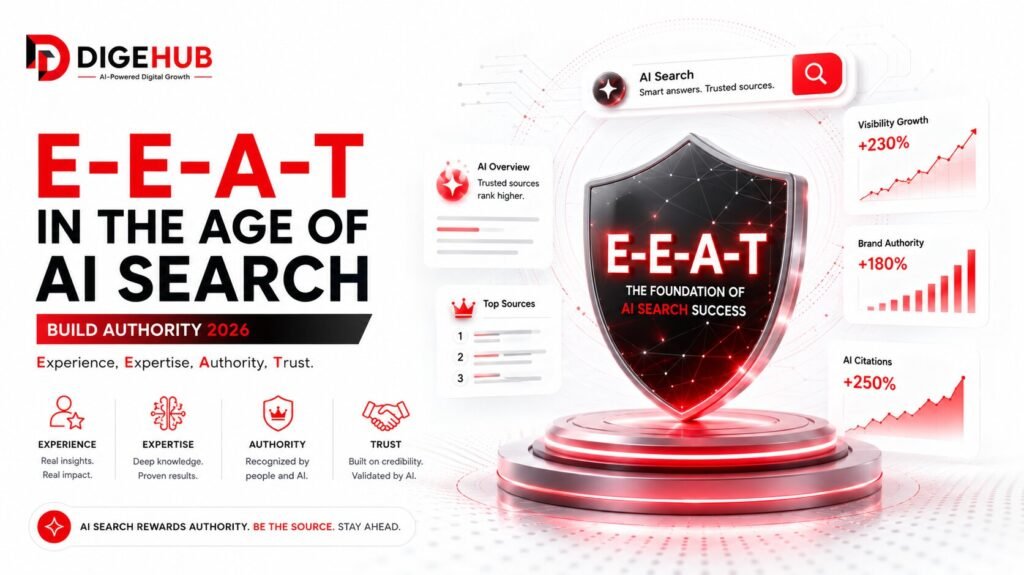
E-E-A-T stands for Experience, Expertise, Authoritativeness, and Trustworthiness. In the context of AI search in 2026, it refers to the set of signals that both Google’s ranking systems and AI citation systems use to evaluate whether a piece of content, an author, and an organization deserve to be ranked or cited in response to a query.
The four components work as follows:
- Experience signals that the content creator has real, first-hand knowledge of the subject, not synthesized knowledge from other sources
- Expertise signals that the creator or organization has domain-specific qualifications, credentials, or demonstrated depth of knowledge
- Authoritativeness signals that the brand or author is recognized as a credible source by other entities in the same field
- Trustworthiness signals that the content is accurate, the site is secure and transparent, and the brand behaves honestly
In 2026, these signals need to be embedded structurally into your content and site architecture, not just demonstrated through writing quality. Schema markup, author profiles, external citations, editorial policies, and multi-platform brand presence are all components of how E-E-A-T is communicated to AI systems that can’t read between the lines the way a human evaluator might.
The Four Components, Reweighted for 2026
Google’s own guidance has consistently stated that Trustworthiness is the most important of the four E-E-A-T components. Everything else, experience, expertise, and authority, contributes to trustworthiness but doesn’t override a fundamental trust deficit.
What’s changed in 2026 is the relative weighting of Experience specifically. This component was added to the framework in December 2022 precisely because Google anticipated the flood of AI-generated content that would follow. Experience is the component that AI systems inherently cannot demonstrate through content alone, because experience requires doing something in the real world, not synthesizing what others have written about doing it.
The practical consequence is that content demonstrating first-hand experience, documented case studies, original testing results, personal observations, and organizational track records, is disproportionately rewarded relative to content that aggregates existing knowledge, however well-structured.
Expertise has shifted from a credentials-focused signal to an entity-focused signal. In 2026, expertise isn’t just communicated by what someone’s bio says. It’s communicated by whether Google’s Knowledge Graph and AI retrieval systems can clearly identify the author or organization as a recognized entity in a specific domain. Author schema, consistent publication history, external mentions, and topical cluster coverage all contribute to this entity-level expertise signal.
Authoritativeness has expanded beyond backlinks. Yes, third-party links from credible sites still signal authority. But in the AI search era, the “consensus signal” has become equally important: whether your brand appears consistently across multiple independent sources (Reddit, YouTube, industry publications, review platforms) saying similar things about your expertise. AI systems weight this cross-platform consistency heavily when evaluating citation confidence.
Trustworthiness is now partially evaluated at the technical level. HTTPS, transparent editorial policies, author disclosures, privacy policies, clear organizational information, and factual accuracy all contribute to trust signals that AI retrieval systems can evaluate without human review.
Experience: The Signal AI Can’t Fake
This is the most strategically important E-E-A-T signal for 2026 and the most underinvested.
Experience means your content demonstrates that the person who wrote it has actually done the thing they’re writing about. Not read about it, not synthesized what others have written about it, but done it. For a marketing agency, that means case studies with real client data. For a SaaS company, that means documented testing with specific results. For a healthcare provider, that means clinical experience reflected in the nuances of how information is presented.
The reason Experience has become so decisive is that AI-generated content is structurally incapable of demonstrating it. An AI can write that “based on our testing, we found X,” but that claim carries no weight without verifiable evidence. First-hand experience signals that are genuinely hard to fake include:
Original data and proprietary research. If you run a survey, conduct an experiment, or pull data from your own client base or platform, that information exists nowhere else on the web. AI citation systems specifically reward content containing information they can’t synthesize from existing sources because it represents genuine information gain. This is one of the highest-leverage experience signals available.
Documented process evidence. Screenshots, before-and-after results, process documentation, and case study data with specific numbers (not “we improved traffic by a lot” but “organic sessions increased 47% in 90 days, from 12,400 to 18,200”) all signal first-hand experience in ways that prose claims can’t.
Specific, non-generic observations. Generic content says “it’s important to update your content regularly.” Content with genuine experience says “we found that posts updated within 90 days of the original publish date held AI Overview citations significantly longer than posts left static, across a sample of 40+ client accounts.” The specificity is the signal.
Temporal consistency. An author or brand that has been publishing on a topic over multiple years, with evolving perspectives that reflect changing industry conditions, demonstrates experiential credibility that a newly published page can’t replicate regardless of how well-written it is.
For businesses building experience signals, the most actionable step is also the most direct one: document what you actually do. Your internal processes, client results, testing outcomes, and organizational decisions are experience signals that competitors cannot copy.
Expertise: From Author Bios to Entity Infrastructure
Most brands treat expertise as a content quality problem. In 2026, it’s an entity infrastructure problem.
Writing well about a topic signals some level of knowledge, but it doesn’t tell Google’s Knowledge Graph or Perplexity’s ML reranker who the author is, what their credentials are, where else they’ve published, or how their expertise relates to the brand entity publishing the content. That information needs to be declared and verifiable, not inferred.
The expertise infrastructure that actually moves the needle in 2026 looks like this:
Author profiles with real credential depth. Every piece of content needs a named author with a bio that specifies their actual qualifications: years of experience, specific roles held, publications they’ve contributed to, certifications they hold, or organizations they’re affiliated with. Vague bios (“John is a marketing expert”) don’t pass the entity clarity test that AI rerankers apply.
Person schema with linked external presence. Author expertise signals are dramatically strengthened when the Person schema on your author pages links to the author’s LinkedIn profile, any publications where they’ve been cited or contributed, their own website if applicable, and verifiable credentials. Pages with author Person schema that includes linked credentials achieve 2.3x higher AI citation rates than those without, per practitioner research from early 2026.
Topical consistency across the domain. An author who writes about SEO, then recipes, then parenting advice, then cryptocurrency, sends a diluted expertise signal regardless of individual article quality. Expertise is recognized at the entity level, meaning both the author entity and the domain entity need to have clear, consistent topical territory.
Editorial standards documentation. Explicitly publishing your editorial policy, including how you verify facts, who reviews content, and what your update standards are, provides a trust signal that AI systems can locate and evaluate without requiring human review.
Consistent external attribution. When other authoritative sources cite your brand or your authors by name on topics you cover, that’s an expertise validation signal coming from outside your own ecosystem. It’s the difference between claiming expertise and having it recognized. This is one reason why contributing to industry publications, participating in expert roundups, and getting quoted in research matters, not just for backlinks but for entity recognition.
The connection between expertise infrastructure and AI visibility is direct. As our What Is AI Search Visibility? guide covers, AI systems evaluate brand and author entity signals as part of their reranking process. Without this infrastructure, you’re asking AI systems to trust content from an unrecognized entity, and they typically don’t.
Authoritativeness: The Multi-Platform Consensus Signal
Authority in 2026 is not just backlinks. This point needs to be stated plainly because a lot of SEO strategy is still anchored in link-centric authority models that don’t fully capture how AI systems evaluate credibility.
Traditional authoritativeness: earned through backlinks from authoritative sites, brand mentions in credible publications, and Google’s PageRank-adjacent systems. This still matters and contributes to both traditional rankings and AI citation probability.
AI-era authoritativeness: the consensus signal. AI platforms including Perplexity, ChatGPT, and Gemini check for agreement across multiple independent sources before confidently citing a brand. If your expertise and positioning are consistently reflected across your own website, Reddit communities, YouTube content, LinkedIn presence, and third-party review platforms, AI systems gain confidence in citing you. If you only exist on your own website, you’re asking the system to trust a single unverified source, and it typically won’t.
This is why the authority-building strategies that work in the AI search era look different from traditional link-building:
Reddit participation. Reddit accounts for 46.7% of Perplexity’s top citation sources. Authentic, non-promotional participation in communities relevant to your industry, answering questions genuinely and occasionally referencing your own research or published content when directly relevant, builds citation authority on a platform that AI systems weight heavily. This isn’t about gaming Reddit. It’s about being genuinely present where your buyers are.
YouTube content. YouTube is the second most-cited source in Perplexity’s citation pool. Tutorial content, thought leadership videos, and documented process walkthroughs build authority signals that operate independently from your website and contribute to the multi-source consensus that AI platforms reward.
Industry publication contributions. Guest articles, expert quotes in industry roundups, and speaking mentions in conference coverage all create authoritative external attributions that validate your brand entity in ways your own content can’t.
Review platform presence. G2, Clutch, Capterra, and similar platforms carry explicit third-party trust signals that AI systems incorporate when evaluating commercial-intent queries. Strong profiles with genuine, detailed reviews validate your organizational authority independently of anything you publish yourself.
Consistent brand positioning across all surfaces. Authority is undermined when your LinkedIn messaging, your website positioning, your Reddit contributions, and your publication bylines tell slightly different stories about what you do and who you serve. Cross-platform consistency reinforces the entity signal. Inconsistency dilutes it.
Building this kind of authority systematically is exactly what our Content Marketing Services are designed to support, covering the full stack from publication strategy to multi-platform presence building.
Trustworthiness: The Foundation Everything Sits On
Google has explicitly stated that Trustworthiness is the most critical E-E-A-T dimension. Experience, Expertise, and Authoritativeness all contribute to trustworthiness, but none of them compensate for a fundamental trust deficit.
In the AI search era, trust signals operate at multiple levels:
Technical trust signals. HTTPS is baseline. Beyond that, page security, privacy policy clarity, cookie consent compliance, and the absence of deceptive design patterns (hidden fees, misleading claims, manipulative UX) all contribute to how AI quality systems evaluate your site.
Content accuracy and sourcing. AI systems, particularly Perplexity’s reranker, specifically favor verifiable, fact-dense content over vague assertions. Including specific statistics with named sources and dates is a trust signal. Making claims without attribution is a trust deficit. “Studies show” without specifying which studies is the kind of unsourced assertion that reduces citation probability.
Transparency signals. A clearly identified organization (About page with real team information), clearly identified authors (not “Staff Writer”), transparent business model, and honest product or service representation all contribute to trust evaluation at the organizational level.
Factual consistency across platforms. If your website claims one thing and your review platform profiles show a different picture, or if your LinkedIn posts contradict your published content, AI systems encounter conflicting signals about your trustworthiness. Consistency across surfaces is a trust signal in itself.
Update transparency. When you update published content, noting what changed and when, builds trust with both readers and AI systems. It signals that you care about accuracy enough to revise, rather than just leaving outdated information live indefinitely.
No deceptive content patterns. Clickbait titles that don’t match article content, hidden affiliate disclosures, paid coverage presented as editorial, these all damage trust signals. AI systems that evaluate quality at scale are increasingly effective at identifying patterns of deceptive content behavior.
How E-E-A-T Signals Flow Into AI Citation Systems
This is the part most E-E-A-T guides skip, and it’s the most important for understanding why the framework matters beyond traditional SEO.
Each major AI platform evaluates E-E-A-T signals in its retrieval and reranking process, but the implementation differs by platform.
Google AI Overviews and AI Mode are directly connected to Google’s E-E-A-T evaluation framework because they draw from Google’s organic index. Pages that fail E-E-A-T checks for traditional rankings are also deprioritized in AI Overview citations. Author schema, topical authority, and trust signals all apply. Our Google AI Overviews optimization guide covers the full citation mechanism.
Perplexity applies its own ML reranker that incorporates entity-level signals, domain authority, recency weighting, and source diversity. The entity clarity signal, whether a page clearly identifies the authoring entity and their relationship to the content’s subject, directly maps to E-E-A-T’s expertise and authority components. Pages with clear author attribution and person schema consistently outperform anonymous content in Perplexity citation rates. Full details in our Perplexity ranking guide.
ChatGPT weights established domain authority and brand entity recognition more heavily than other platforms. Its citation behavior is conservative (0.59% brand cite rate) and skewed toward well-established entities with long content histories. This makes the Authoritativeness and Trustworthiness components particularly important for ChatGPT visibility. Our ChatGPT ranking guide covers the platform-specific implications.
Google Gemini in AI Mode uses query fan-out retrieval and synthesizes from diverse sources. E-E-A-T signals influence both which pages are retrieved and how much weight their content receives in the synthesis process. The Gemini ranking guide covers how this works in practice.
The cross-platform implication is significant: E-E-A-T isn’t a Google-specific concern anymore. It’s the shared foundation of credibility evaluation across all major AI search surfaces. Brands that build genuine E-E-A-T infrastructure benefit across every platform simultaneously, while brands that skip it are penalized everywhere simultaneously.
This is also the core reason why LLMO optimization and Generative Engine Optimization both treat E-E-A-T infrastructure as a foundational requirement rather than an optional enhancement.
E-E-A-T by Industry: Where the Stakes Are Highest
E-E-A-T requirements are not uniform across industries. Google’s Quality Rater Guidelines use the concept of YMYL (Your Money or Your Life) to identify content categories where accuracy and authority are most critical, and AI systems apply similar logic in their quality filtering.
Healthcare and medical. The highest E-E-A-T bar exists here. Author credentials need to be verifiable and directly relevant (medical professionals writing about medical topics, not generalist writers). Medical reviewer attribution is expected on clinical content. Clinical sources need to be cited with specificity. A general blog post about symptoms written by an anonymous author has near-zero AI citation probability in this vertical.
Legal and financial. Similar standard to healthcare. Author credentials need to be specific and verifiable. Jurisdictional accuracy matters. Content that gives generic legal or financial information without appropriate professional attribution and caveats fails the trust filter.
B2B SaaS and technology. E-E-A-T here operates more through demonstrated experience than credentials. Case studies, documented client results, original platform data, and technical depth all serve as experience and expertise signals. The bar is high enough that generic “what is X software” content is increasingly displaced by AI-generated summaries, while vendor-specific experience content with real data continues to earn citations.
Marketing and agencies. This is a topically dense vertical with significant AI Overview coverage. The brands earning consistent citations are those with original research, documented methodologies, specific client outcome data, and clear organizational expertise signals. Generic marketing advice is the lowest-value content category on the web right now. Specific, experience-backed insight is still highly citable.
Education. AIO coverage grew 361% in one year for this sector. Institutional credibility matters enormously. Content from recognized educational institutions, accredited programs, or credentialed educators is weighted heavily. Pure information aggregation from unknown sources is heavily discounted.
E-commerce. Lower YMYL pressure but trust signals still matter for conversion-adjacent content. Product reviews with documented purchase experience, comparison content with genuine testing data, and brand reputation signals all influence both traditional ranking and AI mention probability on research-phase queries.
Building E-E-A-T Infrastructure: The Practical Checklist
Here’s the practical implementation framework, organized by priority:
Author Infrastructure (Highest Priority)
- Named authors on every piece of content (no “Staff Writer” or “Admin”)
- Author bio pages with specific credentials, not vague descriptions
- Person schema implemented with author name, credentials, employer, and links to external presence
- Author LinkedIn profiles linked from author bio pages
- Consistent author publishing history across the domain
Organizational Entity Signals
- Organization schema in the site header with complete information
- About page with real team information, organizational history, and mission
- Contact information that matches across all platforms (NAP consistency)
- Clear business model and service transparency
Content Trust Signals
- All statistics cited with named sources and dates
- Editorial policy page specifying review and update standards
- Content update dates visible (and accurate, not cosmetically refreshed)
- Clear differentiation between editorial content and sponsored or affiliate content
Technical Trust Signals
- HTTPS across all pages
- Privacy policy and cookie compliance
- Fast page load (LCP under 2.5 seconds)
- Mobile responsiveness and Core Web Vitals compliance
External Authority Signals
- Contributions to industry publications under named author bylines
- Authentic Reddit participation in relevant communities
- YouTube content with clear topical relevance
- Review platform profiles (G2, Clutch, Capterra as appropriate) with genuine reviews
- Industry directory listings with consistent brand information
Schema Implementation
- Article schema with author credentials on all blog content
- FAQ schema on all content pieces answering multiple questions
- HowTo schema on step-based guides
- Organization schema sitewide
- BreadcrumbList schema for content hierarchy
This infrastructure doesn’t get built in a weekend. But each component contributes to a compounding E-E-A-T signal that becomes more valuable over time as it accumulates external validation.
If you want help auditing where your current E-E-A-T infrastructure has gaps and building a prioritized plan to close them, our AI Visibility Services and SEO Services are built for exactly this.
Common E-E-A-T Mistakes in the AI Search Era
Anonymous content. Still one of the most common and most damaging mistakes. “Admin” bylines, no author information, and missing author schema all fail the entity clarity test that AI rerankers apply. Every piece of content needs a named, credentialed author.
Cosmetic E-E-A-T. Adding a generic bio and a stock photo to a previously anonymous author page doesn’t build genuine expertise signals. AI systems evaluate the depth and verifiability of credentials, not just their presence.
Optimizing for Google E-E-A-T only. E-E-A-T signals flow into Perplexity, ChatGPT, and Gemini’s quality filters too. A brand that treats E-E-A-T purely as a Google ranking concern is missing its role in AI citation probability across all platforms.
Ignoring the Experience component. The hardest E-E-A-T signal to fake is also the most underinvested. Brands publishing synthesized, generic content without any first-hand experience signals are the most vulnerable to displacement by AI-generated answers that can do synthesis just as well.
No external validation. E-E-A-T is partly about what others say about you, not just what you say about yourself. Brands that haven’t invested in external mentions, industry publication contributions, or third-party review profiles lack the independent validation signals that AI systems weight heavily.
Inconsistent author personas. Using AI to generate author bios, or rotating fake authors, creates inconsistency that quality systems eventually detect. Real authors with real publishing histories across multiple platforms create the kind of consistent entity signal that’s genuinely hard to replicate.
Claiming expertise without documenting it. “We have 10 years of experience” is a claim. A case study documenting a client outcome from year one compared to year ten is evidence. AI systems favor verifiable evidence over self-assessed claims.
Expert Insights: What Actually Moves the Needle
Working across AI visibility and SEO campaigns, a few patterns stand out that most E-E-A-T guides don’t capture clearly enough.
The brands with the strongest E-E-A-T performance in 2026 share one consistent characteristic: they treat their organizational knowledge as content infrastructure, not just as internal IP. Their processes, methodologies, case study data, and original research are all systematically documented and published. The content exists because the experience exists first, not the other way around.
The Experience component is where most competitive advantages are currently available. Because generic content is now abundant and cheap, the scarcity has shifted to content that contains information that can only come from doing something in the real world. Original data, client outcome documentation, proprietary testing results, and institutional experience signals are the E-E-A-T assets that are genuinely hard to commoditize.
Author entity building takes longer than any other E-E-A-T investment but compounds more durably. An author who has been consistently publishing under their name on a specific topic for three years, with external citations, a linked LinkedIn profile, and contributed articles in industry publications, has accumulated E-E-A-T infrastructure that a competitor can’t replicate in three months regardless of budget.
The Answer Engine Optimization framework connects directly to E-E-A-T here: content structured for direct AI extraction needs to come from a credible, identifiable source to earn consistent citation. Strong AEO structure without E-E-A-T infrastructure is like having a well-formatted CV without verifiable credentials. The form is right but the substance is missing.
Future Trends: Where E-E-A-T Is Heading
AI detection sophistication will increase. Google and the major AI platforms are actively investing in distinguishing AI-synthesized content from content with genuine human experience embedded in it. The Experience component will become more precisely evaluated, not less, as detection capabilities improve.
Author entities will become first-class SEO assets. Right now, most brands treat authors as a content delivery mechanism. In the next 12 to 18 months, the author entity will be recognized as a strategic asset in its own right, with measurable authority scores, citation rates by author, and deliberate “author SEO” as a distinct discipline within the E-E-A-T framework.
Cross-platform E-E-A-T signals will be weighted more uniformly. As AI search platforms mature and share more infrastructure (Gemini powering both Google’s traditional systems and AI Mode, Bing powering both traditional search and ChatGPT retrieval), the E-E-A-T signals that work across all platforms will converge further. Building for one surface will increasingly benefit all surfaces, but only if the underlying infrastructure is genuinely built rather than cosmetically applied.
Original research will become the primary citation differentiator. As AI systems get better at synthesizing publicly available information, the content that earns consistent citations will increasingly be content that contains information the AI can’t generate on its own. Original data is the clearest version of this. Brands that invest in systematic research publication will have a durable citation advantage that content quality alone cannot match.
E-E-A-T compliance will become a prerequisite for AI advertising adjacency. As ads appear alongside AI Overviews on 40% of SERPs (per Semrush data), Google’s quality filters for what appears near those ads will tighten. Brands with weak E-E-A-T signals may find their content excluded from the AI Overview context entirely, which increasingly means exclusion from the most visible search real estate.
If you’re building an E-E-A-T strategy for the AI search era and want to make sure it covers both traditional ranking signals and AI citation requirements, our AI Visibility Services and SEO Services cover the full implementation stack. We work with brands across the USA, UK, Canada, and Australia. And you can start by running your existing content through our Free SEO Blog Writing Tool to identify the most immediate structural gaps.
FAQ: E-E-A-T AI Search 2026
1. What does E-E-A-T stand for and why does it matter for AI search in 2026? E-E-A-T stands for Experience, Expertise, Authoritativeness, and Trustworthiness. In AI search 2026, it functions as both a Google ranking filter and an AI citation filter across Perplexity, ChatGPT, and Gemini. Brands that lack strong E-E-A-T signals are deprioritized in both traditional organic results and AI-generated responses.
2. How is E-E-A-T different in AI search compared to traditional SEO? In traditional SEO, E-E-A-T influenced rankings primarily through content quality signals and backlinks. In AI search, E-E-A-T is evaluated structurally through schema markup, author entity recognition, multi-platform presence, and cross-source consensus signals that AI retrieval and reranking systems can evaluate at scale without human review.
3. Which E-E-A-T component matters most in 2026? Google explicitly states Trustworthiness is the most critical component. However, Experience has become strategically decisive because it’s the only component that AI-generated content cannot fake. Content demonstrating genuine first-hand experience through original data, documented outcomes, and specific non-generic observations is the hardest to replicate and the most durably citable.
4. Does E-E-A-T affect AI citation probability on Perplexity and ChatGPT? Yes, directly. Perplexity’s ML reranker incorporates entity-level authority signals and author credential signals. ChatGPT weights established brand entities and long-form domain authority. Google Gemini uses E-E-A-T signals inherited from Google’s quality evaluation framework. All three platforms reward identifiable, credentialed sources over anonymous or entity-unclear content.
5. What is the fastest way to improve E-E-A-T signals? The highest-immediate-impact actions are: adding named authors with real credentials and Person schema to all existing content, implementing FAQ and Article schema across your top pages, and creating or improving your About page with verifiable organizational information. These are infrastructure changes that take days to implement but have lasting citation impact.
6. Do small businesses and agencies need E-E-A-T optimization? Yes, regardless of company size. Perplexity research found that 92.78% of its cited pages had fewer than 10 referring domains. Small brands with clear author credentials, strong schema implementation, and authentic multi-platform presence consistently outperform larger brands with weak E-E-A-T infrastructure.
7. How does original research improve E-E-A-T? Original research is the strongest Experience signal available. It contains information that exists nowhere else on the web, which means AI systems can’t synthesize it from other sources. Proprietary studies, client data aggregates, and original surveys become citation anchors that competitors cannot replicate by writing better versions of the same content.
8. How often should E-E-A-T infrastructure be audited? Quarterly audits of schema implementation, author profile completeness, and external mention patterns are the minimum. Content accuracy and freshness need to be reviewed on a per-post cycle, with high-value informational content updated at least every 90 days to maintain citation eligibility on recency-sensitive AI platforms like Perplexity.
9. Is E-E-A-T the same as domain authority? No. Domain authority is a backlink-derived metric from third-party tools. E-E-A-T is Google’s internal quality evaluation framework covering experience, expertise, authoritativeness, and trust across content, authors, and organizations. The two correlate but are distinct. E-E-A-T evaluation encompasses signals that domain authority doesn’t capture, including author credentials, content accuracy, and organizational transparency.
10. What’s the biggest E-E-A-T gap most brands have in 2026? The Experience component is the most commonly underdeveloped. Most brands have some version of author bios and HTTPS, but very few have systematically documented their organizational experience through original data, client outcome case studies, and proprietary research. This is the gap that’s hardest to close quickly and most valuable to close strategically.
DigeHub is a global digital marketing agency helping businesses across the USA, UK, Canada, and Australia build E-E-A-T authority and AI search visibility through integrated SEO and content strategy.