AI Visibility for Businesses India 2026: How to Get Your Brand Cited, Found, and Chosen
Why AI Visibility Is an Urgent Business Priority in India Right Now
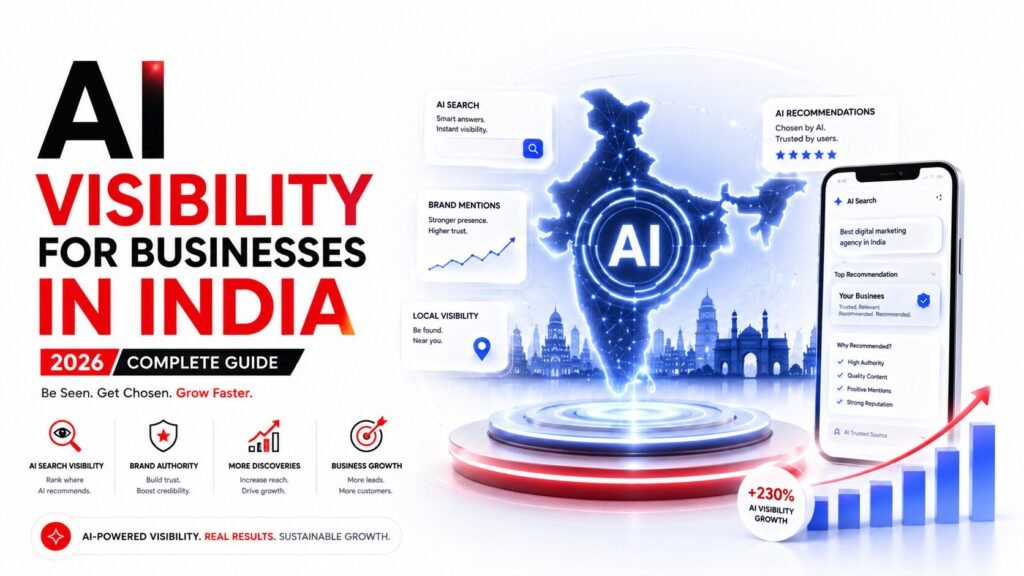
AI visibility for businesses in India is no longer a future consideration. It’s a present-tense competitive issue that most Indian businesses haven’t fully acted on yet, and that window of first-mover advantage is closing fast.
Here’s the data that makes this urgent. India has the highest AI adoption rate of any country in the world at 59%, ahead of the UAE at 58%, Singapore at 53%, and the USA at a significantly lower rate. Perplexity AI users in India grew by 640% year-over-year in Q2 2025, driven partly by Airtel’s partnership that gave Airtel subscribers free access to Perplexity Pro. India now accounts for 22.75% of Perplexity’s entire global audience, making it Perplexity’s single largest market by traffic. Google AI Overviews are live across India in multiple languages. ChatGPT processes 2 billion queries daily globally, with India and Southeast Asia showing the fastest year-over-year adoption at 190 to 210%.
What this means practically: a significant and rapidly growing portion of the research your potential customers do before making a purchasing decision is now happening inside AI interfaces, not on traditional search result pages. If your brand isn’t appearing in those AI-generated answers, you’re being skipped in the consideration phase entirely, before a buyer even reaches your website.
The good news is that the citation advantage is still available to build. Most Indian businesses are not yet systematically optimizing for AI visibility, which means the brands that move now are establishing citation authority that will compound as AI search usage continues to grow.
Quick Answer: What Is AI Visibility and Why Does It Matter for Indian Businesses?
AI visibility for businesses refers to how consistently and positively your brand, products, or services appear in AI-generated responses across platforms like Google AI Overviews, Perplexity AI, ChatGPT, and Google Gemini when users ask questions relevant to your business.
Unlike traditional SEO, where success means appearing as a ranked link in a list of results, AI visibility means being cited inside the synthesized answer itself. The distinction matters because 65 to 70% of all Google searches now end without a click, and AI-generated answers are the primary driver of that zero-click behavior.
For Indian businesses specifically, AI visibility matters because:
- Indian buyers in B2B, SaaS, fintech, healthcare, and education verticals are actively using AI tools for research and vendor evaluation
- Perplexity’s India user base grew 640% in a single year and now represents nearly a quarter of its global traffic
- Google AI Overviews are available in India in multiple languages, changing how Indian users interact with Google search results
- AI referral traffic converts at 14.2% compared to Google organic’s 2.8%, meaning AI-cited brands see dramatically higher-quality visitor intent
- 94% of B2B buyers globally used generative AI tools during their purchase process in 2025, and Indian B2B adoption is among the highest worldwide
For a foundational understanding of what this discipline covers, our guide on What Is AI Search Visibility? explains the full landscape and why it’s a distinct strategic category from traditional SEO.
- AI Visibility for Businesses India 2026: How to Get Your Brand Cited, Found, and Chosen
- Why AI Visibility Is an Urgent Business Priority in India Right Now
- Quick Answer: What Is AI Visibility and Why Does It Matter for Indian Businesses?
- The India AI Search Landscape in 2026: Data You Need to Know
- How AI Search Engines Decide What to Show Indian Users
- Platform-by-Platform: Where Indian Buyers Are Searching
- The 7 AI Visibility Signals Indian Businesses Must Build
- Content Strategy for Indian Businesses Targeting AI Citations
- Technical AI Visibility Checklist for Indian Websites
- Industry-Specific AI Visibility Strategy for India
- Building Multi-Platform Presence as an Indian Business
- Measuring AI Visibility: What Indian Businesses Should Track
- Common Mistakes Indian Businesses Make With AI Visibility
- Expert Insights: What We See Working in the Indian Market
- Future Trends: Where AI Search Is Heading in India
- FAQ: AI Visibility for Businesses India
The India AI Search Landscape in 2026: Data You Need to Know
India’s AI search adoption isn’t just fast. It’s structurally different from most markets in ways that have specific strategic implications.
Perplexity in India. India recently surpassed the United States as Perplexity’s largest market by traffic. The Airtel Pro partnership drove 640% user growth in Q2 2025 alone, with app downloads growing 600% year-over-year to 2.8 million in that quarter. Perplexity’s CEO Aravind Srinivas has explicitly named India as one of the company’s major growth engines for 2026. For Indian businesses, this means Perplexity is not a niche platform. It’s reaching mainstream consumer and professional audiences at scale.
ChatGPT in India. ChatGPT has 883 million monthly users globally as of January 2026, with India and Southeast Asia being among the fastest-growing user bases. Its deep Android integration is particularly relevant in India, where Android dominates mobile device usage. ChatGPT is increasingly used for work-related research, making it a significant B2B discovery channel for Indian buyers evaluating vendors, software, and services.
Google AI Overviews in India. Google AI Overviews are available across India, including in Hindi and other regional languages. Google reported that AI Overviews drive over a 10% increase in search usage specifically in markets including India. For Indian businesses targeting Google organic traffic, AI Overviews are already reshaping how their potential customers receive search results.
Google Gemini. Deeply integrated into Android via the Pixel lineup and available across Indian markets through Google’s apps ecosystem. For Indian consumers on Android (which is the majority of the smartphone market), Gemini is the AI assistant they’re most likely to encounter through default device integration.
The Indian B2B buyer specifically. Cross-checking AI tools is becoming the new “open three tabs” behavior among Indian B2B buyers. Enterprise and professional users in sectors like SaaS, fintech, IT services, and consulting are triangulating across ChatGPT, Perplexity, and Google before making vendor decisions. Being absent from this research process is a meaningful competitive disadvantage.
How AI Search Engines Decide What to Show Indian Users
AI search engines don’t have a separate “India mode.” The selection signals they apply to Indian queries are the same ones they apply globally. But understanding these signals in the Indian context helps prioritize where Indian businesses should invest first.
All major AI search platforms use some version of a Retrieval-Augmented Generation (RAG) pipeline: retrieve candidate pages from a live index, rerank them for quality and relevance, then synthesize a response citing the top-ranked sources. The signals that determine which sources get cited include semantic relevance, content freshness, answer-forward structure, schema markup, E-E-A-T signals (author credentials, entity clarity, external brand mentions), and multi-platform presence.
For Indian businesses, a few of these signals deserve specific attention:
Language and regional context. Google AI Overviews in India serve results in Hindi, Tamil, Telugu, Kannada, and other regional languages alongside English. Indian businesses serving regional markets need content in those languages structured with the same answer-forward formatting and schema markup as English content to be citation-eligible for regional language queries.
Entity recognition for Indian brands. Many Indian businesses, especially mid-market and SMB, have weak entity signals in AI systems: minimal external brand mentions, no schema markup, anonymous authorship, and no presence on international platforms. This creates a specific gap where Indian brands are underrepresented in AI citations even for queries that clearly relate to their market.
Trust signals in the Indian context. AI systems evaluate organizational transparency and trust indicators. Indian businesses with clear company registration details, physical address consistency, active review platform profiles, and verifiable organizational information perform better in trust-based reranking than businesses with opaque or inconsistent organizational signals.
Our detailed breakdown of how AI search engines choose content covers the full selection mechanism, including why retrieval eligibility and citation authority are two separate problems that need separate solutions.
Platform-by-Platform: Where Indian Buyers Are Searching
Perplexity AI (Highest Priority for Indian B2B and Professional Audiences)
With 22.75% of global traffic coming from India and 640% year-over-year user growth driven by the Airtel partnership, Perplexity is the highest-urgency platform for Indian businesses to optimize for right now. Its citation behavior is the most open of any major platform: 92.78% of cited pages have fewer than 10 referring domains, and 67% of citations come from pages outside Google’s first page. This means Indian businesses without massive domain authority can earn Perplexity citations through excellent content structure, freshness, and schema markup. Full optimization strategy in our Perplexity ranking guide.
Google AI Overviews (Highest Volume, Integrated Into Existing Google Strategy)
Google AI Overviews affect every business already targeting Google India traffic. They appear on nearly 50% of queries, are available in regional Indian languages, and directly affect the click-through dynamics on queries your business already ranks for. The good news is that optimization for Google AI Overviews overlaps significantly with traditional SEO, with key additions around schema markup and answer-forward content structure. Full strategy in our Google AI Overviews optimization guide.
ChatGPT (Longest Build Time, Highest Domain Authority Dependence)
ChatGPT’s citation behavior is more conservative than Perplexity, with a 0.59% brand citation rate versus Perplexity’s 13.05%. It weights established domain authority and long-form content history more heavily. For Indian businesses with lower domain authority, ChatGPT is a longer-term investment. The Wikidata entity signal is particularly important here: a clean Wikidata entity is described by practitioners as the fastest realistic E-E-A-T win specifically for ChatGPT visibility. Our ChatGPT ranking guide covers the full approach.
Google Gemini and AI Mode (Default Android Integration = Mass Market India Reach)
Google Gemini’s deep Android integration makes it the AI assistant with the broadest reach in India by default device distribution. AI Mode has surpassed 1 billion monthly users globally. For Indian businesses targeting consumer audiences specifically, Gemini is likely the AI platform reaching the widest cross-section of their potential customers. Strategy in our Gemini ranking guide.
The 7 AI Visibility Signals Indian Businesses Must Build
1. Answer-Forward Content Structure
90% of Perplexity’s top-cited sources answer the core question within the first 100 words. Google AI Overviews pull heavily from early-page content. Most Indian business websites and blogs bury the key insight after several paragraphs of context-setting. Restructuring content to lead with the direct answer, then support it, is the single fastest improvement most Indian businesses can make to their AI citation probability.
2. Schema Markup Implementation
Schema-enabled pages achieve 47% top-3 citation rates on Perplexity compared to 28% for pages without schema, a 19-percentage-point difference. Source citations improve by 30% when schema is included across AI platforms generally. FAQ schema, Article schema with author credentials, and HowTo schema are the highest-impact types. JSON-LD is the preferred format. Most Indian business websites we audit are missing schema entirely on their blog and service content.
3. Named Author and Person Entity Infrastructure
Anonymous content, which is extremely common on Indian business blogs, fails the entity clarity test in AI rerankers. Every piece of content needs a named author with a detailed credential bio and Person schema linking to verifiable external presence (LinkedIn, industry profiles). Pages with author Person schema achieve 2.3x higher citation rates than those without. This applies equally to Indian-market content as to global content.
4. Content Freshness Maintenance
70% of Perplexity’s top citations come from pages updated within the last 12 to 18 months. AI platforms treat content freshness as a quality proxy, especially in fast-moving sectors like fintech, SaaS, and digital marketing. Indian businesses that publish content once and never update it are systematically losing citation eligibility as their content ages out of the recency window.
5. Topical Cluster Authority
A single well-written blog post on a topic doesn’t build topical authority. AI systems reward domains that comprehensively cover a topic across multiple interconnected pieces. Indian businesses that publish a wide variety of one-off posts without a clear topical strategy are sending a diluted authority signal. Building content clusters around your core service areas, with a pillar post linking to supporting content on related subtopics, is the structural approach that earns cluster-level authority. This is the foundation of LLMO optimization and Generative Engine Optimization as disciplines.
6. External Brand Mentions and the Consensus Signal
AI systems gain citation confidence from cross-source validation. An Indian business that appears on its own website only lacks the independent validation that AI platforms require. Building authentic presence on LinkedIn, relevant Reddit communities, YouTube, and industry publications creates the consensus signal that gives AI systems confidence to cite you. For Indian businesses, this means participating genuinely in communities like r/india, r/IndiaInvestments, r/IndianStartups, and vertical-specific forums relevant to your industry.
7. E-E-A-T Infrastructure
Experience, Expertise, Authoritativeness, and Trustworthiness signals underpin citation selection across all major AI platforms. For Indian businesses, the most commonly missing elements are author credential depth, organizational transparency signals (About page, team page, verifiable business information), and original research or documented client outcomes that demonstrate genuine experience. Our full guide on E-E-A-T in the AI search era covers every component of this infrastructure.
Content Strategy for Indian Businesses Targeting AI Citations
The content approach that earns AI citations follows a consistent pattern, regardless of industry or geography. Here’s how it applies specifically for Indian businesses.
Write for extractability, not just readability. The most citable content structure is: direct answer in the first paragraph, supporting evidence with specific data and sources, contextual explanation, and a FAQ section. This isn’t just good writing. It’s the specific format that AI extraction systems can parse cleanly.
Include India-specific data where relevant. AI systems prefer content that contains specific, verifiable claims. Indian businesses have access to India-specific market data, regulatory context, cultural nuances, and localized use cases that global content can’t replicate. This specificity is a citation differentiator. A post on “digital marketing strategies for Indian D2C brands” with India-specific data and examples is more citable on India-relevant queries than a generic global post on the same topic.
Cover your service area in depth, not breadth. Topical cluster authority in your specific service niche is more valuable than broad coverage across many unrelated topics. An Indian fintech consultancy that publishes 20 deeply connected pieces on GST compliance, digital lending, UPI payment infrastructure, and RBI regulatory updates has stronger topical authority on fintech queries than a firm with 50 posts spread across unrelated business topics.
Update quarterly at minimum. Build a content refresh calendar. Every high-value post should be reviewed every 90 days: update statistics, revise claims that have changed, and note the update date visibly. This keeps content within the freshness window that AI platforms weight heavily.
Use regional language content strategically. For Indian businesses serving regional markets, Hindi, Tamil, Telugu, or Kannada content with proper schema markup and answer-forward structure is essentially uncrowded citation territory right now. Most competitors aren’t optimizing regional language content for AI citation. This is a genuine first-mover opportunity.
If you want to build a content architecture that earns AI citations systematically rather than incidentally, our Content Marketing Services are built to do exactly this for Indian and global markets.
Technical AI Visibility Checklist for Indian Websites
Allow AI crawlers in robots.txt. Check that PerplexityBot, OAI-SearchBot (for ChatGPT), and Googlebot are explicitly allowed. Many Indian website robots.txt files have overly broad crawler restrictions set up years ago that now inadvertently block AI crawlers.
Submit to Bing Webmaster Tools. Perplexity and ChatGPT both use Bing’s index as a retrieval source. Many Indian SEOs focus entirely on Google Search Console while ignoring Bing Webmaster Tools. Submit your sitemap to Bing and monitor indexing status there.
Ensure content is in the initial HTML. AI crawlers have time constraints. Content rendered via JavaScript after page load may not be processed. For Indian business websites built on platforms like WordPress, Wix, or custom frameworks with heavy JavaScript rendering, verify that your key content is present in the page’s initial HTML response.
Page speed matters for AI crawlers too. Aim for Time to First Byte under 600ms. Indian hosting infrastructure varies significantly in quality. Slow hosting directly suppresses AI crawler processing, which affects citation eligibility before content quality even enters the equation.
Implement schema markup. FAQ schema on every content piece that answers multiple questions. Article schema with author credentials on every blog post. Organization schema sitewide with complete Indian business information. HowTo schema on process-based guides. JSON-LD format throughout.
Canonical tags and URL stability. AI systems build source authority around specific URLs. Indian businesses that frequently redesign their websites, change URL structures, or consolidate content reset the authority their pages have built as citation sources.
HTTPS across all pages. Still not universal across all Indian business websites. AI systems don’t cite insecure pages.
NAP consistency. Your business name, address, and phone number need to be consistent across your website, Google Business Profile, and all directory listings. Inconsistent NAP is a trust signal problem that affects AI citation probability alongside local SEO.
Industry-Specific AI Visibility Strategy for India
SaaS and B2B Technology Indian SaaS companies have a significant opportunity here. B2B buyers are actively using AI tools to research software categories, compare vendors, and evaluate solutions. A SaaS company that earns Perplexity citations on queries like “best project management software for Indian teams” or “GST-compliant invoicing software comparison” is entering the buyer’s consideration set before the first marketing email is sent. Optimize comparison content, use-case guides, and integration documentation specifically for AI extraction.
Fintech and Financial Services India’s fintech sector is one of the most dynamic in the world, with UPI, digital lending, and investment platforms all operating in rapidly evolving regulatory environments. Content that provides accurate, current, RBI-compliant information on financial topics is both high-demand and high-E-E-A-T territory. Financial services firms with credentialed authors, sourced data, and well-structured content on fintech topics have strong citation potential on queries Indian consumers and businesses are actively asking AI tools.
IT Services and Consulting India’s IT and consulting industry serves a global client base that is increasingly researching vendors via AI tools. An Indian IT services firm that earns ChatGPT or Perplexity citations on queries like “best nearshore development teams,” “India IT outsourcing for enterprise software,” or “managed services providers India” is reaching potential international buyers during their research phase.
Healthcare and Wellness Healthcare queries have the highest AI Overview coverage globally (88%), and Indian healthcare providers, diagnostics chains, and wellness brands face the same dynamic. E-E-A-T requirements here are strictest: author credentials (MBBS, MD, or equivalent), medical reviewer attribution, and clinically accurate sourcing are prerequisites for citation consideration in this vertical.
Education and EdTech India’s EdTech sector is massive, and education queries show 83% AI Overview coverage globally. The specific opportunity for Indian EdTech companies is in detailed, credential-relevant content: how specific courses or certifications map to Indian job market outcomes, how Indian regulatory frameworks apply to online education, and comparison content that addresses the questions Indian students are asking AI tools.
D2C and E-commerce Transactional queries remain largely in traditional search format, so AI Overviews don’t heavily affect pure product pages. The opportunity for Indian D2C brands is in informational content around buying guides, category comparisons, and product education that builds brand authority and funnels into product discovery.
Building Multi-Platform Presence as an Indian Business
The consensus signal is critical for AI citation confidence. AI systems check whether your brand is recognized across multiple independent sources before citing you. For Indian businesses, building this multi-platform presence looks like this:
Reddit. Reddit accounts for 46.7% of Perplexity’s top citation sources. Relevant Indian and international subreddits including r/IndianStartups, r/india, r/IndiaInvestments, r/digitalnomad, r/SaaS, and vertical-specific communities are citation-rich territories. Authentic, helpful participation in these communities, answering questions genuinely and occasionally referencing your own research, builds citation authority that your own website can’t generate alone.
YouTube. The second most-cited source in Perplexity’s citation pool. Indian businesses have an advantage here: YouTube is massively popular in India, and business, finance, and technology content in both English and Hindi has large audiences. Tutorial content, explainer videos, and thought leadership in your vertical build multi-platform citation authority that compounds over time.
LinkedIn. For B2B Indian businesses, LinkedIn is the highest-ROI professional authority platform. Consistent publication of thought leadership, original data, and expert commentary under named individual profiles builds the kind of entity recognition that AI systems weight for professional and commercial queries.
Industry publications and media. Getting featured in or contributing to publications like YourStory, Inc42, Economic Times, and vertical-specific Indian industry media creates authoritative external attributions that validate your brand entity. These citations from recognized Indian media properties carry strong trust signals for AI systems evaluating Indian market authority.
Google Business Profile and Indian directories. For businesses with physical presence or locally-targeted services, a well-maintained Google Business Profile and consistent listings on Justdial, Sulekha, and other Indian directories contribute to the trust and organizational transparency signals that AI quality filters evaluate.
Measuring AI Visibility: What Indian Businesses Should Track
Standard Google Analytics and Search Console data doesn’t capture AI citation performance. You need a separate measurement framework for AI visibility.
Share of Model. Run your 20 most important queries directly in Perplexity, ChatGPT, and Google with AI Overviews active. Note whether your brand appears, where it appears, and what competitors are being cited instead. Do this weekly for your most important queries.
Citation Rate by Platform. What percentage of relevant AI responses cite your content? Track this separately for Perplexity, ChatGPT, and Google AI Overviews since their citation behaviors are genuinely different.
Citation Position. Being cited as source [1] or [2] in Perplexity carries more weight than being cited as source [8]. Position within the citation set matters for both user attention and the authority signal it represents.
AI referral traffic in GA4. AI-sourced traffic increasingly shows up in analytics. Traffic from claude.ai, perplexity.ai, and chatgpt.com is trackable as referral traffic. AI referral traffic converts at 14.2% compared to Google organic’s 2.8%, so even small volumes carry disproportionate commercial value.
Brand mention sentiment. When AI tools mention your brand without a direct citation, how are you characterized? Positive recommendations, neutral mentions, and qualified (“it depends”) framings all have different conversion implications.
Tools like Profound, BrightEdge, and emerging GEO monitoring platforms can automate this tracking. At a minimum, building a manual weekly prompt audit across your 20 core queries gives you the data to see whether your AI visibility is improving.
Common Mistakes Indian Businesses Make With AI Visibility
Treating AI visibility as a future concern. With India at 59% AI adoption and Perplexity users growing 640% in a single quarter, AI visibility is a present-tense operational issue, not a future strategic consideration.
Anonymous content. Possibly the most common issue we see across Indian business websites. “Team DigeHub” or “Admin” bylines fail the entity clarity test in every AI reranker. Named authors with verifiable credentials are non-negotiable.
No schema markup. The vast majority of Indian business websites we audit have no schema implementation on their blog or service content. The 19-percentage-point citation rate difference between schema and non-schema pages represents an enormous opportunity for Indian businesses willing to implement what most competitors aren’t.
Publishing only in English for audiences that search in regional languages. Google AI Overviews serve Indian regional languages. Businesses serving Hindi, Tamil, Telugu, or other regional language audiences that publish only in English are missing citation opportunities in their own market.
No Bing Webmaster Tools submission. Perplexity and ChatGPT both use Bing’s index. Submitting your sitemap to Bing is a 15-minute task with direct AI visibility implications. Most Indian SEOs haven’t done this.
Measuring success only in Google traffic. If your reporting focuses only on Google Search Console data, you’re invisible to your own AI citation performance. Building AI visibility measurement alongside traditional SEO reporting is essential for making informed optimization decisions.
One-time publishing without refresh cycles. Content published once and never updated falls out of the freshness window that AI platforms weight. Building a quarterly refresh calendar for your highest-value content is an operational discipline, not just a one-time effort.
Expert Insights: What We See Working in the Indian Market
From working with businesses across India and globally on AI visibility strategy, a few patterns stand out that are particularly relevant to the Indian market context.
Indian businesses have a genuine data advantage that most aren’t using. India has unique regulatory frameworks (GST, UPI, RBI guidelines), unique market dynamics (tier-2 and tier-3 city consumer behavior, regional language market segmentation, the startup ecosystem), and unique professional contexts (IT outsourcing, BPO, domestic SaaS for Indian business operations) that global content simply can’t cover with the same specificity. Indian businesses that build content around India-specific data, case studies, and context are producing citation-eligible content that global competitors can’t replicate.
The Perplexity opportunity in India is still relatively uncrowded. Given that India represents 22.75% of Perplexity’s global traffic and user growth was 640% in a single quarter, there’s a disproportionate opportunity for Indian businesses that optimize for Perplexity citation right now. Most Indian competitors aren’t doing this systematically yet.
The regional language content opportunity is genuinely underexplored. We’ve seen Indian businesses build meaningful citation presence in regional language AI responses (Hindi especially, but also Tamil and Telugu) with relatively modest content investment, because the competitive set of well-structured, schema-marked, answer-forward regional language content is thin.
The SEO squared framework that integrates traditional SEO with AI visibility is particularly relevant for Indian businesses that have already invested in Google SEO, because it builds AI visibility on top of the existing SEO foundation rather than replacing it.
Future Trends: Where AI Search Is Heading in India
Perplexity’s continued India expansion. With India named as a major growth engine by Perplexity’s CEO and the Airtel partnership already driving mass-market adoption, Perplexity’s India footprint will continue growing through 2026 and beyond. Businesses building citation authority now are positioning for a significantly larger citation pool.
Google AI Overviews deepening in regional languages. Google has invested heavily in Indian language AI capabilities. Expect AI Overviews to expand in regional language query coverage, making regional language content optimization increasingly important for Indian businesses serving non-English speaking audiences.
Gemini’s Android integration deepening. In a market where Android dominates mobile, Gemini’s increasing integration as the default AI assistant on Android devices puts it in front of Indian consumers at scale. As Gemini’s capabilities expand and its integration deepens, it will become an increasingly important citation surface for consumer-facing Indian businesses.
Agentic AI reaching Indian enterprise. As AI agents that perform multi-step research and make procurement recommendations become standard in enterprise workflows, Indian B2B businesses need to build citation authority now. The brands that AI agents recommend will be the ones with established entity recognition and consistent citation presence across multiple platforms.
Voice and multimodal search in Indian languages. Voice-based AI queries in Hindi and other regional languages are growing. Content optimized for conversational query formats and direct spoken-language answers will have citation advantages for voice AI responses in these languages.
The window to build first-mover AI visibility in India is open but narrowing. AI adoption is growing faster here than almost anywhere else, and the brands establishing citation authority now will benefit from compounding recognition as the platforms grow.
We work with businesses across India and globally to build systematic AI visibility through content architecture, schema implementation, entity infrastructure, and multi-platform presence. Our AI Visibility Services cover the full stack. We also serve clients through our offices supporting businesses in the USA, UK, Canada, and Australia. And if you want to start assessing your content’s AI-readiness today, our Free SEO Blog Writing Tool gives you an immediate read.
FAQ: AI Visibility for Businesses India
1. What is AI visibility for businesses in India? AI visibility for businesses in India refers to how consistently your brand appears in AI-generated responses on platforms like Perplexity, ChatGPT, Google AI Overviews, and Gemini when Indian users search for topics relevant to your business. It’s distinct from traditional SEO because it targets citation inside synthesized AI answers, not just ranked link positions.
2. Why is AI visibility especially important for Indian businesses in 2026? India has the highest AI adoption rate in the world at 59%. Perplexity’s Indian user base grew 640% in a single quarter. India now accounts for 22.75% of Perplexity’s global traffic, making it the platform’s largest market. Indian and Southeast Asian markets show 190 to 210% year-over-year AI search adoption growth. These numbers make AI visibility an urgent priority, not a future concern.
3. Which AI platforms should Indian businesses prioritize? Perplexity is the highest-urgency platform given India’s dominance of its user base and its open citation behavior. Google AI Overviews are highest-volume given Google’s search dominance in India. ChatGPT is highest-reach globally and growing fast in India. Google Gemini has the broadest reach in India through Android integration. Ideally, optimize for all four, but if resources are limited, start with Perplexity and Google AI Overviews.
4. Do Indian businesses need to create content in regional languages for AI visibility? Yes, for businesses serving regional language audiences. Google AI Overviews serve regional Indian languages including Hindi, Tamil, and Telugu. Well-structured, schema-marked content in regional languages is largely uncrowded citation territory right now, representing a genuine first-mover opportunity for Indian businesses targeting non-English-speaking markets.
5. How long does it take for AI visibility optimization to show results in India? Perplexity can cite fresh, well-structured content within days of publication. Google AI Overviews improvements typically take 60 to 90 days of systematic optimization. ChatGPT citation development is the longest timeline, requiring sustained authority building over months. For most Indian businesses, Perplexity improvements are the fastest measurable indicator of AI visibility progress.
6. Does traditional SEO in India still matter alongside AI visibility? Yes, both matter and they reinforce each other. Traditional Google SEO performance correlates with Google AI Overview citation probability. Technical SEO health (page speed, indexing, clean HTML) is foundational for AI crawler accessibility. The SEO squared framework treats both as parallel tracks running simultaneously rather than choosing one over the other.
7. What is the biggest AI visibility mistake Indian businesses make? Anonymous content is the most common and most damaging error. The vast majority of Indian business websites use “Admin” or team-generic bylines with no author credentials. This fails the entity clarity test in every major AI reranking layer. Adding named, credentialed authors with Person schema to existing content is the single highest-impact change most Indian businesses can make immediately.
8. How do Indian businesses measure AI visibility performance? Run your 20 most important queries weekly in Perplexity, ChatGPT, and Google with AI Overviews active. Track whether you appear, your citation position, and what competitors appear instead. Monitor AI referral traffic in GA4 (from perplexity.ai, chatgpt.com, etc.). Use tools like Profound or BrightEdge for automated tracking. Standard GSC and Analytics data don’t capture AI citation performance.
9. Is AI visibility relevant for small and medium Indian businesses, not just large enterprises? Very much so. 92.78% of Perplexity’s cited pages have fewer than 10 referring domains. Small and medium Indian businesses can earn AI citations through content quality, schema markup, and topical authority even without large backlink profiles. Entry barriers to AI citation are meaningfully lower than entry barriers to top Google organic rankings for competitive terms.
10. What content types earn the most AI citations for Indian businesses? How-to guides and procedural content, comparison content (X vs Y format), FAQ sections with schema markup, and original India-specific research or data all perform strongly. The common factor is answer-forward structure that leads with the direct answer, supports it with specific sourced data, and is formatted so AI systems can cleanly extract and attribute the claim.
DigeHub is a global digital marketing agency helping businesses in India and across the USA, UK, Canada, and Australia build AI visibility, SEO authority, and organic growth through integrated strategy.