How AI Search Engines Choose Content: What Every Business Needs to Know in 2026
- How AI Search Engines Choose Content: What Every Business Needs to Know in 2026
- Why Understanding AI Content Selection Is Now a Business Priority
- Quick Answer: How Do AI Search Engines Choose Content?
- The Core Mechanism: RAG Pipelines Explained Simply
- Platform-by-Platform: How Each AI Engine Selects Differently
- The 8 Selection Signals That Matter Across All Platforms
- The Three Layers of AI Content Evaluation
- Why Great Content Gets Ignored by AI Search Engines
- How Query Type Shapes What AI Search Engines Pull
- The Consensus Signal: Why Your Website Alone Is Not Enough
- How AI Search Engines Handle Conflicting Sources
- What This Means for Your Content Strategy in 2026
- Common Mistakes Brands Make When Optimizing for AI Search
- Expert Insights: Patterns We See Across AI Platforms
- Future Trends: Where AI Content Selection Is Heading
- FAQ: How AI Search Engines Choose Content
Why Understanding AI Content Selection Is Now a Business Priority
How AI search engines choose content is a question that used to belong to SEO specialists and content strategists. In 2026, it belongs to anyone who wants their business to be visible during the research and buying process.
Here’s the practical reality. Google AI Overviews now appear on nearly 50% of all US search queries. Perplexity processes over 30 million searches per day. ChatGPT’s search capabilities reach hundreds of millions of sessions weekly. Google AI Mode has surpassed 1 billion monthly users. And Gartner projects that 25% of organic search traffic will shift to AI chatbots and voice assistants by the end of this year.
Combined, these platforms are now fielding a volume of queries that rivals traditional organic search. And unlike traditional search, where the output is a list of links, AI search produces synthesized answers with a small number of cited sources. If your brand isn’t in that citation set, you’re invisible on that query, regardless of your traditional ranking position.
The difference between brands that get cited and brands that don’t isn’t primarily content quality. It’s content architecture, entity infrastructure, and multi-platform presence. Understanding how AI search engines actually select and evaluate content is the prerequisite for building any of those things correctly.
As we’ve covered in our analysis of AI search vs traditional SEO, the shift isn’t just tactical. It’s a fundamental change in how search surfaces and attributes information.
Quick Answer: How Do AI Search Engines Choose Content?
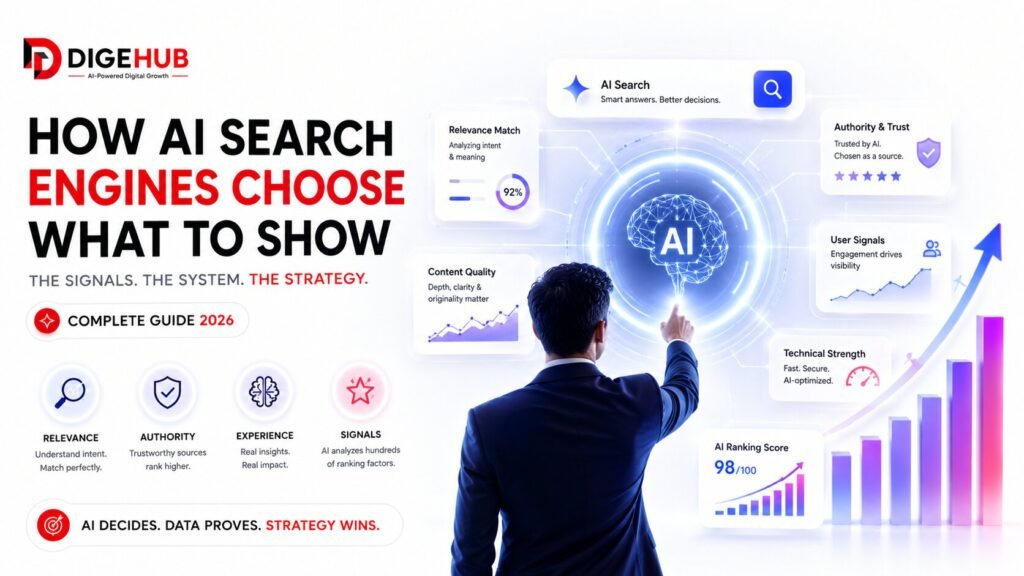
How AI search engines choose content follows a shared underlying logic across platforms, even though the specific implementation differs by system.
The process works in three stages:
- Retrieval: The AI system issues a search query (or multiple queries) and pulls candidate pages from its index, a partner index like Bing or Google, or both
- Reranking: A reranking model evaluates the retrieved candidates for semantic relevance, quality signals, recency, entity authority, and structural extractability
- Synthesis: The AI model reads the top-ranked sources, extracts relevant content, and generates a response with citations embedded
The signals that influence which content is selected at each stage include: semantic relevance to the query, content freshness, structured formatting that makes answers extractable, E-E-A-T signals including author credentials and entity recognition, schema markup, external brand mentions across multiple platforms, and domain-level topical authority.
The key insight most guides miss is that getting retrieved (Stage 1) and getting cited (Stage 3) are two different outcomes with two different sets of optimization requirements. You can be retrieved without being cited. You need to pass both stages to appear in the final answer.
The Core Mechanism: RAG Pipelines Explained Simply
Every major AI search platform, Perplexity, ChatGPT with search, Google AI Overviews, and Google AI Mode, runs on some version of Retrieval-Augmented Generation (RAG). Understanding what RAG actually does makes the rest of the optimization logic clear.
Before RAG, large language models generated answers entirely from their training data, which meant they couldn’t access current information and had no ability to cite specific sources. RAG changed this by adding a retrieval step before generation: the model retrieves relevant documents from a live index or database, then uses those documents as context to generate its response.
The practical consequence is that AI search engines are not just pattern-matching against training data when they answer queries. They’re actively pulling content from the web, evaluating it, and using it as source material. This means content that was never “trained into” the model can still influence AI responses, and content that was trained into the model can be contradicted or supplemented by newer sources.
For brands, this is important for two reasons. First, new content can achieve AI citation within hours or days of publication on platforms like Perplexity, without waiting for any training cycle. Second, existing content that isn’t structured for extraction may be retrieved but not meaningfully used in responses, even if it would be the most authoritative source on a given topic.
The RAG pipeline typically has these stages, though implementation varies by platform:
Query classification: The system determines what type of query it’s dealing with (factual, procedural, comparative, multi-part, conversational) and routes it accordingly. Different query types trigger different retrieval behaviors.
Index retrieval: The system queries its index for candidate pages matching the query semantics. This is where keyword and semantic relevance matter most.
Candidate reranking: A cross-encoder or ML reranker evaluates candidates more precisely for quality, authority, recency, and content structure. This is where E-E-A-T signals, schema markup, and entity clarity have their most decisive impact.
Synthesis and citation: The model generates a response using the top-ranked sources, embedding citations inline. Only a fraction of retrieved pages, typically 3 to 5 out of 10 to 30 candidates, end up cited.
Platform-by-Platform: How Each AI Engine Selects Differently
This is the gap that most optimization guides fail to address. Treating “AI search” as a single channel is one of the most common and most costly strategic errors in 2026. The major platforms have genuinely different selection behaviors, and optimizing for one doesn’t automatically optimize for the others.
Google AI Overviews
Google AI Overviews draw from Google’s organic index, meaning your traditional SEO performance correlates with AI Overview citation probability, but doesn’t determine it. Research shows approximately 38% of AI Overview citations come from pages that don’t rank in the organic top 10. The additional signals Google AI Overviews weight include: schema markup (especially FAQ, Article, and HowTo schema), answer-forward content structure, topical cluster authority (not just individual page performance), and E-E-A-T signals directly inherited from Google’s quality evaluation framework. Informational intent queries are heavily covered (healthcare 88%, education 83%, B2B tech 70%). Transactional queries remain largely in traditional SERP format. Full optimization details in our Google AI Overviews guide.
Perplexity AI
Perplexity issues a live web search for every single query, using its own index of 200+ billion URLs plus Bing and Google APIs. It cites brands at a 13.05% rate, the highest of any major platform, averaging 21.87 citations per response. Its strongest selection signals are recency (70% of top citations from pages under 18 months old), front-loaded answers (90% of cited sources answer within the first 100 words), schema markup (47% vs 28% citation rate with and without schema), and multi-platform presence. Reddit accounts for 46.7% of Perplexity’s top citation sources. 67% of its citations come from outside Google’s first page. Platform-specific strategy in our Perplexity ranking guide.
ChatGPT Search
ChatGPT operates on a hybrid of training data and Bing-powered real-time retrieval. It cites brands at only 0.59%, far more conservative than Perplexity, but serves hundreds of millions of sessions weekly. Its selection behavior skews toward established domain authority: sites with 32,000+ referring domains are 3.5x more likely to be cited. Wikipedia presence matters significantly here, unlike on Perplexity where Wikipedia is essentially absent from the citation pool. ChatGPT rewards long-term content history and established brand entities more than any other platform. Full breakdown in our ChatGPT ranking guide.
Google Gemini and AI Mode
Google AI Mode uses a query fan-out technique, issuing multiple related sub-queries and synthesizing from a diverse source pool. It has surpassed 1 billion monthly users and cites the same URLs as standard AI Overviews only 13.7% of the time, making it a genuinely distinct optimization target. It tends to pull from a broader, more diverse set of sources than standard AI Overviews, rewards fresh content more heavily, and is more likely to surface voices from non-traditional publishers alongside established domains. Our Gemini ranking guide covers the AI Mode-specific signals.
The practical takeaway: only 11% of domains are cited by both ChatGPT and Perplexity. Building a comprehensive AI search presence requires understanding each platform’s distinct selection behavior rather than applying a single generic strategy.
The 8 Selection Signals That Matter Across All Platforms
Despite their differences, the major AI search platforms share a core set of selection signals. Getting these right improves your citation probability across all platforms simultaneously.
1. Semantic Relevance to the Query This is the most basic gate. Your content needs to be about what the query is asking, not just tangentially related. AI systems evaluate semantic relevance using embedding similarity, not just keyword matching. Content that genuinely covers a topic in depth outperforms content that inserts keywords without substantive coverage.
2. Content Freshness Recency weighting varies by platform but applies everywhere. Perplexity weights it most heavily (70% of top citations under 18 months old). Google AI Overviews apply it more selectively. ChatGPT gives the least weight to freshness among the major platforms. Making your publication and update dates visible, and actually keeping content current, is a universal citation signal.
3. Answer-Forward Structure 90% of Perplexity’s top citations answer the core question within the first 100 words. Google AI Overviews pull heavily from early-page content. ChatGPT synthesis extracts from the most direct and clearly stated claims. Content that buries the answer in preamble is structurally disadvantaged across every platform.
4. Schema Markup Schema-enabled pages achieve 47% top-3 citation rates on Perplexity vs 28% without it. FAQ schema, Article schema with author credentials, and HowTo schema all improve AI parsing accuracy and citation probability. JSON-LD is the preferred implementation format across platforms. This is one of the highest-leverage technical investments available.
5. E-E-A-T Signals Experience, Expertise, Authoritativeness, and Trustworthiness signals influence citation probability on all major AI platforms. Author credentials in schema, organizational entity clarity, external brand mentions, and cross-platform presence all contribute. Our deep-dive on E-E-A-T in the AI search era covers the full implementation framework.
6. Entity Clarity AI rerankers evaluate whether a page clearly identifies the entity it’s about, meaning the brand, author, or concept, and whether that entity is verifiable through external sources. Pages that discuss multiple topics without clear entity focus score lower on entity clarity than pages with a well-defined subject.
7. Topical Cluster Authority AI systems evaluate your domain’s topical coverage as a signal of genuine expertise. A brand with 15 well-structured pieces covering a topic cluster earns a “reputation uplift” effect where new content in that cluster starts with higher citation probability than content from brands without cluster depth. This is the core logic behind LLMO optimization and Generative Engine Optimization.
8. Quantified, Sourced Claims AI systems specifically favor verifiable, fact-dense content over vague assertions. A claim with a named source, a specific number, and a date is more citable than the same claim made without attribution. This isn’t just about credibility. It’s about giving the AI system something concrete to extract and attribute.
The Three Layers of AI Content Evaluation
Most brands think about AI search optimization as a single-layer problem. It’s actually three overlapping evaluation layers, and failure at any one of them suppresses citation probability regardless of performance on the others.
Layer 1: Technical Accessibility Can the AI crawler reach and process your content? This layer includes: robots.txt permissions for AI crawlers (PerplexityBot, OAI-SearchBot, Googlebot for AI Overviews), page speed and Time to First Byte (AI crawlers abandon slow pages before content analysis), content in the initial HTML response rather than loaded via JavaScript, Bing indexing status (critical for Perplexity and ChatGPT), and stable URL structures that allow citation authority to accumulate.
Layer 2: Content Extractability Can the AI system cleanly pull specific answers from your content? This layer includes: heading structure that mirrors actual queries, answer-first paragraphs under every heading, short extractable evidence units (claim + sourced data + brief context), structured lists for processes, visible dates on time-sensitive claims, and FAQ sections with schema markup. Research shows 44.2% of AI citations come from the first 30% of page content, so front-loading your most important answers isn’t just good practice, it’s structurally necessary.
Layer 3: Citation Authority Should the AI system trust and cite your content over competing sources? This layer includes: E-E-A-T signals including author schema with credentials, external brand mentions and cross-platform presence, topical cluster authority, domain-level trust signals (HTTPS, transparent organizational information, editorial standards), and the consensus signal (consistent brand presence across your own site, Reddit, YouTube, industry publications, and review platforms).
Most optimization advice focuses on Layer 2 (content quality and structure). Layer 1 and Layer 3 failures are invisible to brands that aren’t specifically looking for them, but they’re responsible for a significant portion of unexplained citation gaps.
Why Great Content Gets Ignored by AI Search Engines
This is the frustration point for most brands that have invested in content quality and still aren’t getting cited. The content is good. The writing is clear. The topic is relevant. And AI search still isn’t surfacing it. Here’s what’s actually happening.
The AI crawler can’t reach it. Overly restrictive robots.txt rules, slow page speed, JavaScript-rendered content, or Bing indexing gaps can all make technically excellent content completely invisible to AI retrieval.
It answers the wrong question structure. AI systems retrieve content matching query semantics. If your content is about a topic but not answering the specific question being asked, it fails the semantic relevance gate regardless of quality.
The answer is buried. If your best answer appears in paragraph 12 after 800 words of context-setting, AI systems that weight early-page content heavily will miss it or underweight it even if they retrieve the page.
There’s no schema. The 19-percentage-point difference in citation rates between schema and non-schema pages is one of the clearest signals in the research. Without schema, AI systems have to infer structure from prose, which they do less reliably.
There’s no author entity. Anonymous content or content with vague author attribution fails the entity clarity test in AI rerankers. A well-written piece with no clear authoring entity is treated with lower confidence than an adequately written piece from a clearly identified, credentialed author.
Nobody else is saying the same thing. AI systems gain citation confidence from cross-source consensus. If your brand is the only source making a particular claim, even a correct one, it may be cited less reliably than a claim validated by multiple independent sources.
The domain has diluted topical coverage. A website covering 40 different topics without depth in any of them lacks the cluster-level authority signal that AI systems use to evaluate whether a domain is genuinely expert in a space.
How Query Type Shapes What AI Search Engines Pull
Not all queries trigger the same selection behavior. Understanding query type is essential for matching your content to the right retrieval pattern.
Informational queries (what is X, how does X work, why does X happen) are where AI search engines are most active and where citation opportunity is highest. 99.2% of AI Overview-triggering queries have informational intent. These queries favor comprehensive, well-structured content with clear definitions and direct answers. This is where Answer Engine Optimization has the most direct application.
Comparative queries (X vs Y, best X for Y, how does X compare to Z) favor content with clear structured comparisons, often in table format. AI systems extract comparison data more reliably from structured tables than from prose comparisons.
Procedural queries (how to do X, steps to accomplish Y) favor numbered step formats with clear action items. Content that describes a process in paragraph form is structurally disadvantaged against content that uses numbered steps for the same information.
Commercial research queries (best X, X reviews, top X tools) trigger a mixed response. Transactional queries remain largely in traditional SERP format, but research-phase queries with commercial intent do trigger AI responses. These favor content from review platforms, established comparison sites, and brands with strong third-party validation signals.
Multi-part queries are handled through query fan-out (especially by Google AI Mode), where the system issues multiple sub-queries and synthesizes across sources. Brands with topical cluster depth are advantaged here because different pages from the same authoritative domain can be cited for different sub-queries within a single response.
Time-sensitive queries trigger recency weighting more heavily. AI systems actively prioritize the most recently updated, most specifically dated content for queries about current events, recent changes, or evolving situations.
The Consensus Signal: Why Your Website Alone Is Not Enough
One of the most operationally important concepts in AI search optimization is what researchers describe as the “consensus signal.” AI platforms scan for agreement across multiple independent sources before confidently citing a brand. This is particularly true for claims that could be contested or for brands that don’t have established entity recognition.
The practical consequence: a brand that exists only on its own website is asking AI systems to trust a single, self-reported source. AI systems are specifically designed to be skeptical of unverified single-source claims. The way to build citation confidence is to be consistently recognized across multiple independent platforms.
This is why Reddit’s 46.7% share of Perplexity’s citation pool is strategically significant beyond just “Reddit SEO.” When a brand’s expertise is consistently reflected in Reddit discussions, YouTube content, industry publication articles, and third-party review profiles, all independently attributing similar positioning, AI systems gain confidence that the brand is genuinely recognized in its space.
Building this multi-platform presence is exactly what AI Search Visibility strategy addresses as a systematic discipline, not just a content quality exercise.
The platforms that contribute most meaningfully to the consensus signal vary by industry, but consistently include Reddit (for research-heavy, technically sophisticated audiences), YouTube (for procedural and educational topics), LinkedIn (for B2B and professional services), G2/Clutch/Capterra (for software and agency selection queries), and industry-specific publications and forums where genuine expert discourse happens.
How AI Search Engines Handle Conflicting Sources
When AI search engines encounter conflicting information across sources, they apply a tiered resolution process that has practical implications for how you position your content.
Cross-source triangulation. AI systems generally prefer claims that are consistent across multiple independent sources over claims that appear in only one place. For well-established facts, this means that content aligning with the mainstream consensus gets cited more reliably than content with heterodox claims, even if the heterodox claims are better documented.
Recency weighting for contested information. On topics where information changes (regulatory requirements, software features, market data, statistics), AI systems give significant weight to the most recently dated source. Being the most current source on a time-sensitive claim is a citation advantage.
Authority weighting when sources conflict. When two sources make conflicting claims, established domain authority often tips the balance. For newer or smaller brands, this means the quality and specificity of your sourcing (naming the study, giving the year, linking to the primary source) becomes a compensating trust signal.
Multiple perspectives for genuinely contested topics. On topics without a clear factual consensus, AI systems typically present multiple viewpoints and cite diverse sources. Brands that acknowledge complexity and present balanced analysis of contested areas are more likely to be cited in these multi-perspective responses than brands that present only one side.
Conflict avoidance through niche specificity. Content that occupies a clearly defined, non-contested niche (your specific methodology, your documented client outcomes, your original research) doesn’t compete in the same citation pool as general topic content. Original data and proprietary frameworks sidestep the conflict resolution problem entirely because there are no competing claims to weigh against yours.
What This Means for Your Content Strategy in 2026
Pulling the above together into actionable strategy, here’s how understanding AI search engine selection behavior should shape your content approach.
Audit your retrieval eligibility before optimizing content. Confirm PerplexityBot, OAI-SearchBot, and Googlebot are allowed in your robots.txt. Verify Bing indexing status. Test page speed and ensure key content is in the initial HTML response. These are binary gates, and all the content optimization in the world doesn’t matter if you can’t clear them.
Structure every piece for extraction, not just for reading. Lead with the answer. Use heading structures that mirror query phrasings. Keep answer paragraphs short and self-contained. Add FAQ sections to every major content piece. Implement schema markup.
Build topical clusters instead of isolated pages. A standalone post on any topic, however well-written, earns lower cluster authority than the same post supported by a network of related pieces that collectively signal genuine domain expertise.
Invest in author entity infrastructure. Named authors, detailed credential bios, Person schema with linked external profiles, and consistent publishing history under named bylines are foundational. Anonymous content increasingly loses the entity clarity contest.
Build multi-platform presence deliberately. Authentic Reddit participation, YouTube content, industry publication contributions, and review platform maintenance are citation infrastructure, not brand marketing. The consensus signal requires independent sources. Plan for this specifically rather than treating it as a byproduct of other activities.
Measure AI citation performance separately from traditional analytics. Standard GA4 and Search Console reporting doesn’t capture AI citation visibility. Run your core queries weekly in Perplexity, ChatGPT, and Google AI Mode. Note whether you appear, where you appear, and what competitors are being cited instead of you.
This is also the operating philosophy behind DigeHub’s SEO squared framework: running traditional SEO and AI visibility optimization as parallel, integrated tracks with distinct metrics rather than treating them as one unified channel.
If you want support building content architecture that performs across both traditional search and AI citation surfaces, our AI Visibility Services, SEO Services, and Content Marketing Services cover the full stack.
Common Mistakes Brands Make When Optimizing for AI Search
Treating all AI platforms as one channel. Only 11% of domains are cited by both ChatGPT and Perplexity. Platform-specific optimization is not optional.
Focusing only on content quality. Technical accessibility (robots.txt, page speed, HTML structure) and citation authority (entity signals, multi-platform presence) matter as much as content quality. A poorly structured technically excellent piece gets retrieved but not cited.
Publishing without schema. The 19-percentage-point citation rate gap between schema and non-schema pages is one of the clearest optimization levers available. Not implementing it is leaving citations on the table.
No named authors. Anonymous content fails the entity clarity evaluation in AI rerankers across all major platforms.
Relying only on Google Search Console for performance measurement. GSC doesn’t capture AI citation visibility. You can be invisible in AI search while your GSC data looks healthy.
Optimizing for click traffic from informational queries. 60% of searches now end without a click. For informational content, the goal is citation presence, not click generation. Brands measuring the ROI of informational content purely through click traffic are systematically undervaluing their AI citation visibility.
Ignoring Bing Webmaster Tools. Perplexity and ChatGPT both draw from Bing’s index. Being well-indexed on Google doesn’t guarantee Bing visibility, and Bing visibility is a direct Perplexity and ChatGPT retrieval input.
Expert Insights: Patterns We See Across AI Platforms
Working across AI visibility campaigns, a few consistent patterns show up that aren’t well-captured in generic optimization guides.
The biggest gap between brands that get cited consistently and those that don’t is usually not content quality. It’s entity clarity combined with multi-platform presence. Brands that are clearly identifiable as authoritative entities on a specific topic, with consistent recognition across multiple independent platforms, get cited at dramatically higher rates than brands producing higher-quality content with weaker entity signals.
The freshness signal is underestimated by most brands. The operational implication isn’t just “update content occasionally.” It’s building a content refresh calendar as a core editorial process, with quarterly reviews of high-value informational content, updated statistics, and revised claims wherever the underlying data has changed. Brands that treat content as a one-time investment are systematically losing citation share to brands that treat it as an ongoing asset.
Original data is still the most durable citation advantage available. If you produce proprietary research, that information exists nowhere else in the AI’s retrieval pool. It can’t be outcompeted by a better-written synthesis because the synthesis doesn’t have access to your data. The brands building research-backed content programs now are creating citation moats that compound over time.
Finally, the multi-platform consensus signal is chronically underinvested. Most brands allocate zero budget to Reddit participation and minimal resources to YouTube content, despite these being the first and second most-cited source categories in Perplexity’s citation pool. The ROI math on authentic multi-platform presence, measured in citation authority rather than direct traffic, is significantly better than most brands realize.
Future Trends: Where AI Content Selection Is Heading
Agentic AI will expand the citation surface. When AI agents perform multi-step research on behalf of users and make purchasing or vendor recommendations, the content selection logic becomes more consequential, not less. The citation architecture that earns trust from AI search engines today is the same architecture that earns trust from AI agents tomorrow.
Multimodal content will enter the citation pool. Video transcripts, podcast content, and image-embedded text are increasingly being indexed and cited by AI systems. Brands with strong written content but no video or audio presence will have a narrowing advantage as multimodal retrieval matures.
Platform personalization will fragment the citation landscape further. As AI platforms incorporate user preference signals and conversational history into retrieval decisions, the “right answer” for different users querying the same thing will diverge. Brands with broad multi-platform presence are better positioned for this fragmentation than brands with narrow single-channel coverage.
Real-time fact verification will become standard. AI systems are increasingly building real-time fact-checking into their retrieval pipelines. Content with verifiable, sourced claims will have an increasing advantage over content making unsupported assertions, as verification layers filter out low-confidence sources more aggressively.
Share of Model will become a standard strategic KPI. How often does your brand appear in AI-generated responses for queries relevant to your business? This metric is not yet standard in most marketing reporting but will be within 12 to 18 months, as AI search volume continues to grow and the correlation between AI citation and downstream commercial outcomes becomes more measurable.
Understanding how AI search engines choose content, and building your content and entity infrastructure accordingly, is the most durable strategic investment available in 2026. The brands that get this right now are building citation authority that compounds, while competitors are still measuring success purely in traditional organic traffic terms.
We work with businesses across the USA, UK, Canada, and Australia to build AI search visibility across all major platforms. Our AI Visibility Services cover the full stack from technical retrieval eligibility to multi-platform citation authority. And if you want to test your current content’s AI extractability right now, our Free SEO Blog Writing Tool gives you an immediate read.
FAQ: How AI Search Engines Choose Content
1. How do AI search engines choose content to cite? AI search engines choose content through a three-stage process: retrieval (pulling candidate pages from an index), reranking (evaluating candidates for quality, relevance, freshness, and authority), and synthesis (generating a response using the top-ranked sources with inline citations). Only 3 to 5 out of 10 to 30 retrieved pages typically end up cited in the final response.
2. Do AI search engines use the same signals as Google? They share foundational signals including topical relevance, E-E-A-T, and content quality, but weight them differently and add platform-specific signals. Perplexity weights freshness and multi-platform presence heavily. ChatGPT weights established domain authority and brand entity recognition. Google AI Overviews are most closely tied to traditional Google ranking signals.
3. Does ranking on Google guarantee I’ll appear in AI search results? No. Research shows 67% of Perplexity citations come from pages outside Google’s first page. Only 38% of Google AI Overview citations come from top-10 organic results on the same query. Traditional Google rankings correlate with but don’t determine AI citation probability.
4. How important is schema markup for AI search engine selection? Very important. Schema-enabled pages achieve 47% top-3 citation rates on Perplexity compared to 28% for pages without schema, a 19-percentage-point difference. Article schema with author credentials, FAQ schema, and HowTo schema are the highest-impact types across all platforms.
5. Can small brands get cited by AI search engines? Yes. Research found 92.78% of Perplexity’s cited pages had fewer than 10 referring domains. Topical cluster authority, content freshness, schema markup, and extractable structure matter more than raw domain size on AI platforms.
6. How does content freshness affect AI search engine selection? Significantly on most platforms. 70% of Perplexity’s top citations come from pages updated within the last 12 to 18 months. Google AI Overviews apply recency weighting selectively. ChatGPT gives the least weight to freshness but still incorporates it for time-sensitive queries. Quarterly content updates are the minimum maintenance standard for maintaining citation eligibility.
7. Why would high-quality content get ignored by AI search engines? Common reasons include: AI crawlers blocked by robots.txt, content not indexed on Bing (critical for Perplexity and ChatGPT), answers buried in the second half of long articles, missing schema markup, anonymous authorship with no entity signals, and no multi-platform presence creating the consensus signal AI systems need for citation confidence.
8. What is the consensus signal and why does it matter? The consensus signal is the cross-platform consistency of brand recognition. AI systems check whether your brand’s expertise is validated by multiple independent sources (Reddit, YouTube, industry publications, review platforms) before confidently citing you. Brands that exist only on their own website lack this independent validation and are cited less reliably, regardless of content quality.
9. How do I measure my AI search engine citation performance? Standard analytics tools don’t capture AI citation visibility. The measurement approach includes: manually running target queries in Perplexity, ChatGPT, and Google AI Mode weekly; tracking Share of Model (how often your brand appears); monitoring citation position; and using specialized tools like Profound or BrightEdge for automated tracking.
10. How is optimizing for AI search different from traditional SEO? Traditional SEO optimizes for ranked link positions and click-through traffic. AI search optimization targets citation inclusion in synthesized responses where clicks may not occur at all. The content structure, entity signals, multi-platform presence requirements, and measurement framework are all meaningfully different, which is why they need to be treated as parallel disciplines rather than one unified strategy.
DigeHub is a global digital marketing agency helping businesses across the USA, UK, Canada, and Australia build AI search visibility and organic authority through integrated SEO and content strategy.