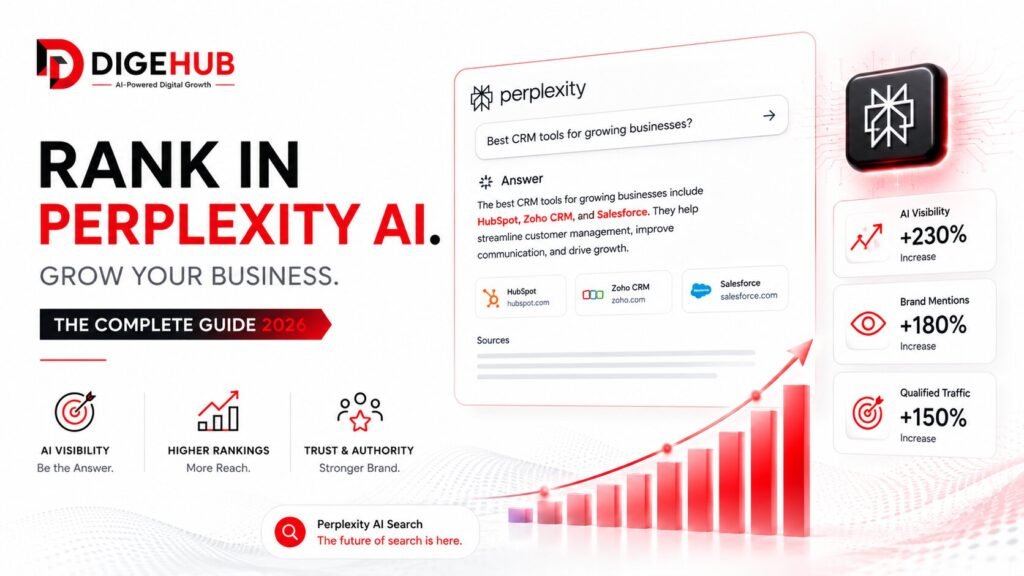
How to Rank in Perplexity AI: A Business Guide for 2026
Why Perplexity AI Matters for Your Business in 2026
How to rank in Perplexity AI is a question more businesses should be asking right now. Most are still fixated on Google rankings while Perplexity quietly became one of the most commercially significant AI search platforms on the internet.
Here are the numbers that put this in perspective. Perplexity now processes over 30 million searches per day, attracts more than 170 million monthly visits, and has surpassed 230 million monthly active users as of Q1 2026. Its user base skews heavily toward developers, researchers, analysts, founders, and senior marketers, which is precisely the audience that influences B2B buying decisions and evaluates software, agencies, and services.
What makes Perplexity different from the other AI search platforms isn’t just the scale. It’s the citation behavior. A 2026 study analyzing AI responses across platforms found that Perplexity cites brands at a 13.05% rate, compared to ChatGPT’s 0.59%. Perplexity also averages 21.87 citations per response, the highest of any major AI platform. That means more citation slots, more visibility opportunities, and more surface area for your brand to show up.
If your buyers are using AI tools to research solutions, Perplexity is where a significant portion of that research is happening. And if you’re not being cited there, your competitors are filling that space by default.
Quick Answer: How Do You Rank in Perplexity AI?
Ranking in Perplexity AI means passing two distinct gates: retrieval selection (getting your page pulled as a candidate source) and answer absorption (having your content actually shape the generated response). Most optimization guides only address one of these. You need both.
The core signals Perplexity weights most heavily are:
- Content freshness, with 70% of top citations coming from pages updated within the last 12 to 18 months
- Front-loaded answers, with 90% of top-cited sources answering the core question within the first 100 words
- Schema markup, where schema-enabled pages achieve 47% top-3 citation rates vs. 28% without it
- Multi-platform presence, particularly authentic Reddit engagement and YouTube content
- Entity clarity, meaning Perplexity’s reranker can clearly identify what your page is about and who wrote it
- Topical consistency across your domain, because Perplexity applies reputation uplift to brands that consistently appear across related queries
- Quantified, sourced claims rather than opinion-heavy or vague assertions
If this is your first time looking into AI search optimization, it helps to start with the fundamentals. We’ve covered the broader framework in What Is AI Search Visibility? and What Is Generative Engine Optimization?, both of which explain the concepts that Perplexity-specific optimization builds on.
- Why Perplexity AI Matters for Your Business in 2026
- Quick Answer: How Do You Rank in Perplexity AI?
- How Perplexity Actually Works: The RAG Pipeline Explained
- The Two-Gate Problem Most Brands Get Wrong
- The 9 Citation Signals That Actually Drive Perplexity Rankings
- Content Structure Perplexity Rewards
- Reddit, YouTube, and the Multi-Platform Strategy
- Technical Optimization for Perplexity Crawlers
- How Perplexity Differs From Google AI Overviews and ChatGPT
- Industry-Specific Perplexity Strategy
- Measuring Your Perplexity Visibility
- Common Mistakes That Kill Perplexity Citation Chances
- Expert Insights: What Actually Moves the Needle
- Future Trends: Where Perplexity Is Heading
- FAQ: How to Rank in Perplexity AI
How Perplexity Actually Works: The RAG Pipeline Explained
Before we get into tactics, understanding the mechanism matters. Perplexity runs on a Retrieval-Augmented Generation (RAG) pipeline with six discrete stages. Each stage filters candidate sources further, which means your content has to clear multiple bars before it earns a citation.
Stage 1: Query Intent Parsing. Perplexity classifies the query type (factual, procedural, comparative, multi-part) and routes it to the appropriate retrieval index. Time-sensitive queries get routed differently than evergreen informational ones.
Stage 2: Real-Time Web Retrieval. Unlike ChatGPT, which draws partly from training data, Perplexity runs a live web search for every single query. It searches its own proprietary index of over 200 billion URLs, combined with external search APIs including Google and Bing. New content can be cited within hours of being indexed.
Stage 3: Initial Candidate Filtering (BM25 + Embeddings). Perplexity casts a wide net, retrieving roughly 10 to 30 candidate pages using a hybrid of traditional keyword matching (BM25) and semantic embedding similarity. If your page doesn’t appear here, nothing downstream matters.
Stage 4: Cross-Encoder Reranking. A cross-encoder model evaluates the semantic quality and contextual fit of each candidate page more precisely. Surface-level keyword matches without genuine topical depth get filtered out at this stage.
Stage 5: ML Reranker With Entity and Authority Signals. The final ranking layer incorporates entity-level signals, domain authority scores, recency weighting, and source diversity. This is where topical authority and brand credibility have the most decisive impact.
Stage 6: LLM Synthesis. Gemini or Perplexity’s own model synthesizes the answer from the top-ranked sources, embedding citations inline. Only 3 to 4 out of every 10 candidate pages retrieved actually get cited in the final response.
That last number is important. Even if your page makes it into the candidate pool, there’s still a selection process. The gap between retrieval and citation is where most content strategies fall apart.
The Two-Gate Problem Most Brands Get Wrong
Here’s the insight most Perplexity optimization guides miss completely. Citation in Perplexity isn’t one problem. It’s two separate problems with two different solutions.
Gate 1: Retrieval Selection. Your page must be selected when Perplexity retrieves candidates for a query. This is about crawlability, indexing, freshness, and semantic relevance to the query. If you can’t pass Gate 1, nothing else matters.
Gate 2: Answer Absorption. Your content must actually influence the generated response. A page can be listed as a source without any of its content shaping the answer. A page can also influence a response even when it isn’t prominently listed. These are genuinely different outcomes and they require different optimization approaches.
Selection is about retrieval eligibility. Absorption is about evidence quality and extractability.
The practical consequence is that you might be doing everything right for Gate 1 (good SEO, indexed, crawlable) and still failing at Gate 2 because your claims are buried, ambiguous, or structurally hard for the model to attribute. And you might pass Gate 2 (your writing is clear and extractable) while failing Gate 1 because your page is slow, poorly indexed, or lacks freshness signals.
Most brands optimize for one gate and wonder why they’re not appearing in Perplexity.
The 9 Citation Signals That Actually Drive Perplexity Rankings
Based on published research from SourceBench, LLMClicks, Ahrefs, and authoritative practitioner studies analyzing hundreds of thousands of Perplexity citations, here are the signals that consistently predict citation success.
1. Freshness Above Almost Everything Else
Perplexity has a stronger recency bias than any other major AI platform. Research from LLMClicks found that 70% of Perplexity’s top citations had a visible publication or update date within the last 12 to 18 months. In fast-moving sectors, newer pages from smaller, less-authoritative blogs regularly displace older content from legacy publishers because recency outweighs authority when both are competing.
Practical implication: update your strategic content quarterly at minimum. Refresh statistics, update examples, and make the modification date visible in your content. Visible year signals, including “2026” in titles and H2 headings, improve citation rates by approximately 30%.
2. Bottom Line Up Front (BLUF) Structure
90% of Perplexity’s top-cited sources answer the core question within the first 100 words. Perplexity’s synthesis stage pulls from the first substantive claim it can attribute. Long introductions, throat-clearing preambles, and buried answers all reduce citation probability because the model deprioritizes pages where the direct answer isn’t immediately extractable.
Every piece of content you’re optimizing for Perplexity should open with the answer, not build toward it.
3. Schema Markup, Especially JSON-LD
Schema-enabled pages achieve 47% top-3 citation rates on Perplexity compared to 28% for pages without schema, a 19-percentage-point advantage. Pages with Person schema that includes author credentials achieve 2.3x higher citation rates than those without. FAQ schema, Article schema, and HowTo schema all contribute to Perplexity’s ability to parse and attribute your content accurately.
This is one of the most underutilized signals in the research, and one of the highest-leverage technical investments you can make.
4. Quantified, Sourced Claims
Perplexity’s algorithm specifically favors verifiable, fact-dense content over opinion or vague assertions. “The market grew 23% in Q3 2025, per Gartner” is more citable than “the market has been growing rapidly.” Include specific statistics, name your sources explicitly, and use dates near time-sensitive claims. This passes the factual verification layer in Perplexity’s reranking pipeline.
5. Entity Clarity
Perplexity’s ML reranker specifically evaluates whether a page clearly identifies the entity it’s about. Pages that bury the subject under brand adjectives, talk around the topic, or discuss multiple entities without clear structure fail this gate. Use the precise entity name (your brand, your product, the concept you’re defining) in the first paragraph, in at least one H2, and in your schema markup.
This is also where LLMO becomes relevant as its own discipline. If you want a deeper breakdown of how Large Language Model Optimization works alongside entity-level signals like this, see What Is LLMO Optimization?
6. Topical Consistency Across Your Domain
Perplexity applies what researchers describe as “reputation uplift,” where brands that consistently appear across related queries in a topic cluster receive a ranking boost on new queries in that cluster. HubSpot ranking well for “best digital marketing certifications” is partly driven by its consistent performance across dozens of adjacent marketing prompts.
This is why isolated pages underperform. Building a content cluster around your core topics, rather than producing disconnected individual pieces, has compounding returns on Perplexity that don’t exist in the same way on traditional search.
7. Cross-Platform Presence and the Consensus Signal
Research from Profound and Semrush shows that AI platforms scan for agreement across multiple independent sources before confidently citing a brand. If your brand appears consistently across Reddit, YouTube, industry publications, review platforms like G2 and Clutch, and your own website, all with consistent positioning, Perplexity’s systems gain confidence in citing you.
If you only exist on your own website, you lack the independent validation signals that give AI systems confidence. This “consensus signal” is one of the most operationally important insights in Perplexity optimization.
8. Crawlability and Technical Accessibility
Nothing else matters if Perplexity can’t reach your page. Verify your robots.txt isn’t blocking AI crawlers, confirm your key pages are indexed (not just by Google, but accessible via Bing which Perplexity also uses), ensure content isn’t buried in JavaScript that requires rendering, and keep page speed fast. AI crawlers have time constraints and slow pages get abandoned before content is analyzed.
9. Content That Cites Other Authoritative Sources
Perplexity research describes the pages that consistently perform as building “a web of mutual verification.” Pages that cite other authoritative external sources, rather than making unsupported claims or only linking internally, perform better in Perplexity’s quality evaluation. This signals to the system that your content operates within the verified knowledge ecosystem rather than existing in isolation.
Content Structure Perplexity Rewards
Beyond the signals above, the formatting of your content is a distinct factor in absorption quality. Here’s what the data consistently shows:
Heading structure that mirrors actual queries. H2 and H3 headings organized around specific questions that users would ask outperform headings that are creative or descriptive but don’t reflect search queries. “How does Perplexity select citations?” as an H2 is more citable than “The Selection Process.”
Answer-first paragraphs under every heading. State the direct answer in the first sentence under each heading, then support it. Don’t save the conclusion for the end of a section.
Short, extractable evidence units. The most citable content format is: claim (one sentence) + supporting evidence (one to two sentences with a source) + context (one to two sentences). Long paragraphs that weave multiple claims together are harder for Perplexity to extract and attribute cleanly.
Numbered and bulleted lists for processes and comparisons. Structured lists are disproportionately extractable. Step-based content and comparative lists outperform equivalent prose in Perplexity citation rates.
Visible dates on time-sensitive claims. Put dates next to statistics. “According to BrightEdge’s February 2026 analysis” is more citable than the same stat without attribution. The model favors dateable claims because it can verify recency.
Content length and front-loading. Research from Superlines found that 44.2% of AI citations come from the first 30% of content. This doesn’t mean keep content short. It means your highest-value answers should appear in the first third of the page.
This entire approach, answering the question directly and structuring content so it can be lifted cleanly, is the core idea behind Answer Engine Optimization. We’ve covered that discipline in full in What Is Answer Engine Optimization?, which pairs well with the Perplexity-specific signals above.
Reddit, YouTube, and the Multi-Platform Strategy
This is the section most optimization guides gloss over, and it’s one of the highest-leverage strategies available for Perplexity visibility.
Reddit accounts for 46.7% of Perplexity’s top 10 citation sources. YouTube comes in second at around 13.9%. Together, these two platforms represent a citation opportunity that rivals or exceeds anything you can do on your own website.
Perplexity maintains manually curated authority domain lists that give algorithmic boosts to recognized platforms including Reddit, LinkedIn, YouTube, and GitHub. When content from these platforms matches a query, it gets a structural citation advantage over comparable content on less-established domains.
Reddit strategy for Perplexity. Authentic participation in the communities where your buyers ask questions is the approach that works. Perplexity is currently facing litigation over Reddit content use, which signals just how much it values this source. Overtly promotional content gets downvoted and becomes a negative signal. Genuine contributions that naturally reference your expertise, your own research, or your published content perform significantly better. Identify the subreddits where your target queries appear (r/SEO, r/marketing, r/SaaS, r/startups depending on your vertical) and build a presence through consistent, helpful participation.
YouTube strategy for Perplexity. Tutorial content, explainer videos, and thought leadership content on YouTube creates citation surface area that operates independently from your website. Even basic video content, well-titled and described with clear keyword relevance, builds the multi-platform presence that Perplexity’s consensus signal rewards.
LinkedIn, industry forums, and review platforms. Consistent brand mentions across LinkedIn, specialized forums, and third-party review platforms (G2, Clutch, Capterra) all contribute to the consensus signal. For commercial-intent queries, Perplexity gives additional weight to trust signals from these review platforms, so maintaining strong profiles with genuine reviews matters more than most brands realize.
If your business wants to build a systematic multi-platform presence that compounds into AI citation authority, our Content Marketing Services and AI Visibility Services are built to do exactly this.
Technical Optimization for Perplexity Crawlers
A few technical factors directly affect your Gate 1 retrieval eligibility:
Allow PerplexityBot in robots.txt. Perplexity uses its own crawler. If you have overly restrictive robots.txt rules that inadvertently block AI crawlers, you’re invisible to Perplexity’s retrieval layer. Check your robots.txt explicitly for PerplexityBot.
Ensure indexing via Bing Webmaster Tools. Perplexity uses Bing’s index as one of its retrieval sources. Many SEOs focus entirely on Google Search Console while ignoring Bing Webmaster Tools. Submitting your sitemap to Bing and monitoring indexing status there is a genuine Perplexity optimization move.
JavaScript rendering. Perplexity’s crawlers have time constraints. Content rendered via JavaScript after page load may not be processed. Key content, especially your opening answer paragraphs, should be in the initial HTML response.
Page speed. Slow pages get abandoned before content analysis. Aim for a Time to First Byte under 600ms for content pages targeting Perplexity citations.
Stable URLs. Perplexity builds source authority signals around specific URLs. Changing URL structures, 301-redirecting content frequently, or consolidating URLs disrupts the authority accumulation your pages build over time.
Clean, accurate canonical tags. Duplicate content across multiple URLs confuses retrieval systems. Perplexity cites specific pages, not domains, so canonical clarity matters.
How Perplexity Differs From Google AI Overviews and ChatGPT
Treating AI search as a single optimization target is one of the most common mistakes in this space right now.
Analysis of citation patterns finds that only 11% of domains are cited by both ChatGPT and Perplexity. Google AI Overviews and AI Mode cite the same URLs only 13.7% of the time. A brand ranking well in Google AI Overviews can be completely invisible on Perplexity, and vice versa. The platforms are genuinely different systems.
Here’s how they differ in ways that matter for strategy:
Perplexity vs. ChatGPT. ChatGPT operates on a hybrid of training data and selective Bing-powered retrieval, activated primarily for commercial-intent queries. Perplexity runs a live web search for every query without exception. ChatGPT cites brands 0.59% of the time. Perplexity cites at 13.05%. ChatGPT averages fewer citations per response. Perplexity averages 21.87. Freshness matters more on Perplexity. Wikipedia, which ChatGPT favors heavily, is notably not cited by Perplexity at all. If you’re building an AI visibility strategy that includes ChatGPT, we’ve covered that platform’s distinct ranking behavior in How to Rank in ChatGPT.
Perplexity vs. Google AI Overviews. Google AI Overviews draw primarily from organic results, with historical data showing a strong correlation with top-10 organic rankings. Perplexity shows only about 1 in 3 citations coming from Google’s top 10. 67% of Perplexity citations come from pages that don’t rank on Google’s first page at all. This is the most underappreciated distinction in AI search optimization: you can rank in Perplexity without ranking on Google, and you can rank on Google without appearing in Perplexity.
What this means for strategy. You cannot optimize for “AI search” as a single category. Each platform has distinct retrieval mechanics, source biases, and content preferences. A comprehensive AI visibility strategy tracks and optimizes for each surface separately.
Industry-Specific Perplexity Strategy
Perplexity’s user base shapes which industries have the most to gain from citation optimization.
B2B SaaS and technology. This is where Perplexity citation has the most immediate commercial impact. Perplexity’s audience of developers, founders, and analysts uses it actively for software research and vendor evaluation. Being cited when someone asks “what’s the best [category] tool for [use case]” is a direct revenue signal. Optimize comparison content, use-case guides, and integration documentation for Perplexity extraction.
Agencies and professional services. When buyers research agencies and consultancies via AI, Perplexity is increasingly the tool they use. Building citations on queries like “best SEO agencies for SaaS” or “how to choose a digital marketing agency” positions your brand in the evaluation conversation before it even reaches your website.
Healthcare and legal. These verticals trigger heavy Perplexity usage for research. YMYL content on Perplexity requires especially strong E-E-A-T signals, with author credentials and institutional affiliations being critical for surviving the quality reranking layers.
E-commerce and retail. Perplexity’s research-heavy audience uses it for product comparisons and category education more than transactional buying. Optimize for “best [product category] for [use case]” and informational buying-guide content rather than product pages.
Measuring Your Perplexity Visibility
Traditional SEO metrics don’t capture Perplexity performance. Rankings, impressions, and organic clicks don’t tell you whether you’re being cited in AI responses.
The measurement framework for Perplexity visibility includes:
Share of Model. How often does your brand appear when Perplexity discusses your category? Test this manually by running your core queries directly in Perplexity and noting whether you appear.
Citation Rate. What percentage of relevant Perplexity responses cite your content? This requires tracking specific queries over time.
Citation Position. Perplexity cites sources with numbered citations inline. Being citation [1] or [2] carries more weight than being citation [8].
Sentiment Analysis. When Perplexity mentions your brand, how is it characterized? Positive, neutral, or qualified recommendations all have different conversion implications.
Competitive Share. Who else appears in the citation set for your core queries? This tells you who you’re actually competing against in AI search, which may be different from your traditional search competitors.
Tools like Profound, BrightEdge, and emerging GEO monitoring platforms can automate this tracking. If you’re managing this manually, run your 20 most important queries in Perplexity weekly, note whether you appear, where you appear, and what your competitors are doing differently.
Common Mistakes That Kill Perplexity Citation Chances
Optimizing for Google and assuming it transfers. Perplexity and Google share some signals but the correlation is weak. 67% of Perplexity citations come from outside Google’s first page. Identical content strategies produce very different results on each platform.
Burying the answer. Long-form content that builds to a conclusion is the exact opposite of what Perplexity’s synthesis layer extracts. Lead with the answer. Every time.
Publishing and never updating. Freshness decay on Perplexity is real. Content more than 18 months old without updates loses citation eligibility on time-sensitive queries regardless of domain authority. Build a content refresh calendar.
Ignoring robots.txt for AI crawlers. Blocking PerplexityBot, even unintentionally through broad crawler restrictions, makes you invisible to retrieval regardless of content quality.
Skipping schema markup. The 19-percentage-point citation rate difference between schema-enabled and non-schema pages is one of the clearest ROI signals in the data. Not implementing JSON-LD schema on your strategic content is leaving citations on the table.
Only owning your website. Brands that exist only on their own properties lack the multi-source consensus signal that gives Perplexity confidence to cite them. Without Reddit presence, YouTube content, industry media mentions, or review platform profiles, you’re asking Perplexity to trust a single unverified source.
Treating all AI platforms the same. Running your Perplexity strategy through a Google SEO lens, or assuming ChatGPT and Perplexity want the same things, leads to optimization that works partially but misses the specific signals that Perplexity’s unique retrieval architecture rewards.
Expert Insights: What Actually Moves the Needle
From working across AI visibility campaigns and following the practitioner research closely, a few things stand out that most guides don’t articulate clearly enough.
The brands winning consistently on Perplexity aren’t just producing better content. They’re building what researchers describe as source architectures, which means a network of content across multiple platforms, all consistently attributing expertise to the same brand entity, all cross-referencing each other in ways that create mutual verification signals.
The transition from individual page optimization to source architecture thinking is the strategic shift that separates brands getting consistent Perplexity citations from those that show up occasionally but can’t maintain it.
Original data is still one of the highest-leverage investments available. If you publish a proprietary study or survey, that becomes a citation anchor that competitors cannot replicate by writing similar content. Perplexity specifically rewards “content that cites other authoritative sources” and content that contains evidence no other page has. Original research is the most defensible version of both.
Finally, the Reddit engagement point is underestimated in almost every optimization guide. 46.7% of Perplexity’s top citations point to Reddit. If your brand has no authentic Reddit presence, you are ceding nearly half of Perplexity’s citation pool to platform-native content that you have no influence over.
Future Trends: Where Perplexity Is Heading
Perplexity Comet and agentic browsing. Perplexity’s expansion into AI-assisted browsing through its Comet browser integration means that your brand’s discoverability is expanding beyond search queries into agentic research sessions. As AI agents perform multi-step research on behalf of users, the citation architecture you build now will influence what agents find and recommend.
Enterprise push and B2B integration. Perplexity’s enterprise product is growing, which means its citation reach is expanding into corporate research workflows. Brands that establish citation authority now will benefit from compounding reputation uplift as enterprise usage scales.
Deeper integration with review platforms. Commercial-intent queries on Perplexity already give additional weight to G2, Clutch, and Capterra. Expect this to deepen as Perplexity continues optimizing for buyer-intent queries where third-party validation matters most.
Real-time content indexing becoming a competitive lever. Perplexity’s ability to index and cite content within hours of publication means that brands with active, frequently updated content ecosystems will have a structural citation advantage over static site owners. Publishing velocity, not just publishing quality, will become a measurable performance variable.
Cross-platform citation correlation. Early research suggests that brands getting consistently cited across Perplexity, ChatGPT, and Google AI Overviews build compounding authority faster than brands concentrating on one platform. The overlap between citation sources is low (11% between ChatGPT and Perplexity), but the underlying trust signals, E-E-A-T, entity clarity, and topical authority, transfer across platforms in ways that accelerate the flywheel.
If you’re building for AI search in 2026, the window to establish citation authority before competitors do is still open but closing. The brands that move now will have the reputation uplift advantage compounding on their behalf while latecomers start from zero.
For businesses serious about Perplexity AI visibility, our AI Visibility Services cover the full stack: citation auditing, content architecture, schema implementation, multi-platform strategy, and ongoing measurement. We also work with businesses across the USA, UK, Canada, and Australia on integrated SEO and AI visibility programs. And if you want a quick starting point, our Free SEO Blog Writing Tool can help you audit your content’s extractability before your next update.
FAQ: How to Rank in Perplexity AI
1. How do you rank in Perplexity AI? You rank in Perplexity AI by passing two gates: retrieval selection, where your page is pulled as a candidate source, and answer absorption, where your content actually shapes the generated response. Freshness, schema markup, and entity clarity are the strongest signals.
2. Does ranking on Google help you rank in Perplexity AI? Partially. Perplexity draws from Bing’s index as well as its own, so traditional SEO contributes. But 67% of Perplexity citations come from pages that don’t rank on Google’s first page, so Perplexity-specific signals matter independently.
3. How important is Reddit when trying to rank in Perplexity AI? Very important. Reddit accounts for 46.7% of Perplexity’s top citation sources. Authentic participation in relevant subreddits is one of the highest-ROI activities for anyone working to rank in Perplexity AI.
4. How often should I update content to rank in Perplexity AI? Quarterly at minimum for strategic content, and monthly for time-sensitive topics. Perplexity has a stronger recency bias than any other major AI platform, and content over 18 months old without updates loses citation eligibility.
5. Does Perplexity use Wikipedia the way ChatGPT does? No. Perplexity does not cite Wikipedia at all, while ChatGPT favors it heavily. This is a key difference if you’re trying to rank in Perplexity AI versus optimizing for ChatGPT.
6. Can small brands with low domain authority rank in Perplexity AI? Yes. Research found that 92.78% of Perplexity’s cited pages had fewer than 10 referring domains. Content quality, freshness, extractability, and schema markup matter far more than backlink volume.
7. How long does it take to rank in Perplexity AI? Faster than traditional SEO. Since Perplexity indexes and cites content within hours of publication, fresh, well-structured content with proper schema can appear in citations within days. Sustained visibility builds over weeks through consistent updates and multi-platform presence.
8. What schema types help you rank in Perplexity AI? FAQ schema, Article schema with author credentials, and HowTo schema are the highest-impact types. JSON-LD is Perplexity’s preferred format, and pages with author Person schema achieve 2.3x higher citation rates.
9. What’s the biggest mistake brands make trying to rank in Perplexity AI? Treating it like Google SEO. Burying the answer in long introductions, skipping schema markup, and relying only on your own website without Reddit, YouTube, or review platform presence are the most common reasons brands fail to get cited.
10. Do you need a different strategy to rank in Perplexity AI versus ChatGPT? Yes. Only 11% of domains are cited by both platforms. ChatGPT cites brands 0.59% of the time versus Perplexity’s 13.05%, and Perplexity averages far more citations per response, so each platform needs its own optimization approach.
Digehub is a global digital marketing agency helping businesses build AI search visibility, SEO authority, and organic growth across the USA, UK, Canada, and Australia.