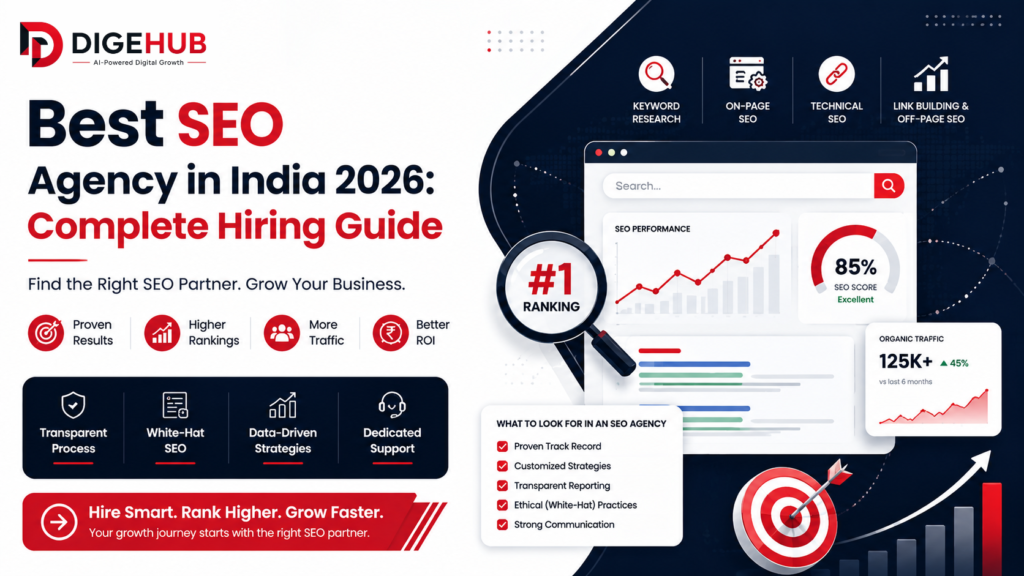
Best SEO Agency in India 2026: Complete Hiring Guide
Quick Answer
If you are searching for a SEO company in India in 2026 pick a partner that cares about growing your business not just getting high rankings. A good agency will provide you with SEO services, a solid content plan, honest link building methods, AI and GEO optimization and clear reports that show how much revenue they are bringing in. Many businesses start to see some improvements in a months usually between 3 to 6 months.. It typically takes longer around 6 to 12 months to really see a big impact on your revenue. Be careful of any agency that promises you will be number one, in search rankings or uses tactics to get there.
Table of Contents
- Why This Guide Is Important
- Why Choosing the Right SEO Agency Matters in 2026
- What Does an SEO Agency Actually Do?
- Types of SEO Services Explained
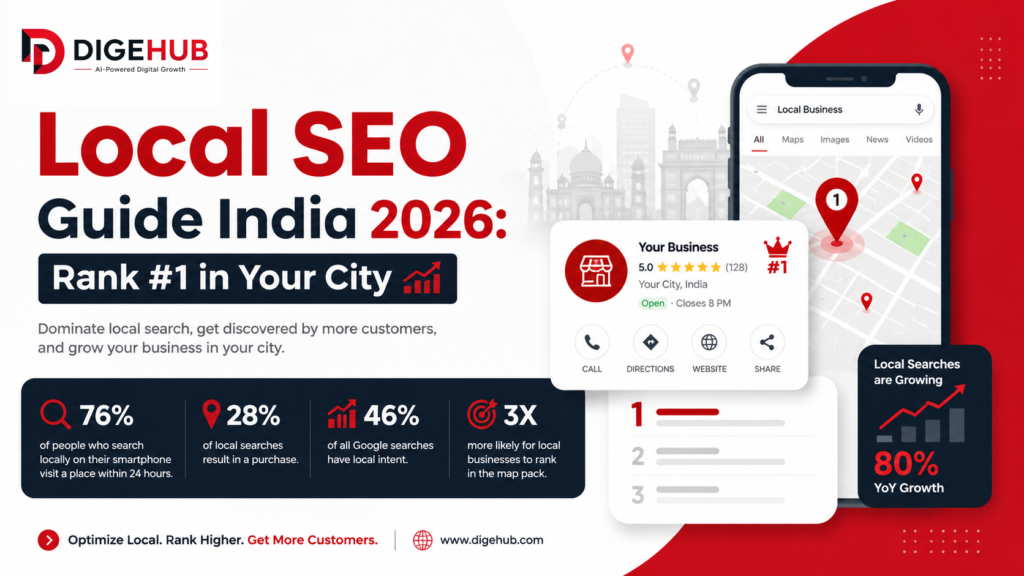
- Local SEO
- Ecommerce SEO
- Enterprise SEO
- Technical SEO
- AI SEO & GEO (Generative Engine Optimization)
- If you run a salon, gym, spa, clinic, or any other local service business, don’t miss our complete SEO for Service Businesses India 2026 (Salons, Gyms & Spas) guide to learn how to rank higher in local search results and attract more customers.
- How to Choose the Best SEO Agency in India — A 5-Step Hiring Framework
- SEO Pricing in India 2026: Benchmarks & Models
- SEO Red Flags & Scams to Avoid
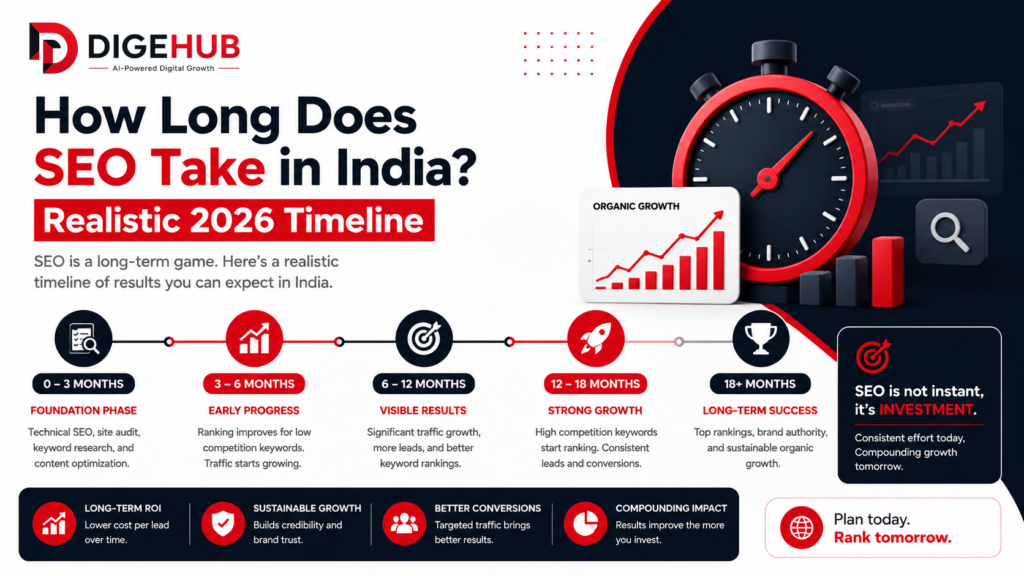
- Expected SEO Timelines & Realistic Outcomes
- SEO Metrics That Actually Matter
- SEO for Different Business Types
- AI SEO & Future-Proof SEO Trends (2026)
- SEO Agency Comparison Checklist
- Final Hiring Checklist
- FAQs (Voice & AI Optimized)
- Need Professional SEO Help?
1. Why This Guide Is Important
Most ‘Best SEO Agency in India” lists are promotional: they repeat agency slogans, lack real data, and don’t help you evaluate whether an agency will deliver revenue—not just traffic.
This guide gives you a practical hiring framework:
- How to set goals. What success looks like
- How do I know if an agency is good at stuff making content and using AI and GEO?
- What things should I look for to compare agency costs and contract details?
- Some things to be careful about:
- What are the warning signs I should watch out for?
- How to make a plan that works and track progress
- How do I set timelines and what are KPIs?
- How to keep your SEO up to date with AI and Generative Engine Optimization
- How can I make sure my SEO is ready for the future, with AI and GEO?
Whether you’re a SaaS founder in Bangalore, an ecommerce brand in Mumbai, a local service business in Patna, or an enterprise in Delhi NCR, this guide will help you hire an SEO partner that drives measurable business outcomes.
2. Why Choosing the Right SEO Agency Matters in 2026
SEO in 2026 is fundamentally different from SEO five years ago.
Search engines now use:
- When we talk about search results we look at answers that are made by intelligence. These are like summaries that use language models to find what we are looking for.
- We also look at how important something’s not just what words are used. This is called entity-based ranking.
- What the user thinks of a website is important too. We call this user experience signals. It includes things like how fast a website loads. If people like using it.
- The quality of what we read is important. We want to know if the person who wrote it really knows what they are talking about. This is called content quality. It includes things, like experience being an expert if the writer is someone we should listen to and if we can trust what they say.
- We can search for things in different ways now. We can look on the web on maps watch videos go shopping online and even talk to intelligence to find what we need. This is called -surface search.
Choosing the wrong agency can lead to:
- Wasted budgets, on tactics that do not work
- Low-quality backlinks that get you penalized
- Technical issues that slow down your website
- Content that does not turn into sales
- No alignment with what your business wants.
- More leads
- More revenue
- More sign-ups
- Are you still torn between scaling organically or running paid ads? Before committing your hard-earned marketing budget, read our complete operational framework on SEO vs PPC India 2026: Which Is Right for Your Business? to see where your first rupee should go.
Choosing the right agency means:
- A strategy that is tied to the revenue of a company not just the traffic it gets.
- This means we need to have a mix of technical search engine optimization, content and link building.
- We will give you reporting with clear key performance indicators.
- Our artificial intelligence and geographic capabilities will help your business survive the wave of search.
- The team that will be working with you really understands your industry and your business model.
3. What Does an SEO Agency Actually Do?
An SEO agency is really helpful for businesses because it helps them get noticed on the internet and get people to visit their website from search engines. But the thing is, SEO is not about using the right words and getting other websites to link to them it is a lot more than that. SEO is about getting people to see the businesses online and getting the right people to visit their website from search engines, like Google.
If you’re new to search engine optimization, read our detailed guide on What Is SEO and How It Works for Indian Businesses.
What Is SEO and How It Works for Indian Businesses
Technical SEO Guide for Indian Websites 2026: What Actually Moves Rankings
A full-service SEO agency typically provides:
Strategy
- We need to look at the market and see what our competitors are doing.
- This will help us understand what our buyers want.
- We have to figure out the way to reach people so we are thinking about using search engine optimization and creating content and being on social media without paying for ads and also getting some public relations work done.
- We want to make a plan for how we can grow our business in thirty days and in ninety days and in one hundred and eighty days. This plan will have steps, for each of these time periods.
- Keyword Research Guide India 2026: Step-by-Step Framework for Global Brands — Modern guide to multi-lingual, voice search, Hinglish, and AI-driven keyword research in India.
Technical SEO
- Site audits help check how well a site works for search engines.
- This includes checking
- crawlability
- indexing
- and site architecture.
- Technical SEO Guide for Indian Websites 2026).
- Optimizing Core Web Vitals makes a site load faster. Work better.
- Adding schema markup or structured data helps search engines understand the site better.
- Log file analysis provides insights, into how a site interacts with search engines.
- Migration support makes moving a site to a platform or rebranding easier.
- This includes
- site changes
- rebrands
- Platform moves.
Content Strategy & Production
- Let us talk about topic clusters and topical authority.
- We need to make sure we have content briefs and editorial calendars.
- Here are some things we have to do:
- On-page optimization. This includes things like title tags and meta and headings and internal links.
- We also need to do conversion-focused copywriting.
- Sometimes we have to do a content refresh. Then we have to optimize the content again to make it better.
- This is, about topic clusters and topical authority.
Off-Page & Link Building
- We do something called white-hat outreach. This is when we help people get their brand mentioned online. We also do PR and try to get brands mentioned in the press.
- We like to work with people to create content that is useful, to everyone. This is what we call content partnerships.
- Sometimes we look at what our competitors are doing and see where they are getting mentioned online. We call this competitor link gap analysis. It helps us figure out where we can get our brand mentioned too. Our outreach process avoids spam networks entirely—we focus on digital PR and data assets, using the exact methodology detailed in our complete strategy guide on Link Building for Indian Websites 2026: What Actually Works.
- Our outreach process avoids spam networks entirely. We focus on digital PR and data assets, using the exact methodology detailed in our complete strategy guide on Link Building for Indian Websites 2026: What Actually Works.
Local SEO (if relevant)
- Google Business Profile optimization helps your business show up often in search results.
- Here are some key areas to focus on:
- Citation management is important. It means making sure your businesss name, address and phone number are the same online.
- Local landing pages can help. They are pages, on your website that are designed to help people in a specific area find your business.
- Review management is also crucial. It involves responding to customer reviews and using them to improve your business.
- Google Business Profile optimization matters. It helps people find your business when they search online.
AI SEO & GEO
- Lets talk about making our answers better, with the help of computers.
- We need to think about what the main thing’s that we want to talk about.
- Then we can make our questions in a way that the computer can understand what we are asking.
- We should also make sure our information is organized so that big language computers can see it and give us answers.
Measurement & Reporting
- I want to set up GA4 and Google Search Console.
- This will help me with tracking conversions, which includes leads and revenue and sign-ups.
- I also need quarterly dashboards to see how things are going.
- Then I can do ROI analysis. Try out new things with experimentation, on GA4 and Google Search Console.
4. Types of SEO Services Explained
Local SEO
Who it’s for:
Local businesses, multi-location brands, service-area companies (e.g., clinics, law firms, home services, restaurants).
What it includes:
- Google Business Profile (GBP) optimization
- Local keyword research
- Citation building and cleanup
- Local landing pages (city/area pages)
- Review generation and management
- Local schema (LocalBusiness, OpeningHours, etc.)
Key outcomes:
- Higher visibility, in Google Maps and local pack listings
- This really helps to get calls get more people asking for directions and more foot traffic to my business.
- Also when I see lots of reviews it makes me trust a business more.
Ecommerce SEO
Who it’s for:
Online stores, DTC brands, marketplaces.
What it includes:
- Let us talk about making our product pages better.
- We need to think about how our category pagesre set up and how we group our products.
- We also have to figure out how to use filters on our website and make sure the right pages show up in search results.
- Our product information needs to be clear and easy to understand this includes details, about the product, what it costs and what other people think of it.
- We have to make sure our website loads fast and works well.
- It is also important to link our products so people can find what they want easily.
- We need to make it easy for people to buy things from our website so we have to make the checkout process simple and easy to use this is what we call conversion rate optimization for our checkout flow.
Key outcomes:
- People really look at our products often when they are natural.
- We get more people putting our products in their shopping cart. Then buying them.
- When people visit our product pages they do not leave quickly as before.
Enterprise SEO
Who it’s for:
Large brands with thousands to millions of pages, complex site structures, and multiple stakeholders.
What it includes:
- Enterprise-scale technical checks
- Seo. Hreflang tags
- Multi-language support
- Multi-region optimization
- We focus on Governance and create playbooks.
- CMS and platform connections
- Data integrations
- CRM system
- Business Intelligence tools
- Server-side tracking setup
- Cross-functional teamwork
- Development
- Content creation
- Public Relations
- Product management all work together
Key outcomes:
- We want to make our Search Engine Optimization processes bigger and better.
- Our Search Engine Optimization has to work everywhere no matter where we are.
- We need to get rid of problems, with our Search Engine Optimization when it is used by a lot of people.
Technical SEO
Who it’s for:
Any website with performance, crawl, or indexing issues.
What it includes:
- When we talk about a website, the site architecture and the URL structure are very important.
- We also need to think about crawl budget optimization to make sure the website is working properly.
- The website needs to have indexation control this includes things like robots.txt, meta robots and noindex.
- We should look at the Core Web Vitals this includes things like the Contentful Paint which is also known as LCP, the First Input Delay which is also known as FID or the Interaction to Next Paint which is also known as INP and the Cumulative Layout Shift which is also known as CLS.
- The server response time and the caching are also very important for the website.
- We need to think about JavaScript search engine optimization this includes things like rendering and lazy loading.
- The log file analysis is also necessary to see what is going on with the website.
- When the website is moved or updated we need to have migration and redeployment support, for the website.
Key outcomes:
- Better crawling and indexing
- Faster page speeds
- Fewer errors in Google Search Console
AI SEO & GEO (Generative Engine Optimization)
Who it’s for:
Forward-thinking brands aiming to appear in AI-powered search results and LLM-generated answers.
What it includes:
- We need to think about the kind of content that works with artificial intelligence. This includes things like
- making it clear who wrote the page and what the page is about
- writing answers to questions that people might have, like how to do something or what something means
- thinking about what questions people will ask intelligence and trying to answer them
- making sure the information is organized in a way that artificial intelligence can understand, like
- articles
- frequently asked questions
- instructions on how to do something
- information about products
- seeing how the content looks when it is used in artificial intelligence chat interfaces, like
- ChatGPT
- Perplexity
- Copilot
- Gemini
- creating content that artificial intelligence models will likely reference because this content is useful and accurate and that is what artificial intelligence models look for when they’re trying to answer questions so we are talking about content that is likely to be cited by artificial intelligence models.
Key outcomes:
- Increased presence in answers made by intelligence
- More authority for my brand on search results that use AI
- Preparing for changes in how search results are shown on traditional websites
- Increased presence in answers made by artificial intelligence
- More authority for my brand on search results that use intelligence
- Preparing for changes, in how search resultsre shown on traditional websites with artificial intelligence
5. How to Choose the Best SEO Agency in India — A 5-Step Hiring Framework
Step 1: Define Your Goals
Before contacting agencies, clarify what success looks like.
Common SEO goals:
- We want to get qualified leads you know, the kind that are most likely to become customers like Marketing Qualified Leads and Sales Qualified Leads.
- We also want to make money from people who find us on their own without paying for ads so we need to increase revenue from organic channels.
- To do this we have to get more people to visit the pages on our website that are really important to us so we need to improve traffic for those target pages.
- We also want to be easier to find when people are searching for things in their area so we need to improve our local visibility, which means showing up on maps and, in the local pack.
- And finally we want to be well known in certain countries like India and the United States and the United Kingdom so we need to improve our brand visibility in those specific markets.
Write down:
- Our main aim is to increase revenue by 40 percent in the next 12 months.
- We also want to improve traffic by 60 percent.
- The countries we want to focus on are India and maybe the United States of America too.
- Our target audience is medium businesses, big companies and the people who buy things from us.
Step 2: Evaluate Agencies
Use a scorecard to compare agencies objectively.
Evaluation criteria:
Industry experience
Have they worked with businesses to yours?
Do they understand how your business works, like if you offer a free trial and then charge or if you sell products online and people add them to their cart?
Case studies & results
Look for real numbers: how much did traffic grow, how much did sales increase how much more money did they make?
Don’t trust claims like “we got more visitors” without knowing the actual numbers.
Technical expertise
Can they work with your website system (like WordPress, Shopify or a custom one)?
Do they have experience working with developers?
Reporting quality
Do they show you easy-to-understand reports with important business numbers?
Do they explain what the numbers mean, not just list them?
Team structure
Who will be working on your project?
Is there one person in charge of your account?
Can you talk to experts in planning, writing and developing?
AI/GEO capability
Do they know about search technologies and how to make content work with them?
Can they show examples of content they improved with these technologies?
Culture
Do they communicate clearly and in a way that makes sense?
Are they quick to respond and honest, with you?
Step 3: Request Proposals (RFP)
Send a short RFP to 3–5 agencies. Include:
- Business background
- We need to know about your business.
- What does your company do?
- Target. Audience
- Who are your customers?
- What are their needs?
- Primary and secondary goals
- What do you want to achieve?
- Are there goals too?
- Current. Ranking baseline (if available)
- How many people visit your site now?
- Where does your site rank?
- Tech stack (CMS, analytics, CRM)
- What tools do you use for your site?
- How do you track visitors?
- Budget range
- How much are you willing to spend?
- Timeline expectations
- When do you want results?
- What is your deadline?
Ask agencies to provide:
- Proposed strategy (30/90/180 days)
- Deliverables per month
- If you want to know how an execution framework is built internally, see our comprehensive guide on [How to Do SEO in India 2026].
- Team members and roles
- Reporting format and cadence
- Pricing model and breakdown
Step 4: Interview Agencies
Ask these 10 essential questions:
- To figure out if our Search Engine Optimization is working we need to see how money we are making from it. For our business how do you measure the return on investment of Search Engine Optimization?
- We want to know if our Search Engine Optimization is really working. Can you tell us about a time when our website showed up higher in search results. We did not get more customers? What did you do to change that?
- When it comes to Search Engine Optimization there are a lot of things to do. How do you decide what to do like fixing the website making new content or getting other websites to link to us?
- We also want to know about using Artificial Intelligence and making sure our website shows up in the places. Have you tried using Artificial Intelligence to help with this? What did you find out?
- To see how well our advertising is working we need to use a model. Which model do you think we should use. Why do you think that?
- We do not want to do much to try to make our website show up higher in search results. How do you make sure we are not doing much and just using the right keywords?
- Who is in charge of the content on our website making changes, to the website and looking at the numbers to see how we are doing?
- Sometimes the search engines change how they work. How do you handle those changes. Make sure our website is still showing up in search results?
- What tools do you use to help with Search Engine Optimization and who pays for them?
- Who will we talk to every day. What do we do if we have a problem that needs to be fixed quickly?
Step 5: Review Contract Terms
Ensure the contract includes:
Here is what we need to do:
We have to make sure we are clear on what we’re doing.
Clear deliverables are important.
We need to know how content pieces we are going to make how many pages we are going to create what technical fixes we need to do and what outreach activities we need to do.
We also need to think about how we’re going to measure if we are doing a good job.
KPIs and reporting cadence are crucial.
We need to agree on what metrics we’re going to use to measure our success like how many organic leads we get how much revenue we make and how much traffic we get to our website.
Then we need to make monthly or quarterly dashboards to track all of this.
Now who is in charge of what?
Ownership is important.
The client owns all the analytics accounts the content management system, the content we create and any code changes we make.
We also need to talk about who gets to see what data.
Data access is key.
The agency gets to see the data in Google Analytics 4 Google Search Console and other relevant tools but they can only look at it not change it.
If we need to make any changes we need to have a process for that.
Change control is necessary.
We need to figure out how we are going to prioritize and approve any changes that need to be made.
What if we decide to stop working
Exit terms are important.
We need to have a plan, for how we’re going to hand everything over what we still need to do and how we are going to do one final report.
We also need to think about how we’re going to measure our performance.
Performance clause is crucial.
We need to review our progress at each milestone. We should not promise that we can get a certain rank in a short amount of time.
Now lets talk about money.
Payment is important.
We need to decide if we are going to pay a retainer, a rate or a project-based fee.
Before we make a long-term commitment we should try working for a little while.
Trial milestones are an idea.
We can test out how we work together before we commit to anything term.
6. SEO Pricing in India 2026: Benchmarks & Models
SEO pricing in India varies by experience, scope, and deliverables.
Pricing Models
- Monthly retainer is what people usually pay for when they want Search Engine Optimization work.
- This is the common way to pay for Search Engine Optimization that is ongoing.
- Fixed-price project is what you pay for when you want something like an audit or when you need to move your website to a new system or when you want a one-off website build.
- You can also pay someone by the hour when you need help with tasks or when you want a consultant to give you some advice.
- There is also something called performance-based payment which’s when you pay a monthly retainer and then you also pay a bonus when the person you hired does what they agreed to do but you should be careful, with this one.
- Search Engine Optimization is what people mean when they say Search Engine Optimization and it is also what people mean when they talk about Search Engine Optimization work.
- People usually pay monthly for Search Engine Optimization.
India 2026 Benchmark Ranges (Monthly Retainer)
| Provider Type | Price Range (INR/month) | Price Range (USD/month) |
|---|---|---|
| Freelancers | ₹30,000 – ₹80,000 | $350 – $1,000 |
| Small Agencies | ₹80,000 – ₹2,50,000 | $1,000 – $3,000 |
| Mid-Sized Agencies | ₹2,50,000 – ₹8,00,000 | $3,000 – $10,000 |
| Enterprise Agencies | ₹8,00,000+ | $10,000+ |
One-Time Project Costs (Indicative)
- SEO Audit: ₹50,000 – ₹3,00,000 ($600 – $3,600)
- Full Technical Overhaul: ₹2,00,000 – ₹20,00,000 ($2,400 – $24,000+)
- Site Migration SEO: ₹3,00,000 – ₹15,00,000 ($3,600 – $18,000)
What Affects Price
- When we think about the size of a website we have to consider the scale. For example a website with 100 pages is very different from a website with 100,000 pages.
- The type of industry the website is in matters. If the website is for something like finance or law it can be more expensive.
- We also need to think about what kind of content the website needs. Does it need written words, design or videos?
- Then there are the tools. Paid media that need to be integrated into the website.
- If the website is for people in countries or languages that is another thing to consider. This is called multi-language SEO and it can be complex especially with things like hreflang.
- Finally there is the use of intelligence and geography, in the website, which can involve experimentation and special tools including AI and GEO experimentation and tooling.
Example Pricing Structures
- Small ecommerce (pilot): ₹1,50,000/month
- Tech fixes, 8 content pieces/month, basic outreach
- SaaS startup (growth): ₹3,00,000/month
- Content + technical + CRO experiments
- Enterprise migration: ₹10,00,000 one-time + monthly retainer
7. SEO Red Flags & Scams to Avoid
Avoid agencies that:
Be careful of people who say they can get you to the number one spot on search engines.
The truth is that nobody can really promise you the spot because search engines are always changing.
They might try to use something called blog networks.
These are basically tricks to get links that are not allowed and can get you in trouble.
Some people will promise you good results that sound too good to be true.
For example they might say they can double the number of people visiting your website in thirty days.
That is probably not going to happen. You should be careful.
You should also be able to see all the information about how your website’s doing.
If someone does not want to show you that it is not a sign.
If someone does not want to give you examples of the work they have done for people that is not good either.
It is very important to be open and honest, about what you’re doing.
If the price is very low that might be a problem too.
If it is too cheap they are probably not doing good work.
What really matters is getting people to your website who will actually do business with you.
Getting a lot of people to visit your website does not mean anything if they are not helping your business.
Common Scam Tactics
- I do not think it is an idea to sell something called “tiered links” or secret networks and say they are okay to use.
- Some people buy quality links from vendors in other countries and then sell them again.
- They use tricks like hiding where a link really goes to try to fool the search engines into ranking them
- Sometimes you see a jump in traffic and then the search engines catch on and punish the website.
- Selling “tiered links” or secret networks and saying they are white-hat is not good
- Reselling quality link packages from vendors, in other countries is also bad
- Using redirects to manipulate rankings is a trick that can get you in trouble
- You might see traffic spikes followed by penalties when you do these things
If you see unnatural traffic surges with no increase in conversions or revenue, ask questions immediately.
Hiring an organic search partner is a multi-year commitment. To make sure you don’t sign a bad contract, run your options through our checklist of How to Choose an SEO Agency in India in 2026: 10 Questions to Ask.
8. Expected SEO Timelines & Realistic Outcomes
SEO is a long-term strategy. Here’s what to expect:
1–2 Months
- Technical improvements and quick wins
- Site speed fixes, indexation issues resolved
- Initial keyword research and strategy
3–6 Months
- Improved rankings for target pages
- Organic traffic growth begins
- Early content starts performing
6–12 Months
- Significant lead and revenue growth
- Stronger topical authority
- More conversions from organic channels
12+ Months
- Strong domain authority
- Long-term sustainable growth
- Resilience to algorithm updates
Important: Timelines depend on:
- Baseline site health
- Competition level
- Content production velocity
- Resources for execution
9. SEO Metrics That Actually Matter
Don’t get distracted by vanity metrics. Focus on business-impact KPIs.
Primary Metrics
- Organic leads are people who show interest in my business. They might fill out a form sign up for a newsletter or even give me a call.
- Organic revenue comes from sales or bookings I get without paying for ads. For example if I have a store organic revenue would be from people buying from it. If I offer services like hotel rooms or appointments organic revenue would be from people booking them.
- Conversion rate is how well I turn visitors into leads or customers. It’s like asking, how many people who visit my website or social media actually give me their information or make a purchase? I measure it by looking at traffic and seeing how many of those visitors become leads or generate revenue.
- Organic leads (like form submissions, sign-ups and calls)
- Organic revenue (, like e-commerce sales and bookings)
- Conversion rate (how many organic traffic visitors become leads or revenue)
Secondary Metrics
- People who visit our website from search engines are really important to us.
- We look at how sessions we get from search.
- We also check how well our website ranks for the keywords we want to be found for.
- Our website needs to be seen as an expert in the topics we care about so we look at how people are talking about us for those topics.
- We want to know how many people are searching for our website by name and how many people are searching for something general.
- So we look at the split, between people searching for our brand and people searching for something that’s not our brand.
Technical Metrics
- Core Web Vitals (LCP, INP, CLS)
- Pages crawled & indexed
- Crawl errors (404s, server errors)
Off-Page Metrics
- Referring domains (quality over quantity)
- Backlink relevance (industry-related links)
10. SEO for Different Business Types
SaaS Companies
- Our focus is on content marketing and product-led SEO. We also do documentation. Create a knowledge base.
- The key pages we have are product pages, features, integrations, use cases and a blog.
- We measure our success, with free trial sign-ups, demo requests and marketing leads which we call MQLs.
Ecommerce Businesses
- Focus: Category pages
- Product SEO
- Conversion Rate Optimization
- pages:
- Home
- Category pages
- Product pages
- Collection pages
- Key Performance Indicators:
- Add to cart
- Checkout starts
- Revenue growth
Local Businesses
- Focus: Google Business Profile, local rankings, reviews
- Key pages: Location pages, service pages, contact
- KPIs: Calls, directions, local pack appearances
Enterprise Businesses
- Focus: Governance, making things scalable search engine optimization and global search engine optimization.
- Pages: We have thousands of pages spread across different regions and languages.
- KPIs:
- Organic revenue in regions
- How visible our brand is
- Our main goals are:
- Governance
- Scalability
- Technical SEO
- Seo
- We track:
- Organic revenue, across regions
- Brand visibility
11. AI SEO & Future-Proof SEO Trends (2026)
AI Search Visibility
LLMs and AI assistants use different signals:
- Entity matching
- Authoritative sources
- Freshness and relevance
Tactics:
- Clear entity representation (About pages, author bios)
- Structured data (Article, FAQ, HowTo, Product)
- Concise “answer” blocks for common questions
Generative Engine Optimization (GEO)
GEO focuses on being a source that AI models cite when generating answers.
Tactics:
- People usually ask for content that is what they are looking for.
- Content that is what people are looking for is very useful.
- When we talk about content that maps to what people’re looking for we mean content that is useful to people.
- Some things that help content be useful to people are links from trusted websites and references to books or articles.
- These are called backlinks and citations.
- Authoritative backlinks and citations are very important for content.
- We also need to see if people can find content when they use computer programs that talk to them like AI chat interfaces.
- Testing to see if people can find content in AI chat interfaces is very important.
- Testing visibility in AI chat interfaces helps us make sure that content is useful, to people.
Measure: AI SERP share (how often your domain is cited by AI).
Programmatic SEO
- When you use pages you have to be careful.
- You need to make sure each page is unique and that a real person checks them.
- You should track how well the programmatic pages are doing for each group of users, which is called a cohort.
Search Experience Optimization (SXO)
- To make the user experience better we need to make sure it does what the user wants.
- We should give users answers.
- We should also have tools and calculators to help the user experience.
- The user experience should be able to track when it helps someone make a decision and when people are actually using it.
- This includes things like assisted conversions and how engaged people are, with the user experience.
Privacy & Measurement
- GA4, cookieless measurement, server-side tracking
- Privacy-first conversion models
12. SEO Agency Comparison Checklist
Use this table when shortlisting agencies:
| Criteria | Agency A | Agency B | Agency C |
|---|---|---|---|
| Industry experience | |||
| Case studies (with data) | |||
| Technical expertise | |||
| AI/GEO capability | |||
| Reporting quality | |||
| Pricing (monthly) | |||
| Team access (dedicated) | |||
| Trial offering (audit) | |||
| References (yes/no) | |||
| Contract flexibility |
13. Final Hiring Checklist
Before hiring an Best SEO Agency in India :
- Define Your Goals Clearly
- When starting make sure you know what you want to achieve.
- Look at case studies to see how others have succeeded.
- Check client references to ensure they are happy, with the service.
- Verify that client references are real.
- Find out how they report results.
- Confirm who owns the account.
- Understand how much it costs.
- Break down the pricing structure so it makes sense to you.
- Evaluate what the AI can do for SEO.
- Make sure it can help with search engine optimization.
- Before making a long-term commitment start small.
- Try a pilot project to see if it works for you.
14. FAQs
What is the Best SEO Agency in India?
The Best SEO Agency in India for search engine optimization really depends on what you want to achieve the kind of business you’re in how much money you have to spend and where your company is right now. You should use the steps we talked about earlier to see which agencies are good at what they do how much they charge if they’re honest with you and what kind of results they can get for search engine optimization agencies, like the search engine optimization agency you are looking for.
How much does SEO cost in India?
SEO pricing varies a lot. It can cost between ₹30,000 to ₹8,00,000 or more every month. This depends on what you need and who you hire. Freelancers usually charge less for SEO. Big agencies charge more for SEO services.
How long does SEO take?
Most businesses get SEO results in about 6 to 12 months.
They start seeing some wins in 3 to 6 months.
It usually takes over 12 months to build long-term authority.
SEO results take time businesses see progress in 6 to 12 months with SEO.
On in 3 to 6 months they might see some small victories.
But to really establish themselves as an authority it often takes, than 12 months.
Can SEO guarantee rankings?
No. If an agency says they can get you the number one ranking that’s a bad sign. Search engines are always. The results depend on a lot of different things. Search engines like Google are always making changes and the results, for search engines can be different every time. This is because search engines take into account factors when they show you the results.
Is SEO still worth it in 2026?
Yes. Search Engine Optimization remains one of the ways to get a good return on investment when it comes to marketing as long as you do it the right way and focus on what really matters for your business not just getting a lot of people to visit your website. Search Engine Optimization is really important, for this.
What should an SEO agency provide?
I think a good plan is very important. We need to work on search engine optimization come up with a good content strategy build links and give reports. It is also nice to have access to people who can help us. You should be, in charge of all the accounts and things that belong to us.
How do I hire an SEO company?
To get started you need to define what your goals are. Then you have to issue something called an RFP. After that you will have to shortlist an agencies probably around three to five agencies.
Next you should run a pilot with these agencies this pilot will include an audit and a plan.
You will evaluate these agencies using a scorecard.
You will eventually sign a contract with the agency you like. The contract needs to be straightforward. Say what the agency is going to do for you.
The agency contract should have things that the agency has to deliver.
You have to make sure the agency contract is easy to understand, about what the agency’s supposed to do for you.
The contract with the agency must be clear, about what you want the agency to do.
What is GEO optimization?
GEO helps prepare your content and entity signals. This is done so AI powered search surfaces and assistants can use them. GEO is like Generative Engine Optimization.
It makes sure your content and entity signals are ready. They are then used by AI and LLM powered search surfaces. These include assistants well.
The goal is to optimize content. This is, for AI and LLM powered search. GEO works with entity signals. These are used by search surfaces. They are also used by assistants.
15. Need Professional SEO Help?
At Digehub, we help businesses improve search visibility through:
- Technical SEO
- Content strategy
- AI SEO & GEO optimization
- Local SEO
- Performance-driven growth strategies
- We don’t just focus on backlinks; our core strength lies in data-driven, on-site optimization. See the exact framework we use to rank brands in our comprehensive On-Page SEO Checklist 2026.
Master Your Search Strategy (2026 Guides):
We don’t just execute; we build transparent frameworks. Dive into our latest blueprints to optimize your digital footprint for AI and modern search engines:
- [On-Page SEO Checklist 2026]: Check out the exact framework we use to make Indian websites AI-search friendly and rank on page one.
- [What is SEO? The Ultimate 2026 Beginner’s Guide]: Understand the fundamentals of modern search algorithms, AI Overviews, and how ranking works today.
- [How to Do SEO in India 2026: Step-by-Step]: Discover how to navigate localized keyword trends, Hinglish search behavior, and Tier-2/Tier-3 market targeting.
We care about the money our clients make the people who’re interested in what they have to offer and the sales they get. Not just how high they show up in search results. If you want a plan to help with search engine optimization that you can use over the thirty days, ninety days or one hundred eighty days or if you need someone to take a close look, at the technical side of things or if you want to try out a small project to see what Digehub can do then Digehub can help with that.
Explore our services:
Author Bio (optional):This guide was written by the Digehub team.
They are from a digital marketing agency.
The agency specializes in SEO AI visibility and content-driven growth.
The Digehub team helps businesses.
They are located in India and all over the world.
These businesses build organic growth strategies for 2026 and, beyond.
The Digehub team does this to help them.