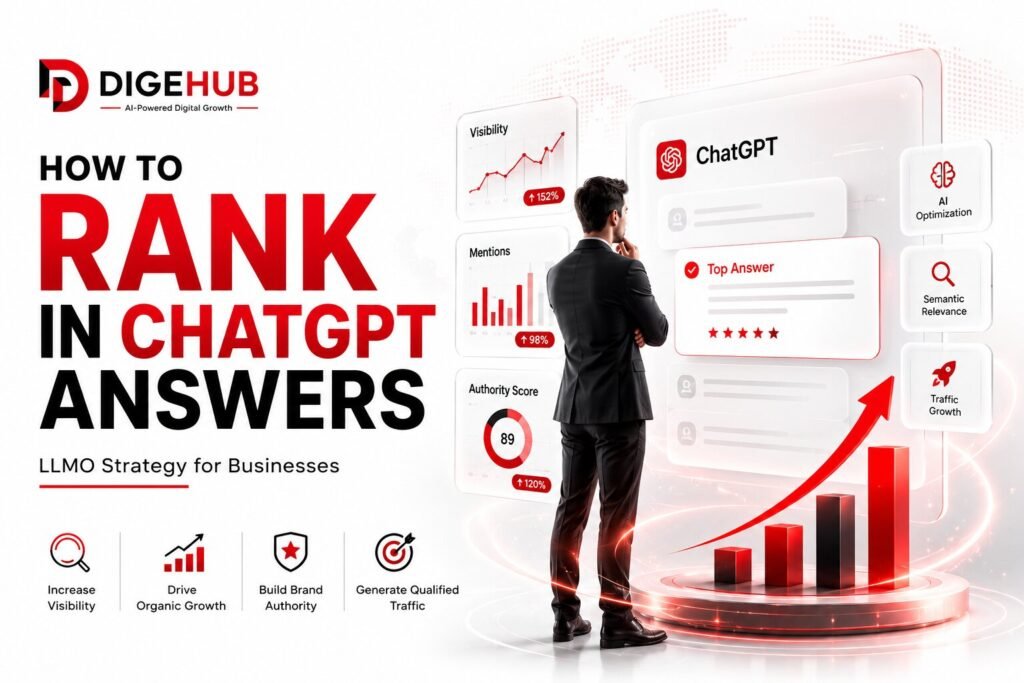
- How to Rank in ChatGPT Answers: The LLMO Strategy Businesses Need Right Now
- Quick Answer: What Does It Actually Take to Rank in ChatGPT?
- The Gap Nobody Talks About: Brand Mentions vs. Brand Citations
- How ChatGPT Actually Decides What to Cite
- The LLMO Framework: 5 Layers That Actually Work
- The Platforms Aren't All the Same: ChatGPT, Perplexity, and Gemini
- Common Mistakes That Kill Your AI Visibility
- Expert Insight: What We See in Client LLMO Audits
- How to Measure Your ChatGPT Visibility
- Future of LLMO: What's Coming in 2026-2027
- FAQ: How to Rank in ChatGPT
- Where Digehub Fits In
How to Rank in ChatGPT Answers: The LLMO Strategy Businesses Need Right Now
Most of the content out there on this topic reads like a checklist. Add schema. Write FAQs. Get backlinks. Sure, those things matter. But they leave out the part that actually makes the difference: why ChatGPT picks one brand over another, and how to consistently be that brand.
We’ve been deep in this at Digehub, working with clients across SaaS, agencies, and global businesses who are watching their organic traffic plateau while noticing that competitors are showing up in AI answers they’re not. That gap is real, it’s growing, and it won’t fix itself.
This is not an introduction to LLMO. If you need that foundation first, our guide on what LLMO actually is covers the basics well. What we’re doing here is going past that. This is the operational strategy.
Quick Answer: What Does It Actually Take to Rank in ChatGPT?
What does “ranking” in ChatGPT mean? Unlike Google, ChatGPT doesn’t return a list of links. It surfaces synthesized answers, and it pulls from sources it considers credible, structured, and well-cited across the web. “Ranking” here means being the source ChatGPT cites, references, or names when someone asks a question in your category.
What are the core requirements? Three things: your content has to be AI-parseable (structured, clear, factual), your brand entity has to be established across trusted third-party sources, and your website has to be technically open to AI crawlers. If any one of these breaks down, the other two won’t carry you.
How is this different from SEO? Traditional SEO ranks pages. LLMO builds trust with AI systems at the entity and concept level. A page can rank on Google without being cited by ChatGPT. Getting both requires a coordinated approach, not just SEO tactics applied to AI. If you want to understand the broader picture of how AI systems surface content, our AI search visibility guide is worth reading alongside this.
The Gap Nobody Talks About: Brand Mentions vs. Brand Citations
Here’s the thing most LLMO content glosses over. There’s a real difference between ChatGPT mentioning your brand and ChatGPT citing your brand as a source.
Mentions happen when a model has absorbed enough training data about you to know you exist. Citations happen when the model actively retrieves your content as the answer to a specific question.
A lot of companies obsess over mentions. They Google their brand name in ChatGPT, see it come up, and think they’re winning. They’re not. Citation is the actual KPI. Citation is what happens when someone asks “what’s the best tool for X” and ChatGPT links or names your platform as its source, not just as one of twenty things it vaguely remembers.
The practical implication: your strategy can’t just be about brand awareness. It has to be about becoming a citable source. That means content that answers specific questions with specific answers, formatted so an AI can extract and reproduce it with confidence.
How ChatGPT Actually Decides What to Cite
This is where most guides stop short. They say “produce authoritative content” without explaining what signals the model is actually acting on.
ChatGPT, especially in its search-enabled mode, is doing a few things when it generates an answer:
1. It prioritizes content it can parse without friction. Dense, conversational paragraphs with no structure make it harder for the model to extract a clean, citable answer. Headers, bullet points, direct answers near the top of sections, and simple declarative sentences all reduce parsing friction. The model isn’t lazy, it’s efficient. It goes for what’s easiest to use.
2. It cross-references entity signals. If your brand name, product, or author is consistently associated with a topic across multiple trusted sources (industry publications, forums, third-party review sites, academic or research content), ChatGPT develops higher confidence in citing you. It’s looking for corroboration, not just a single strong page.
3. It weights recency for fast-moving topics. For topics like AI tools, marketing platforms, or anything tech-adjacent, ChatGPT’s search mode actively pulls current content. An article from 2022 about AI visibility tools is probably not going to get cited in 2025. Freshness matters, especially in this space.
4. It trusts what humans trust. The correlation between traditional domain authority and AI citation frequency is not perfect, but it’s real. Publications that have years of editorial credibility tend to get cited more. That doesn’t mean you need DA 90 to rank in ChatGPT, it means that building genuine third-party credibility isn’t optional.
The LLMO Framework: 5 Layers That Actually Work
Layer 1: Entity Establishment
Before your content can be cited, your brand needs to exist as a clear entity in the AI’s knowledge graph. This is more foundational than most people realize.
An entity, in this context, means ChatGPT can answer “what is [your brand]” with a coherent, accurate description. If it can’t, you’re starting from zero every time.
How to build entity clarity:
- Wikipedia or Wikidata presence is still one of the most powerful trust signals for LLMs. It’s not accessible to everyone, but for brands with enough coverage, it’s worth pursuing.
- Consistent NAP-style information across the web. Your brand name, what you do, where you operate, and who leads it should appear consistently across Crunchbase, LinkedIn company pages, G2, Capterra, and relevant industry directories.
- Your own About page needs to be machine-readable. Use Organization schema. State clearly who you are, what you do, and who you serve. Don’t make an AI infer it from your homepage hero copy.
- Author entities matter too. If your content team or leadership publishes under their own names, those individuals should have their own professional web presence (LinkedIn, bylines on industry sites, author schema on your blog) that connects them to your brand’s topic area.
This is the layer most businesses skip. They go straight to content without establishing the underlying entity, and then wonder why the model still doesn’t cite them after six months.
Layer 2: Content Architecture for AI Extraction
Once your entity is established, your content has to be structured so AI can actually use it. This is different from writing for humans, though great AI-citable content is also great human content.
The key structural principles:
Answer first, elaborate second. If someone asks “how does [process] work,” your content should answer that in one to two sentences at the top of the section, then expand. Don’t make the reader or the AI wade through context before getting to the answer. This is the biggest formatting gap we see in client content audits.
Use headers as standalone questions. “What is LLMO?” is a better H2 than “Understanding LLMO.” The question format maps directly to how people (and AI) query. It also helps with featured snippets on Google, so it’s a dual benefit.
Tables for comparative data, lists for steps or options. Structured formats are significantly easier for AI to parse and reproduce accurately. If you have a comparison (“ChatGPT vs Perplexity for business use cases”), put it in a table. If you have a process, number the steps.
Keep paragraphs short. Three to four sentences max, as a rule. Long paragraphs are hard to extract cleanly. Short paragraphs are easy to lift as citable chunks.
Add a dedicated FAQ section to every major piece of content. This is not just for voice search or featured snippets anymore. AI models actively look for FAQ-structured content because it provides clean, direct Q&A pairs that can be reused verbatim or near-verbatim in generated answers.
Layer 3: Technical Accessibility for AI Crawlers
This is the most consistently overlooked area in LLMO strategy, and it’s costing brands real visibility.
Are you blocking AI crawlers? Check your robots.txt right now. If you’re disallowing GPTBot, OAI-SearchBot, or ChatGPT-User, you’re actively preventing OpenAI from crawling and indexing your content for use in ChatGPT’s search-enabled responses. A lot of site owners added these blocks during the early AI scraping panic of 2023-2024 and never revisited them.
To allow OpenAI crawlers, your robots.txt should include:
User-agent: GPTBot
Allow: /

User-agent: ChatGPT-User
Allow: /

User-agent: OAI-SearchBot
Allow: /
Create an LLMs.txt file. This is an emerging standard, similar to robots.txt but designed specifically for AI systems. It signals which parts of your site AI can access, who owns the content, and how you prefer to be cited. It’s a proactive trust signal and it takes about 20 minutes to implement. Drop it at yourdomain.com/llms.txt.
Your core content has to render in clean HTML. JavaScript-heavy pages where content loads dynamically are hard for AI crawlers to index reliably. If your key landing pages or blog posts depend on JS rendering for their main content, this is a priority fix.
Site speed and crawlability basics still apply. Fast load times, clean URLs, no redirect chains on important pages. These affect how frequently AI crawlers revisit your site.
Layer 4: Third-Party Citation Building
This is the equivalent of link building for LLMO, except the currency isn’t PageRank, it’s credibility corroboration.
ChatGPT doesn’t just crawl your website and decide to trust you. It needs to see your brand, your claims, and your expertise referenced and validated by sources it already trusts. That network effect is how you build the kind of authority that translates into consistent AI citations.
What “trusted sources” actually means for AI:
- Editorial publications with long track records (industry blogs with 5+ years of consistent publishing, trade media, regional business publications)
- Wikipedia and knowledge bases
- Academic and research institutions
- Platforms with verified user-generated content (Reddit, G2, Capterra, Trustpilot)
- Podcast appearances and transcripts (these get indexed and cited more than most people think)
What to actually do:
The single highest-leverage activity here is original data. Publish a survey, an analysis, a proprietary dataset, something with a number in the headline that nobody else has. Original data is citation bait for both human publishers and AI systems. When a journalist uses your stat, that’s a citation. When an AI answer includes that stat, it often traces back to the same original source.
After original data, the next priority is getting on “best of” or comparison lists on sites that already rank well or that AI trusts. If a SaaS review site lists the top 10 tools in your category and you’re not on it, that’s a gap. Being added to those lists doesn’t just help your SEO, it builds the kind of third-party corroboration that AI citation depends on.
Digital PR with a specific angle: don’t pitch “company news.” Pitch expert commentary on a trend, a counter-intuitive data point, or a useful framework. Journalists use quotes that are specific and insightful. And those quotes become the kind of third-party references that AI systems learn to trust.
Layer 5: Topical Depth and Cluster Authority
ChatGPT doesn’t just evaluate individual pages. It evaluates how comprehensively a source covers a topic. This is the content strategy layer.
If you want to rank in ChatGPT for “B2B SaaS SEO strategy,” having one good article on that topic isn’t enough. You need a cluster: a pillar covering the broad topic, and supporting content covering every meaningful sub-question. What tools to use. How to do keyword research for B2B SaaS specifically. How to measure organic growth in a SaaS context. What “good” conversion looks like from organic traffic.
The model looks for topical authority, not just individual document quality. A site with 40 deeply connected, well-structured pieces on a topic is more likely to be cited than a site with one excellent piece.
The practical implication: map your content around the questions your target buyers actually ask at each stage of consideration. Not keyword clusters for SEO (though there’s overlap), but conversational questions that someone would type into ChatGPT.
Then write content that answers each of those questions clearly, links internally to related content, and uses consistent terminology (so the model can build a coherent entity map around your brand’s topic area).
The Platforms Aren’t All the Same: ChatGPT, Perplexity, and Gemini
Most guides say “optimize for all AI platforms with one strategy.” That’s mostly true at the foundational level, but there are real differences worth knowing.
ChatGPT (search-enabled mode) actively crawls the web for recent information. It tends to cite sources directly in its interface when in search mode. The citation link appears inline. This is the most “classic” SEO-adjacent behavior, clean content, crawlable pages, trusted external mentions.
Perplexity is aggressively citation-first. Almost every sentence in a Perplexity answer has a footnote. It surfaces multiple sources per answer and gives users the ability to see exactly where each claim came from. Getting cited by Perplexity is often faster than ChatGPT because it refreshes its sources more frequently. If you’re trying to build initial AI visibility, Perplexity is a good leading indicator.
Gemini (especially in Workspace) pulls heavily from Google’s existing index and knowledge graph. This means your traditional Google SEO performance has a higher correlation with Gemini visibility than with ChatGPT. Strong domain authority, Google entity recognition (via Google’s Knowledge Panel), and indexed content all carry more weight here. This is also where Generative Engine Optimization (GEO) becomes its own discipline worth understanding separately.
The baseline strategy covers all three. But if you’re measuring performance and noticing you’re visible in one but not others, these distinctions help you understand why.
Common Mistakes That Kill Your AI Visibility
Mistake 1: Publishing AI-generated content without genuine expertise added. This is the biggest own-goal brands are scoring right now. AI tools can produce content fast, but if the output is just a synthesis of what’s already published, it adds nothing new to the information ecosystem. ChatGPT doesn’t cite content that just repeats what it already knows. It cites sources that say something it can use, something original, data-backed, or uniquely expert.
Mistake 2: Blocking AI crawlers in robots.txt. Already mentioned, but worth saying twice. We’ve audited client sites where GPTBot was blocked since 2023. No wonder they weren’t getting cited.
Mistake 3: Optimizing for keywords instead of questions. LLMO is about answering questions. Not just including keywords in content. The framing matters. “SEO for SaaS companies” is a keyword phrase. “What SEO strategy should a B2B SaaS company use in 2025?” is a question a real buyer types into ChatGPT. Your content should answer the question, not just include the keyword.
Mistake 4: Treating LLMO as a one-time project. AI models update. ChatGPT’s search index refreshes. New competitors publish content. The brands that maintain strong AI visibility treat it as an ongoing program, not a setup task.
Mistake 5: Ignoring the off-site layer. You can have perfect on-page optimization and still not get cited if there’s no third-party corroboration. The entity validation layer is not optional.
Mistake 6: Writing for authority without demonstrating real experience. E-E-A-T matters here. “Experience” specifically means showing evidence that you’ve actually done the thing you’re writing about. Case studies with real numbers. Specific outcomes. Named clients (with permission). Vague claims of expertise don’t cut it.
Expert Insight: What We See in Client LLMO Audits
When we run AI visibility audits at Digehub, the patterns are consistent across industries.
The brands getting cited most frequently share a few characteristics: they publish original research or proprietary frameworks at least a few times per year, their content consistently answers specific questions rather than just covering topics broadly, and they have an active third-party presence (media mentions, review platforms, industry directories) that’s been built over time.
The brands that are invisible in AI answers usually have one of three problems: their content is technically inaccessible to AI crawlers, their brand entity isn’t established enough for the model to trust, or they’re producing high-volume content that’s low on original insight.
One pattern we see a lot: brands that invested heavily in SEO content volume between 2021 and 2023 have a lot of mediocre content that Google tolerates because of their domain authority, but that ChatGPT simply doesn’t use. Quantity built for search crawlers doesn’t translate to quality that AI systems cite.
The correction isn’t to delete everything and start over. It’s to audit your highest-traffic content and upgrade the pieces most likely to be cited: add original data where you can, restructure for AI extraction, add FAQ sections, and update statistics.
How to Measure Your ChatGPT Visibility
If you’re not measuring, you’re guessing. Here’s the practical measurement approach.
Manual prompt testing: Run a set of 20-30 conversational queries relevant to your category in ChatGPT (search mode on). Note which competitors appear, which sources get cited, and whether your brand appears at all. Do this monthly, track it in a spreadsheet, and look for patterns over time.
Track referral traffic from ChatGPT: In GA4, check for referral traffic from chat.openai.com and chatgpt.com. This is direct evidence of citation-driven traffic. It’s often smaller than you’d expect right now, but it’s growing.
Third-party AI visibility platforms: Tools like Profound, Brandwatch, and others now track brand mentions and citation frequency across AI platforms. For businesses seriously investing in LLMO, these tools provide the kind of data that manual testing can’t scale to.
Backlink and mention monitoring: Since AI citation authority is correlated with third-party web presence, tracking new mentions and backlinks from high-authority domains is a useful proxy metric for AI visibility growth.
Key metrics to track:
| Metric | What It Tells You |
|---|---|
| Citation frequency in ChatGPT | How often you’re the cited source, not just mentioned |
| Share of voice vs. competitors | Your relative presence in AI answers in your category |
| Referral traffic from AI platforms | Real-world traffic impact of AI citations |
| Third-party mention velocity | How fast your off-site authority is building |
| Query coverage | How many of your target questions your content answers |
Future of LLMO: What’s Coming in 2026-2027
ChatGPT is becoming a primary research channel, not just a tool. OpenAI’s product roadmap points toward deeper integration of web search, memory, and personalization. The more ChatGPT remembers about a user’s context, the more it will weight sources that consistently appear in their domain of interest. Being a cited source early builds a head start that compounds.
AI-generated content is flooding the web. This is creating a massive trust gap that well-sourced, genuinely expert content will fill. The brands that invest in original research and real expert voices now will be the ones AI systems cite when everything else is noise.
Paid AI placement is real now. ChatGPT ads began appearing in approximately 20% of US ChatGPT responses as of early 2026. The organic and paid AI visibility distinction is starting to mirror the SEO/SEM split. Organic AI citations remain the high-credibility play, but paid options are emerging.
Voice and agentic search will expand the surface area. As AI assistants take on more autonomous research tasks (booking, comparing, evaluating), being the cited source becomes even more valuable because the AI may make a recommendation without the user ever seeing the raw results.
Multimodal optimization will matter more. ChatGPT’s vision capabilities mean that images, infographics, and video content with clean metadata and transcripts are becoming part of the AI visibility picture, not just text.
FAQ: How to Rank in ChatGPT
What is LLMO and how is it different from SEO? LLMO stands for Large Language Model Optimization. It’s the practice of optimizing your content and brand presence so that LLMs like ChatGPT cite and reference you in their generated answers. SEO focuses on ranking pages in search engine results. LLMO focuses on building the kind of entity authority, content structure, and third-party validation that AI systems use to decide which sources to trust and cite. A closely related discipline is Answer Engine Optimization (AEO), which focuses specifically on getting your content surfaced as the direct answer in AI-generated responses.
How long does it take to rank in ChatGPT? Technical fixes (crawling access, schema, site structure) can start taking effect within weeks. Content quality improvements take a few months to get indexed, processed, and incorporated into model responses. Third-party citation building is a 6-12 month play. Real, durable AI visibility is built over time, not overnight.
Does traditional SEO help with ChatGPT ranking? Yes, but not completely. Strong domain authority, clean site structure, and high-quality content all correlate with AI citation. But there are differences. AI systems place higher weight on specific structural signals (FAQ format, direct answers, structured data) and third-party corroboration than Google does. You need both strategies running in parallel, not one instead of the other.
Should I block AI crawlers to protect my content? No. Blocking GPTBot and OAI-SearchBot prevents your content from being considered for citation in ChatGPT’s search-enabled mode. Unless you have a specific legal reason to block crawling, keeping your content accessible to AI crawlers is in your interest.
How do I know if ChatGPT is citing my brand? Run manual prompt tests regularly in ChatGPT (with web search enabled). Use GA4 to track referral traffic from ChatGPT’s domain. Consider using an AI visibility monitoring tool for scaled tracking. The combination of manual testing and analytics gives you the most complete picture.
Is LLMO only relevant for large brands? No. In fact, niche authority is very achievable for smaller brands and agencies. If you’re the most comprehensive, well-structured, and well-cited source on a specific topic, ChatGPT will cite you regardless of your overall domain size. Topical depth beats broad authority at the niche level.
What types of content get cited most by ChatGPT? Original research with data, comprehensive how-to guides with direct answers, FAQ-structured content, content from recognized expert authors, and content that’s well-cited by other sources. The common thread is that they’re all genuinely useful, structured for extraction, and verifiably accurate.
Where Digehub Fits In
We built our AI Visibility Services specifically for businesses navigating this shift. We run AI visibility audits, help clients establish entity presence, restructure content for AI extraction, and build the third-party citation footprint that makes AI systems trust and cite your brand consistently.
If your content strategy is built for 2022-era SEO and you’re wondering why your competitors keep showing up in ChatGPT answers while you don’t, that’s a solvable problem. The strategy above is where we’d start.
For businesses who also need the SEO foundation strengthened alongside LLMO, our SEO Services and Content Marketing Services work together as a coordinated system. AI visibility doesn’t live in a silo. It’s built on the same foundation as organic search, but optimized for how AI systems actually work.
Working in a specific market? We operate globally, with teams focused on:
Also worth trying: If you want a quick way to test AI-optimized content creation, check out our Free SEO Blog Writing Tool built for teams producing content at scale.
The brands that get ahead in AI visibility over the next 18 months won’t be the ones who started with the biggest budgets. They’ll be the ones who understood how these systems actually work, built the right foundation early, and stayed consistent. That’s the whole strategy.