How to Appear in Google AI Overviews: Optimization Guide 2026 (What Most Blogs Miss)
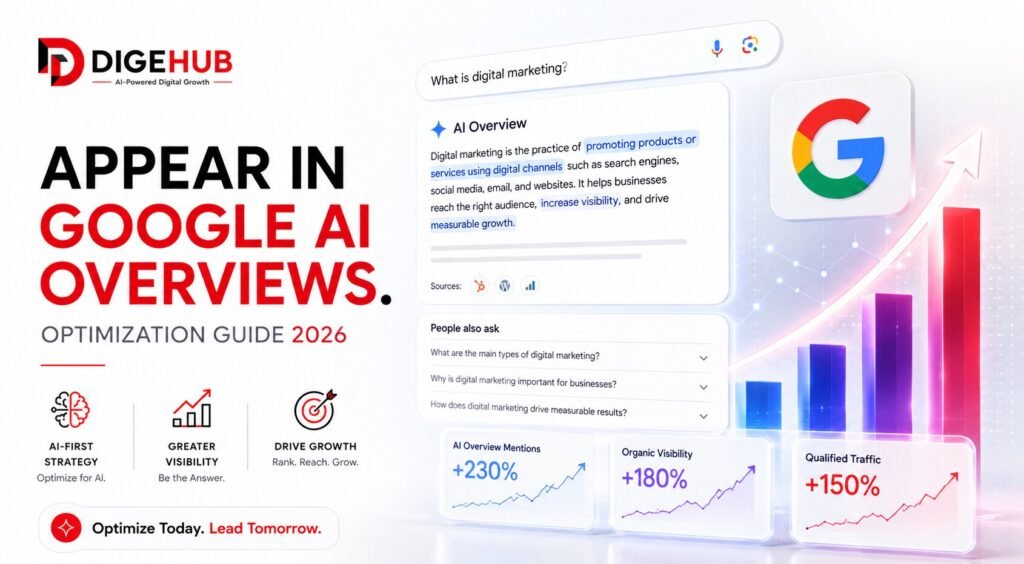
- How to Appear in Google AI Overviews: Optimization Guide 2026 (What Most Blogs Miss)
- What's Actually Happening With Google AI Overviews in 2026
- Quick Answer: How Do You Get Into Google AI Overviews?
- The Citation Gap Most Brands Are Missing
- How Google Actually Selects Content for AI Overviews
- Step-by-Step: Optimizing for AI Overviews in 2026
- The Content Structure Google's AI Rewards
- Entity Authority: The Signal Most SEOs Skip
- Technical Signals That Actually Matter
- Industry-Specific Exposure and What To Do About It
- The AI Mode Complication Nobody's Talking About
- Common Mistakes Killing Your AI Overview Chances
- Expert Insights on AI Overview Optimization
- Future Trends: Where This Is All Heading
- FAQ: Google AI Overviews Optimization
- The Bottom Line
What’s Actually Happening With Google AI Overviews in 2026
Let me be blunt about what’s happening to organic search right now, because most of the content on this topic softens it too much.
Google AI Overviews now appear on roughly 48 to 50% of all US search queries. That’s up from just 6.49% in January 2025, which means the feature has expanded nearly 8x in 15 months. Globally, it reaches over 2 billion monthly users across 200+ countries and 40+ languages. This isn’t a beta feature or an experiment anymore. It’s the new default surface for how Google delivers information.
And here’s the number that should get your attention: organic click-through rate on queries that trigger an AI Overview dropped 61%, from 1.76% to 0.61%, according to Seer Interactive’s landmark study across 2.43 billion impressions. Pew Research’s independent analysis of 68,000 queries puts the click reduction at 46.7%. Even the most conservative study (Amsive Digital, 700,000 keywords) confirms a 15.5% hit.
But here’s where it gets interesting, and where most optimization guides stop short.
Brands that get cited inside AI Overviews earn 35% more organic clicks and 91% more paid clicks than uncited brands ranking at position one below the AI answer. Let that sink in. Being cited in AI Overviews can outperform ranking first in traditional results. This isn’t a reason to panic. It’s a reason to completely rethink how you’re approaching visibility.
The game didn’t end. It changed surfaces.
Quick Answer: How Do You Get Into Google AI Overviews?
Google AI Overviews pull from content that satisfies these core criteria:
- Clear, direct answers to informational queries written in plain language
- Topical authority across a cluster of related content, not just a single optimized page
- Strong E-E-A-T signals, including author expertise, real-world experience, and verifiable credentials
- Structured content with clean heading hierarchies, FAQ schema, and concise answer paragraphs
- Entity recognition, meaning Google understands who you are, what you cover, and that you’re trustworthy
- External brand mentions, which Ahrefs found correlate at 0.664 with AI Overview citations
- Fresh, updated content, because content freshness matters 3x more for maintaining AI citations
You don’t need to rank #1 to get cited. Research confirms that roughly 38% of cited pages don’t rank in the organic top 10 at all. Google’s AI reaches further down the results to find the most useful answer.
If you’re new to this space, it helps to start with the fundamentals. We’ve covered the foundations in What Is AI Search Visibility? and What Is Generative Engine Optimization?, both of which explain the broader framework that Google AI Overviews optimization sits inside.
The Citation Gap Most Brands Are Missing
This is the section I wish more guides would actually talk about.
Most businesses are still optimizing for position one. But Google AI Overviews don’t care about your position as much as they care about your answerability and credibility. There’s a gap between ranking well and being cited, and most brands aren’t tracking it.
The breakdown works like this. Queries without an AI Overview generate about 33,500 clicks per million impressions. Cited brands on AIO queries get around 20,743. But uncited brands on those same queries? Only 9,445, which is less than a third of the pre-AIO baseline.
What this tells us is that there are now three tiers in search:
- Cited in the AI Overview (highest visibility, highest brand authority signal)
- Ranking organically below the AIO (reduced but still meaningful click traffic)
- Not cited, not visible (effectively invisible for that query)
If you’re in tier two or three right now, your optimization strategy needs to address citation, not just ranking. These are different problems with partially different solutions.
The first step is an audit. You need to know which of your high-value informational keywords are triggering AI Overviews and whether your content is appearing in them. Most analytics platforms don’t show this by default. Tools like BrightEdge, Semrush’s AI Overview tracker, or dedicated GEO platforms can surface this data. If you want help building that audit and closing the visibility gap, our AI Visibility Services are built exactly for this.
How Google Actually Selects Content for AI Overviews
Understanding the selection mechanism changes how you approach optimization.
Google’s AI Overviews use a process called FastSearch combined with query fan-out, where Gemini issues multiple related sub-queries, synthesizes answers from different sources, and produces a unified response. It’s not scraping the top-ranking page. It’s triangulating from multiple credible sources.
This means a few things:
First, single-page optimization isn’t enough. Google’s system is looking for a signal that you genuinely understand a topic across multiple angles. A brand that has ten well-structured pieces covering a topic cluster looks more authoritative than a brand with one perfectly optimized pillar page.
Second, citation isn’t random. The most reliable predictors of AI Overview citation, based on Ahrefs’ 2026 data, are external brand mentions (correlation of 0.664), domain authority (sites with 32,000+ referring domains are 3.5x more likely to be cited in ChatGPT and AI surfaces), and content structure.
Third, Reddit and YouTube dominate the citation pool. Surfer SEO’s analysis of 46 million citations found YouTube at 23.3% and Wikipedia at 18.4%. Other research puts Reddit at 21%. This isn’t a coincidence. Google trusts user-generated content and established community knowledge because it carries implicit social proof. For brands, this means your presence on these platforms, through authentic participation not thin content, matters.
Fourth, informational intent is almost exclusively what triggers AIOs. Research on 300,000 AIO-triggering keywords found that 99.2% had informational intent. Transactional queries are largely protected. Only about 4% of e-commerce searches trigger AI Overviews, down from 29% at launch.
This selection mechanism is also why LLMO (Large Language Model Optimization) has become its own discipline rather than a footnote inside traditional SEO. For the full breakdown of how LLMO differs from classic search optimization, see What Is LLMO Optimization?
Step-by-Step: Optimizing for AI Overviews in 2026
Step 1: Map Your Informational Content Exposure
Before you optimize anything, audit your informational content against AIO trigger rates in your industry. If you’re in healthcare (88% AIO coverage), education (83%), or B2B tech (70%), virtually every informational query you care about is already triggering an AI Overview. The urgency is different for a SaaS company than a local restaurant.
Create a spreadsheet of your top 50 informational keywords. Check which ones trigger AI Overviews. Note whether your content is cited. This becomes your priority list.
Step 2: Build Topical Clusters, Not Isolated Pages
Stop writing individual blog posts and hoping they rank. Build content clusters where a comprehensive pillar page connects to multiple supporting pieces, each covering a distinct subtopic with real depth. Google’s Gemini doesn’t just look at one page. It looks at the entire body of evidence that your brand covers a subject seriously.
For each cluster, you should have:
- A definitive guide (the pillar)
- Supporting posts covering adjacent questions
- A FAQ or glossary page if the topic warrants it
- Internal links connecting all of them logically
Step 3: Write for Direct Answer Extraction
Every section of your content should be structured so that a specific paragraph could be lifted and used as a standalone answer. This sounds obvious but most content is structured to tell a story, not to be extracted.
The optimal format: a heading that mirrors the search query, followed by a 40 to 60 word direct answer, followed by supporting explanation and context. Think of every H2 and H3 as a mini-featured-snippet opportunity.
Avoid burying your answer. If someone asks “how do I appear in Google AI Overviews,” your first paragraph under that heading should answer it directly, not build up to it.
Step 4: Implement Schema Markup Properly
FAQ schema, HowTo schema, and Article schema all increase the probability of Google extracting your content for AI Overviews. This is not a guarantee, but structured data makes it unambiguous for Google’s systems to identify the answer, the context, and the source.
Implement FAQ schema on every content piece that answers multiple questions. Use HowTo schema on step-based guides. Make sure your Article schema includes author name, author credentials, and date modified, as these are E-E-A-T signals the system reads.
Step 5: Invest in Author and Brand Entity Signals
This is where most brands are genuinely underinvesting. Google’s AI systems make trust judgments based on entity signals, not just content quality. Entity optimization means:
- Author profiles with real credentials, bios, and links to external presence (LinkedIn, industry publications, speaker pages)
- A well-structured About page that clearly defines what your brand does, who it serves, and why it’s credible
- Consistent NAP data if you’re a local or regional business
- Wikipedia presence if achievable (most B2B brands won’t reach this, but industry directory listings serve a similar function)
- Third-party mentions in credible publications, especially those in your vertical
The external brand mention correlation with AI citations (0.664 per Ahrefs) is one of the strongest signals in the research. Getting mentioned in industry media, quoted in roundups, or referenced in authoritative blogs genuinely moves the needle.
Step 6: Update Content Consistently
Content freshness matters 3x more for maintaining AI Overview citations than for traditional rankings. If a piece of yours gets cited, it won’t stay cited forever without maintenance. AI Overviews reflect current web knowledge, so a post with outdated statistics or missing 2025/2026 data will eventually get replaced.
Build a content refresh calendar. Every pillar page and high-value informational post should be reviewed and updated at least quarterly. Add new data, update statistics, remove outdated references, and revise your main answers to reflect the current state of the topic.
The Content Structure Google’s AI Rewards
Beyond keywords, the formatting of your content is a signal in itself. Here’s what the research and our own testing consistently shows works:
Clear heading hierarchy. H1 for the page topic, H2 for major sections, H3 for subsections. Never use headings decoratively. Every heading should be answering a question or naming a concept.
Short answer paragraphs before expanded explanation. Lead with the answer, then elaborate. This is the opposite of how academic writing works, and it’s exactly what AI extraction needs.
Numbered lists and bullet points for processes. Google’s AI is much more likely to pull structured lists than wall-of-text explanations when the query is procedural. “How to” content that uses numbered steps outperforms prose equivalents in AIO citations.
Tables for comparisons. If you’re comparing options, tools, or approaches, a table format signals that this is extractable data.
Real statistics with dates and sources. Vague claims don’t get cited. Specific, sourced statistics do. Including research data with attribution signals that your content meets the factual verification standard AI systems need.
Bold key terms in context. This helps parsing systems identify what’s being defined or emphasized, without relying solely on heading structure.
This kind of answer-first formatting is, at its core, Answer Engine Optimization. If you want a deeper look at the discipline behind it, we’ve broken it down fully in What Is Answer Engine Optimization?
Entity Authority: The Signal Most SEOs Skip
Entity SEO is the piece of Google AI Overview optimization that gets the least attention and probably has the most leverage.
Google’s Knowledge Graph underpins how AI systems understand who is credible on what topic. If Google’s systems don’t have a clear entity understanding of your brand, your authors, and your topical focus, you’re competing for citation with one hand tied behind your back.
Here’s how to build entity authority in practice:
Define your topical territory clearly. Your website should make it unambiguous what subjects you cover with depth. Diluted topical coverage sends weak entity signals. If you’re an SEO agency that also writes about recipes, that confusion carries over into how Google categorizes you.
Get your brand mentioned on established sites. Contributing articles to industry publications, being quoted in research roundups, earning backlinks from recognized authorities in your space, these aren’t just link-building tactics. They’re entity validation signals that tell Google’s knowledge graph you’re a recognized voice.
Use structured data to declare your identity. Organization schema, Person schema for authors, and BreadcrumbList schema all help Google parse your entity relationships more accurately.
Claim and optimize your Google Business Profile if applicable. Your Knowledge Panel, if you have one, is a direct entity signal.
Technical Signals That Actually Matter
A few technical factors come up consistently in research on AI Overview citation behavior:
Page speed and Core Web Vitals. Slow pages don’t get cited. Google’s AI systems don’t extract from pages that fail basic user experience standards. Aim for LCP under 2.5 seconds, CLS under 0.1, and INP under 200ms.
Clean, crawlable HTML. Content buried in JavaScript frameworks that require rendering is harder for Googlebot (and Gemini’s retrieval) to parse. Ensure your key content is in the page’s initial HTML response, not loaded dynamically after the fact.
HTTPS. Not worth mentioning for most sites, but we still occasionally audit sites without it. Google doesn’t cite insecure pages in AI Overviews.
Logical URL structure. URLs that reflect content hierarchy (e.g., /blog/topic/subtopic) perform better in topical authority signals than random slug patterns.
Canonical tags. Duplicate content confusion can suppress citation probability. Ensure your canonicals are clean and accurate.
Industry-Specific Exposure and What To Do About It
Not all industries are equally affected by AI Overviews, and your strategy should be calibrated to your sector’s exposure:
Healthcare (88% AIO coverage): Every informational query about symptoms, treatments, or health guidance is almost certainly triggering an AI Overview. E-E-A-T is non-negotiable here. Author credentials, medical reviewer attribution, and cited clinical sources are essential for citation consideration.
Education (83%): Coverage grew 361% in a single year. Informational and definitional content in the education space is now almost entirely AI-answer territory. Tactical pivot: focus educational content on opinion, analysis, and original insight that AI can’t synthesize from public sources.
B2B Technology (70%): SaaS and tech companies face significant AIO exposure on product category and comparison queries. Strategy: dominate your specific product niche with depth, case studies, and original data.
E-commerce (4%): Largely protected. Transactional queries remain in traditional SERP format. The optimization focus for e-commerce brands should shift toward supporting informational content that builds brand authority and funnels into product pages.
Marketing, Agencies, and SaaS (mixed): Informational and how-to content is highly exposed. Service pages and pricing pages are much less so. A combined strategy of informational AIO optimization plus commercial intent SEO is the right approach.
The AI Mode Complication Nobody’s Talking About
Here’s something most Google AI Overviews guides are not covering properly: AI Overviews and Google’s new AI Mode are two different surfaces, and they cite different content.
Google AI Mode, the conversational chat-style search experience powered by Gemini, surpassed 1 billion monthly users in 2026. Its queries use a “query fan-out” technique, issuing multiple related searches and synthesizing a comprehensive response.
The critical data point: AI Mode and AI Overviews cite the same URLs only 13.7% of the time, even though they often reach similar conclusions. This means that ranking for or being cited in AI Overviews does not automatically mean you’re visible in AI Mode, and vice versa.
If you’re optimizing only for AI Overviews, you’re potentially invisible on a surface that has already reached 1 billion users and is growing faster than almost any product in Google’s history.
The implication for brands is significant: comprehensive AI visibility requires optimizing for multiple surfaces with distinct retrieval behaviors, not just one. This is why a disciplined AI Visibility strategy has to cover both surfaces, monitor citation patterns separately, and measure visibility as brand mentions, not just clicks.
The same logic extends beyond Google. ChatGPT has its own retrieval behavior, its own citation preferences, and its own blind spots, all distinct from both AI Overviews and AI Mode. We’ve covered that surface separately in How to Rank in ChatGPT, which is worth reading alongside this guide if your buyers research across multiple AI tools, not just Google.
Common Mistakes Killing Your AI Overview Chances
Writing for humans only. Your content needs to serve human readers and be extractable by AI systems. These goals aren’t in conflict, but they require intentional structure.
Publishing and forgetting. The 3x freshness signal for AI citation maintenance is real. Old, un-updated content loses its citation status over time.
Optimizing single pages in isolation. Topical authority is a cluster-level signal. One great page surrounded by thin content won’t get consistent citation.
Ignoring external mentions. If nobody in your industry is linking to or citing your brand, AI systems have weak validation signals. Invest in digital PR, guest contributions, and strategic outreach.
Burying answers in introductions. Long preambles before the actual answer are one of the clearest patterns that reduces AI extractability.
Relying only on traditional rank tracking. If your analytics and reporting don’t include AI Overview citation rate, you’re flying blind on roughly half of all search queries.
Treating AI Overviews and AI Mode as the same surface. As covered above, they’re not. Tracking and optimizing for both requires a different approach than traditional SEO.
Expert Insights on AI Overview Optimization
A few things we’ve observed from working across SEO and AI visibility campaigns:
The brands winning AI Overview citations most consistently aren’t necessarily the ones with the highest domain authority. They’re the ones with the clearest content architecture. When Google’s AI can reliably find, parse, and trust specific answers from your content, it uses them. Authority helps, but clarity is often the more decisive factor.
Original data is a genuine differentiator. Proprietary studies, original surveys, internal case study data, these are things AI systems can’t synthesize from combining other sources. If you publish original research, it becomes a citation anchor that competitors can’t replicate by writing similar content.
Also, the FAQ section of your content is underrated. Well-structured FAQ content with schema markup is disproportionately represented in AI Overview citations because it’s the clearest possible signal of direct question-answer pairs. Every major piece of content should have one.
Finally, the “experience” component of E-E-A-T is getting more weight, not less. Content that demonstrates personal or organizational experience (first-person case studies, original testing, documented processes) is being favored over content that synthesizes existing knowledge. AI can do synthesis. It can’t replicate genuine experience.
Future Trends: Where This Is All Heading
A few trends that are already in motion and will compound through the rest of 2026 and beyond:
AI Mode will continue absorbing informational search. With query volume doubling every quarter, AI Mode is becoming the default interface for complex, multi-part questions. Content that performs well in AI Overviews may still underperform in AI Mode if it’s not structured for multi-part synthesis.
Zero-click is the new normal for informational queries. 60% of searches already end without a click. For purely informational content, the goal shifts from driving traffic to occupying citation real estate. Brand visibility inside the answer is increasingly more valuable than the click.
Ads alongside AI Overviews are scaling rapidly. Semrush data shows ads appearing alongside AI Overviews grew from 3% of SERPs in January 2025 to 40% by November. For brands running Google Ads, the paid and organic strategies around AI Overviews are converging in ways that create compounding visibility.
Agentic AI search will shift the optimization target again. BrightEdge’s April 2026 data predicts that most online customer interactions will occur through AI agents by end of 2026. When an AI agent is researching on behalf of a user and making decisions, the citation signal becomes even more critical. Your content needs to be the source agents quote, not just a page users visit.
Gartner’s projection that 25% of organic search traffic will shift to AI chatbots and voice assistants by end of 2026 appears to be on track. If you haven’t started planning content for an AI-first search landscape, the window for proactive adaptation is narrowing.
FAQ: Google AI Overviews Optimization
1. What is Google AI Overviews optimization?
Google AI Overviews optimization is the process of structuring, positioning, and building authority around your content so that Google’s Gemini-powered AI systems select it as a cited source in AI-generated answer summaries at the top of search results.
2. Do I need to rank #1 to appear in Google AI Overviews?
No. Research confirms that roughly 38% of pages cited in AI Overviews don’t rank in the organic top 10. AI Overviews pull from a much broader source pool based on topical authority, content structure, and trust signals rather than position alone.
3. How long does Google AI Overviews optimization take to show results?
There’s no fixed timeline. Factors like your domain authority, topical cluster depth, schema markup, and external brand mentions all influence how quickly Google’s systems begin selecting your content. Most brands see initial citation improvements within 60 to 90 days of systematic optimization.
4. What content types get cited most in Google AI Overviews?
Informational content dominates: how-to guides, definitional content, comparison posts, and FAQ sections. 99.2% of AIO-triggering queries have informational intent. Content with clear heading structure, FAQ schema, and direct answer paragraphs is cited most reliably.
5. Does Google AI Overviews optimization hurt traditional SEO?
No. The practices that improve AI Overview citation, such as topical authority, E-E-A-T, structured content, and technical quality, overlap almost entirely with best-practice traditional SEO. They reinforce each other.
6. How are Google AI Overviews different from Google AI Mode?
AI Overviews are summaries embedded at the top of standard Google SERPs. AI Mode is a separate conversational, chat-style search experience. They use different retrieval systems and cite different pages (same URL overlap is only 13.7%), so they require distinct optimization approaches.
7. What industries are most affected by Google AI Overviews?
Healthcare (88% coverage), education (83%), and B2B technology (70%) face the highest AIO exposure. E-commerce is largely protected at just 4%.
8. Should I be worried about AI Overviews hurting my traffic?
If your content is informational and you’re not being cited, yes, the traffic impact is real. But the response is optimization, not retreat. Brands cited in AI Overviews see 35% more organic clicks than uncited brands on the same queries. The strategy is to be cited.
9. How is Google AI Overviews optimization different from LLMO or GEO?
They overlap heavily but aren’t identical. LLMO and GEO cover optimizing for AI platforms broadly, including ChatGPT and Perplexity, while Google AI Overviews optimization focuses specifically on Google’s Gemini-powered retrieval and citation behavior. Most of the underlying tactics, freshness, entity clarity, structured data, transfer across both.
10. Do external brand mentions actually affect Google AI Overviews citations?
Yes, significantly. Ahrefs’ 2026 data found a 0.664 correlation between external brand mentions and AI Overview citation likelihood, making it one of the strongest predictive signals identified so far. Earning mentions in credible publications and industry roundups is a genuine optimization lever, not just a branding exercise.
The Bottom Line
Most brands are watching AI Overviews from the sideline, confused about whether to optimize for them or work around them. The data is clear enough at this point to act on: nearly half of all Google searches trigger AI Overviews, citations drive significantly more traffic than non-cited rankings on those queries, and the gap between being cited and being invisible is growing.
The optimization playbook isn’t fundamentally different from good SEO, but the emphasis has shifted. Topical clusters over individual pages. Answer-forward structure over narrative flow. Entity authority over keyword density. External mentions over internal optimization alone. And freshness as an ongoing operational commitment, not a one-time publish.
If you’re operating in a high-AIO industry (healthcare, education, B2B tech, marketing) and you don’t have an AI visibility strategy running in parallel with your traditional SEO, you’re already behind.
We work with brands across the USA, UK, Canada, and Australia to close exactly this gap. If you want to understand where your content stands in the citation landscape and build a systematic plan to improve it, our AI Visibility Servicesand SEO Services are the place to start.
And if you want to quickly audit your content’s AI-readiness before that, try our Free SEO Blog Writing Tool to see how your content measures up.
Digehub works with global brands across the USA, UK, Canada, and Australia on SEO, AI visibility, and content strategy.