AI Visibility Service Cost India 2026: The Honest Pricing Guide for Indian Businesses
Why Indian Businesses Are Asking About AI Visibility Pricing Right Now
AI visibility service cost in India has become one of the most searched commercial queries in the digital marketing space in 2026, and the reason is straightforward. India now accounts for 22.75% of Perplexity’s entire global traffic, and Perplexity AI users in India grew by 640% year-on-year in Q2 2025 after Airtel introduced free access to Perplexity Pro. Google AI Overviews are live across India. ChatGPT processes 2.5 billion queries daily globally with India among its fastest-growing markets. The buyer behavior has shifted. Indian businesses’ potential customers are researching products, vendors, and services inside AI tools, not just on traditional search results pages.
The urgency is real. India has the highest AI adoption rate globally at 59%, and the gap between how actively Indian consumers use AI search tools and how prepared Indian businesses are to appear in AI-generated responses is wide. Most Indian businesses haven’t started building AI visibility infrastructure. The ones that do now earn first-mover citation authority that compounds over time while competitors are still at the awareness stage.
This guide gives you the actual numbers, the tier breakdowns, the hidden costs, the ROI math, and the questions you need to ask before committing to any AI visibility agency. No “book a call to find out pricing” deflection. Direct answers.
- AI Visibility Service Cost India 2026: The Honest Pricing Guide for Indian Businesses
- Why Indian Businesses Are Asking About AI Visibility Pricing Right Now
- Quick Answer: What Does AI Visibility Service Cost in India?
- What an AI Visibility Service Actually Includes
- The Four Pricing Tiers: What You Get at Each Level
- Indian Agency vs. Global Agency: How Pricing Differs
- What Gets Billed Separately and What's Often Hidden
- How to Calculate ROI on AI Visibility Investment
- What to Expect in the First 90 Days
- How to Evaluate an AI Visibility Agency Before Signing
- Industry-Specific Pricing Considerations for India
- When to Upgrade Your AI Visibility Investment
- Common Mistakes Indian Businesses Make When Buying AI Visibility Services
- Expert Insights: What Drives Price Differences Between Agencies
- Future Trends: How AI Visibility Pricing Will Evolve
- FAQ: AI Visibility Service Cost India
Quick Answer: What Does AI Visibility Service Cost in India?
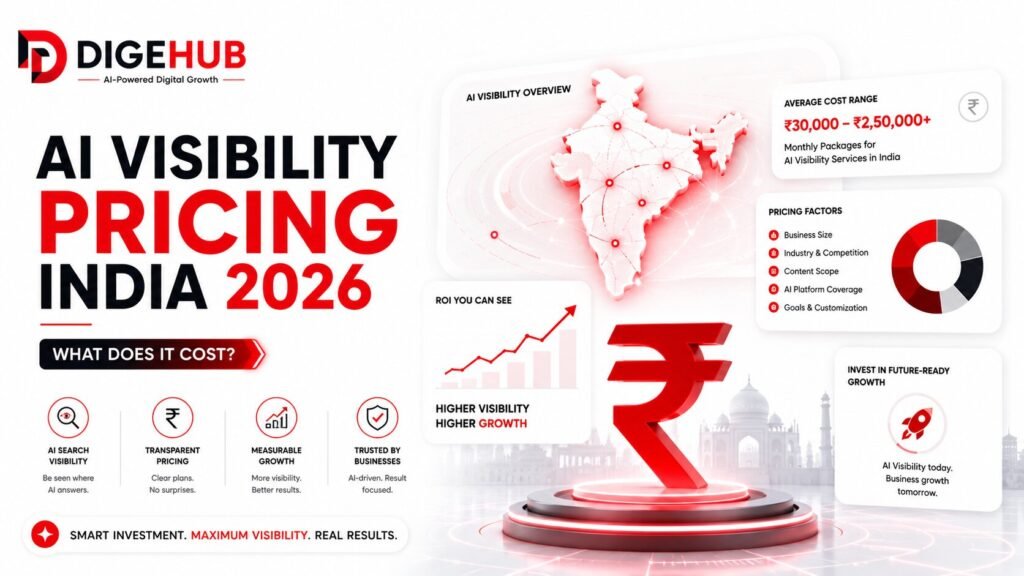
AI visibility service cost in India ranges from Rs 25,000 to Rs 8,00,000 per month depending on scope, number of AI platforms targeted, content volume, and agency tier. For international agencies serving Indian clients in USD, the equivalent range is approximately $500 to $8,000 per month.
The practical breakdown:
- Entry-level (Rs 25,000 to Rs 75,000/month): Single platform focus, minimal content, basic schema. Appropriate for very early-stage startups or businesses testing the channel.
- Starter (Rs 75,000 to Rs 1,50,000/month): Two to three platform optimization, 2 to 4 content pieces monthly, entity optimization, foundational schema. Appropriate for growth-stage businesses with limited budget.
- Growth (Rs 1,50,000 to Rs 4,00,000/month): Multi-platform coverage, 6 to 8 content pieces monthly, comprehensive entity building, full schema, bi-weekly reporting. This is where most funded Indian startups and mid-market businesses operate.
- Enterprise (Rs 4,00,000 to Rs 8,00,000+/month): Large-scale content operations, custom dashboards, competitive intelligence monitoring, dedicated account team. Appropriate for Series B+ companies, enterprise businesses, or brands with multiple product lines.
Most Indian B2B businesses in competitive categories see the best ROI in the Rs 1,50,000 to Rs 3,00,000 tier, where multi-platform optimization, schema implementation, and consistent content production work together to build compounding citation authority.
What an AI Visibility Service Actually Includes
Before comparing prices, understand what you’re buying. AI visibility services are not a single product. They’re a bundle of workstreams, and different agencies include different things in their retainer versus billing separately. Knowing the component breakdown is the most important step before evaluating any pricing proposal.
AI Visibility Auditing and Monitoring
This is the diagnostic and measurement layer. A proper audit covers your current citation status across ChatGPT, Perplexity, Google AI Overviews, and Gemini for your target queries. It maps where you appear, where competitors appear, which queries you’re missing from, and what structural issues are preventing citation. Ongoing monitoring tracks citation rate by platform, citation position, competitor share, and AI referral traffic in your analytics. This should be a monthly deliverable, not a one-time exercise.
If an agency can’t show you what your current citation status looks like across multiple platforms before you sign, that’s a red flag.
Entity Optimization
Entity optimization establishes your brand as a recognized, verifiable entity in AI knowledge systems. This covers Organization schema implementation (sitewide, not just the About page), LinkedIn company profile optimization, Google Business Profile completeness, Wikidata entity creation or verification, industry directory listings, and sameAs linking across platforms.
This is often treated as a one-time setup in months 1 and 2, with maintenance-level effort afterward. Beware agencies that price entity optimization as a major ongoing monthly cost without explaining what they’re actually doing each month.
Content Creation and Optimization
Content is the primary ongoing workstream. AI visibility content follows specific structural requirements: answer-forward openings (answering the core question within the first 100 words), question-style headings, self-contained evidence units with sourced data, FAQ sections, and FAQ schema. Each piece is optimized for citation across specific target queries on specific AI platforms.
Monthly content volume is one of the most significant pricing variables. A retainer that includes 2 pieces per month versus 8 pieces per month at the same price point is not the same service. Always verify content volume and content standards before comparing prices.
Technical Implementation
This covers schema markup deployment (FAQ schema, Article schema with author credentials, Organization schema, HowTo schema on relevant content), robots.txt configuration to ensure AI crawlers including PerplexityBot and OAI-SearchBot can access your content, Bing Webmaster Tools submission (critical for Perplexity and ChatGPT which use Bing’s index), and UTM tracking configuration for AI referral traffic attribution in GA4.
Technical implementation is typically heavier in months 1 and 2 and then maintenance-level afterward. This is worth knowing because some agencies quote high ongoing monthly fees for technical work that should largely be complete by month 3.
The full picture of how these components work together to earn AI citations is covered in our guide on how AI search engines choose content, and the underlying strategic framework is our SEO squared methodology.
The Four Pricing Tiers: What You Get at Each Level
Here’s an honest breakdown of what each investment tier typically includes, what it’s appropriate for, and what its limitations are.
Tier 1: Entry-Level (Rs 25,000 to Rs 75,000/month)
What you typically get: Single AI platform focus (usually ChatGPT or Google AI Overviews, rarely both), 1 to 2 content pieces per month, basic schema markup on a handful of pages, monthly report.
What you don’t get: Multi-platform coverage, comprehensive entity building, content volume sufficient to build topical cluster authority, active monitoring across multiple platforms.
Appropriate for: Pre-seed or bootstrapped startups that want to understand AI visibility before committing more, or businesses in very low-competition niches where even minimal content produces citations.
Realistic expectations: Citation appearances will be sporadic at best. You’re paying for learning and foundation, not consistent results. This tier is not appropriate for businesses in competitive categories or with immediate commercial pressure on the channel.
Tier 2: Starter (Rs 75,000 to Rs 1,50,000/month)
What you typically get: Two to three platform optimization (ChatGPT, Perplexity, and Google AI Overviews), 3 to 4 content pieces per month, entity optimization including Organization schema and LinkedIn, basic author entity setup, monthly reporting.
What you don’t get: Comprehensive schema implementation across all content, Gemini-specific optimization, deep topical cluster strategy, original research, competitive intelligence monitoring.
Appropriate for: Seed-stage startups, SMBs in moderately competitive categories, or businesses supplementing an existing SEO program with AI visibility as an add-on.
Realistic expectations: Initial citations will appear in months 3 to 4 on less competitive queries. This tier can work if you’re patient and consistent, but topical cluster authority will be slow to build at 3 to 4 pieces per month.
Tier 3: Growth (Rs 1,50,000 to Rs 4,00,000/month)
What you typically get: Full multi-platform coverage across ChatGPT, Perplexity, Google AI Overviews, and Gemini, 6 to 8 content pieces per month, comprehensive entity building including Wikidata, full schema implementation across all content, author Person schema for all writers, bi-weekly reporting and strategy, competitive citation monitoring, Bing Webmaster Tools optimization.
What you don’t get: Custom AI visibility dashboards, dedicated account team, integration with paid media programs, original research production (usually optional at extra cost at this tier).
Appropriate for: Most funded Indian startups (Series A and above), mid-market businesses, B2B SaaS companies, professional services firms in competitive categories, D2C brands with significant informational content needs.
Realistic expectations: Initial citation appearances by months 2 to 3, consistent multi-platform citations by month 5 to 6, compounding growth in citation authority from month 6 onward. This is the tier where AI visibility typically starts generating measurable referral traffic and attributable lead flow.
Tier 4: Enterprise (Rs 4,00,000 to Rs 8,00,000+/month)
What you typically get: Everything in Tier 3 plus: 10 to 15+ content pieces per month across multiple content types (pillar content, supporting cluster content, original research, regional language content), custom Share of Model dashboards, dedicated content and strategy team, competitive intelligence monitoring, integration with existing SEO and paid media programs, C-level reporting, original research production, multilingual content (Hindi, Tamil, Telugu, etc. as relevant).
Appropriate for: Series B+ companies, large enterprise Indian businesses, businesses with multiple product lines or market segments, companies with international expansion ambitions where AI visibility across global platforms matters.
Realistic expectations: At this investment level, with proper execution, brands typically achieve dominant citation positions in their category within 6 to 9 months and maintain them through content velocity and freshness discipline.
Indian Agency vs. Global Agency: How Pricing Differs
This distinction matters and most pricing guides ignore it. Indian businesses buying AI visibility services have two distinct options: Indian agencies that price in INR for the domestic market, and global agencies (including international agencies with India-serving operations) that may price in USD or at INR rates that reflect international cost structures.
Indian agency pricing generally falls in the ranges described in the tier breakdown above. The content is produced in India by Indian teams, which means both cost efficiency and the advantage of genuine India-specific market knowledge for content that targets Indian buyers.
Global agency pricing for Indian clients varies widely. Agencies headquartered in the US or UK and serving Indian clients often charge in USD, which translates to Rs 3,000 to Rs 8,000 per month at entry level and Rs 25,000 to Rs 80,000+ per month at enterprise level. In some cases this reflects genuinely different expertise or access to global citation networks. In many cases it doesn’t. Evaluate based on demonstrated outcomes, not location of HQ.
The key question to ask any agency, Indian or global: Can you show me specific examples of clients you’ve gotten cited on Perplexity, ChatGPT, and Google AI Overviews in India-relevant queries? The answer tells you more than the price does.
For the India-specific AI visibility landscape, including which platforms matter most in the Indian market and why Perplexity’s 640% India growth changes the strategic priority order, see our AI visibility guide for Indian businesses.
What Gets Billed Separately and What’s Often Hidden
This is the section that saves you budget surprises. Here are the items most commonly outside the monthly AI visibility retainer.
One-time onboarding or setup fee. Many agencies charge Rs 50,000 to Rs 1,50,000 for the initial comprehensive audit, entity architecture planning, schema design, and strategy roadmap. This is legitimate if clearly defined. Watch for agencies that bury this fee in the first month’s invoice without disclosing it upfront.
Content production above the included volume. Retainers include a defined number of content pieces per month. Additional pieces are typically billed at Rs 5,000 to Rs 25,000 per piece depending on length, complexity, and research requirements. If your industry needs more content velocity to compete, budget for this from the start.
Original research production. Proprietary surveys, original data studies, and industry research reports are almost always billed separately and at premium rates. A well-executed original research report typically costs Rs 75,000 to Rs 2,00,000 depending on scope. The ROI is disproportionate because original data creates citation anchors that persist indefinitely, but it’s rarely included in base retainers.
Tool and platform subscriptions. AI visibility monitoring platforms (Profound, BrightEdge, or specialized GEO tools), schema validators, and competitive intelligence subscriptions may be passed through at cost or bundled differently by different agencies. Clarify what tools are used and who pays for subscriptions.
Development and technical work beyond standard scope. If your website needs structural changes to support schema implementation correctly (common on older WordPress sites or custom CMS builds), development hours are typically billed separately. Budget Rs 15,000 to Rs 50,000 for this if your site hasn’t had a technical SEO audit recently.
Regional language content. Hindi, Tamil, Telugu, Kannada, or other regional language AI visibility content is almost always outside standard retainers and billed either per piece or as a separate program track. Given that regional language AI search is genuinely uncrowded territory right now, this may be worth adding proactively.
Reporting and analytics setup. GA4 configuration for AI referral traffic attribution, custom dashboard setup, and integration with your existing analytics infrastructure are sometimes included and sometimes not. Confirm upfront.
How to Calculate ROI on AI Visibility Investment
The ROI calculation for AI visibility differs from paid advertising because the returns compound and don’t reset monthly when spending stops. Here’s the framework.
Step 1: Establish your baseline metrics. What is your current AI citation rate across your 20 most important queries on Perplexity, ChatGPT, and Google AI Overviews? If you don’t know this, your agency should run an audit as the first deliverable. Without a baseline, you can’t measure improvement.
Step 2: Define target citation metrics. How many queries do you want to be cited on? At what position? On which platforms? These targets, combined with the agency’s delivery history, give you a realistic timeline for results.
Step 3: Calculate expected traffic and conversion value. AI-referred traffic currently converts at 14.2% according to available research, compared to Google organic’s 2.8%. Even small volumes of AI-sourced visits carry disproportionate commercial value. If your AI visibility investment generates 30 qualified visits per month by month 6 and your average customer value is Rs 2,00,000, you need fewer than 2 conversions to justify a Rs 2,00,000 monthly retainer.
Step 4: Account for the compounding effect. Content that earns AI citations in month 4 continues earning them in month 12, month 24, and beyond without incremental cost per citation. The ROI calculation for month 12 is materially different from month 4 because the content library keeps working. This is why AI visibility is correctly described as an investment rather than a recurring advertising cost.
Step 5: Track Share of Model as the primary AI visibility KPI. Share of Model measures how often your brand appears when AI systems discuss your category. This metric, tracked monthly across your core queries, is a leading indicator of downstream commercial impact. An agency that can’t define how they’ll measure and report Share of Model improvement isn’t managing an AI visibility program. They’re managing content production.
What to Expect in the First 90 Days
Setting realistic expectations for the first 90 days prevents early misalignment and premature program cancellation. Here’s what a well-executed program looks like month by month.
Month 1: Foundation. The comprehensive AI visibility audit completes. Your baseline citation status is documented across all target platforms. Entity optimization begins: Organization schema goes live sitewide, LinkedIn profile is optimized, Wikidata entity is created or verified, sameAs links are connected. Robots.txt is updated for AI crawler access. Bing Webmaster Tools is configured. The content strategy is finalized with query mapping. The first 1 to 2 content pieces publish in week 4. You won’t see meaningful AI citations yet. The infrastructure is being built.
Month 2: Building. The content publishing cadence reaches full production. Author pages are built or improved with Person schema. FAQ schema and Article schema go live across all new content and priority existing content. The first citations may begin appearing on lower-competition queries on Perplexity (which can index and cite fresh content within days). AI referral traffic tracking is confirmed in GA4. The reporting infrastructure is complete.
Month 3: Early signals. If execution is strong, initial citations should be appearing across multiple queries on Perplexity. Google AI Overview citations may begin appearing on informational queries in your topic area. ChatGPT citations are unlikely at this stage without established domain authority, but the entity signals are being built. The content cluster is taking shape with 6 to 10 pieces published.
The brands that quit before day 90 lose their entire investment. The brands that push through the foundation period and into month 4 start seeing the compounding returns that make AI visibility one of the highest-ROI digital marketing investments available in 2026.
How to Evaluate an AI Visibility Agency Before Signing
AI visibility is a relatively new discipline and the market has many agencies repackaging traditional SEO with “AI” language added. Here’s how to separate genuine AI visibility expertise from surface-level rebadging.
Ask for specific citation evidence. Request screenshots or reports showing current client brands being cited by name in ChatGPT, Perplexity, Google AI Overviews, or Gemini for relevant queries. Generic “we improve AI visibility” claims without specific evidence of citation outcomes are a red flag.
Ask how they measure Share of Model. This metric is the core KPI for AI visibility. If they don’t know the term or can’t explain their measurement methodology, they’re not running a genuine AI visibility program.
Ask about their content production standards. Have them walk you through how a piece of content is structured for AI extraction. If the answer is “we write high-quality content” without specific mention of answer-forward structure, FAQ schema, self-contained evidence units, and query-specific optimization, they’re producing general content, not AI-optimized content.
Ask which schema types they implement and how. A credible AI visibility agency can explain the difference between FAQ schema, Article schema with Person author, and Organization schema with sameAs linking, and can describe how each one affects citation probability on each AI platform. Vague answers about “implementing structured data” indicate limited technical depth. Our schema markup AI search guide gives you the technical baseline to evaluate answers.
Ask for platform-specific strategy breakdowns. Perplexity, ChatGPT, Google AI Overviews, and Gemini have genuinely different citation behaviors. An agency that treats them as one channel doesn’t understand AI visibility at the level you need. Ask specifically how their approach differs for Perplexity versus ChatGPT. The answer should be substantively different.
Ask about their content freshness process. 70% of Perplexity’s top citations come from content updated within 18 months. An agency without a defined content refresh process is building AI visibility infrastructure that will decay. Ask specifically how they maintain content freshness and who is responsible for refresh cycles.
Industry-Specific Pricing Considerations for India
AI visibility service costs in India vary by industry because the level of effort required to earn citations differs significantly by competitive landscape and E-E-A-T requirements.
Fintech and Financial Services: High competition for queries related to UPI, digital lending, investment platforms, insurance comparison, and GST compliance. Content requires credentialed financial authors (SEBI-registered advisors, CAs, CFPs). E-E-A-T requirements are strict. Expect to be in the growth tier (Rs 1,50,000 to Rs 4,00,000/month) and anticipate longer timelines for citation in highly competitive sub-categories.
B2B SaaS: Competition varies enormously by product category. A niche SaaS tool in an uncrowded space can earn Perplexity citations at the starter tier within 60 days. A CRM or project management tool competing with global giants needs enterprise-level investment and 6 to 9 months of compounding before citations become consistent.
Healthcare and EdTech: High AIO coverage (88% and 83% respectively), strict E-E-A-T requirements (MCI-registered doctors for healthcare content, credentialed educators for EdTech), and strong competition from established platforms. Healthcare providers and EdTech companies in competitive categories typically need growth tier investment and named credentialed authors as a non-negotiable.
D2C and E-commerce: Transactional queries are mostly protected from AI Overviews (only 4% of e-commerce queries trigger them), so AI visibility investment for D2C is best directed at informational and category education content rather than product pages. This makes the ROI math different: you’re building brand authority for the research phase, not driving direct purchase intent traffic. Starter to growth tier is appropriate depending on brand size.
Professional Services (Legal, Consulting, CA Firms): Indian professional services firms have an excellent AI visibility opportunity because their India-specific regulatory expertise (Companies Act, GST, RERA, SEBI, RBI guidelines) creates content authority that global competitors can’t match. Even starter to growth tier investment in well-structured content from credentialed named professionals can produce significant citation authority within 3 to 4 months.
When to Upgrade Your AI Visibility Investment
These are the signals that indicate your current tier is too limited and investment should increase.
You’re consistently appearing on low-competition queries but not breaking into primary category queries. This usually means content volume is insufficient to build the topical cluster authority needed for competitive queries. Moving from 3 to 4 pieces per month to 6 to 8 is often the solution.
Competitors are being cited instead of you on your core queries. If monthly prompt audits consistently show a specific competitor appearing where you don’t, the gap is usually either content depth (they’ve built more cluster content), schema implementation (they’ve structured their content for extraction while yours isn’t), or entity signals (they have stronger external brand mentions). Each problem has a different solution but most require investment increase to address at speed.
You’re receiving AI referral traffic but it’s not converting. This sometimes means citation quality rather than citation quantity is the issue: you’re being cited as a secondary source on tangential queries rather than as a primary citation on high-intent queries. A more targeted content strategy (mapping content specifically to the queries your buyers ask during research) often requires more senior strategy input, which costs more.
Your topic area is attracting new AI-native competitors. In India’s fast-growing sectors, new competitors that launch with AI visibility as a core channel from day one can build citation authority quickly. If this is happening in your category, matching their investment level is often necessary to maintain competitive position.
Common Mistakes Indian Businesses Make When Buying AI Visibility Services
Choosing the cheapest option and expecting growth-tier results. Rs 30,000 per month buys 1 to 2 content pieces, basic schema, and limited monitoring. It doesn’t produce competitive AI visibility in contested categories. Mismatched expectations between budget and desired outcome cause most early program cancellations.
Not asking for baseline citation data before signing. You should know your current citation status before you pay a single rupee. An agency that won’t run a basic audit before onboarding is either not capable of measuring AI visibility or not confident enough in their baseline methodology to show you the starting point.
Signing long-term contracts before seeing any results. A reputable AI visibility agency should be comfortable with a 3 to 6 month initial engagement where you can evaluate real citation progress before committing to a longer term. Long-term lock-in before any results is a commercial red flag.
Treating AI visibility as a replacement for SEO. AI visibility and traditional SEO work best as parallel tracks, not substitutes. Our AI search versus traditional SEO analysis explains why the two require different but complementary investment strategies. Cutting SEO budget to fund AI visibility is usually the wrong trade.
Ignoring regional language opportunity. For Indian businesses targeting Hindi, Tamil, Telugu, or other regional language markets, AI visibility in those languages is nearly uncrowded right now. Paying for English-only AI visibility when your primary market is Hindi-speaking is a strategy misalignment.
No measurement framework before starting. If you can’t measure it, you can’t evaluate it. GA4 AI referral tracking, monthly prompt audits across target queries, and Share of Model benchmarks should all be in place before the first piece of content is published.
Expert Insights: What Drives Price Differences Between Agencies
From working with businesses across India on AI visibility and having direct visibility into how different agencies operate, a few things consistently explain the price variation you’ll see in the market.
Content quality and AI-optimization depth. The most significant cost driver is content that is genuinely structured for AI extraction versus content that is “AI-themed” but structurally identical to standard blog posts. Writing answer-forward content with proper evidence unit formatting, FAQ schema, question-style headings, and self-contained paragraphs requires either trained writers or significant editorial oversight. Agencies that produce this at scale have higher cost structures, which shows up in pricing.
Schema implementation depth. Implementing Organization schema sitewide, Person schema with proper sameAs for all authors, FAQ schema on all content pieces, Article schema with accurate dateModified, and BreadcrumbList schema as part of cluster architecture takes meaningful technical effort. Agencies that do this properly have different cost structures than those that implement schema on a handful of pages and call it complete.
Measurement infrastructure. Running proper Share of Model tracking across Perplexity, ChatGPT, and Google AI Overviews for a full suite of target queries requires dedicated tool access and analyst time. Agencies that provide genuine measurement (not just GSC and GA4 data) have higher delivery costs.
The difference between AI visibility and AI-themed content marketing is important to understand when evaluating price. A content marketing agency charging Rs 50,000 per month for “AI visibility blog posts” is not providing the same service as an agency charging Rs 2,00,000 per month for full-stack entity optimization, schema implementation, multi-platform monitoring, and structured citation content. The price difference is real because the service difference is real.
For context on what a comprehensive AI visibility approach looks like across the full stack, our E-E-A-T in AI search guide and content strategy for AI search guide explain the strategic infrastructure that proper AI visibility builds on.
Future Trends: How AI Visibility Pricing Will Evolve
Prices will increase as demand outpaces supply of genuine expertise. Right now, the market for AI visibility services is fragmented between a small number of agencies with genuine expertise and a larger number of agencies rebadging existing services. As demand grows and genuine expertise becomes more differentiable, pricing for credible AI visibility work will rise. The entry-level pricing available now in 2026 won’t be available in 2028.
Regional language AI visibility will become a distinct service line. As AI platforms improve Hindi, Tamil, and other regional language quality, regional language AI visibility will emerge as a separately scoped and separately priced service. Brands that invest in this now at current prices will benefit from compounding authority before the service becomes competitively priced.
Original research will become a standard premium tier item. As AI synthesis commoditizes generic informational content, the services that produce proprietary data for citation anchoring will command premium pricing. Original research production, which is currently often treated as an add-on, will likely be integrated as a core tier differentiator.
Measurement will be a primary service differentiator. Share of Model tracking, competitive citation monitoring, and AI referral attribution are currently performed at different quality levels by different agencies. As these measurement capabilities become table stakes expectations, agencies without robust measurement infrastructure will lose credibility. Investing in an agency that already has proper measurement in place is therefore more valuable now than it will be in 12 to 18 months when everyone claims to offer it.
ChatGPT advertising in India will change the paid-organic AI landscape. ChatGPT Ads are likely to launch in India at more accessible price points than the current global minimum. When they do, the relationship between organic AI visibility (citation earning) and paid AI visibility (advertising alongside AI responses) will create new budget allocation questions for Indian marketing teams.
DigeHub works with Indian businesses across the full AI visibility stack: citation auditing, entity infrastructure, schema implementation, content architecture, and multi-platform monitoring. Our AI Visibility Services cover the complete implementation stack. For Indian businesses combining AI visibility with traditional SEO, our SEO Services run both tracks as part of an integrated program. And if you want an immediate read on how your current content scores on AI extractability, our Free SEO Blog Writing Tool gives you that assessment without any commitment.
FAQ: AI Visibility Service Cost India
1. What is the typical AI visibility service cost in India in 2026? AI visibility service cost in India ranges from Rs 25,000 to Rs 8,00,000 per month depending on scope and agency tier. Most funded Indian startups and mid-market businesses in competitive categories operate in the Rs 1,50,000 to Rs 4,00,000 per month growth tier, where multi-platform optimization and consistent content production produce compounding citation results.
2. Is AI visibility service worth the cost for Indian businesses? Yes, for businesses where buyers research products or vendors using AI tools before making contact. AI-referred traffic converts at 14.2% versus Google organic’s 2.8%, making it one of the highest-intent traffic sources available. India’s 59% AI adoption rate and Perplexity’s 640% India user growth make this particularly urgent for Indian businesses.
3. How does AI visibility pricing differ between Indian agencies and global agencies? Indian agencies typically price in INR in the ranges described above. Global agencies serving Indian clients often price in USD ($500 to $8,000+/month), which translates to premium INR pricing. Higher price doesn’t necessarily mean better outcomes. Evaluate based on demonstrated citation results in India-relevant queries, not agency location.
4. What’s the minimum investment for meaningful AI visibility results in India? For competitive B2B categories in India, the Rs 1,50,000/month tier is typically the minimum investment that produces consistent multi-platform citations within 6 months. Below this, content volume and schema implementation depth are usually insufficient to build topical cluster authority quickly enough to compete effectively.
5. What does a good AI visibility agency include in their retainer for Indian businesses? A legitimate AI visibility retainer for Indian businesses should include: monthly citation audits across ChatGPT, Perplexity, and Google AI Overviews, entity optimization, content production with proper AI-extraction structure, full schema markup, Bing Webmaster Tools optimization, AI referral traffic tracking in GA4, and Share of Model reporting. Anything less is incomplete.
6. How long before AI visibility investment produces results in India? Initial Perplexity citations typically appear in months 2 to 3 for well-executed programs. Google AI Overview citations typically develop by months 3 to 4. Consistent multi-platform citation authority develops from months 6 onward. ChatGPT citations take longest, typically months 6 to 12, due to its stronger domain authority requirements.
7. Is regional language AI visibility included in standard Indian AI visibility packages? Not typically. Hindi, Tamil, Telugu, and other regional language AI visibility content is usually billed separately. Given that regional language AI search is currently very low competition, this is worth exploring as an addition to English-language programs for businesses with regional market ambitions.
8. What hidden costs should Indian businesses watch out for when buying AI visibility services? The most common hidden costs are: one-time setup or onboarding fees (Rs 50,000 to Rs 1,50,000), additional content pieces above monthly volume (Rs 5,000 to Rs 25,000 per piece), original research production (Rs 75,000 to Rs 2,00,000 per study), tool subscriptions, and development work for schema implementation on legacy websites.
9. How does AI visibility service cost in India compare to traditional SEO pricing? AI visibility retainers are typically 20 to 40% higher than comparable traditional SEO retainers because they require additional expertise in entity optimization, multi-platform monitoring, and AI-specific content formatting. Agencies offering both services together typically bundle them at lower combined cost than standalone pricing for each.
10. What should I ask an AI visibility agency before signing in India? Ask for: specific screenshots or reports of client citations on ChatGPT, Perplexity, and Google AI Overviews; their Share of Model measurement methodology; how their content standards differ from standard SEO content; which schema types they implement and how; platform-specific strategy differences between Perplexity and ChatGPT; and their content freshness and refresh process.
DigeHub is a global digital marketing agency offering AI visibility services for businesses across India and globally, including the USA, UK, Canada, and Australia.