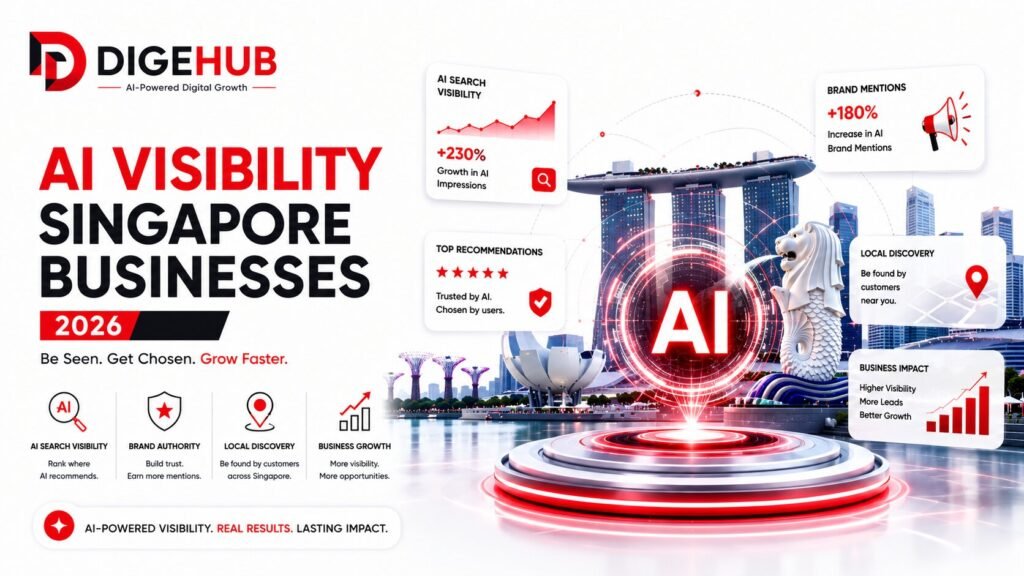
AI Visibility Singapore 2026: The Complete Strategy Guide for Businesses That Want to Get Found
Why AI Visibility Is the Most Urgent Digital Priority for Singapore Businesses in 2026
AI visibility Singapore is not a trend to monitor. It’s a competitive advantage to build right now, because the market is moving and most Singapore businesses haven’t moved with it.
Here’s the data that changes the conversation. According to Stanford HAI’s 2026 AI Index, Singapore tops global country rankings for AI adoption at approximately 61%, ahead of the UAE, India, Norway, and every Western market including the United States, which sits at just 28.3% despite leading global AI investment. Singapore isn’t just adopting AI tools. It’s adopting them faster than almost any country in the world.
The commercial implication is direct. A significant and growing share of the research your potential customers and B2B buyers do before making purchasing decisions is now happening inside ChatGPT, Perplexity, Google AI Overviews, and Google Gemini, not on traditional search results pages. AI referral traffic converts at 14.2% compared to Google organic’s 2.8%. That’s not a marginal difference. It’s 5x higher buying intent from visitors who arrive via AI citations.
And the Singapore AI Visibility Index 2026 revealed something that should concern every Singapore business: a significant readiness gap exists among B2B firms in Singapore, with most lacking the basic content architecture, schema markup, and entity infrastructure that AI citation requires. High AI adoption by users combined with low AI optimization by businesses creates a citation vacuum. The brands that fill it now will be the brands that buyers find when they research in AI tools.
- AI Visibility Singapore 2026: The Complete Strategy Guide for Businesses That Want to Get Found
- Why AI Visibility Is the Most Urgent Digital Priority for Singapore Businesses in 2026
- Quick Answer: What Is AI Visibility for Singapore Businesses?
- The Singapore AI Search Landscape: Data That Changes the Strategy
- The Readiness Gap: Where Most Singapore Businesses Actually Stand
- Platform-by-Platform: Where Singapore Buyers Are Searching
- How AI Search Engines Select Content for Singapore-Relevant Queries
- The 7 AI Visibility Signals Singapore Businesses Must Build
- Content Strategy for Singapore Businesses Targeting AI Citations
- Technical AI Visibility Checklist for Singapore Websites
- Industry-Specific AI Visibility Strategy for Singapore
- Building Multi-Platform Presence as a Singapore Business
- Measuring AI Visibility: What Singapore Businesses Should Track
- Common Mistakes Singapore Businesses Make With AI Visibility
- Expert Insights: What We See Working in the Singapore Market
- Future Trends: Where AI Search Is Heading in Singapore
- FAQ: AI Visibility for Singapore Businesses
Quick Answer: What Is AI Visibility for Singapore Businesses?
AI visibility for Singapore businesses means how consistently and positively your brand appears in AI-generated responses across ChatGPT, Perplexity, Google AI Overviews, and Google Gemini when users search for topics relevant to your products, services, or industry.
Unlike traditional SEO, where success means a ranked link position, AI visibility means being cited inside the synthesized answer itself. The difference matters because 65 to 70% of all Google searches now end without a click, and AI-generated answers are the primary driver.
For Singapore businesses specifically, AI visibility matters because:
- Singapore has the highest or near-highest AI adoption rate globally at 61%, per Stanford HAI 2026
- Singapore’s B2B sector, professional services, and tech-forward industries are among the heaviest professional AI tool users in the Asia-Pacific region
- 94% of B2B buyers globally used generative AI tools during their most recent purchase process in 2025, and Singapore’s B2B adoption is well above the global average
- AI referral traffic converts at 14.2% vs. Google organic’s 2.8%, making AI-cited brands significantly more efficient in acquisition
- Singapore’s role as a regional headquarters hub for MNCs means that international buyers researching Singapore-based vendors, service providers, and market entry partners are using AI tools for that research
For the full strategic context, our guide on What Is AI Search Visibility? covers the broader landscape this discipline sits inside.
The Singapore AI Search Landscape: Data That Changes the Strategy
Singapore’s position in the global AI adoption picture is genuinely exceptional, and it shapes the strategic urgency in ways that market-generic AI visibility guides miss.
Singapore leads globally on AI adoption. Stanford HAI’s 2026 AI Index places Singapore at approximately 61% AI adoption, the highest of any country in their rankings. This is not a projection. It’s current measured behavior. Singapore’s combination of high digital literacy, strong English-language internet usage, high-income professional population, and government digital transformation initiatives has produced one of the world’s fastest AI tool adoption curves.
The professional usage picture. Singapore’s economy is concentrated in financial services, technology, professional services, logistics, and biomedical sectors, all of which are research-intensive and AI-tool-heavy. B2B buyers in these sectors are actively using ChatGPT for vendor research, Perplexity for market analysis, and Google AI Overviews for quick informational lookups. 78% of US users use AI search multiple times per week; Singapore’s professional population is likely tracking similarly or higher given its adoption lead.
The MNC headquarters dynamic. Singapore hosts regional headquarters for hundreds of multinational corporations. International buyers, partners, and investors researching Singapore-headquartered vendors, service providers, and market opportunities are using AI tools to conduct that initial research. A Singapore professional services firm, a fintech company, or a logistics provider that earns AI citations on relevant queries is reaching international prospects during their research phase, before any sales interaction occurs.
The regional hub implication. Singapore businesses often serve markets across Southeast Asia, and AI tools are being used to research regional players and vendors across ASEAN. Being cited as an authoritative source on Singapore-specific and ASEAN-relevant queries creates visibility that extends beyond the domestic market.
Google’s dominance in Singapore means AI Overviews affect everything immediately. Google holds strong search market share in Singapore. With AI Overviews now appearing on approximately 50 to 60% of queries globally, every Singapore business that depends on Google organic traffic is already operating in an AI Overview-affected environment, whether they’re optimizing for it or not.
The Readiness Gap: Where Most Singapore Businesses Actually Stand
The Singapore AI Visibility Index 2026 revealed what we’ve observed directly in practice: a significant gap exists between how advanced Singapore users are in AI adoption and how prepared Singapore businesses are to be found in those AI responses.
The specific gaps that appear consistently across Singapore B2B firms include:
No schema markup. The vast majority of Singapore business websites have no FAQ, Article, or Organization schema on their content pages. Schema-enabled pages achieve 47% top-3 citation rates on Perplexity versus 28% for pages without, a 19-percentage-point difference that represents straightforward, unclaimed competitive ground.
Anonymous content. Generic team bylines, “admin” authorship, or no author attribution at all are extremely common on Singapore business websites and blogs. Every major AI reranker applies an entity clarity test that anonymous content fails. A named author with verifiable credentials and proper Person schema is non-negotiable for AI citation.
Single-platform SEO thinking. Singapore businesses that have invested in Google SEO frequently assume that translates to AI search visibility. It doesn’t. Only 14% of URLs cited by Google AI Mode rank in the traditional top 10. 67% of Perplexity citations come from pages outside Google’s first page. Each platform has distinct retrieval behavior that requires deliberate, separate optimization.
No AI-specific measurement. Most Singapore marketing teams report on Google Search Console data and GA4 organic traffic. Neither captures AI citation performance. Brands are flying blind on how visible they are across the AI surfaces where their buyers are increasingly spending research time.
Minimal multi-platform content presence. Reddit, YouTube, and industry publications account for a disproportionate share of AI citation sources. Singapore businesses that exist only on their own websites lack the multi-source consensus signal that AI systems require before confidently citing a brand.
This readiness gap is, practically speaking, an opportunity. The Singapore businesses that close it first will build citation authority that compounds, while competitors who don’t act will be increasingly absent from the research phase of their buyers’ journeys.
Platform-by-Platform: Where Singapore Buyers Are Searching
Google AI Overviews (Highest Volume, Immediate Impact)
Google’s strong search market share in Singapore means AI Overviews affect the largest volume of Singapore search traffic immediately. They appear on 50 to 60% of queries, are available in English (the dominant language for Singapore professional and business searches), and directly change click-through dynamics on queries Singapore businesses already rank for. The optimization overlap with traditional SEO is significant but incomplete: schema markup, answer-forward structure, and topical cluster authority all need deliberate attention. Full strategy in our Google AI Overviews optimization guide.
ChatGPT (Largest Global Reach, Strong Singapore Professional Usage)
ChatGPT has 900 million weekly active users globally and processes 2.5 billion queries daily. In Singapore, where professional AI adoption tracks among the world’s highest, ChatGPT is actively used for vendor research, financial analysis, market entry investigation, and competitive evaluation. Its citation behavior is conservative (0.59% brand citation rate) and favors established domain authority, long content history, and entity recognition. The Wikidata entity signal is particularly important for ChatGPT visibility. Full strategy in our ChatGPT ranking guide.
Perplexity AI (Most Open Citation Behavior, High-Value Professional Audience)
Perplexity’s audience skews heavily toward researchers, analysts, founders, and senior professionals, exactly the decision-making demographic that drives high-value B2B purchasing in Singapore. Its citation behavior is the most accessible of any major platform: 92.78% of cited pages have fewer than 10 referring domains, and 67% of citations come from outside Google’s first page. Perplexity’s recency bias is stronger than any other platform (70% of top citations from pages under 18 months old), meaning fresh, well-structured Singapore business content can earn citations faster here than elsewhere. Full strategy in our Perplexity ranking guide.
Google Gemini and AI Mode (Deep Android Integration, Growing Fast)
Google AI Mode has surpassed 1 billion monthly users globally and cites only 14% of URLs that overlap with standard organic top-10 results, making it a genuinely distinct optimization surface. Gemini’s integration into Android devices and Google Workspace tools gives it broad reach among Singapore’s tech-connected professional population. Full platform-specific strategy in our Gemini ranking guide.
Claude (Fastest-Growing, Enterprise-Relevant)
Claude was the fastest-growing major chatbot by web visits in early 2026, with traffic roughly tripling in a single quarter per Similarweb estimates. Its long-context capabilities make it particularly suited to complex research tasks, and enterprise adoption through Anthropic’s enterprise products is growing. For Singapore businesses in sectors where complex research queries are common (financial services, legal, consulting, biomedical), Claude’s growing enterprise footprint is worth tracking alongside the other platforms.
How AI Search Engines Select Content for Singapore-Relevant Queries
All major AI platforms use a Retrieval-Augmented Generation (RAG) pipeline: retrieve candidate pages from a live index, rerank them using quality, relevance, freshness, and authority signals, then synthesize a response citing the top-ranked sources. The signals that determine citation include semantic relevance, content freshness, answer-forward structure, schema markup, E-E-A-T signals, and multi-platform brand presence.
For Singapore businesses, several signals have particular strategic relevance:
Entity recognition for Singapore brands. Many Singapore businesses, including well-established companies, have weak entity signals in global AI systems: minimal international brand mentions, no schema markup, anonymous content authorship, no presence on global platforms that AI systems weight. This creates a systematic underrepresentation of Singapore brands in AI citations even for queries directly relevant to Singapore markets.
Singapore-specific content authority. AI systems favor specific, verifiable content. Singapore businesses that publish content covering Singapore-specific regulatory frameworks (MAS guidelines, PDPA compliance, SGX requirements, MOM employment regulations, GST), local market data, Singapore case studies, and ASEAN regional context produce citation-eligible content that global competitors can’t replicate with the same authority and specificity.
English-language advantage. Singapore’s strong English-language business environment means that English-language AI optimization produces direct results without the language-specific complications that arise in other APAC markets. This is a structural advantage Singapore businesses have over counterparts in markets where primary language AI optimization is more complex.
Our detailed breakdown of how AI search engines choose content covers the full three-stage selection mechanism in depth.
The 7 AI Visibility Signals Singapore Businesses Must Build
1. Answer-Forward Content Structure
90% of Perplexity’s top-cited sources answer the core question within the first 100 words. 44.2% of all AI citations come from the first 30% of content. Most Singapore business websites and blogs structure content for narrative readability rather than answer extraction. Restructuring content to lead directly with the answer, then support it, is the fastest single improvement for AI citation probability and improves the content for human readers simultaneously.
2. Schema Markup Implementation
Schema-enabled pages achieve 47% top-3 citation rates versus 28% for pages without, and source citation improves by 30% when schema is present across AI platforms. FAQ schema, Article schema with author credentials, HowTo schema, and Organization schema are all high-impact implementations. JSON-LD is the preferred format. Most Singapore business websites have zero schema on their content pages.
3. Named Author and Person Entity Infrastructure
Anonymous content fails entity clarity tests across all major AI rerankers. Every piece of content needs a named author with a substantive credential bio and Person schema linking to verifiable external presence. For Singapore businesses, this typically means LinkedIn profiles, professional certifications, regulatory licenses where applicable (CFP, CFA, law society membership, etc.), and publication history. Pages with author Person schema achieve 2.3x higher citation rates than those without.
4. Content Freshness Maintenance
70% of Perplexity’s top citations come from pages updated within 12 to 18 months. Pages with visible “last updated” timestamps get 1.8x more AI citations. Singapore’s fast-moving sectors (fintech, biomedical, technology) make content freshness both more important and more commercially visible when outdated information is served to buyers. Build a quarterly refresh calendar for all high-value informational content.
5. Singapore-Specific Topical Cluster Authority
AI systems reward domains that comprehensively cover a topic across multiple interconnected pieces. A Singapore fintech firm with 15 deeply connected pieces on MAS regulatory frameworks, digital payment infrastructure, crypto regulations, BNPL compliance, and Singapore open banking standards earns far stronger cluster authority on Singapore fintech queries than a firm with one comprehensive page or many disconnected posts. This cluster-building approach is the core operational principle of LLMO optimization and Generative Engine Optimization.
6. External Brand Mentions and Consensus Signal
AI systems check for cross-source agreement before confidently citing a brand. A Singapore business recognized only on its own website lacks the independent validation AI systems weight. Building authentic presence on LinkedIn, relevant Reddit communities, YouTube, and international industry publications creates the consensus signal that earns confident citation. For Singapore businesses targeting international clients, mentions in global business publications carry strong validation weight.
7. E-E-A-T Infrastructure
Experience, Expertise, Authoritativeness, and Trustworthiness signals underpin citation selection across all platforms. For Singapore businesses, the most commonly missing elements are: documented organizational experience through specific case studies (not testimonials), author credential depth beyond generic professional titles, and verifiable organizational transparency including business registration details, regulatory licenses, and awards or certifications. Our full E-E-A-T in the AI search era guide covers every component of this infrastructure.
Content Strategy for Singapore Businesses Targeting AI Citations
Write for extractability, not just readability. The most citable structure: direct answer in the opening paragraph, supporting evidence with specific sourced data, contextual explanation, FAQ section. This is the format AI extraction systems parse most cleanly.
Build Singapore-specific data into every relevant piece. Singapore businesses have access to MAS data, SingStat reports, Singapore exchange data, Singapore-specific regulatory frameworks, and local market research that global content simply cannot replicate with the same specificity and authority. A post on “fintech licensing requirements in Singapore” with MAS-specific data and recent regulatory updates is more citable on Singapore-relevant fintech queries than any generic global equivalent.
Cover the full B2B buyer research journey in your vertical. Map the specific questions Singapore B2B buyers ask AI tools when evaluating vendors, partners, or solutions in your sector. Build content that answers each question directly and extractably. This is what Answer Engine Optimization looks like in practice for Singapore’s market context.
Address ASEAN regional context where relevant. Singapore businesses that serve Southeast Asian markets have an opportunity to build citation authority on ASEAN-level queries (regional comparisons, cross-border regulatory analysis, ASEAN market entry guides) where Singapore-headquartered expertise is naturally authoritative.
Publish original Singapore market data. Proprietary surveys, client outcome aggregates, Singapore market analyses, and original research on Singapore-specific topics are the highest-leverage citation anchors available. They contain information AI systems can’t synthesize from existing public sources, making them the most defensibly citable content type.
Update quarterly at minimum. MAS regulation changes, Singapore Budget updates, GST adjustments, MOM employment framework changes, and market data shifts all require content updates to stay within the freshness window that AI platforms weight. Building a quarterly content maintenance cycle is an operational discipline, not a one-time task.
If you want to build a content architecture that earns AI citations systematically, our Content Marketing Services are designed for exactly this.
Technical AI Visibility Checklist for Singapore Websites
Allow AI crawlers explicitly in robots.txt. Check that PerplexityBot, OAI-SearchBot, GPTBot, ClaudeBot, and Googlebot are all permitted. Many Singapore business websites have legacy robots.txt configurations that now inadvertently block AI crawlers, making content invisible to AI retrieval regardless of quality.
Submit to Bing Webmaster Tools. Perplexity and ChatGPT both draw from Bing’s index as a retrieval source. Many Singapore SEOs focus exclusively on Google Search Console. Submitting your sitemap to Bing Webmaster Tools and monitoring Bing indexing status is a direct AI visibility improvement with minimal effort.
Ensure content is in the initial HTML response. AI crawlers have time constraints. Content loaded via JavaScript after initial page render may not be processed. For Singapore business websites built on common enterprise CMS or e-commerce platforms, verify that key content, especially opening answer paragraphs and FAQ sections, is present in the initial HTML.
Page speed for Singapore hosting context. Aim for Time to First Byte under 600ms. For Singapore businesses using local hosting, verify CDN configuration for both Singapore-local and international serving speeds, particularly if you’re targeting international buyers doing research on Singapore vendors.
Implement schema markup comprehensively. FAQ schema on all content pieces answering multiple questions. Article schema with author credentials on all blog and insights content. Organization schema sitewide with complete Singapore business information including UEN (Unique Entity Number) where appropriate. HowTo schema on process-based guides. JSON-LD format throughout.
HTTPS across all pages. AI systems don’t cite insecure pages. Not yet universal across all Singapore business websites.
Stable URL structures. AI systems build source authority around specific URLs. Website redesigns and URL restructures common during rebrands or platform migrations reset the citation authority individual pages have accumulated.
NAP consistency. Business name, address, and contact information must be consistent across your website, Google Business Profile, and all Singapore directory listings (Gobusiness.gov.sg, Singapore Business Federation listings, industry association directories). Inconsistent NAP is both a local SEO problem and an AI trust signal issue.
Industry-Specific AI Visibility Strategy for Singapore
Financial Services and Fintech
Singapore’s position as Asia’s premier financial hub makes financial services one of the highest-value AI visibility targets in the country. Buyers, investors, and institutional partners researching Singapore financial service providers, digital banks, payment platforms, and wealth management firms are using AI tools actively. Content covering MAS regulations, Singapore digital banking frameworks, SGX listing requirements, and Singapore’s approach to digital assets and cryptocurrency regulation has clear authority signals that global competitors can’t match. Named authors with CFA, CFP, or MAS-relevant credentials are especially important for citation credibility in this vertical.
B2B Technology and SaaS
Singapore’s strong startup and B2B SaaS ecosystem competes for international buyers who evaluate Singapore-based vendors alongside global alternatives using AI research tools. Being cited on queries like “best B2B SaaS tools for Southeast Asia,” “Singapore-based enterprise software vendors,” or category-specific comparison queries is a direct pipeline signal. Optimize comparison content, use-case guides, and integration documentation specifically for AI extraction.
Professional Services (Legal, Consulting, Accounting)
International businesses researching Singapore market entry, corporate structuring, regulatory compliance, and professional services are heavy AI research users. Singapore law firms, consultancies, and accounting firms that earn AI citations on queries like “how to incorporate a company in Singapore,” “Singapore employment law for foreign businesses,” or “transfer pricing regulations Singapore” are reaching high-value international prospects during initial due diligence.
Biomedical and Life Sciences
Singapore’s biomedical cluster (Biopolis, Fusionopolis) and life sciences sector attract significant international research partnerships and investment. Researchers and investors evaluating Singapore’s biomedical ecosystem use AI tools for initial landscape mapping. Content on Singapore’s clinical trial infrastructure, HSA (Health Sciences Authority) regulatory pathways, and Singapore’s biomedical R&D environment with verifiable institutional and author credentials has strong citation potential.
Logistics and Trade
Singapore’s role as a global trade and logistics hub means procurement teams worldwide research Singapore-based logistics providers, freight forwarders, and supply chain solutions using AI tools. Content covering port infrastructure, free trade agreements, Singapore customs procedures, and ASEAN logistics networks with specific current data earns citations that position Singapore logistics firms in international procurement research.
Education and Training
Singapore’s educational institutions and professional development providers compete in a market where course research is increasingly AI-mediated. Content covering Singapore professional certifications, MOM-approved programs, SkillsFuture credits, and career pathway outcomes with specific data performs well in AI citation for education-related queries.
Building Multi-Platform Presence as a Singapore Business
The consensus signal is one of the most critical and most underinvested AI visibility factors for Singapore businesses. AI systems check for cross-source recognition before confidently citing a brand.
LinkedIn (Essential for Singapore B2B)
LinkedIn has very high professional adoption in Singapore. Named individual thought leadership (not just company page posts) under the profiles of your actual experts builds the kind of entity recognition that AI systems weight for professional and commercial queries. Consistent publication of Singapore-specific insights, market commentary, and original data under named expert profiles creates entity signals that compound over time.
Reddit (Highest Perplexity Citation Source)
Reddit accounts for 46.7% of Perplexity’s top citation sources. For Singapore businesses with international audiences, relevant subreddits including r/singapore, r/SEA, r/SingaporeFintech, r/startups, r/SaaS, r/investing, and sector-specific communities provide citation-rich territory. Authentic, genuinely helpful participation builds citation authority that your own website can’t generate independently.
YouTube
YouTube is the second most-cited source category in Perplexity’s citation pool. Tutorial content, market explainer videos, Singapore regulatory guides, and thought leadership build multi-platform citation authority. For Singapore businesses serving English-speaking international audiences, YouTube content in English on Singapore-specific professional topics is relatively uncrowded citation territory.
International Industry Publications
Getting featured in or contributing to publications like Tech in Asia, e27, Singapore Business Review, Asian Investor, and global industry publications creates authoritative external attributions that validate your brand entity beyond your own content. For Singapore businesses targeting international buyers, mentions in global publications carry particularly strong consensus signal weight.
Review Platforms
G2, Clutch, and Capterra for B2B technology and service businesses; Trustpilot for consumer-facing brands. Strong profiles with genuine, detailed reviews contribute trust signals that AI systems incorporate for commercial-intent queries.
Measuring AI Visibility: What Singapore Businesses Should Track
Standard Google Analytics and Search Console data doesn’t capture AI citation performance. A separate measurement framework is needed.
Weekly prompt audits. Run your 20 most important queries directly in Perplexity, ChatGPT, and Google with AI Overviews active. Note whether your brand appears, your citation position, how your brand is characterized, and which competitors are being cited instead of you.
Share of Model. How often does your brand appear when AI systems discuss your category in the Singapore or ASEAN context? Track this systematically for your core service or product queries across each major AI platform.
AI referral traffic in GA4. Traffic from perplexity.ai, chatgpt.com, claude.ai, and similar AI platforms appears as referral traffic in GA4. Even small volumes carry disproportionate commercial value given the 14.2% conversion rate versus Google organic’s 2.8%.
Citation position tracking. Being citation [1] or [2] in Perplexity carries meaningfully more user attention than citation [8]. Track position within the citation set, not just presence.
Competitive citation analysis. Who appears in the citation set for your most important Singapore-relevant queries? This tells you your actual AI search competitors, which may differ from your traditional SEO competitors.
Tools like Profound and BrightEdge can automate this tracking. At minimum, a manual weekly prompt audit across your 20 core queries gives you the data to measure whether optimization investments are working.
Common Mistakes Singapore Businesses Make With AI Visibility
Assuming Google rankings equal AI visibility. 67% of Perplexity citations come from outside Google’s first page. 14% of AI Mode citations overlap with traditional top-10 results. Strong Google rankings help but don’t determine AI citation performance. They require separate, deliberate optimization.
Anonymous content. The single most common issue we see across Singapore business websites. “Our team” or department-generic bylines fail entity clarity tests in every AI reranking layer. Named, credentialed authors are non-negotiable.
No schema markup. The majority of Singapore business websites have no FAQ, Article, or Organization schema. The 19-percentage-point citation rate advantage for schema-enabled pages is a straightforward, implementation-only gap.
Single-platform optimization. Optimizing only for Google AI Overviews and ignoring Perplexity, ChatGPT, and Gemini leaves significant AI citation surface area unaddressed. The platforms have different retrieval behaviors, and each needs deliberate attention.
No Bing Webmaster Tools submission. Perplexity and ChatGPT use Bing’s index. It’s a 15-minute task with direct AI visibility implications that most Singapore SEOs haven’t done.
Measuring AI performance through traditional metrics only. If your reporting covers only Google Search Console and GA4 organic traffic, you’re invisible to your own AI citation performance. Building AI-specific measurement is essential for informed decision-making.
Content published once, never refreshed. Content that falls outside the 12 to 18 month freshness window loses citation eligibility on recency-sensitive platforms like Perplexity. Building a quarterly refresh calendar is an operational requirement, not an optional enhancement.
Expert Insights: What We See Working in the Singapore Market
From working across AI visibility campaigns in Singapore and globally, a few patterns stand out that are particularly relevant to the Singapore context.
Singapore businesses have a genuine content authority advantage that most aren’t leveraging. The combination of Singapore-specific regulatory frameworks (MAS, PDPA, SGX, MOM), Singapore market data, and Singapore’s regional hub position for ASEAN creates content authority territory that global competitors simply can’t claim with the same specificity. Singapore fintech firms writing about MAS regulation, Singapore law firms writing about corporate law in Singapore, and Singapore logistics companies writing about Singapore port and customs operations all have inherent authority signals that global generic content lacks. The businesses capitalizing on this specificity are earning citations that global competitors cannot take from them regardless of domain authority.
The Singapore AI Visibility Index 2026’s finding on the readiness gap among B2B firms is consistent with what we see directly: most Singapore businesses haven’t started, which means the opportunity is genuinely available. First-mover citation authority in a high-AI-adoption market like Singapore compounds significantly. Being the brand that gets cited repeatedly for Singapore-relevant professional queries builds recognition in AI systems that becomes self-reinforcing over time.
The SEO squared framework that integrates traditional SEO with AI visibility as parallel, distinct tracks is the right operating model for Singapore businesses that already have a Google SEO foundation. It builds AI visibility as a deliberate second dimension rather than an afterthought, which is how the businesses achieving the most consistent citation performance are approaching it.
The AI search vs traditional SEO comparison is also worth revisiting for Singapore marketing teams that are trying to allocate budget and effort across both channels. The strategic differences are meaningful, and understanding them prevents the common mistake of treating AI visibility as a feature of traditional SEO rather than a parallel discipline.
Future Trends: Where AI Search Is Heading in Singapore
Singapore’s government AI agenda accelerates the timeline. Singapore’s National AI Strategy 2.0 and significant public sector investment in AI adoption mean the institutional and regulatory environment actively accelerates AI uptake across the economy. Unlike markets where AI adoption is driven purely by consumer behavior, Singapore has deliberate policy support behind it. This means the timeline for AI search becoming standard across professional and consumer contexts is compressed relative to most markets.
B2B AI search behavior will deepen and diversify. Cross-checking multiple AI tools (ChatGPT then Perplexity, or vice versa) is already becoming a standard research behavior among sophisticated professional users. Singapore’s highly educated professional population is likely to lead this multi-platform research behavior. Brands that build citation authority across all major platforms simultaneously are better positioned for this multi-tool research pattern than brands concentrating on one surface.
Agentic AI will transform how Singapore enterprises research vendors. As AI agents that perform multi-step research and make procurement shortlisting recommendations become standard in enterprise workflows, the brands that AI agents cite and recommend will be the ones with established citation authority built now. Singapore’s enterprise technology adoption pace makes this timeline shorter than in most other markets.
ASEAN regional AI search will grow. As AI platform adoption grows across Malaysia, Indonesia, Thailand, Vietnam, and the Philippines, Singapore-based businesses that have built citation authority on ASEAN-relevant queries will benefit from that authority extending into a much larger addressable market.
Multilingual AI search queries for Singapore’s multicultural market. Singapore’s Mandarin-speaking, Malay-speaking, and Tamil-speaking populations are increasingly using AI tools. As AI platforms improve multilingual capabilities, Singapore businesses with multilingual content optimized for AI extraction will have citation advantages in queries from these language communities.
The window to build first-mover AI visibility in Singapore is open right now. Singapore’s exceptional AI adoption rate means the transition from “people use AI tools” to “AI citations are the primary discovery channel” is happening faster here than almost anywhere else in the world.
We work with Singapore businesses and global brands to build systematic AI visibility through content architecture, schema implementation, entity infrastructure, and multi-platform presence building. Our AI Visibility Services and SEO Services cover the full implementation stack. We also serve businesses across the USA, UK, Canada, and Australia. To start assessing your current content’s AI-readiness, our Free SEO Blog Writing Tool gives you an immediate read.
FAQ: AI Visibility for Singapore Businesses
1. What is AI visibility for Singapore businesses? AI visibility for Singapore businesses means how consistently your brand appears in AI-generated responses on ChatGPT, Perplexity, Google AI Overviews, and Gemini when users search for topics relevant to your industry. It targets citation inside synthesized AI answers rather than ranked link positions in traditional search results.
2. Why is AI visibility especially important for Singapore businesses in 2026? Singapore has the highest or near-highest AI adoption rate globally at approximately 61% per Stanford HAI 2026. Singapore’s professional and B2B sectors are among the heaviest AI tool users in Asia-Pacific. With 94% of B2B buyers globally using AI tools during their purchase process, and Singapore adoption well above global averages, AI visibility directly affects whether your brand is included in buyer consideration sets before any direct contact occurs.
3. Which AI platforms should Singapore businesses prioritize? Google AI Overviews is the highest-volume priority given Google’s search market position in Singapore. Perplexity has the most open citation behavior (92.78% of cited pages have fewer than 10 referring domains), making it the most accessible for Singapore businesses without massive domain authority. ChatGPT has the largest global reach. Gemini is growing fast with deep Android and Google Workspace integration. Claude is the fastest-growing platform in early 2026 and worth monitoring for enterprise-focused Singapore businesses.
4. What makes Singapore-specific content more citable in AI search? AI systems favor specific, verifiable content over generic assertions. Singapore-specific regulatory frameworks (MAS, PDPA, SGX, MOM), Singapore market data, local case studies, and ASEAN regional context create citation-eligible content specificity that global competitors cannot replicate. Singapore businesses writing about Singapore-specific topics with verifiable local authority have inherent E-E-A-T advantages on those queries.
5. How does AI visibility differ from traditional Google SEO for Singapore businesses? Traditional SEO targets ranked link positions and click-through traffic. AI visibility targets citation inside synthesized responses where clicks may not occur at all. The content structure, entity signals, schema requirements, multi-platform presence needs, and measurement frameworks are meaningfully different. They work best as parallel tracks running simultaneously.
6. Can small Singapore businesses get cited by AI search engines? Yes. 92.78% of Perplexity’s cited pages have fewer than 10 referring domains. Content quality, answer-forward structure, schema markup, freshness, and topical cluster authority matter more than raw domain authority on AI platforms, particularly Perplexity. Entry barriers to AI citation are significantly lower than entry barriers to top Google rankings on competitive Singapore search terms.
7. How long does it take to see AI visibility results for a Singapore business? Perplexity can cite fresh, well-structured content within days of publication. Google AI Overview improvements typically take 60 to 90 days. ChatGPT citation development requires longer-term authority building over months. For most Singapore businesses, Perplexity improvements are the fastest measurable indicator of AI visibility progress.
8. What is the single biggest AI visibility gap for Singapore businesses? The readiness gap identified in the Singapore AI Visibility Index 2026 points to schema markup and named author infrastructure as the most common missing elements. Most Singapore business websites have neither, and both are high-impact, relatively straightforward to implement, and create immediate improvements in AI citation probability across all major platforms.
9. How do Singapore businesses measure AI visibility performance? Run your 20 most important queries weekly in Perplexity, ChatGPT, and Google with AI Overviews active. Track citation presence, position, and competitor citations. Monitor AI referral traffic in GA4 from perplexity.ai, chatgpt.com, and similar sources. Standard Google Search Console doesn’t capture AI citation performance.
10. Does Singapore’s multilingual environment affect AI visibility strategy? Yes, for businesses serving Mandarin, Malay, or Tamil-speaking audiences or regional ASEAN markets where other languages dominate. For most Singapore B2B and professional services businesses, English-language optimization is sufficient and directly effective. For consumer-facing businesses with significant non-English-speaking customer bases, multilingual content with schema markup is an emerging citation opportunity that very few Singapore businesses are currently addressing.
DigeHub is a global digital marketing agency helping businesses in Singapore and across the USA, UK, Canada, and Australia build AI visibility, SEO authority, and organic growth through integrated strategy.