AI Visibility Australia 2026: The Complete Strategy Guide for Businesses That Want to Get Found
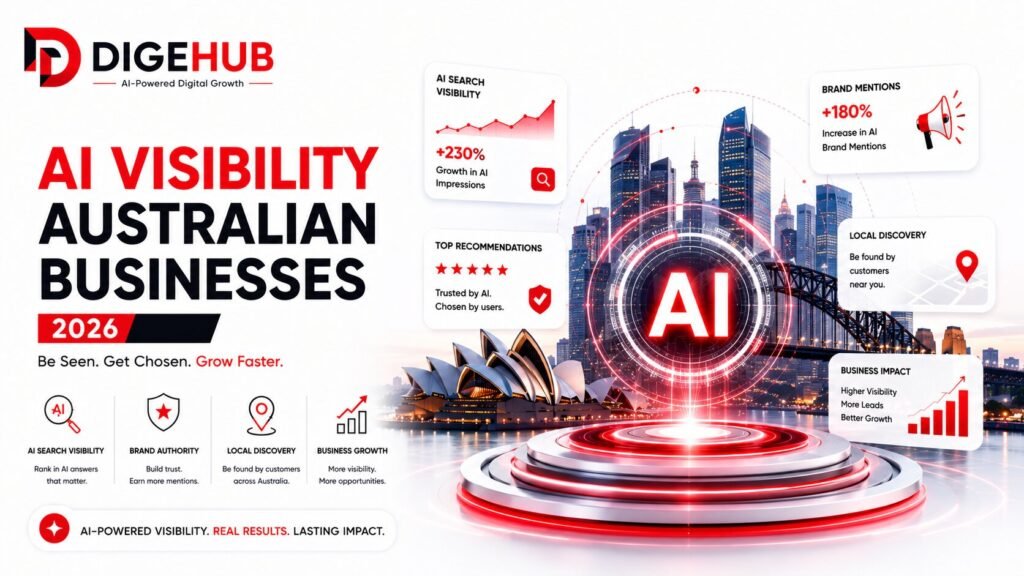
Why AI Visibility Is Now the Number One Digital Priority for Australian Businesses
AI visibility Australia isn’t a trend to file under “watch this space.” It’s a present-tense competitive issue that most Australian businesses are aware of in a general sense but haven’t yet translated into concrete action.
The disconnect is striking. KPMG Australia’s January 2026 survey of 274 C-suite executives and board members found that AI-related concerns jumped from fourth place in 2025 to the outright number one concern for 2026, with 63% of leaders naming new technologies including AI as their biggest challenge for the year ahead, and 61% naming it their top concern for the next three to five years. AI even topped the social issues list at 59%, ahead of housing affordability. Australian business leaders are more concerned about AI than any other issue on their agenda.
And yet, building AI visibility, the practical discipline of ensuring your brand appears in AI-generated search responses, is not something most Australian businesses are systematically addressing. The concern is there. The action isn’t.
Here’s why that gap matters commercially. A growing proportion of the research your potential customers do before making purchasing decisions is now happening inside ChatGPT, Perplexity, Google AI Overviews, and Google Gemini. AI referral traffic converts at 14.2% compared to Google organic’s 2.8%, which is a five-fold difference in buying intent. If your brand isn’t being cited in AI-generated answers, you’re being skipped before buyers even reach your website.
The window to build first-mover AI visibility in Australia is still open. The brands that act now while most competitors are still at the “concern” stage will build citation authority that compounds over time.
- AI Visibility Australia 2026: The Complete Strategy Guide for Businesses That Want to Get Found
- Why AI Visibility Is Now the Number One Digital Priority for Australian Businesses
- Quick Answer: What Is AI Visibility for Australian Businesses?
- The Australian AI Search Landscape in 2026: What the Data Shows
- The Gap Between AI Concern and AI Visibility Action
- Platform-by-Platform: Where Australian Buyers Are Searching
- How AI Search Engines Select Content for Australian Queries
- The 7 AI Visibility Signals Australian Businesses Must Build
- Content Strategy for Australian Businesses Targeting AI Citations
- Technical AI Visibility Checklist for Australian Websites
- Industry-Specific AI Visibility Strategy for Australia
- Building Multi-Platform Presence as an Australian Business
- Measuring AI Visibility: What Australian Businesses Should Track
- Common Mistakes Australian Businesses Make With AI Visibility
- Expert Insights: What We See Working in the Australian Market
- Future Trends: Where AI Search Is Heading in Australia
- FAQ: AI Visibility for Australian Businesses
Quick Answer: What Is AI Visibility for Australian Businesses?
AI visibility for Australian businesses means how consistently and positively your brand appears in AI-generated responses across ChatGPT, Perplexity, Google AI Overviews, and Google Gemini when users search for topics relevant to your products, services, or industry.
Unlike traditional SEO, where success means a ranked link position in a results list, AI visibility means being cited inside the synthesized answer itself. This distinction matters because 65 to 70% of all Google searches now end without a click, and AI-generated answers are the primary driver of that zero-click behavior.
For Australian businesses specifically, AI visibility matters because:
- 63% of Australian C-suite leaders named AI and new technologies as their number one concern for 2026, per KPMG Australia
- 94% of B2B buyers globally used generative AI tools during their most recent purchase process in 2025
- AI referral traffic converts at 14.2% versus Google organic’s 2.8%, making AI-cited brands dramatically more efficient in acquisition
- Google AI Overviews are live in Australia and appear on 50 to 60% of queries
- Australia’s strong English-language digital economy means that AI optimization produces direct results without language complications that affect other markets
For the full strategic context of what AI search visibility covers as a discipline, our guide on What Is AI Search Visibility?explains the landscape this sits inside.
The Australian AI Search Landscape in 2026: What the Data Shows
Understanding Australia’s specific AI adoption profile shapes which platforms to prioritize and how urgently to act.
Australian AI adoption is above the global average but trails the region’s leaders. Stanford HAI’s 2026 AI Index places Australia in the mid-tier globally, behind Singapore (61%), UAE (58-64%), and India (59%) but ahead of the United States (28.3%). The Australian AI search landscape is at a meaningful inflection point: adoption is widespread enough that AI-mediated research behavior is already affecting buyer journeys, but not yet so saturated that competitive citation landscapes are locked in. This is the ideal timing for establishing citation authority.
KPMG’s data tells the operational story. The 2026 survey of 274 Australian C-suite executives and board members found AI concerns dominating every time horizon. New technologies including AI ranked first for the next 12 months (63%), first for the next three to five years (61%), and first as a societal concern (59%). Digital transformation ranked second across all three timeframes. The executives who participated in this survey are the same decision-makers whose buyers are increasingly using AI tools to research vendors and solutions. The buyer behavior is already there. The visibility strategy mostly isn’t.
Google’s dominance in Australia means AI Overviews affect everything immediately. Google holds approximately 94% of Australia’s search market. With AI Overviews appearing on 50 to 60% of queries, every Australian business depending on Google organic traffic is already operating in an AI Overview-affected environment. This isn’t coming. It’s here.
ChatGPT adoption in Australia is substantial. ChatGPT has 900 million weekly active users globally and processes 2.5 billion queries daily. Australia’s high English-language internet usage and tech-forward professional population make it one of the more engaged markets for ChatGPT usage in the Asia-Pacific region. 77% of US users use ChatGPT as a search engine multiple times per week; Australian usage patterns among professionals are likely comparable.
Perplexity’s professional audience is highly relevant to Australian B2B. Perplexity’s user base skews toward researchers, analysts, founders, and senior professionals. For Australian B2B businesses in sectors like professional services, technology, mining services, and financial services, Perplexity is the AI tool their target buyers are most likely to use for research and vendor evaluation.
The Gap Between AI Concern and AI Visibility Action
This is the insight that makes the Australian opportunity genuinely distinctive. Nowhere else in the world has a market’s own research so clearly documented the gap between AI awareness and AI preparedness in the same survey period.
KPMG Australia’s January 2026 findings show that Australian business leaders have elevated AI to their number one concern across every timeframe they were asked about. Yet our own observation across Australian business websites tells a consistent story of what hasn’t been done: most Australian business blogs have no schema markup, most content is published under anonymous or generic authorship, most sites have never submitted to Bing Webmaster Tools, and almost none have a systematic AI visibility measurement framework.
What this gap means practically is that the citation landscape for most Australian industry verticals is relatively uncrowded from an optimization standpoint. Australian businesses that close the infrastructure gap now will establish citation authority while competitors are still at the “we should probably do something about AI” stage.
The specific infrastructure gaps that appear most consistently across Australian businesses include:
No schema markup. Schema-enabled pages achieve 47% top-3 citation rates on Perplexity versus 28% for pages without schema, a 19-percentage-point gap. Most Australian business websites have zero FAQ, Article, or Organization schema on their content pages.
Anonymous content authorship. Generic team bylines, “admin” attributions, and no author information at all are extremely common across Australian business blogs. Every major AI reranker applies an entity clarity test that anonymous content fails at the first gate.
No Bing Webmaster Tools submission. Perplexity and ChatGPT both use Bing’s index as a retrieval source. Most Australian SEOs have submitted to Google Search Console and stopped there. Bing submission is a 15-minute task with direct AI visibility consequences.
No AI-specific measurement. Standard GA4 and Search Console reporting doesn’t capture AI citation performance. Australian marketing teams are measuring the half of search they can see in traditional analytics while being blind to their performance on the surfaces where an increasing share of buyer research is happening.
Platform-by-Platform: Where Australian Buyers Are Searching
Google AI Overviews (Highest Volume, Immediate Impact)
Google’s 94% search market share in Australia means AI Overviews affect the largest volume of Australian search traffic immediately. They appear on 50 to 60% of queries and directly change click-through dynamics on queries Australian businesses already rank for. Click-through rate drops from 15% to 8% when an AI Overview is present on the same SERP. For Australian businesses with significant informational content, this click impact is already measurable. Full optimization strategy in our Google AI Overviews optimization guide.
ChatGPT (Largest Global Reach, Strong Australian Professional Usage)
ChatGPT processes 2.5 billion queries daily globally and has 900 million weekly active users. Its citation behavior is conservative (0.59% brand citation rate) and favors established domain authority and long-term content history more than other platforms. For Australian businesses, the Wikidata entity signal is particularly important for ChatGPT visibility, creating a clean organizational entity entry is consistently the fastest practical E-E-A-T improvement specifically for this platform. Full strategy in our ChatGPT ranking guide.
Perplexity AI (Most Open Citation Behavior, High-Value Professional Audience)
Perplexity’s citation behavior is the most accessible of any major platform: 92.78% of cited pages have fewer than 10 referring domains, and 67% of citations come from pages outside Google’s first page. Its recency bias is the strongest of any platform (70% of top citations from pages updated within 18 months), which means fresh, well-structured Australian business content can earn citations faster here than on any other AI surface. Perplexity’s 18 to 22% click-through rate on cited sources is also materially higher than Google AI Overviews, making it a genuine traffic driver, not just a visibility play. Full optimization in our Perplexity ranking guide.
Google Gemini and AI Mode (Fastest Growing, Deep Google Integration)
Google AI Mode has surpassed 1 billion monthly users globally and cites only 14% of URLs that overlap with standard organic top-10 results, making it a genuinely distinct optimization surface. Gemini’s deep integration into Android devices and Google Workspace tools gives it broad reach among Australia’s professional population. Full platform-specific strategy in our Gemini ranking guide.
Claude (Fastest-Growing Platform in 2026)
Claude was the fastest-growing major AI chatbot by web visits in early 2026, with traffic roughly tripling in a single quarter per Similarweb estimates. Its long-context capabilities make it particularly suitable for complex research tasks, and enterprise adoption through Anthropic’s products is growing. For Australian businesses in professional services, legal, financial services, and consulting sectors, Claude’s growing enterprise footprint is worth tracking as a distinct citation surface alongside the established platforms.
How AI Search Engines Select Content for Australian Queries
All major AI platforms use a Retrieval-Augmented Generation (RAG) pipeline: retrieve candidate pages from a live index, rerank them using quality, relevance, freshness, and authority signals, then synthesize a response citing the top-ranked sources.
For Australian businesses, several signals have particular strategic relevance:
Entity recognition for Australian brands in global AI systems. Many Australian businesses have weak entity signals in global AI retrieval systems: minimal external brand mentions in international publications, no schema markup, anonymous content authorship, and no presence on global platforms that AI systems weight heavily. This creates a systematic underrepresentation of Australian brands in AI citations even for queries directly relevant to Australian markets and services.
Australian-specific content authority. AI systems favor specific, verifiable content. Australian businesses publishing content that covers Australian-specific regulatory frameworks (ASIC requirements, ACCC guidelines, Fair Work Act implications, Australian privacy law, ASX listing rules), Australian market data, and Australia-specific use cases produce citation-eligible content that global competitors cannot replicate with the same authority and specificity.
English-language advantage. Australia’s English-language internet environment means AI optimization produces direct results without the additional complexity of multilingual content strategy that affects markets like the UAE or Singapore. This is a structural advantage for Australian businesses that makes the implementation straightforward.
Our comprehensive guide to how AI search engines choose content covers the full three-stage selection mechanism, including why passing the retrieval gate and earning a citation are two separate problems requiring different solutions.
The 7 AI Visibility Signals Australian Businesses Must Build
1. Answer-Forward Content Structure
90% of Perplexity’s top-cited sources answer the core question within the first 100 words. 44.2% of all AI citations come from the first 30% of content. Most Australian business websites and blogs structure content to build toward a conclusion rather than leading with one. Restructuring key content to open with the direct answer, then support it, is the fastest single improvement for AI citation probability and simultaneously makes content more useful for human readers.
2. Schema Markup Implementation
Schema-enabled pages achieve 47% top-3 citation rates versus 28% for pages without, and source citation improves by 30% when schema markup is present across AI platforms generally. FAQ schema, Article schema with author credentials, HowTo schema, and Organization schema are the highest-impact implementations. JSON-LD is the preferred format. The majority of Australian business websites have no schema on their content pages at all.
3. Named Author and Person Entity Infrastructure
Anonymous content fails entity clarity evaluations in AI rerankers across all major platforms. Every piece of content needs a named author with a substantive credential bio and Person schema linking to verifiable external presence. For Australian businesses, this typically means LinkedIn profiles, professional certifications (CPA, CA, CFA, legal practice certificates, engineering registrations), industry association memberships, and publication history. Pages with author Person schema achieve 2.3x higher citation rates than those without.
4. Content Freshness Maintenance
70% of Perplexity’s top citations come from pages updated within 12 to 18 months. Pages with visible “last updated” timestamps get 1.8x more AI citations. Australia’s fast-moving regulatory sectors (financial services, superannuation, tax law, environmental compliance) make outdated content both a citation liability and a potential trust issue with readers. Build a quarterly refresh calendar for all high-value informational content.
5. Australian-Specific Topical Cluster Authority
AI systems reward domains that comprehensively cover a topic across multiple interconnected pieces. An Australian accounting firm with 15 deeply connected pieces covering GST compliance, superannuation contribution rules, PAYG withholding, ATO audit triggers, and Division 7A loans earns far stronger cluster authority on Australian tax queries than a firm with one comprehensive guide or many disconnected posts. This cluster-building approach is the operational core of LLMO optimization and Generative Engine Optimization.
6. External Brand Mentions and the Consensus Signal
AI systems check for cross-source agreement before confidently citing a brand. An Australian business recognized only on its own website lacks the independent validation AI retrieval systems weight heavily. Building authentic presence on LinkedIn, relevant Reddit communities, YouTube, and industry publications creates the consensus signal needed for confident AI citation. For Australian businesses targeting international clients or buyers, mentions in global publications carry particularly strong validation weight.
7. E-E-A-T Infrastructure
Experience, Expertise, Authoritativeness, and Trustworthiness signals underpin citation selection across all major AI platforms. For Australian businesses, the most commonly missing elements are: documented organizational experience through specific case studies with verifiable outcomes (not just testimonials), author credential depth beyond generic professional titles, and organizational transparency signals including ABN references, ASIC registration, industry license numbers, and professional body memberships. Our full E-E-A-T in the AI search era guide covers every component of this infrastructure.
Content Strategy for Australian Businesses Targeting AI Citations
Write for extractability, not just readability. The most citable structure: direct answer in the opening paragraph, supporting evidence with specific sourced data, contextual explanation, and a FAQ section. This is the format AI extraction systems parse most cleanly, and it also serves human readers better than narrative-first writing.
Build Australian-specific data into every relevant piece. Australian businesses have access to ABS data, ASIC reports, RBA monetary policy statements, ACCC rulings, Australian court decisions, ASX reporting, and sector-specific Australian regulatory updates that global content cannot replicate with the same specificity. A post on “Australian superannuation contribution caps 2026” with ATO-sourced data is more citable on Australian superannuation queries than any generic global equivalent, because it contains verifiable Australian-specific information.
Cover the full B2B buyer research journey in your vertical. Map the specific questions Australian B2B buyers ask AI tools when evaluating vendors, partners, or solutions in your sector. Build content that answers each question directly and extractably. This is Answer Engine Optimization applied to the Australian market context.
Document your organizational experience specifically. Case studies with specific Australian client outcomes, project data, and verifiable results are E-E-A-T signals that AI systems reward and competitors can’t replicate. “We helped a Melbourne-based manufacturer reduce energy costs by 31% over 12 months through X process” with a documented methodology is a citation-worthy experience signal that generic marketing copy is not.
Publish original Australian market research. Proprietary surveys of Australian businesses, aggregated client outcome data, and original research on Australia-specific market dynamics are the most defensible citation anchors available. They contain information that exists nowhere else in the AI’s retrieval pool.
Update quarterly at minimum. ATO rulings, ASIC updates, RBA rate decisions, Fair Work changes, and Australian privacy law developments all require content updates to remain within the freshness window that AI platforms weight. Quarterly content maintenance is an operational discipline, not an optional activity.
If you want to build content architecture that earns AI citations systematically rather than incidentally, our Content Marketing Services are designed for this.
Technical AI Visibility Checklist for Australian Websites
Allow AI crawlers explicitly in robots.txt. Check that PerplexityBot, OAI-SearchBot, GPTBot, ClaudeBot, and Googlebot are all explicitly permitted. Many Australian business websites have legacy robots.txt configurations that now inadvertently block AI crawlers, making content invisible to AI retrieval regardless of quality.
Submit to Bing Webmaster Tools. Perplexity and ChatGPT both draw from Bing’s index. Many Australian SEOs focus exclusively on Google Search Console. Submitting your sitemap to Bing Webmaster Tools and monitoring indexing status there is a direct AI visibility improvement that takes 15 minutes to implement.
Ensure content is in the initial HTML response. AI crawlers have time constraints. Content loaded via JavaScript after initial page render may not be processed. Verify that key content, especially opening answer paragraphs and FAQ sections, appears in the initial HTML for all strategic pages.
Page speed for Australian hosting context. Aim for Time to First Byte under 600ms. For Australian businesses using local hosting providers, verify CDN configuration for both domestic and international serving speeds, particularly if you’re targeting international buyers researching Australian vendors or services.
Implement schema markup comprehensively. FAQ schema on all content pieces answering multiple questions. Article schema with author credentials on all blog and insights content. Organization schema sitewide with complete Australian business information including ABN where appropriate. HowTo schema on process-based guides. JSON-LD format throughout.
HTTPS across all pages. AI systems don’t cite insecure pages. Still not universal across all Australian business websites.
Stable URL structures. AI systems build source authority around specific URLs. Website redesigns that change URL structures, common during rebrands or CMS migrations, reset the citation authority individual pages have built.
NAP consistency. Business name, address, and contact information must be consistent across your website, Google Business Profile, and all Australian directory listings (Yellow Pages, True Local, hipages where relevant, industry association directories). Inconsistent NAP is both a local SEO problem and an AI trust signal issue.
Industry-Specific AI Visibility Strategy for Australia
Financial Services, Accounting, and Superannuation
Australia’s financial services sector operates under some of the most complex and frequently changing regulatory frameworks in the world: ASIC licensing, ATO compliance, APRA prudential standards, superannuation legislation, and the ongoing effects of the Banking Royal Commission recommendations. Australian financial services businesses that publish current, accurately sourced, author-credentialed content on these regulatory topics have inherent E-E-A-T advantages that global competitors cannot claim. Named authors with CA, CPA, CFA, or AFSL credentials are essential for citation credibility in this vertical.
Legal Services
Australian law firms covering Australian jurisdiction-specific content, including Australian contract law, Fair Work Act implications, Australian privacy legislation, state-specific property and tenancy law, and Australian corporate law, have strong citation potential on queries from Australian businesses and individuals researching legal issues. Content with named solicitor or barrister authors, properly cited legislation and case law, and clear jurisdictional scope performs well in AI citation for Australian legal queries.
Mining, Resources, and Energy
Australia’s resources sector is one of the most internationally researched in the world. International investors, commodity traders, and project partners use AI tools to research Australian mining companies, resource projects, regulatory environments (FIRB approvals, state mining regulations, environmental assessment requirements), and market data. Australian resources businesses that produce current, specifically sourced content on Australian regulatory and market topics reach international stakeholders during their AI-mediated research phase.
Property and Real Estate
Australian real estate operates under state-specific regulatory frameworks (different stamp duty structures, strata laws, tenancy regulations across NSW, Victoria, Queensland, WA, SA) that create inherent regional authority for properly structured content. International buyers researching Australian property investment increasingly use AI tools for initial research. Content covering Australian property investment frameworks, FIRB rules for foreign buyers, Australian mortgage structures, and state-by-state regulatory differences earns citations that international property portals and global content can’t match with Australian-specific specificity.
Healthcare and Allied Health
Healthcare queries have 88% AI Overview coverage globally. Australian healthcare providers, specialists, and allied health businesses face the same dynamic. E-E-A-T requirements are strictest here: named clinicians with verifiable AHPRA registrations as content authors, institutional affiliation disclosure, and clinically sourced content are prerequisites for citation consideration. AHPRA registration numbers referenced in author schema are a strong credentialing signal specific to Australian healthcare content.
Technology and SaaS
Australia’s growing technology sector includes a significant B2B SaaS ecosystem serving both domestic and international markets. International buyers evaluating Australian-built software, and domestic businesses researching solutions, use AI tools for vendor research. Being cited on queries like “best project management software built in Australia,” “Australian payroll software for SMEs,” or category comparison queries with an Australian market angle is a direct pipeline signal for Australian tech companies.
Professional Services (Consulting, Engineering, Architecture)
International businesses researching Australian market entry, project partnerships, and professional service providers use AI tools for initial due diligence. Australian consultancies, engineering firms, and professional service providers that earn AI citations on queries like “Australian engineering firms for infrastructure projects,” “management consulting firms Australia,” or sector-specific expertise queries are reaching high-value prospects during their research phase before any RFP is issued.
Building Multi-Platform Presence as an Australian Business
The consensus signal is one of the most important and most underinvested AI visibility factors for Australian businesses. AI systems check for cross-source recognition before confidently citing a brand. A business that exists only on its own website is asking AI systems to trust a single, self-reported source.
LinkedIn (Essential for Australian B2B)
LinkedIn has strong professional adoption across Australia’s corporate and professional services sectors. Named individual thought leadership (not just company page posts) under the profiles of your actual experts builds entity recognition that AI systems weight for professional and commercial queries. Consistent publication of Australia-specific insights, regulatory updates, market commentary, and original data under named expert profiles creates compounding entity signals over time.
Reddit (Highest Perplexity Citation Source)
Reddit accounts for 46.7% of Perplexity’s top citation sources. For Australian businesses with domestic and international audiences, relevant subreddits including r/australia, r/AusFinance, r/AusLegal, r/AusProperty, r/AusBusinesses, and vertical-specific communities are citation-rich territories. Authentic, genuinely helpful participation builds citation authority that your own website cannot generate independently.
YouTube
YouTube is the second most-cited source category in Perplexity’s citation pool. Tutorial content, regulatory explainers, market analysis, and thought leadership videos build multi-platform citation authority that operates independently from your website. For Australian businesses, YouTube content on Australian regulatory topics, market conditions, and industry-specific guidance in English is relatively uncrowded citation territory for AI platforms compared to global generic content.
Australian and International Industry Publications
Getting featured in or contributing to Australian publications like the Australian Financial Review, The Australian, SmartCompany, Inside Small Business, and sector-specific Australian trade publications, as well as global industry media, creates authoritative external attributions that validate your brand entity. For Australian businesses targeting international audiences, international publication mentions carry particularly strong global consensus signal weight.
Review Platforms
G2, Clutch, and Trustpilot for B2B technology and service businesses. Google Business Profile reviews for local and regional businesses. Strong profiles with genuine, detailed reviews contribute third-party trust signals that AI systems incorporate for commercial-intent queries.
Measuring AI Visibility: What Australian Businesses Should Track
Standard Google Analytics and Search Console data doesn’t capture AI citation performance. You need a separate measurement framework.
Weekly prompt audits. Run your 20 most important queries directly in Perplexity, ChatGPT, and Google with AI Overviews active. Note whether your brand appears, your citation position, how your brand is characterized, and which competitors are being cited instead of you.
Share of Model. How often does your brand appear when AI systems discuss your category in the Australian context? Track this systematically across each major AI platform for your core service or product queries.
AI referral traffic in GA4. Traffic from perplexity.ai, chatgpt.com, claude.ai, and similar AI platforms shows up as referral traffic in GA4. Given the 14.2% conversion rate on AI-referred traffic versus 2.8% for Google organic, even small AI referral volumes carry disproportionate commercial value.
Citation position tracking. Being citation [1] or [2] in Perplexity, which has an 18 to 22% click-through rate on cited sources, is meaningfully more valuable than citation [8]. Track position within the citation set, not just presence.
Competitor citation analysis. Who appears in the citation set for your most important Australian-relevant queries? This tells you your actual AI search competitors, which may differ significantly from your traditional organic search competitors.
Common Mistakes Australian Businesses Make With AI Visibility
Conflating AI concern with AI action. The KPMG data shows 63% of Australian business leaders are concerned about AI. Concern doesn’t create citation authority. The businesses that move from concern to systematic implementation are the ones that will be visible when buyers research in AI tools.
Anonymous content. One of the most common issues across Australian business websites. “Our team” or generic department bylines fail entity clarity tests in every AI reranking layer. Named, credentialed authors are non-negotiable for AI citation eligibility.
No schema markup. The majority of Australian business websites have no FAQ, Article, or Organization schema on their content. The 19-percentage-point citation rate advantage for schema-enabled pages is unclaimed, implementation-only competitive ground.
Assuming Google rankings equal AI visibility. 67% of Perplexity citations come from pages outside Google’s first page. 14% of AI Mode citations overlap with traditional top-10 organic results. Strong Google rankings help but don’t determine AI citation performance.
No Bing Webmaster Tools submission. Perplexity and ChatGPT use Bing’s index. It’s a 15-minute implementation with direct AI visibility consequences that the majority of Australian SEOs haven’t completed.
Single-platform optimization. Optimizing only for Google AI Overviews and ignoring Perplexity, ChatGPT, and Gemini leaves significant AI citation surface area unaddressed. Each platform has different retrieval behavior requiring deliberate optimization.
Content published once, never refreshed. Content that falls outside Perplexity’s 12 to 18 month freshness window loses citation eligibility regardless of original quality. Building a quarterly refresh calendar is an operational requirement.
No AI-specific performance measurement. If your reporting covers only Google Search Console and standard GA4, you’re invisible to your own AI citation performance across the surfaces where an increasing share of Australian buyer research is happening.
Expert Insights: What We See Working in the Australian Market
From working across AI visibility campaigns in Australia and globally, a few patterns are consistently relevant to Australian businesses specifically.
Australian businesses have a content authority advantage that most aren’t leveraging. Australia’s unique regulatory environment, including ASIC oversight, APRA prudential standards, ATO ruling systems, state-specific legal frameworks, and AHPRA professional registration, creates content authority territory that global competitors can’t claim with the same specificity. Australian financial services firms writing about Australian superannuation law, Australian lawyers writing about Australian contract law, and Australian healthcare providers writing about AHPRA-regulated services all have inherent E-E-A-T advantages on those queries. The businesses that systematically build this content are earning citations that international competitors cannot take from them regardless of domain authority.
The KPMG survey finding is strategically important beyond the obvious. The fact that AI is Australian business leaders’ number one concern means budget and strategic attention are available for investment in AI-related capabilities. AI visibility, the marketing and content infrastructure required to appear in AI-generated responses, is a natural beneficiary of that budget allocation when marketing and technology leaders make the connection between “AI concern” and “AI search visibility strategy.”
The SEO squared framework that integrates traditional SEO with AI visibility as parallel, distinct tracks is particularly well-suited to Australian businesses that already have a Google SEO foundation, because it builds AI visibility on top of existing investment rather than requiring a wholesale strategy change. And for Australian businesses earlier in their SEO journey, our analysis of AI search versus traditional SEO explains the strategic differences that determine where to invest first.
Looking at how other high-adoption markets have approached this is instructive. The strategic approaches being taken in India, UAE, and Singapore, covered in our geo-specific guides for those markets, all reinforce the same core principle: local market specificity combined with systematic citation infrastructure is the combination that earns durable AI visibility regardless of geography.
Future Trends: Where AI Search Is Heading in Australia
Australian government AI policy will shape enterprise adoption. Australia’s National AI Framework and ongoing regulatory development around AI use in professional services, healthcare, and financial advice will accelerate enterprise AI tool adoption. As AI tools become embedded in professional workflows, AI-mediated research becomes more prevalent across Australian B2B purchase processes, raising the commercial stakes of AI citation visibility.
Agentic AI will transform Australian procurement research. As AI agents that perform multi-step research and make vendor shortlisting recommendations become standard in enterprise procurement workflows, the brands that AI agents cite and recommend will be the ones with established citation authority built before the agent behavior becomes standard. Australian businesses that start building citation infrastructure now are positioning for this next wave.
Perplexity’s professional audience will grow in Australia. Perplexity’s 18 to 22% click-through rate on cited sources, materially higher than Google AI Overviews, makes it an increasingly attractive research tool for professional users who need to follow up on sources. As awareness grows in Australia’s professional sector, Perplexity citation will become a direct traffic driver, not just a brand visibility signal.
Voice AI search will grow in Australian English. As Gemini Live and ChatGPT’s voice mode improve Australian English language quality, voice-based AI queries for practical research (legal questions, product comparisons, service provider evaluation) will grow. Content optimized for conversational query formats and direct spoken-language answers will have citation advantages as voice AI expands.
The competitive citation landscape will tighten. Right now, most Australian business verticals have relatively uncrowded AI citation environments because most competitors haven’t optimized for it. As AI visibility becomes better understood and more systematically pursued, competition for citation slots will intensify. The brands building citation authority now are establishing positions that will be progressively harder and more expensive to displace.
The window for first-mover AI visibility in Australia is open. Australian business leaders have already identified AI as their number one challenge. The next step is translating that concern into the systematic content architecture, entity infrastructure, and multi-platform presence that actually earns AI citations.
We work with Australian businesses and global brands through our Australian digital marketing agency to build AI visibility systematically through content architecture, schema implementation, entity infrastructure, and multi-platform presence. Our AI Visibility Services and SEO Services cover the full implementation stack. We also serve clients across the USA, UK, and Canada. To start assessing your content’s AI-readiness today, our Free SEO Blog Writing Tool gives you an immediate read.
FAQ: AI Visibility for Australian Businesses
1. What is AI visibility for Australian businesses? AI visibility for Australian businesses means how consistently your brand appears in AI-generated responses on ChatGPT, Perplexity, Google AI Overviews, and Gemini when users search for topics relevant to your industry. It targets citation inside synthesized AI answers rather than ranked link positions in traditional search results.
2. Why is AI visibility especially important for Australian businesses in 2026? KPMG Australia’s January 2026 survey found 63% of Australian C-suite leaders named AI and new technologies as their number one concern for the year ahead, the first time AI has topped this list. Meanwhile, 94% of B2B buyers globally used AI tools during their most recent purchase process. AI-referred traffic converts at 14.2% versus Google organic’s 2.8%. The buyer behavior is already there. The visibility infrastructure mostly isn’t.
3. Which AI platforms should Australian businesses prioritize? Google AI Overviews is the highest-volume priority given Google’s 94% search market share in Australia. Perplexity has the most open citation behavior (92.78% of cited pages have fewer than 10 referring domains) and the highest click-through rate on citations (18 to 22%), making it both accessible and a genuine traffic driver. ChatGPT has the largest global reach. Gemini is the fastest-growing platform with strong Google Workspace integration.
4. What makes Australian-specific content more citable in AI search? AI systems favor specific, verifiable content. Australian regulatory frameworks (ASIC, ATO, APRA, AHPRA, Fair Work), Australian market data, state-specific legal frameworks, and Australia-specific case studies create citation-eligible content specificity that global competitors cannot replicate. Australian businesses writing about Australian-specific topics with verifiable local authority have inherent E-E-A-T advantages on those queries.
5. How does AI visibility differ from traditional SEO for Australian businesses? Traditional SEO targets ranked link positions and click-through traffic. AI visibility targets citation inside synthesized responses where clicks may or may not occur. The content structure, entity signals, schema requirements, multi-platform presence needs, and measurement frameworks are meaningfully different. They work best as parallel tracks, which is the approach the SEO squared framework operationalizes.
6. Can small Australian businesses get cited by AI search engines? Yes. 92.78% of Perplexity’s cited pages have fewer than 10 referring domains. Content quality, answer-forward structure, schema markup, freshness, and topical cluster authority matter more than domain size on AI platforms. Entry barriers to AI citation are significantly lower than entry barriers to top Google rankings on competitive Australian terms.
7. How long does it take to see AI visibility results for an Australian business? Perplexity can cite fresh, well-structured content within days of publication. Google AI Overview improvements typically take 60 to 90 days of systematic optimization. ChatGPT citation development requires longer-term authority building over months. Perplexity improvements are the fastest measurable indicator of progress for most Australian businesses starting from scratch.
8. What is the single biggest AI visibility gap for Australian businesses? The gap between AI concern and AI action. Australian business leaders have named AI as their number one priority, but the systematic content architecture, schema markup, named author infrastructure, and multi-platform presence that AI citation requires hasn’t been built. Closing this implementation gap is where the immediate competitive opportunity sits.
9. How do Australian businesses measure AI visibility performance? Run your 20 most important queries weekly in Perplexity, ChatGPT, and Google with AI Overviews active. Track citation presence, position, and competitor citations. Monitor AI referral traffic in GA4 from perplexity.ai, chatgpt.com, and similar AI platform domains. Standard Google Search Console data doesn’t capture AI citation performance.
10. Does the KPMG finding that AI is Australian business leaders’ top concern mean the citation landscape is already competitive? Not yet. Concern about AI and systematic investment in AI visibility infrastructure are different things. Most Australian businesses have elevated AI on their strategic agenda without yet implementing the content, schema, and entity infrastructure that AI citation actually requires. The citation landscape in most Australian industry verticals is still relatively uncrowded from an optimization standpoint, which is exactly why acting now has compounding value.
DigeHub is a global digital marketing agency helping Australian businesses and brands across the USA, UK, and Canada build AI visibility, SEO authority, and organic growth through integrated strategy. Learn more about our Australian digital marketing services.